Cao Shuyang, Founding Partner of Haichuan Capital: Under the New Geopolitical Pattern, the Vast Expanse of China's Energy and Power Industry: Computing Infrastructure, Energy Independence, and the New Localization Wave | 36Kr WAVES 2026 New Wave
“In 2026, the waves in the venture capital circle are surging again: AI has moved from a technological concept into the deep waters of the industry, and hard - tech entrepreneurship has changed from a “niche track” to a “mainstream consensus”. Young entrepreneurs are using code and their hands to redefine the future coordinates of Chinese innovation.
Every year, the WAVES Conference hosted by 36Kr · AnYong is the annual vane of the Chinese venture capital circle. This year's WAVES 2026 is themed “This Summer”. It is held at Liangcang Xinzao Creative Park in Panyu, Guangzhou. In two days, we have gathered top - level investors, industry leaders, and emerging entrepreneurs. Through 14 in - depth round - tables and dozens of independent speeches, we have dissected the underlying logic of core tracks such as AI, hard tech, going global, and healthcare, and witnessed how the perseverance of “the few” converges into a wave that changes the industry.”
Ca Shuyang | Founding Partner of Haichuan Capital
The following is the content of the speech, sorted and edited by 36Kr:
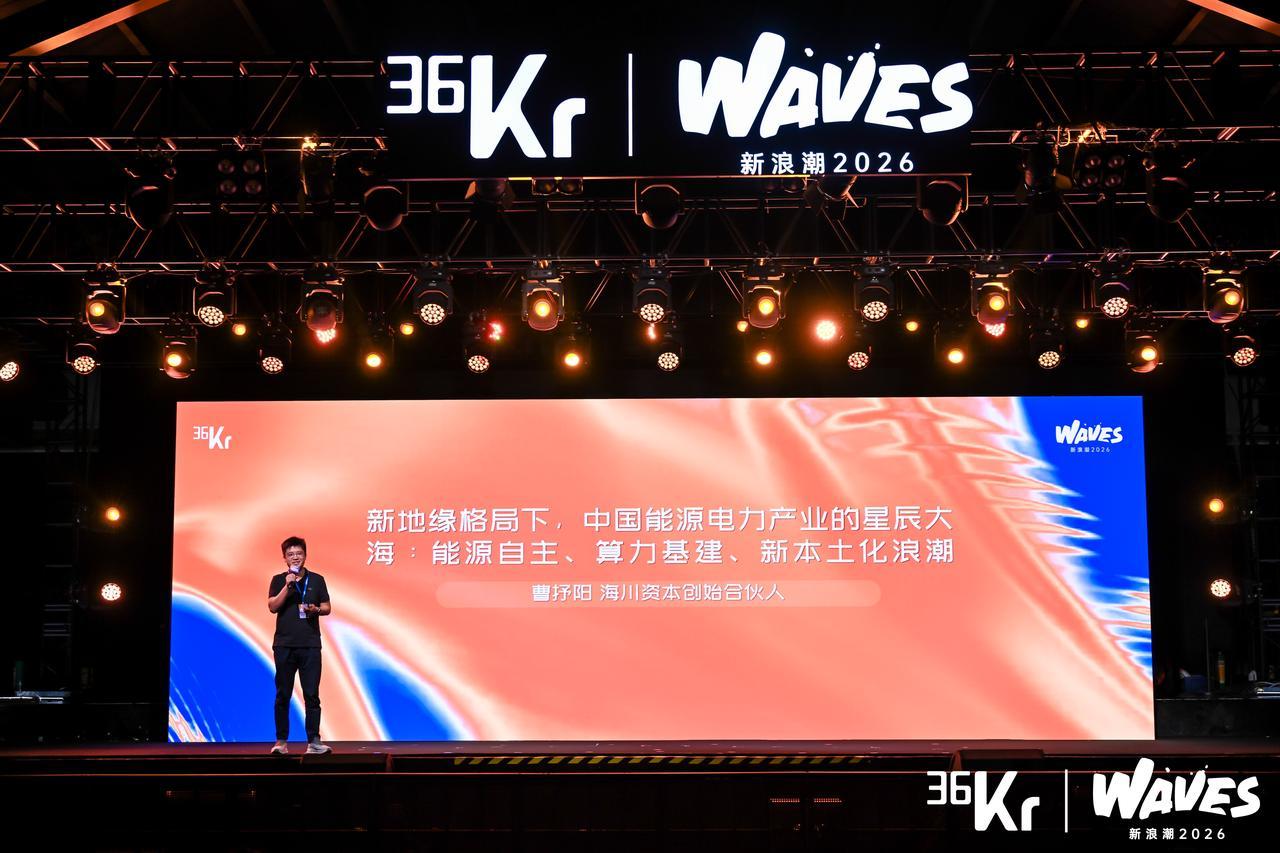
Ca Shuyang: I'm very honored to participate in the annual WAVES Conference again. Every time it is held on a grand scale with rich activities, and I've learned a lot. I'm glad to share with you today some insights from observing the industry and making investments in the past six months or a year, mainly focusing on the power and energy field. Coincidentally, the round - table just now talked about the last mile of AI, and what we're talking about might be the first mile of AI, the power industry that provides energy for AI.
I'm Ca Shuyang from Haichuan Capital. Let me briefly introduce our institution first. We are a very young institution. We established our first blind - pool fund in 2025 and are now actively engaged in normal investment activities. We mainly focus on two major directions. The first is the automotive and transportation sector, and the second is the entire energy and power sector. We are also a market - oriented investment institution.
Actually, energy and power is a very broad topic with many significant driving forces behind it. The recently mentioned AI is also one of the major driving forces for this wave of large - scale power infrastructure. Of course, it's not just AI. We've seen the impact of this year's wars on the infrastructure of countries around the world, and national - level decisions also have a profound and significant impact. Just now, a term “Deglobalization” was mentioned, which has gradually evolved over the past few years. Today, not only between China and the United States, but many countries are vigorously advocating localization or de - globalization starting from the most basic infrastructure and manufacturing. As an important part of infrastructure, the energy sector is also deeply affected. All these grand propositions actually have a greater impact on our investment decisions. Whether it's individuals buying stocks or professional investors in the primary market, there are significant impacts and changes, which are very worthy of sharing and attention.
In this session, I think it's more about observations from the industrial side, not just the primary - market investment part. I've actually compiled a lot of detailed data. Since this year, what we've seen a lot in the media is the demand for AI and power. Due to the explosion of AI demand, there have been many new demands and investments in infrastructure or equipment. But actually, from a global perspective, the boom in the entire power infrastructure has already started three years ago. If you look at the stock of Siemens Energy, you'll know that it has been rising since the end of 2022 and the beginning of 2023. The shortage of production scheduling for various electrical equipment and power grid equipment, including the current shortage of gas turbines, actually started before the rise of AI. The first wave of demand may come from the power grid updates in many European and American countries. This may be traced back to the earlier de - globalization and trade wars. When European and American countries wanted to bring back their manufacturing industries, they found that their power grids were very weak and had not been updated for 30 or 40 years. A large number of electrical equipment, such as the well - known transformers, in the United States have basically not been maintained for 40 years, so they couldn't support the return of the manufacturing industry. Probably starting from 2021 and 2022, many countries, including the EU and the United States, have put forward demands for power grid renovation worth hundreds of billions of euros or dollars. Looking back, the manufacturing of power equipment in these countries has long shrunk or been transferred to emerging countries like China, and they can't produce enough. This has led to a surge in demand for the few remaining large European and American companies, such as Schneider, ABB, and Siemens. This is actually the first major driving factor, power grid update, which is a very long - term thing and may probably continue for the next ten to twenty years. Because the scale of countries like the United States, Japan, South Korea, and Europe is still large, the demand for updating all these basic power and power grid equipment, from high - voltage, ultra - high - voltage to the distribution network side, and to some power generation equipment, is still very large.
The second major part is energy transformation. This may start from the global push for carbon neutrality and carbon peak. Ten years ago, including in our country, the investment in renewable energy was initially driven by environmental protection, that is, reducing carbon emissions and pollution. From the Russia - Ukraine war to this year's Middle East war, many countries have realized, which also proves the foresight of our country, that this is not just an environmental issue, but a deeper issue of energy independence. When the Strait of Hormuz is blocked, the energy prices in many countries have skyrocketed. Even the packaging of snacks in Japan has started to use black and white due to the shortage of oil. Therefore, we've seen that many countries, like Macau last year, have given large - scale subsidies to new energy, especially energy storage. In the past two years, countries in the Middle East have made large - scale investments in clean energy, including solar power, energy storage, and wind power. And this year, we've seen that many African and Latin American countries are also increasingly reaching a consensus on energy transformation. The second driving factor is the increase in the proportion of clean energy on the power generation side. In our country, the “15th Five - Year Plan” still emphasizes this and aims to increase the new energy installed capacity by 80% to 100% in the next ten years. This topic will continue for a very long time.
The third is the AI computing power revolution, which is an old - fashioned topic and everyone is very familiar with it. Of course, I'll focus on sharing that in addition to our country's “Eastern Data and Western Computing” project and the construction of computing - power infrastructure led by state - owned enterprises, and the computing - power construction driven by Internet giants in the United States, many countries around the world are also doing the same thing. Europe, such as Northern and Eastern Europe, and the Middle East are building computing power centers. Southeast Asia is now a new hot spot, and Japan is also building AI computing power. It's a global wave.
The fourth is industrial infrastructure. This may not be such an exciting topic, but especially for many “Belt and Road” countries, in the past few years, there has been a trend that many countries are becoming more politically stable with the rise of strong governments and the certainty of various policies. Many countries are thinking about revitalizing their manufacturing industries. Many countries are learning from our country's reform and opening - up experience 40 years ago. They have done a lot of infrastructure work like building roads and bridges before, and now they are starting to build power grid infrastructure and power generation facilities. The purpose is to truly start the industrialization process of these countries after this wave of infrastructure construction. Definitely, roads and power come first. So we've seen that whether it's rich countries like those in the Middle East and Saudi Arabia, or less - developed countries like many in Africa, South America, and Southeast Asia, there is a driving force for the revitalization of their local manufacturing industries. Driven by the government, the construction of power grid and power equipment is also a huge factor. Whether it's developed countries, “Belt and Road” countries, or developing countries, all these grand narratives converge at this time, making us believe that for the global market, power grids and related energy are a very long - term and certain thing, which may continue until 2040 or even 2050. The new demand generated during this period is very large. Since the energy industry itself is extremely large, we think that whether it's the industry, the secondary market, or the primary market, we highly recommend that everyone conduct in - depth research on the new opportunities in it.
Let me give examples of two regions. One is the Middle East, mainly Saudi Arabia, which accounts for about 80% of the Middle East in terms of both population and economic scale. Saudi Arabia has a Vision 2030. In the power part, in the next six years from 2024 to 2030, there will be an investment of tens of billions of dollars. Whether it's the investment in the power transmission and distribution market, the power - grid - side investment, or the investment in new energy, solar power, and energy storage, led by the national government and local state - owned enterprises of power companies, the investment in this area is in the tens of billions of dollars (see PPT). In the Latin American region, for example, the largest country is Brazil. They also have a plan, which is also about tens of billions of dollars. So the demand for power in these two large regions, plus some small surrounding countries, is about 300 to 400 billion dollars.
Finally, I want to emphasize the issue of localization. The export value of Chinese power equipment last year was about 400 billion RMB, which is a very large number and is increasing by about 20% every year. But now, the feedback from many enterprises in the industry is that the pure export model of finding agents or various channels to sell products to different countries and regions may become more and more difficult in the future because every country hopes that enterprises will build factories locally. We've found a lot of information. In countries like India, Southeast Asia, the Middle East, and even Europe and the United States, the logic is the same. Many large domestic enterprises, such as lithium - battery manufacturers led by CATL in the new - energy field, are almost all overseas, mainly in Europe and Southeast Asia. This year, due to the explosion of the overall demand for energy storage, the plan to build factories overseas is still very large. For example, in the Middle East, there is a very clear plan for the localization of key power grid and power equipment, which they also call the “chokepoint project” internally. Of course, the equipment they are “choking” on is relatively basic, not as high - end as ours. They also hope to have the production and manufacturing capacity of about 20 core power grid and power equipment locally within five to ten years. Those who go there first will definitely benefit the most. Each type of power equipment has a short - list. In the future, the enterprises on the short - list will probably all have local production capacity. The grid access mechanism in these countries is different from that in China. In China, it's basically the bidding of the State Grid, where dozens of enterprises participate and compete on price, which is very intense. But in many overseas countries, most of them use the short - list system. For the same type of equipment, there are four or five enterprises selected globally, and there may be only one or two spots for Chinese enterprises. If you go there early, you can occupy these spots early and enjoy the dividends for a very long time. It's also unlikely that new competitors will be continuously introduced to drive down the price, and the profit margin is generally much higher than that in China. Of course, the same situation also occurs in the equipment in the new - energy fields such as solar power and energy storage. But this time period won't be very long. We've seen that many large and excellent domestic enterprises have already set up points or built factories in Saudi Arabia, the United Arab Emirates, Iraq, or Oman. Those who go there early will definitely enjoy the most dividends.
In the United States, the policy of bringing back the manufacturing industry is very clear. The United States is more focused on AI infrastructure and the power and electronic equipment needed in the entire computing power center. Many domestic enterprises have also started to build factories in Mexico or the United States to meet the demand in North America. This may also be a necessary thing to do because the decoupling between China and the United States is very clear. Now, whether it's NVIDIA or Google, the entire computing - power and infrastructure ecosystem is still planned with enterprises outside China, such as those from Taiwan or Europe and the United States, as the main players in the supply chain. Of course, some fast - moving domestic enterprises are also actively embracing this ecosystem. The most important thing is to build factories locally, so this trend is very obvious.
Finally, our institution is also very actively deploying investment opportunities in the primary market under the major trends mentioned above. One is that we will make some investments around the new - type power grid. The background is that the rapid increase in the installed capacity of new energy, whether on the power generation side or the user side, has led to many pain points in power energy management in the power grid, or more stability failures in the power grid. There are many investment opportunities in secondary equipment. For energy infrastructure related to computing power, such as the widely - mentioned 800V architecture + HVDC, there are many new power - generation equipment opportunities due to the insufficient power supply capacity of the power grid. For example, the entire industrial chain of gas turbines or the popular SOFC in the United States, as well as special power - generation equipment like diesel generators, are basically in short supply globally, and the production capacity is fully utilized.
Another is all kinds of equipment and components in the temperature - control and heat - dissipation industrial chain required by the entire data center. In addition, clean energy, including energy storage, fusion, and green fuel, etc., are also new opportunities born from the major trends mentioned above.
We also attach great importance to teams with global capabilities. Because we think that there are actually more opportunities overseas than in China, and more directly, the profit is much better than in China. The business environment is also relatively more favorable for early - comers. So we may pay more attention to teams with the genes of native global operation and local production, R & D, and implementation. We think they may enjoy a lot of global dividends in the next five to ten years.
In addition, since the energy and power industry is still a very traditional industry, no matter how innovative your technology is, the end - users and your partners are all traditional enterprises. So we are building an ecological network covering more countries and regions with resource and human connections to help domestic startup companies connect with more excellent resource providers and help them expand their business in different countries.
That's all for my sharing. Thank you very much!