A reminder for Hengrui Medicine and Chia Tai Tianqing: Regeneron is set to take over all companies focusing on the Inhbe target
In 2022, after researchers from Alnylam published the article "Rare loss of function variants in the hepatokine gene INHBE protect from abdominal obesity" in Nature Communications, the natural weight - loss target Inhbe instantly became a hot topic.
From 2022 to the present, dozens of domestic and foreign pharmaceutical companies, including Eli Lilly, Amgen, Hengrui, and Chia Tai Tianqing, have laid out plans targeting Inhbe. It is predicted that the peak sales of WVE - 007 could reach $7 billion in December 2025.
However, Regeneron, a multinational pharmaceutical company (MNC) that is not well - known in the weight - loss field, has already applied for a patent for the Inhbe target, aiming to corner all companies entering the Inhbe target area.
01 Understanding Inhbe
The Inhbe protein (inhibin subunit βE) is a member of the TGF - β superfamily, mainly expressed in the liver. It affects fat metabolism and energy balance by regulating the liver - fat axis.
The Inhbe gene is located at 12q13.3 on the human chromosome and encodes a secreted protein belonging to the TGF - β superfamily. Its precursor protein is about 350 amino acids long, containing an N - terminal hydrophobic signal peptide and potential N - glycosylation sites. After cleavage at amino acids 232 - 236, a mature βE subunit of 114 amino acids is generated. The INHBE protein has 97% and 96% homology with activin β - E in mice and rats respectively, and 44% - 64% homology with other activin subunits (β - A, β - B, β - C).
In 2018, researchers from Chugai Pharmaceutical first revealed that Inhibin βE (Inhbe) is related to whole - body energy metabolism. Through gene chip analysis of human liver biopsy samples, they found that the expression level of INHBE is strongly positively correlated with the body mass index (BMI) and insulin resistance index (HOMA - IR) in humans.
In a diabetic mouse model, knocking down the Inhbe gene in the liver significantly inhibited weight gain within two weeks. This weight loss was entirely due to a reduction in fat, without causing muscle loss. This laid the groundwork for the subsequent R & D direction of "reducing fat while preserving muscle".
In 2022, the Alnylam team conducted a gene burden analysis on whole - exome sequencing (WES) of more than 360,000 people in the UK Biobank. They revealed that in carriers of predicted loss - of - function mutations (pLoF) in INHBE, the level of the Activin E secreted protein decreased by about 90%. The direct phenotype was a significantly reduced corrected waist - hip ratio (decreased visceral fat).
This article first proposed that, in addition to INHBE, genetic variations in its potential downstream receptor ACVR1C (i.e., ALK7) are also associated with similar improvements in fat distribution, directly establishing the clinical translational value of the INHBE - ALK7 axis as a target for obesity treatment.
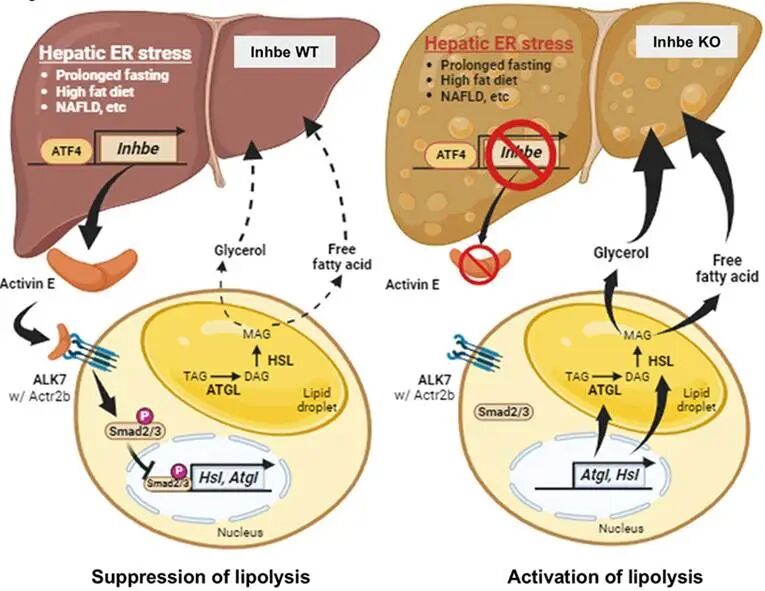
When peripheral adipose tissue is excessively decomposed, leading to an increase in free fatty acids (FFA) in the blood and their influx into the liver, the liver is stimulated to up - regulate the expression and secretion of INHBE, thereby increasing the level of Activin E in the blood. As a circulating factor, Activin E secreted into the blood specifically binds to ALK7 (type II activin receptor - like kinase 7) on the surface of adipocytes. By activating the downstream Smad2/3 signaling pathway, it inhibits lipolysis, increases fat accumulation, and restricts the return of fatty acids to the liver.
Therefore, Inhbe inhibitors can achieve the goal of preserving fat and increasing muscle by blocking the Inhbe - Activin E - ALK7 - Smad2/3 signaling pathway.
02 The Mechanism of Inhbe in Reducing Fat and Increasing Muscle
Core mechanism 1 of Inhbe in preserving fat and increasing muscle: Inhbe is mainly expressed in the liver, targeting "visceral fat" and avoiding the alternative decomposition of muscle.
The drawbacks of traditional weight - loss methods: When drugs such as GLP - 1 strongly inhibit appetite through the central nervous system (CNS), the human body is in a state of severe "calorie deficit". At this time, the body decomposes both fat and muscle indiscriminately to provide energy.
The advantages of INHBE inhibition: Inhibiting INHBE directly removes the inhibition of "browning" of white fat. After white fat is transformed into beige fat, the uncoupling protein - 1 (UCP - 1) in its cells is activated, turning adipocytes into a "calorie burner" that continuously and actively converts visceral fat into heat and dissipates it.
Result of muscle preservation: Since peripheral adipose tissue (especially the most dangerous visceral fat) is efficiently and actively burning to provide energy, the body does not need to degrade skeletal muscle proteins for gluconeogenesis to provide energy, thus protecting muscle at the source.
Core mechanism 2: Blocking the ALK7 - Smad pathway to remove the negative regulation of muscle fibers
At the molecular level, Activin E encoded by INHBE belongs to the TGF - β superfamily, which is well - known in muscle regulation (for example, the well - known myostatin is also a member of this family).
Pathological state: In patients with obesity or insulin resistance, the liver highly expresses INHBE, which secretes a large amount of Activin E. Activin E binds to the ALK7 (activin receptor - like kinase 7) receptor on the cell surface, activating the downstream Smad2/3 signaling pathway. Continuous activation of this pathway inhibits protein synthesis in skeletal muscle cells, leading to muscle atrophy or a decrease in muscle mass.
Blocking state: When INHBE is knocked down using siRNA or ASO, the downstream Smad2/3 signal is weakened. This not only allows adipocytes to start burning fat but also removes the negative suppression of skeletal muscle cell remodeling, maintaining the normal physiological function of muscle fibers.
Core mechanism 3: Reversing "ectopic fat deposition" and eliminating intramuscular lipotoxicity
Muscle atrophy in obese patients is often due to fat being deposited in the wrong place.
The harm of lipotoxicity to muscle: When visceral fat is fully accumulated, free fatty acids are incorrectly deposited in skeletal muscle (known as ectopic fat deposition, similar to "marbled beef"). This leads to chronic inflammation in muscle tissue, insulin resistance, and mitochondrial dysfunction, resulting in reduced muscle strength.
Clearing the "muscle surrounded by fat": Knocking down INHBE can significantly reduce the accumulation of visceral and intermuscular fat. After the "oil" around and inside the skeletal muscle is cleared and lipotoxicity is eliminated, the insulin sensitivity of muscle cells is greatly improved, and nutrients (such as amino acids and glucose) can efficiently enter muscle cells again, greatly promoting muscle maintenance and repair.
03 Inhbe's Setbacks
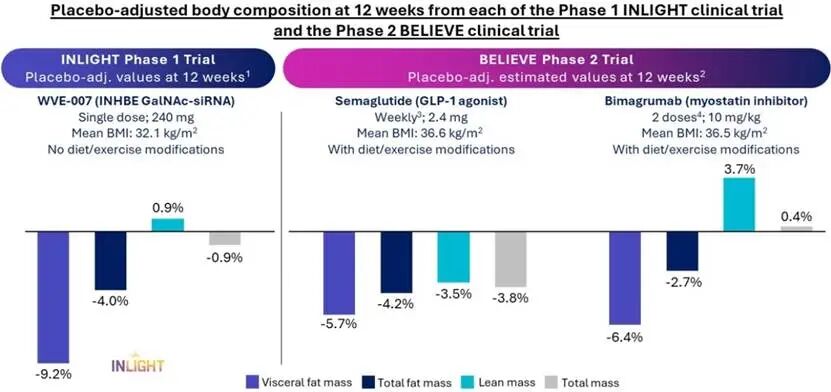
In December 2025, Wave Life Science announced the mid - stage data of the Phase 1 clinical trial of the Inhbe target siRNA inhibitor WVE - 007. The 9.2% reduction in visceral fat was significantly better than that of the GLP - 1 inhibitor semaglutide and the activin type II receptor (ActRIIA/B) monoclonal antibody Bimagrrumab. The 4.0% total fat reduction was similar to that of semaglutide and better than that of Bimagrrumab. In terms of muscle preservation, it was better than semaglutide but worse than Bimagrrumab. The overall weight loss of 0.9% was worse than that of semaglutide but better than that of Bimagrrumab. This caused Wave Life Science's stock price to rise by 147.26% in one day, and the market value at the close of the day reached $3.558 billion. The ideal of the Inhbe target became a reality.
However, four months later, Wave Life Science further disclosed the six - month follow - up data. Although the 240mg group still performed well, the 400mg dose group was disappointing: a 5% reduction in visceral fat in three months, a 0.7% reduction in total body weight, and a 0.2% reduction in lean body weight. The effect was even worse than that of the 240mg dose group. This caused Wave Life Science's stock price to fall by 49.59% in one day. The company's stock price was like a roller coaster, soaring and then suddenly plummeting within four months.
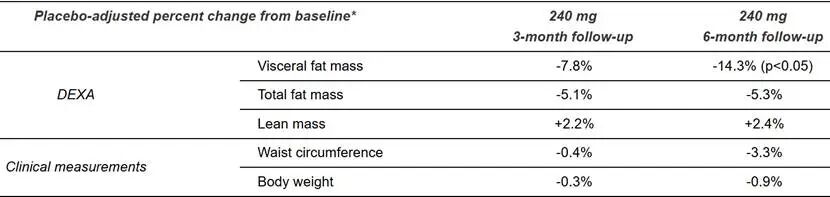
WVE - 007, which burns fat, performs well in reducing visceral fat. However, the performance of the high - dose group does not support it as a single drug for weight loss. Of course, it still has advantages as a supplement to existing GLP - 1 drugs, a maintenance therapy after drug withdrawal, or a therapy only for reducing visceral fat. The market is still broad, and it is still one of the ideal weight - loss targets. However, it is a bit of a dream to become a global blockbuster drug like semaglutide or tirzepatide.
04 Regeneron's Layout
In December 2020, Regeneron applied for the patent WO2022132666 to protect the Inhbe target. In the United States, it applied for patents US2024252528 (pending), US2022184114 (application terminated), US11957704 (authorized on March 27, 2024), and US11759476 (authorized on August 30, 2023). In China, it applied for the patent CN116583291 (under substantive examination). The priority date is December 14, 2020, and the publication date is June 16, 2022.
Regeneron is the first company in the world to apply for a patent for the inhbe target. It has been authorized to protect patent applications for the treatment of type 2 diabetes and obesity, including drug forms such as INHBE antisense nucleic acid molecules, small interfering RNA (siRNA) or short hairpin RNA (shRNA), guide RNA (gRNA), cDNA, Cas proteins, etc.
US11957704 protects the use of inhbe target inhibitors for the treatment of obesity indications. US11759476 protects the use of inhbe target inhibitors for the treatment of type 2 diabetes indications. US2024252528 protects the use of inhbe target inhibitors for the treatment of metabolic disorder indications. US2022184114 protects the use of inhbe target inhibitors for the treatment of metabolic disorders, type 2 diabetes, obesity, elevated triglyceride levels, subcutaneous fat atrophy, liver inflammation, fatty liver disease, hypercholesterolemia, elevated liver enzymes, non - alcoholic steatohepatitis (NASH), cardiovascular diseases, cardiomyopathy, hypertension, heart failure, and other indications.
CN116583291 protects the use of inhbe target inhibitors for the treatment of metabolic diseases, type 2 diabetes, obesity, and other diseases, as well as the molecular forms of inhbe target inhibitors such as siRNA, shRNA, gRNA, and Cas proteins.
In September 2021, Alnylam also applied for the patent WO2023044094 to protect the inhbe target. The patent US2025051779 applied for in the United States is pending authorization, and the patent CN118159654 applied for in China is under substantive examination. However, since it was applied for later than Regeneron, the possibility of future authorization is not high.
05 Conclusion
As one of the natural and ideal weight - loss targets mainly expressed in the liver, developing inhibitors for Inhbe has broad market prospects. In addition, patents for ideal liver - targeting carriers such as Galnac and L96 have expired or are about to expire, opening the door for the development of Inhbe inhibitors.
Dozens of domestic and foreign companies, including MNCs such as Eli Lilly and Amgen, and domestic giants such as Hengrui and Chia Tai Tianqing, are competing to enter the field. However, they all cannot bypass Regeneron's patent, which is like a net that will trap dozens of companies.
This article is written based on publicly available information and is only for information exchange purposes. It does not constitute any investment advice.
This article is from the WeChat official account "Medical Shine". Author: Yan Song. Republished by 36Kr with authorization.