Both "Snow King" and Guming have a valuation multiple of less than 16, so why does Hushang Ayi get 28 times?
Shanghai Auntie is the third company in China's tea - beverage industry to exceed the 10,000 - store threshold, following Xuebi Bingcheng and Guming.
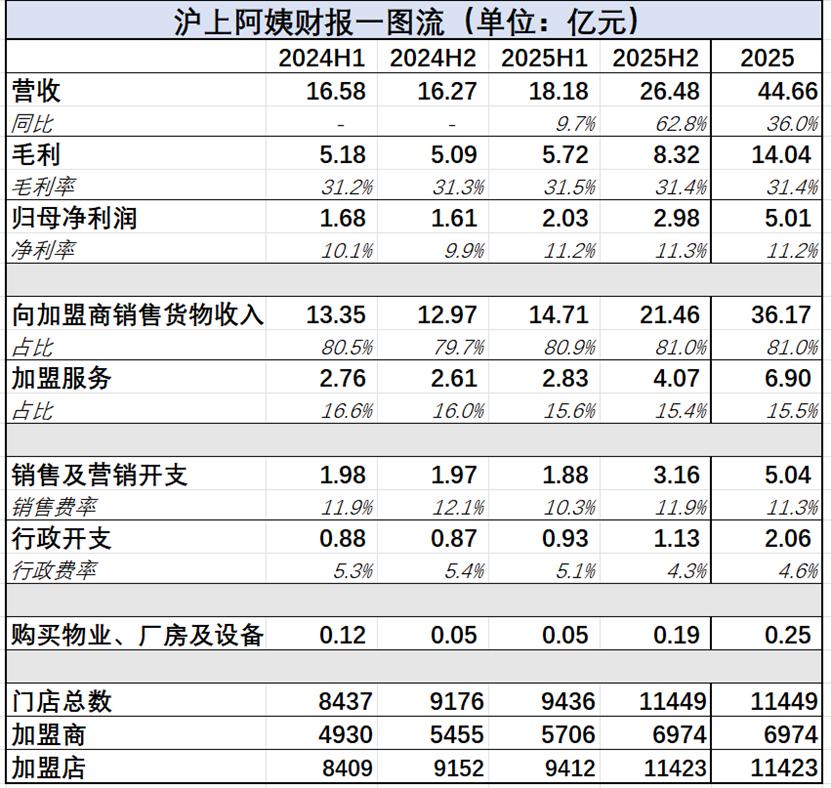
In 2025, Shanghai Auntie's overall revenue was 4.466 billion yuan, a year - on - year increase of 36.0%; the gross profit was 1.404 billion yuan, with a gross profit margin of 31.4%, a slight year - on - year increase of 0.2 percentage points, basically in line with market expectations; the net profit attributable to the parent company was 501 million yuan, slightly exceeding expectations. After the annual report was released, from mid - April to the present, the stock price nearly doubled within a month, and the valuation reached around 28 times.
(The following is a one - page summary of Shanghai Auntie's financial report. The unit is in billions of yuan. All data are from the company's financial report and are compiled by Jinduan Research Institute)
Xuebi Bingcheng, with a larger scale, and Guming, with a faster revenue growth rate, both have valuations of around 16 times. As a member of the 10,000 - store club, the market's pricing logic for Shanghai Auntie is significantly different. The question is whether this premium is an endorsement of the fundamentals or a pricing for something else.
Our core views are as follows:
1. The revenue growth accelerated in the second half of 2025, mainly driven by franchise - related income. The proportion of such business income remained at around 96.5%. Shanghai Auntie lowered the franchise threshold in 2025, attracting a group of new franchisees, which also reflects that Shanghai Auntie is essentially a B2B supply - chain service provider.
2. On the profit side, the net profit increased significantly due to effective cost control, and the gross profit margin increased slightly. The reason for the small change in the gross profit margin is mainly the offset between the rising raw material costs and the improved supply - chain efficiency.
3. Shanghai Auntie is currently in the store - expansion phase. On the one hand, it still focuses on the sinking market; on the other hand, it is expanding overseas, opening 45 overseas stores in 2025. This all - round store - expansion network conforms to the current trend of stock competition, but it is difficult to digest many market shares.
4. The current rise in the company's stock price is actually not closely related to the fundamentals. It is mainly driven by the event of the announcement of the extended lock - up period. In the short and medium term, it will be quite difficult to maintain the high - growth trend in 2026.
01
After Reaching 10,000 Stores
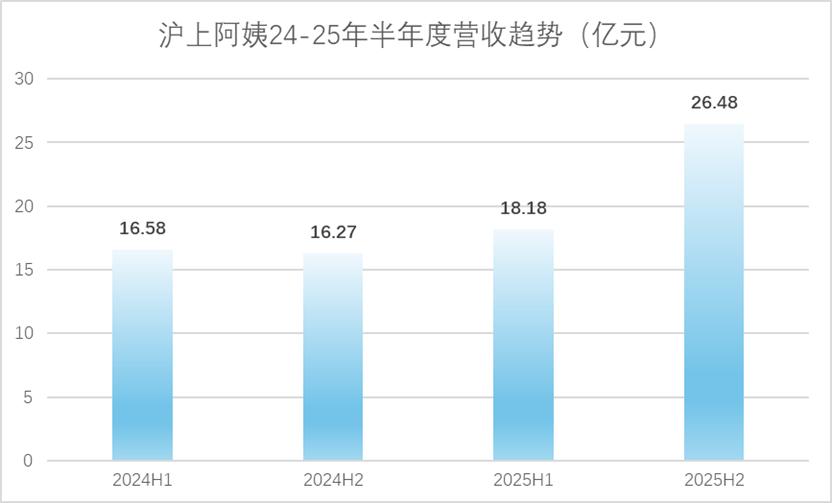
Throughout 2025, Shanghai Auntie achieved a revenue of 4.466 billion yuan, a year - on - year increase of 36.0%. The growth rate accelerated significantly in the second half of the year, reaching 62.8%, and the overall revenue far exceeded the market's consensus expectations. The core driving force behind this report card comes from the large - scale expansion of the franchise business.
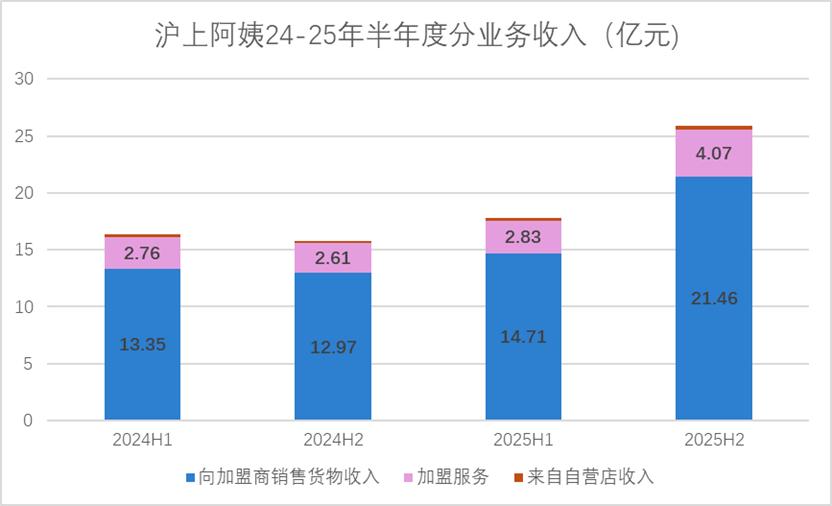
Shanghai Auntie's business model is essentially a light - asset B2B supply - chain service. As the core income of the group, the franchise business has always accounted for about 96% of the total revenue. In 2025, the income from selling goods to franchisees was 3.617 billion yuan, a year - on - year increase of 37.4%, of which the second half of the year contributed 2.648 billion yuan; the franchise service income for the whole year was 690 million yuan, accounting for about 15.5% of the total income, and reached 407 million yuan in the second half of the year.
The direct reason for the accelerated revenue is the rapid expansion of the number of franchise stores. In order to reach the goal of 10,000 stores, Shanghai Auntie launched a set of radical and diverse franchise policies in the second half of 2025, including reducing the franchise fee from 49,800 yuan to 29,800 yuan and providing additional subsidies for experienced personnel. As of December 31, 2025, the total number of franchise stores reached 11,423, officially entering the 10,000 - store club, with a net increase of 2,749 stores in the second half of the year.
Of course, all brands with 10,000 stores have enjoyed phased scale dividends when crossing this threshold, especially light - asset franchise brands. Xuebi Bingcheng's revenue was 24.83 billion yuan in 2024, and soared to 33.56 billion yuan after exceeding 10,000 stores in 2025, a year - on - year increase of 35.2%. The revenue growth rate accelerated significantly from 22.3% in 2024. Guming's net increase in stores in 2025 was 3,640, reaching 13,554, and the annual revenue was 12.914 billion yuan, a year - on - year increase of 46.9%.
The 10,000 - store threshold itself is a strong signal. The scale effect and enhanced brand awareness brought about by exceeding 10,000 stores are the key window periods for new tea - beverage enterprises to achieve a leap in revenue. However, this does not mean that 10,000 stores are the end - game for new tea - beverage businesses.
02
The Gross Profit Margin Stood Still
In 2025, Shanghai Auntie's gross profit margin remained basically the same. The annual report shows that the annual gross profit was 1.404 billion yuan, with a gross profit margin of 31.4%, a slight year - on - year increase of 0.2 percentage points. The gross profit in the second half of the year was 832 million yuan, and the gross profit margin was also 31.4%. The lack of obvious fluctuations in the gross profit margin is due to the offset between the rising raw material costs and the improved supply - chain efficiency.
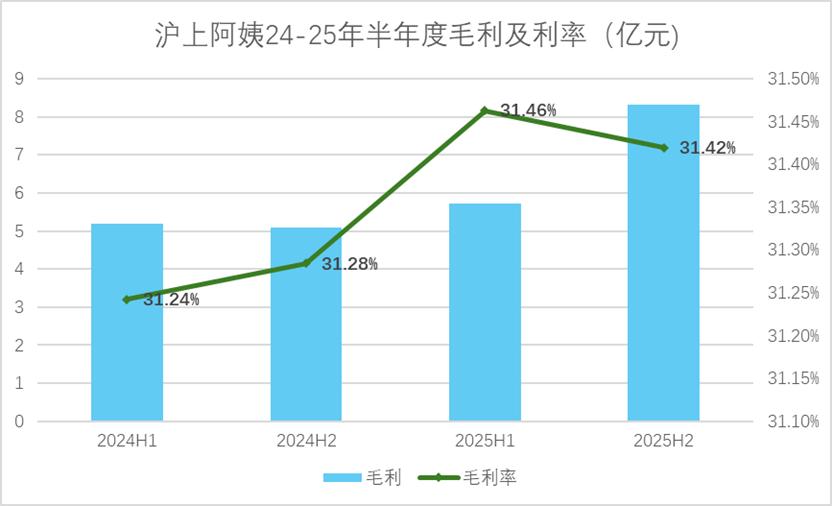
One of the current shortcomings of Shanghai Auntie is that its supply - chain construction is not as mature as that of leading enterprises. As a result, after the scale of 10,000 stores was expanded, the gross - profit level did not improve due to the scale.
The expansion paths of new tea - beverage businesses can be roughly divided into two categories: One is represented by Xuebi Bingcheng, which first builds a self - sufficient supply - chain network and then opens stores intensively in the region; the other is represented by Shanghai Auntie, which expands its stores more aggressively and makes up for the supply - chain construction later.
For Xuebi Bingcheng, although the scale expansion is slower, its greatest advantage is that the scale effect is more obvious after reaching 10,000 stores. In 2025, after the franchise business increased in scale, the gross profit margin increased by 220bp, improving the profit space.
For Shanghai Auntie, which expanded its scale of 10,000 stores relatively quickly, the gross profit margin only increased slightly by 20bp last year, which obviously did not reflect the profit - level advantages brought by scale. The control over the supply chain is still in the stage of making up for deficiencies. The bargaining power with upstream suppliers and the pricing power of materials for downstream franchisees need to be gradually strengthened as the scale expands. This is a threshold that Shanghai Auntie must cross in the process of moving from "quantity" expansion to "quality" improvement.
This brings about the current problem - in the financial reports of the next few quarters, the most worthy thing to pay attention to is actually the gross - profit - margin indicator, which directly reflects whether the self - built supply - chain ability is being strengthened and whether the bargaining space is expanding after reaching the scale of 10,000 stores. This is the core variable for Shanghai Auntie to truly transform the scale of 10,000 stores into a profit moat.
03
Cost Control is Stable, but Efficiency has not Won
Of course, Shanghai Auntie also has obvious strengths in the process of large - scale expansion of 10,000 stores: maintaining stable cost control. In 2025, Shanghai Auntie's net profit attributable to the parent company reached 501 million yuan, exceeding market expectations, a year - on - year increase of 52.4%, with a net profit margin of 11.2%, a year - on - year increase of 1.2pct.
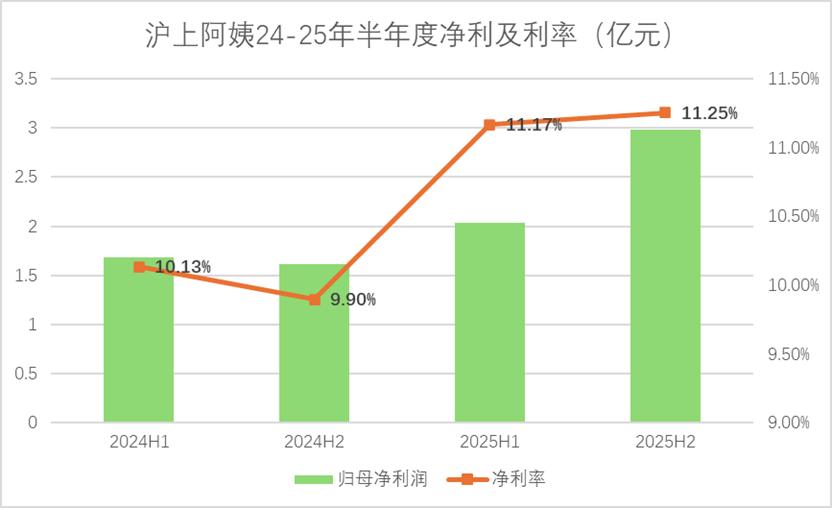
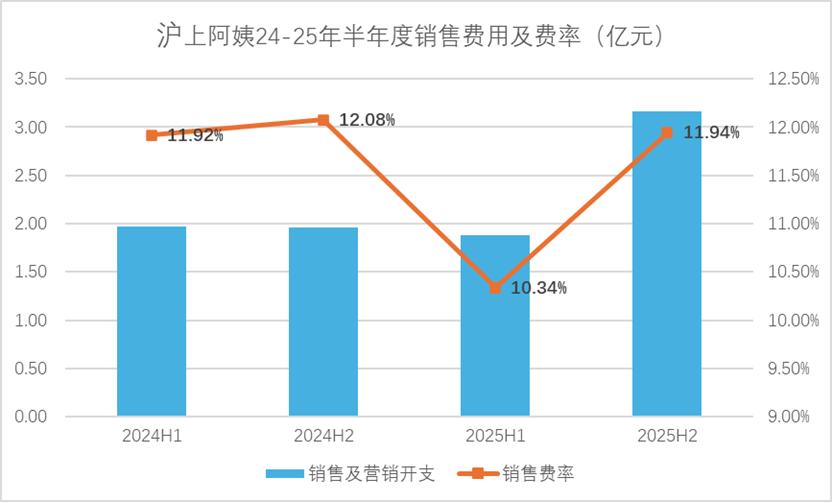
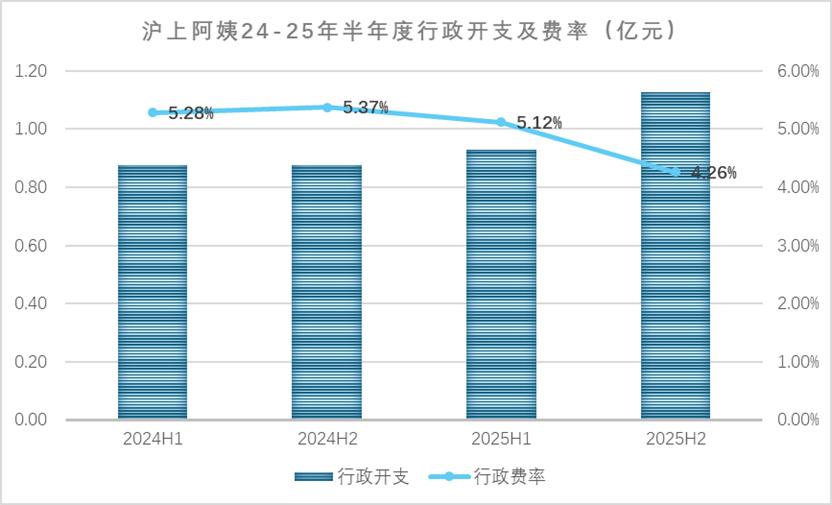
The biggest reason for this is the significant decrease in the operating - cost ratio. The company disclosed that the sales cost was 316 million yuan, with a sales - cost ratio of 11.3%, a year - on - year decrease of 69bp; the administrative expenses were 113 million yuan, with a cost ratio of 4.6%, a year - on - year decrease of 71bp.
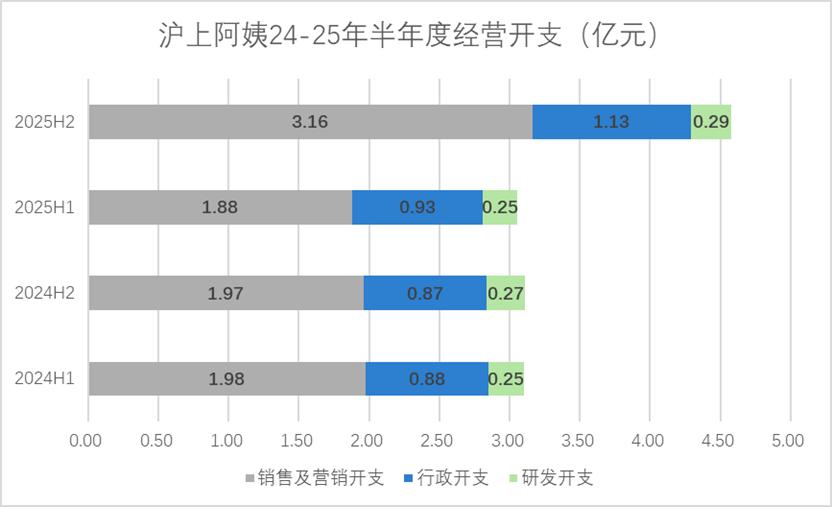
Cost control has two sides. Shanghai Auntie's cost - control rhythm needs to be analyzed from two perspectives:
First, the cost - control trend is not bad, and it has withstood the stress test.
The mid - end tea - beverage segment is more vulnerable than the high - end and low - end segments. Brands like Heytea and Ba Wang Cha Ji above 20 yuan have brand premiums to support their marketing budgets, and Xuebi Bingcheng below 10 yuan has a fully self - produced supply chain to spread costs. Shanghai Auntie's price range of 10 - 20 yuan is exactly the area most vulnerable to the impact after the reduction of food - delivery subsidies. Once the platform coupons are reduced, consumers' price sensitivity is directly transmitted to the brand, and the pressure to passively compress sales costs has persisted throughout 2025.
In this context, Shanghai Auntie's annual sales cost of 504 million yuan increased by 27.9% year - on - year, with a growth rate lower than the 36% revenue growth rate, and the cost ratio decreased by 70bp year - on - year. In fact, its performance is quite excellent.
Second, the absolute value of the sales - cost ratio is still relatively high, and there is objective room for optimization.
The sales - cost ratios of Xuebi Bingcheng, Guming, and Cha Baidao are all between 5.4% and 6.8%. Shanghai Auntie's 11.3% is significantly higher than this range. Under the franchise model, even if calculated conservatively, Shanghai Auntie's scale of 45,000 stores far exceeds that of most similar brands, but its sales - cost ratio is higher, indicating that the efficiency of channel marketing has not kept up with the speed of store expansion.
It also proves from the side that there are still many areas worthy of improvement in Shanghai Auntie's operation after large - scale expansion.
04
Excessive Scale Expansion Leads to a Significant Increase in Store - Closing Rate
On the other side of revenue growth and cost - ratio optimization, the side effects brought about by store expansion are accelerating.
In the second half of 2025, the number of closed stores of Shanghai Auntie reached a record high of 738, and the total number of closed stores for the whole year was 1,383, a 40% increase compared with the previous year. Calculated, for every about 3 newly opened stores, 1 old store closed. The number of exiting franchisees also reached a new high, with 1,639 for the whole year, of which 1,108 exited in the second half of the year. The store - closing rate was 15.1%, ranking first in the industry.
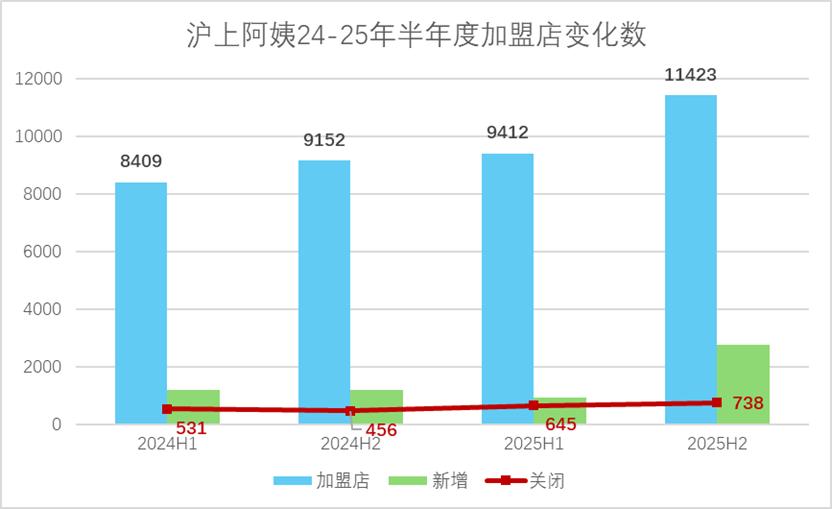
Combined with the sales - cost ratio and gross profit margin, they actually point to an essential problem: the speed of large - scale expansion is too fast, and the carrying capacity of the system has not kept up.
As a B2B supply - chain enterprise that essentially "sells shovels", there has always been a long - term game between the enterprise and franchisees. How to ensure store efficiency, store density, and franchisee management are all difficult problems. The material list with a price higher than the market price, the monthly