There have been new changes in urban renewal.
Recently, the State Council officially issued the "15th Five-Year Plan for Urban Renewal", which is worth reading carefully.
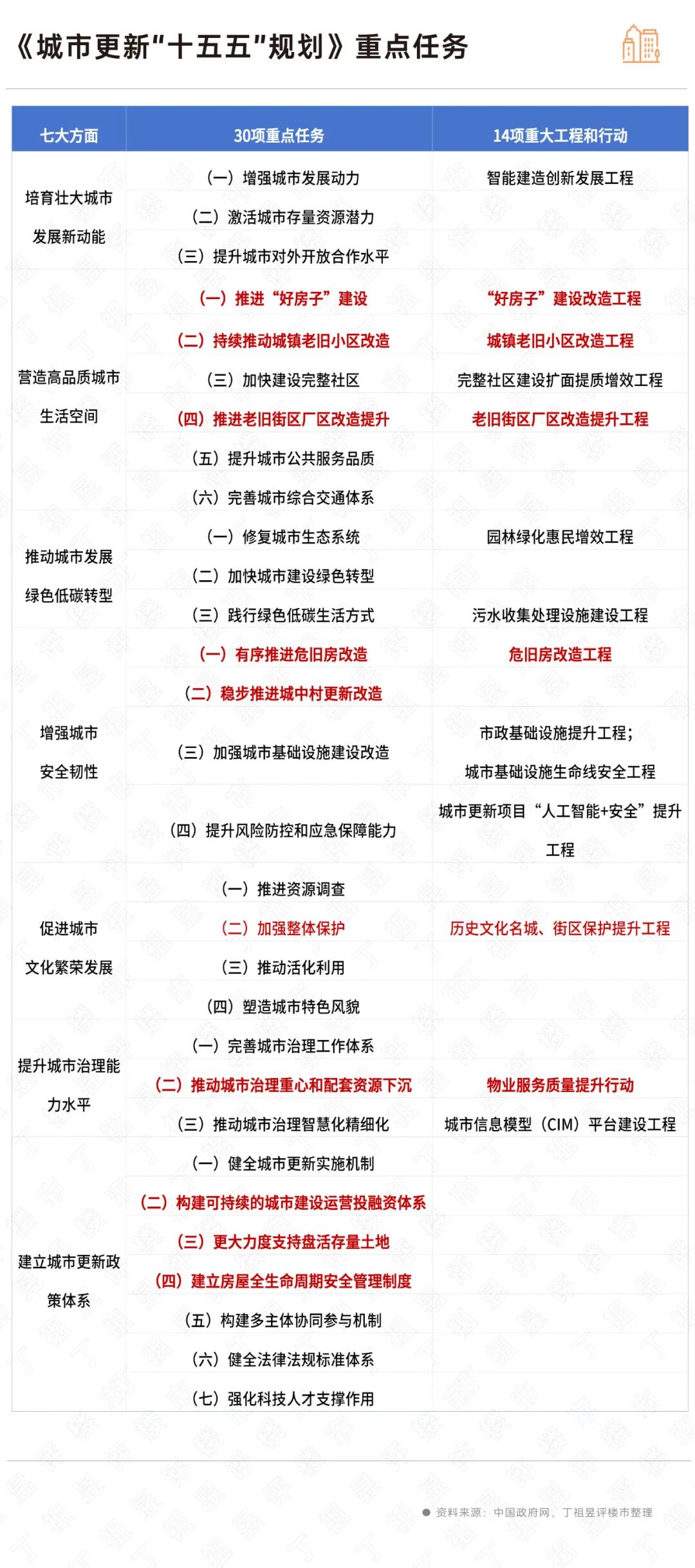
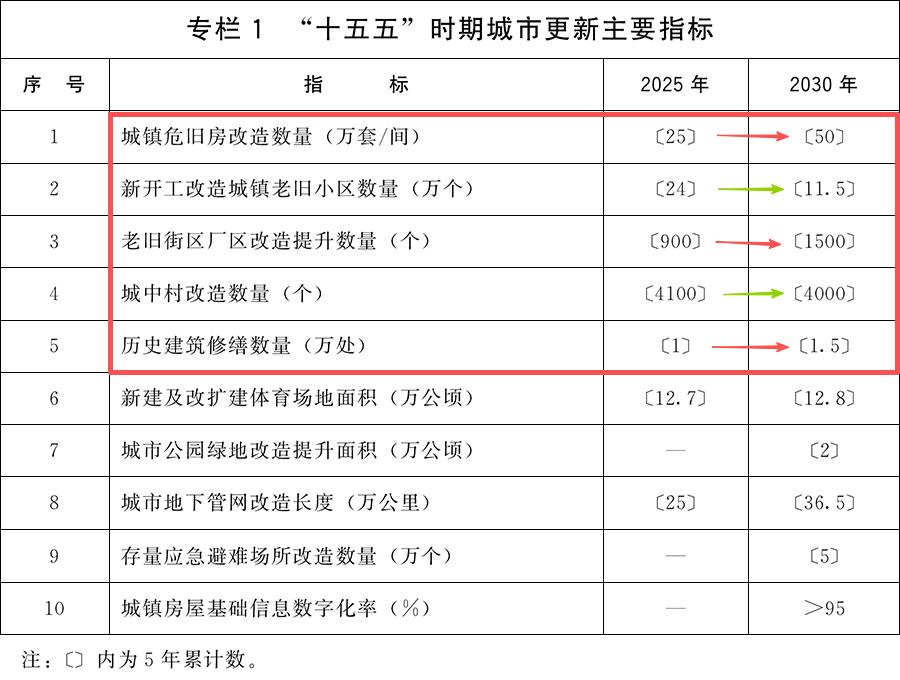
It is neither a regulatory policy nor a measure to rescue the market. Instead, it is the first national-level special plan in the field of urban renewal, clarifying the goals for two stages in 2030 and 2035. For the first time at the national level, it gives the quantitative indicators for urban renewal during the "15th Five-Year Plan" period: Renovation of urban dilapidated and dangerous houses: 500,000 units/rooms; Newly started renovation of old urban residential communities: 115,000; Renovation of old blocks and factory areas: 1,500; Renovation of urban villages: 4,000; Restoration of historical buildings: 15,000
Compared with the "14th Five-Year Plan", the biggest difference in this round is that the scale has undergone a structural adjustment: the number of newly started renovation projects of old urban residential communities has shrunk significantly, and the renovation of urban villages has shrunk slightly. Correspondingly, the renovation of urban dilapidated and dangerous houses has doubled, and the scale of renovation of old blocks and factory areas has expanded significantly.
This means that the main battlefield of urban renewal is shifting from "demolition and reconstruction" to "stock renewal".
If we interpret the above content within the framework of the real estate industry, the plan is answering an essential question: After the era of incremental growth ends, where will the industry go?
01
There is a clear timeline before the release of the "15th Five-Year Plan for Urban Renewal".
As early as the Central Economic Work Conference in December 2019, the concept of "urban renewal" was proposed for the first time, clarifying the need to "strengthen urban renewal and the renovation of existing housing."
Since then, urban renewal has appeared in the Central Economic Work Conference many times. In April 2025, this term appeared in the meeting of the Political Bureau of the Central Committee for the first time. In July last year, the Central Urban Work Conference, which was held again after a ten-year interval, further elevated urban renewal to the strategic height of high-quality development. At that time, two changes were mentioned: China's urbanization is shifting from a period of rapid growth to a period of stable development, and urban development is shifting from a stage of large-scale incremental expansion to a stage mainly focused on improving the quality and efficiency of the existing stock.
This series of actions shows that the functional positioning of urban renewal has been completely reshaped. It is no longer focused on the single dimension of stabilizing the real estate market, but is deeply bound to people's livelihood security, real estate transformation, and urban-rural integrated development, becoming an important support for promoting high-quality economic and social development.
By 2026, with the release of the "15th Five-Year Plan for Urban Renewal", the "roadmap" for urban renewal has become clearer.
02
Judging from the main indicators of urban renewal during the "15th Five-Year Plan" period, the overall pattern shows "two decreases, five increases, and three new additions", behind which is a profound structural change in the market.
First, the structural expansion of the renovation scale releases a large amount of space for stock renewal.
The plan clarifies that 500,000 units/rooms of urban dilapidated and dangerous houses will be renovated in the next five years, doubling that during the "14th Five-Year Plan" period. Correspondingly, the number of newly started renovation projects of old urban residential communities will decrease from 240,000 during the "14th Five-Year Plan" period to 115,000.
Behind this increase and decrease, it means that revitalizing stock resources has become the core task of urban renewal in the next five years. The renovation of old residential communities will shift from full-scale implementation to a stage of intensive cultivation. The plan clearly promotes the renovation of dilapidated and dangerous houses in an orderly manner, especially for Class C and D dilapidated houses with potential safety hazards, which is the bottom line for people's livelihood in urban renewal. Halving the number of newly started renovation projects of old residential communities means a reduction in the new scale, and in the future, more attention will be paid to the long-term operation after renovation and the improvement of community vitality. At the same time, the plan also clarifies the sources of funds, namely: central subsidy funds, local government special bonds, etc.
In addition, during the "15th Five-Year Plan" period, the renovation of urban villages will be promoted by "adopting various methods such as demolition and reconstruction, improvement and upgrading, and a combination of demolition and improvement", with a target of 4,000 projects. Although it is a slight decrease of 100 compared with the "14th Five-Year Plan", it is still at a relatively high level.
The coordinated renovation of old residential communities, dilapidated and dangerous houses, and urban villages not only provides a guarantee for people's livelihood but also further improves the housing quality. This will also play an important supporting role in stabilizing the second-hand housing prices. At the same time, during the renovation of dilapidated and dangerous houses and urban villages, if housing vouchers or monetized resettlement are used, it is expected to promote the entry of improved housing demand into the market, injecting great certainty into the industry.
Practices at the local level have been fully rolled out. As of the end of May, local governments have introduced a total of 78 urban renewal policies, covering the entire scenarios of renovation of old residential communities, urban villages, dilapidated and dangerous houses, and the revitalization of inefficient commercial and office buildings:
Cities such as Chengdu and Wuhan have legislated to clarify the combination of "preservation, renovation, and demolition"
Beijing has launched a policy toolbox of 75 items to simplify the approval process
Changsha and Nanjing are promoting the renewal of large-scale acquired existing housing areas
Chongqing and Hainan have released lists of renewal projects worth tens of billions of yuan
Luoyang has launched three "purchase instead of construction" models: housing voucher resettlement, self-purchase, and organized purchase
This means that urban renewal has entered a large-scale and replicable implementation stage.
Second, the focus of urban renewal has shifted, and the growth momentum has changed.
The number of renovation and improvement projects of old blocks and factory areas has increased significantly from 900 during the "14th Five-Year Plan" period to 1,500, an increase of 67%.
The focus of urban renewal is undergoing a fundamental shift: from single "residential function repair" to "function activation and industrial introduction" at the district level. The plan specifically emphasizes the need to "avoid excessive commercialization and homogenization", which means that future urban renewal is not simply commercial development but organic renewal based on cultural inheritance and industrial upgrading.
More importantly, three new indicators have been added in the next five years: renovation and improvement of urban parks and green spaces, renovation of existing emergency shelters; and the digitalization rate of basic information of urban houses.
The signaling significance of these three new indicators is very strong: Urban renewal is no longer just about improving the quality of living but has evolved into a grand systematic project covering new urbanization, modernization of urban governance, improvement of people's livelihood, and economic transformation and upgrading.
From the perspective of the industry, in the next five years, the market demand for the operation of complete communities, industrial parks, historical blocks, and municipal facilities will grow rapidly. Operation services will become one of the most promising tracks in the field of urban renewal.
03
A more important signal is that real estate has become a key piece in the big game of urban renewal.
The plan clearly states in the part of cultivating and strengthening new driving forces for urban development: Accelerate the construction of a new model for real estate development, improve the basic systems for commercial housing development, financing, and sales, and optimize the supply of affordable housing; Promote the transformation and development of real estate development enterprises and their participation in urban renewal; Revitalize idle and inefficient old factories, commercial and office buildings, commercial housing, public housing, etc.; Strengthen and standardize the asset management of existing urban infrastructure.
It can be seen that real estate is positioned as an important means to activate the potential of urban stock resources, and participating in urban renewal has become an inevitable choice for the industry.
Urban renewal has opened up a new track for real estate enterprises: from participating in the functional transformation of old factory areas, to promoting the revitalization of idle commercial and office buildings, and then to exploring the construction and operation of affordable housing. The traditional "land acquisition - development - sales" model is no longer sustainable. This also requires completely different capabilities from real estate enterprises. They need to have not only the traditional incremental development capabilities but also the comprehensive capabilities of stock operation, quality upgrading, capital balance, and community building.
At the same time, the plan injects great certainty into the industry in terms of supply and supporting facilities optimization. Specifically:
On the supply side, in addition to the incremental demand brought about by the renovation of old residential communities, urban villages, and blocks and factory areas, the plan clearly promotes the construction of "good houses", optimizes the design of housing products, improves the functions of house types, increases the floor height, improves the sound insulation performance, increases the application ratio of prefabricated decoration, and builds basic digital families. At the same time, it clearly increases the supply of improved housing according to local conditions. These will directly bring supply certainty to the industry.
In terms of supporting facilities, the upgrading of communities, transportation, and public services significantly improves the livability and asset value of housing.
In addition, the plan revitalizes idle real estate and optimizes the supply of affordable housing, which will promote the transformation of the real estate industry towards improving the quality of the existing stock and combining rental and purchase, effectively hedging the pressure of traditional development, and helping the industry to develop steadily, healthily, and sustainably. It is an important opportunity for the industry's transformation and development.
After 20 years of rapid development in the real estate industry, the housing demand of urban residents has changed significantly, that is, from "having a place to live" in the past to "living in a better place".
Urban renewal is a further answer to "living in a better place". The release of the "15th Five-Year Plan for Urban Renewal" marks that urban development has officially entered the "renewal era". The keyword is no longer "large-scale demolition and construction" but "organic renewal", and quality improvement will replace the past "scale expansion".
2026 will be a year for confirming the bottom of the real estate industry. The enthusiasm of real estate enterprises to participate in urban renewal will increase. Coupled with the gradual removal of bottlenecks and pain points in terms of funds and factors, the implementation of urban renewal will be comprehensively accelerated.
Coupled with the continuous promotion of the construction of "good houses" and the in-depth integration of the two, the underlying logic of the real estate industry will be reshaped. A new development model for the real estate industry featuring "high quality, low risk, and sustainability" is gradually being established.
This article is from the WeChat official account "Ding Zuyu's Review of the Real Estate Market". Author: Editorial Department. Republished by 36Kr with permission.