Jushi Capital and ZHANG Wei behind Changxin Technology
■On May 27, 2026, Changxin Technology passed the IPO review on the Science and Technology Innovation Board, planning to raise 29.5 billion yuan, becoming the second-largest IPO on the board. In the DRAM field monopolized by Samsung, SK Hynix, and Micron for three decades, Chinese manufacturers have jumped to the fourth place in the world and the first in China with a global share of 7.67%.
■Five years ago, it was Shenzhen-based Cornerstone Capital and its chairman Zhang Wei who led the investment of 1.2 billion yuan in Changxin. At that time, Changxin was suffering huge losses year after year, and the return was far from sight. Zhang Wei believes in: don't invest in the track, invest in the racers - it's not the cycle that determines the result, but the specific people in the cycle.
■From Sunward Intelligent, SenseTime, BGI Genomics, to Changxin, LandSpace, Zhipu AI, MiniMax, Cornerstone Capital has invested in 439 enterprises in 25 years, with a managed scale of nearly 90 billion yuan. We have dissected three questions about Zhang Wei: why he can always turn the tables against the odds, why he has a special preference for hard technology, and why he values "management" above all else.
In the world of chips, memory (DRAM) is the most unforgiving business.
It is technology-intensive, capital-intensive, and has a brutal cycle, but the winner takes all. In the past half-century, the throne has changed hands several times: in the 1970s, it was invented by Americans and quickly occupied the market; in the 1980s, it was snatched by the Japanese - Fujitsu, NEC, and Toshiba swept the United States, capturing 80% of the global share at their peak. But a few years later, the South Koreans overthrew the Japanese with a near-suicidal "counter-cyclical expansion." From 1984 to 1985, a fierce price war broke out in the global DRAM market, and the price of some products plummeted by more than 90% within a year. Samsung's memory business continued to lose money, and the whole company suggested withdrawing. However, Lee Byung-chul instead increased his investment. Subsequently, Samsung became the world's number one in 1992.
Today, there are only three major players left at the table: Samsung, SK Hynix, and Micron. These three have long occupied more than 90% of the global share, reaching over 95% at most. All the remaining manufacturers can only be listed in the "Others" column in the statistics. Technical patents, huge funds, large-scale production capacity, and top talents are like four walls stacked together, blocking the cracks for latecomers. Everyone assumes that there will be no new players in this track.
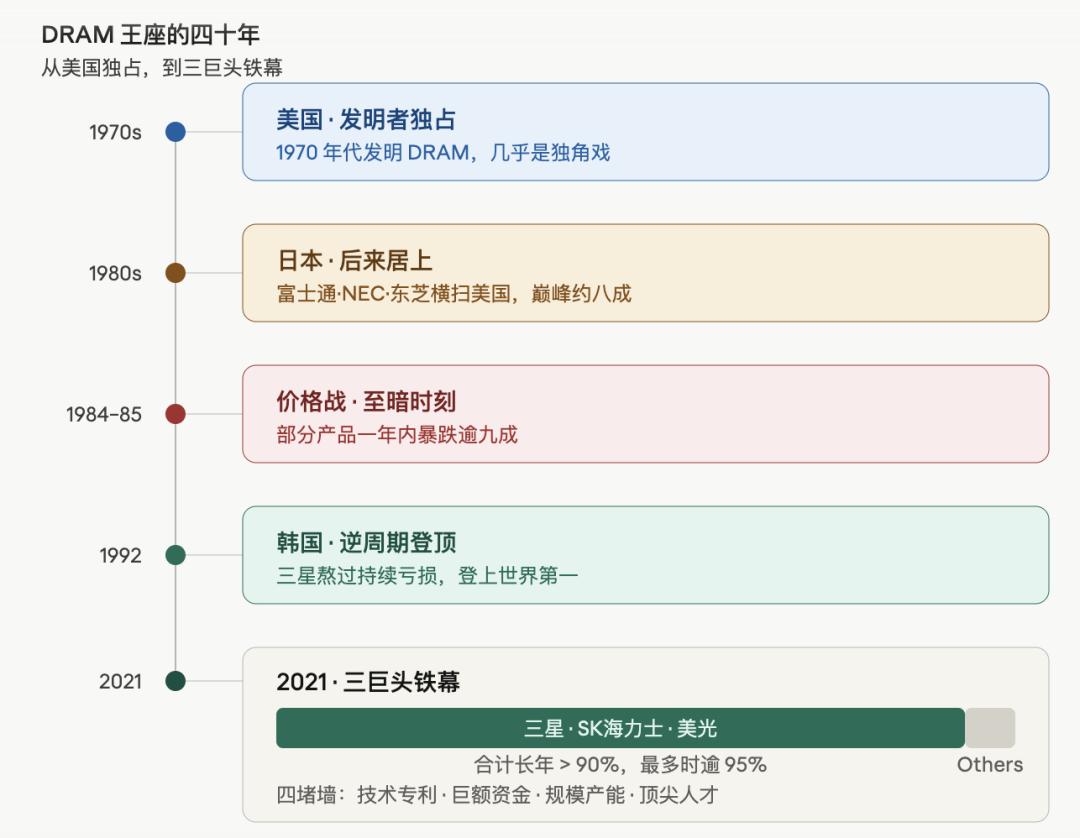
The half-century of the DRAM throne
But in 2021, a Chinese company and a Chinese investor didn't believe in this so-called rule.
That year, Changxin Technology launched a new round of financing. On the table was a company that had been losing money year after year, with almost negligible revenue, but its valuation had reached 100 billion yuan, and the return was far from sight. It seemed "uneconomical" to anyone. However, an investment institution in Shenzhen led the investment alone, completed the due diligence by itself, and heavily invested 1.2 billion yuan. What was even more difficult was after the investment. From 2022 to 2024, Changxin Technology suffered losses for three consecutive years, with a cumulative net loss of more than 30 billion yuan. At the same time, the company continued to expand production and conduct research and development, and the scale of fixed assets climbed rapidly.
The investment institution that led the investment in Changxin is called Cornerstone Capital, and its helmsman is Zhang Wei.
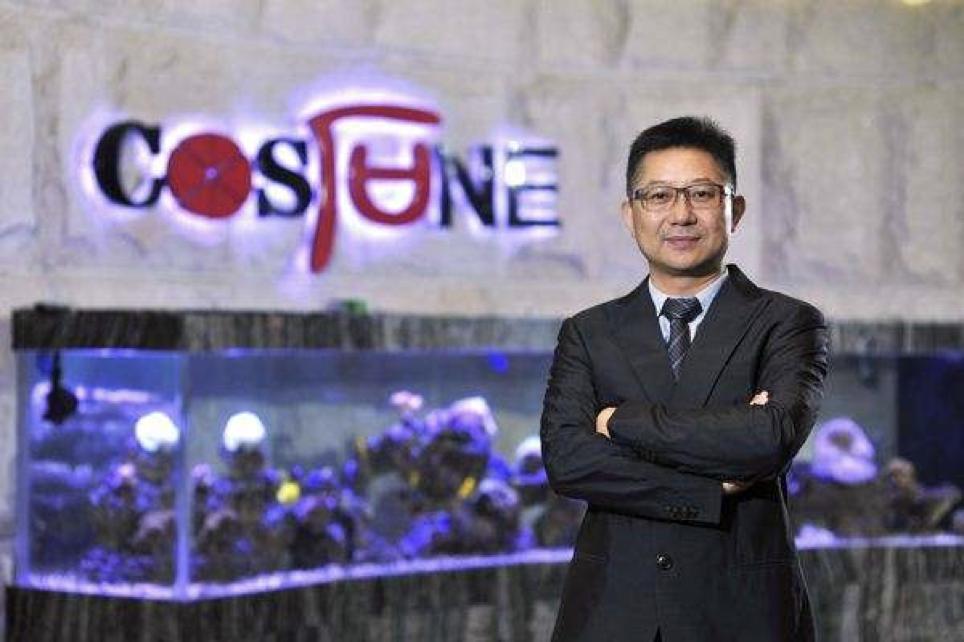
Five years later, on May 27, 2026, Changxin Technology successfully passed the IPO review on the Science and Technology Innovation Board, planning to raise 29.5 billion yuan, becoming the second-largest IPO project on the board after SMIC. Due to the almost greedy demand for storage from AI computing power, DRAM has become the most sought-after thing in the world again, and the ledger has finally turned to the right page. Since the second half of 2025, Changxin Technology has been making continuous profits, with an annual net profit attributable to the parent company of 1.875 billion yuan. In the first half of 2026, it is expected to have a revenue of 110 billion to 120 billion yuan and a net profit of 66 billion to 75 billion yuan (net profit attributable to the parent company of 50 billion to 57 billion yuan). Its global share has reached 7.67%, jumping to the fourth place in the world and the first in China. The iron curtain monopolized by the three giants for thirty years has been torn open.
Zhang Wei's investment has amazed many people, but what is more worth pondering than the right or wrong of an investment is the recurring "problem" in him.
Albert Camus has a famous saying: In the depth of winter, I finally learned that within me there lay an invincible summer. Zhang Wei is probably such a person: when everyone is rushing out of the winter of the cycle, he firmly believes that there is an invincible summer sitting in that empty room. In his eyes, this summer has never been given by the cycle, but by people.
In the 25 years since the establishment of Cornerstone Capital, he and his team have invested in 439 enterprises, and the cumulative asset management scale has reached about 90 billion yuan. Sunward Intelligent has a return of 120 times, Shandong Liuhe has a return of 30 times. Behind a long list of names such as Mindray Medical, SenseTime, BGI Genomics, Shannon Core, and Changxin Technology, there is almost the same scenario: entering against the wind, preferring hard technology, without applause, and finally turning the tables.
To understand this "turning the tables against the odds," we have to put him and another person together.
01 Drawing from the same well in two ways
In the winter of 2016, Zhou Jintao passed away due to pancreatic cancer at the age of 44.
This "King Zhou" remembered by countless people systematically introduced Kondratiev's long-wave theory of a 50 - 60-year cycle into the Chinese capital market and developed the "Theory of Zhou's Cycle" named after himself: within the 60-year Kondratiev wave, there are 3 real estate cycles, 9 investment cycles, and 18 inventory cycles. His words "Getting rich in life depends on the Kondratiev wave" are still the most appealing words in the Chinese investment circle. In Zhou Jintao's world, economic laws are like the laws of nature, not subject to human will, just like the four seasons. His most famous speech is called "Fate and Resistance," but the conclusion is cold: "Resistance is always ineffective."
Also in the winter of 2016, Cornerstone Capital held its last investment review meeting of that year. The topic was an artificial intelligence company with a relatively high valuation but low revenue: SenseTime. Many institutions were still waiting and watching, but Zhang Wei invested firmly, making several rounds of investments. The first round was 40 million US dollars, and the cumulative investment exceeded 100 million US dollars. Looking back many years later, this investment marked that Cornerstone Capital "fully entered the era of hard technology from a cognitive perspective."
Zhou Jintao left with all his faith in the cycle; almost at the same time, Zhang Wei placed his chips heavily on "people who can achieve things". However, intriguingly, these two people who seem to be on opposite sides actually draw from the same well.
It was the economist Joseph Schumpeter who truly systematized the Kondratiev theory. And what Schumpeter left to future generations are precisely two things: one is the nested cycle, and the other is "creative destruction," that is, regarding innovation and entrepreneurs as the most fundamental driving force for growth. Zhou Jintao took the former, while Zhang Wei took the latter. However, Zhang Wei got this "ladle" through another person - the management scientist Peter Drucker.
Drucker made it very clear as early as the 1980s: the United States would not fall into the so - called "Kondratiev cycle" like Europe and Japan because it has a brand - new entrepreneurial economy. In the eyes of Drucker and Zhang Wei, who is deeply influenced by him, entrepreneurial spirit itself is the antidote to the cycle.
So when Zhou Jintao said "Getting rich in life depends on the Kondratiev wave," Zhang Wei almost repeated a diametrically opposite sentence in his New Year's addresses every year: "Investment has nothing to do with the macro - economy" and "The stock market is not a barometer of the economy." He said that what he invests in is "not the macro - economy, but excellent enterprises representing the new economy in the macro - economy; not the index, but a very small number of targets that can lead us through the cycle." He even used two old poems to express his determination: "Don't be afraid that the macro - economy blocks your view; the light boat has already passed through numerous mountains."
He doesn't believe in the Kondratiev wave. Or more precisely, he is not willing to leave his fate to the Kondratiev wave. This is the key to understanding his entire investment philosophy and almost answers three questions at once: why he can always turn the tables against the odds, why he has a special preference for hard technology, and why he values "management" above all else.
02 Don't invest in the track, invest in the racers
Let's start with the first question: why can he always turn the tables against the odds?
The answer is a simple sentence: Don't invest in the track, invest in the racers.
Cornerstone has an internal book recommendation list that has been going on since 2012 for 21 seasons. There are hundreds of books, and all the recommendation notes are written by Zhang Wei himself. If you look through them, you will find that what he prefers is never the kind of "industry research" books, but books about people, systems, innovation, and art - Ronald Coase's How China Became Capitalist, Mancur Olson's Power and Prosperity, Daron Acemoglu's Why Nations Fail, Edmund Phelps's Mass Flourishing, Gustave Le Bon's The Crowd, as well as Schumpeter and Drucker. These books keep saying the same thing: What determines the result is often not the grand trend, but the specific people in the trend and the set of rules they are in.
Zhang Wei directly applied this perspective to investment. He likes to quote the opening sentence of Ernst Gombrich's The Story of Art - "Actually, there is no such thing as art; there are only artists." It's the same with him: there is no such thing as a "track"; there are only "racers." The track is abstract, just another way of saying the cycle, and no one can penetrate it; while the racers are specific, including products, R & D, organization, and entrepreneurial spirit, which can be clearly understood one by one.
Shifting his focus from the erratic waves to the real people in the waves made him part ways with the "cycle prophets." Prophets play a game of betting on the direction all at once. If they bet right, they will go down in history; if they bet wrong, they will lose everything. Zhang Wei simply doesn't play this game. Sunward Intelligent gave him a 120 - fold return, and he was the first to admit that there was an element of luck: "If we say that the hundred - fold return is entirely due to a sharp investment vision and a clear understanding of the macro - economy and the capital market, it's just a lie." He admitted that he couldn't understand when the macro - control would end, but he understood Professor He Qinghua and the doctoral team supporting him, and he understood that this was an "enterprising enterprise."
Since no one can price the cycle, don't bet on the cycle. Instead, bet on what you can really evaluate - people and the organizations composed of people.
03 Invest in the hunger and anxiety of the era
The second question: why does he have such a preference for hard - technology enterprises?
To answer this, we need to zoom out the lens.
In 1977, semiconductor expert Wang Shouwu spoke bluntly in front of Deng Xiaoping: "The total output of integrated circuits produced by more than 600 semiconductor factories in the country in a year is only one - tenth of the monthly output of a large Japanese factory." That year, Apple just launched the Apple II, Intel was about to introduce the 8086, the starting point of x86, and IBM's annual revenue was 18.8 billion US dollars, equivalent to twice the total export volume of China. The gap was huge.
In the following more than forty years, how did China catch up? First, it seized the first two waves with digital communication (Huawei, ZTE) and the Internet (BAT), giving birth to the first batch of giants. Then it exploded in the smartphone and mobile Internet era, accumulating abundant funds and a large number of engineers. Finally, it turned back to "make up for the lessons" in the three waves of chips, PCs, and software that it missed in the early days.After six pursuits and three make - up lessons, China has accumulated a second - only - to - the - United States information industry foundation. And this foundation is the most valuable asset in the global race of the Fourth Industrial Revolution.
The hardest part of making up for the lessons is integrated circuits; the hardest part of integrated circuits is memory. This is exactly Changxin's battlefield.
2018 was a watershed. Before that, China trusted and even relied on the global chip supply chain. In 2015, China's chip import value reached as high as 200 billion US dollars, more than that of crude oil. However, once the sanctions became endless and gradually intensified, "self - control" changed from a slogan to a must - answer question. The entire industry was forced into a "dark forest" - like fear, and every link had to be redone in China.
What Zhang Wei wants is this kind of toughness forced out by the era.
In his New Year's address in 2026, he explained this very clearly. Someone asked him why the price - to - earnings ratio of some domestic computing power chip enterprises is as high as several hundred times, while that of NVIDIA is only about 50 times. His answer was: the logic is exactly the opposite. "The greater the gap, the higher the strategic value; the harder it is to obtain, the more hungry; the harder it is to catch up, the more anxious." He condensed the entire logic of hard - technology investment into one sentence: Invest in the hunger and anxiety of each era.
He even gave it a geographical image: "The most beautiful scenery in China often exists in the Hengduan Mountains. The huge drop and structural fracture have created magnificent landscapes." This is exactly the sentence he wrote in 22 Investment 'Rules' of Cornerstone Capital: "When an investment conforms to the dual influence of technological progress trends and policy guidance, its valuation will also deviate from the traditional financial model."
There seems to be a contradiction here: a person who keeps saying "has nothing to do with the macro - economy" actually chooses the hard technology most dominated by the macro - economy?
The contradiction is only on the surface. What Zhang Wei rejects is the timing of when the cycle will bottom out and rebound, which no one can accurately calculate.