In the real estate sector, investment is experiencing a "gap". Who is snatching land?
Since May, land grabbing competitions have been frequently staged in core cities.
Among them, the competition in Shanghai's fourth batch of land auctions was particularly fierce. There were "un-capped" bidding for two consecutive days. The average premium rate of the 5 plots reached as high as 34%. The premium rates of the plot in Pujiang Town, Minhang and the combined plot in Nanmatou, Pudong New Area both exceeded 40%.
Similarly in Hangzhou, the plot in the Beiganxi Unit of Xiaoshan was sold at a 42% premium, and the average premium rate of the combined residential land in the Future Science and Technology City reached 35%.
Driven by high-premium high-quality plots in core cities, there have been two positive changes on the land investment side: the enthusiasm of land auctions in May was higher than the average level in the fourth quarter of 2025; the land acquisition intensity of enterprises has significantly rebounded compared with that from January to April.
However, the active replenishment of land reserves by a few leading real estate enterprises in core cities has not led to an overall recovery in land acquisition. In the first five months, the total land acquisition volume and the land acquisition threshold of real estate enterprises have both reached the lowest levels in the past five years. For most real estate enterprises, they are in a dilemma of "unable to compete" in core cities and "not participating" in non-core cities.
01
Let's first look at the transaction data of the land market in May.
According to CRIC statistics, the transaction floor area of commercial land through public tender, auction and listing in May was 21.78 million square meters, a month-on-month decrease of 5% and a year-on-year decrease of 27%. The transaction amount was 67.2 billion yuan, a month-on-month increase of 9%, but still a year-on-year decrease of 20%.
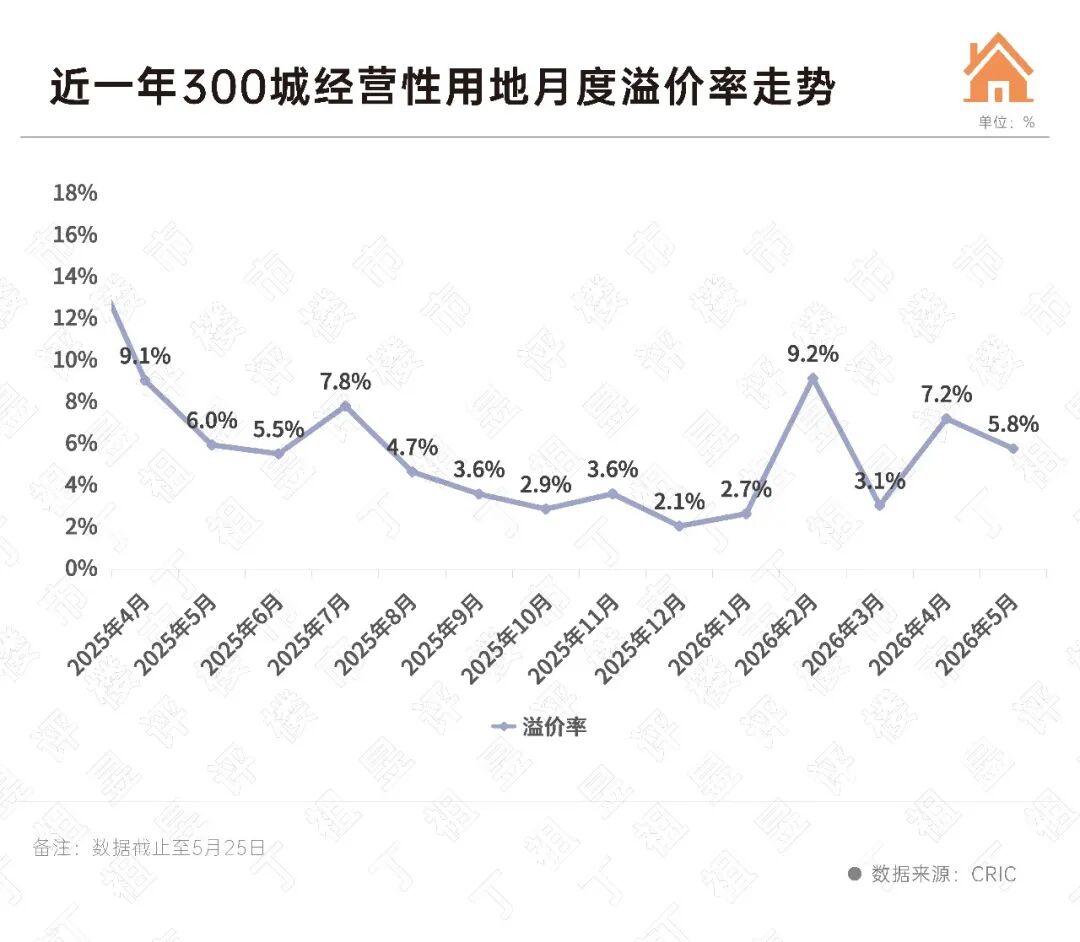
In terms of market enthusiasm, the average premium rate in May was 5.8%, a month-on-month decrease of 1.8 percentage points and a year-on-year decrease of 1.3 percentage points. Although the overall enthusiasm has decreased both month-on-month and year-on-year, the enthusiasm of land auctions is still higher than the average level since the fourth quarter of 2025.
Since 2026, cities have implemented the policy of "controlling the increment and optimizing the supply". High-quality plots in a few core cities have been scrambled for, resulting in sporadic high heat. However, the vast majority of plots are still sold at the reserve price. This has led to the situation where "land grabbing" scenes frequently occur in core cities, but the overall premium rate is pulled down.
02
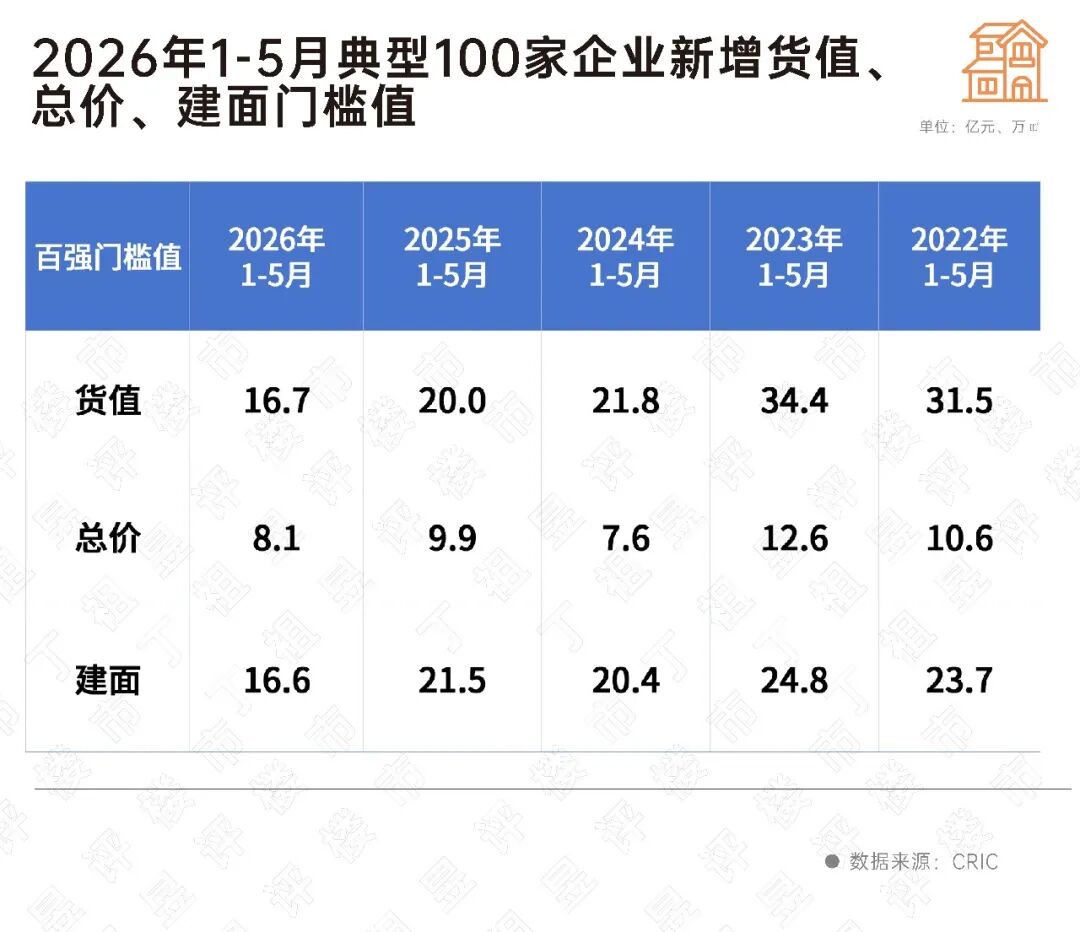
From January to May 2026, the land acquisition threshold of 100 typical sample enterprises has been continuously decreasing: the threshold of land value: 1.66 billion yuan, a year-on-year decrease of 16.5%; the threshold of land acquisition amount: 810 million yuan, a year-on-year decrease of 18.2%; the threshold of construction area: 167,000 square meters, a year-on-year decrease of 22.8%.
Behind the overall decline of the land acquisition threshold, the overall investment willingness of real estate enterprises is still at a low level. The active replenishment of land reserves by a few leading real estate enterprises in core cities has not led to an overall recovery.
However, for most real estate enterprises, they are still in the dilemma of "unable to compete" in core cities and "not participating" in non-core cities. Their attitude towards land acquisition is still inclined to wait-and-see and caution.
It is worth noting that the decline rates of the land value and land acquisition amount thresholds have both narrowed compared with the first four months, which also means that the investment enthusiasm of real estate enterprises is still being repaired.
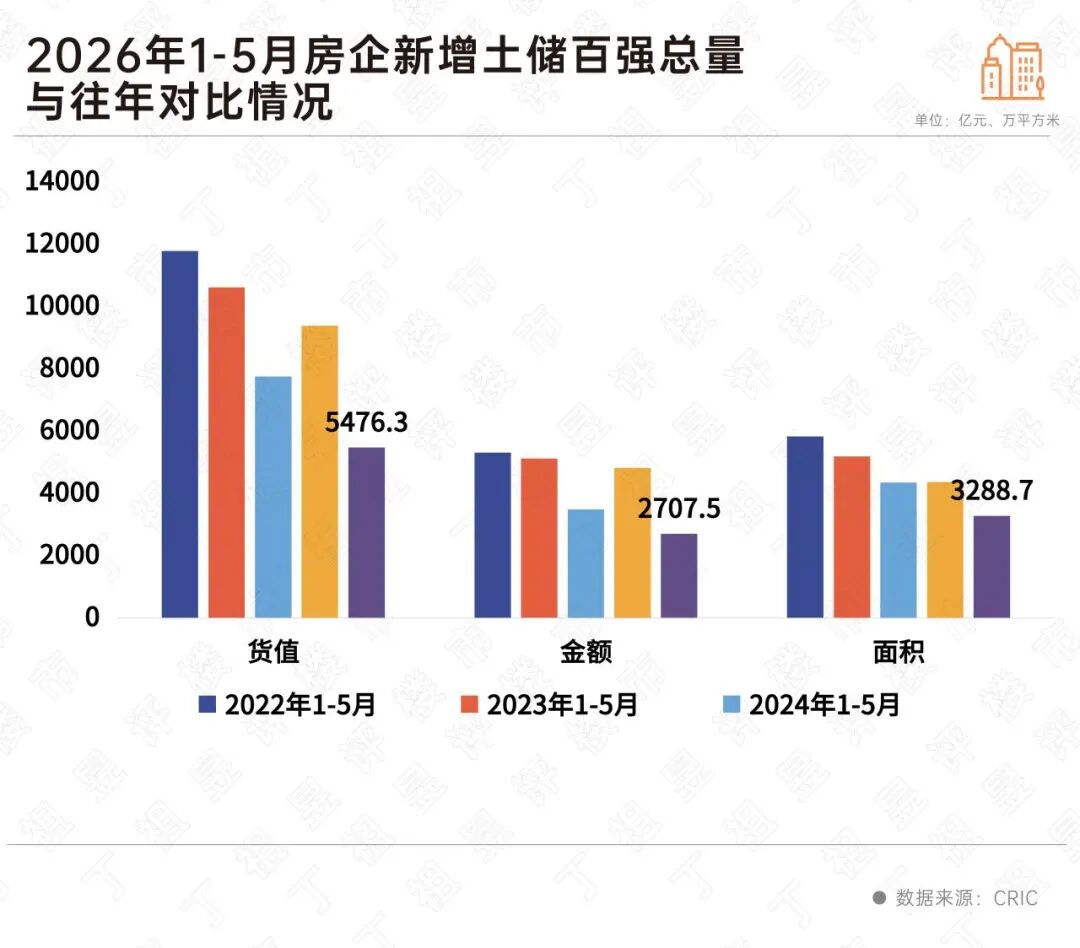
In terms of the total land acquisition volume, from January to May 2026, the total land acquisition volume of 100 typical sample enterprises still decreased year-on-year: the newly added land reserve value: 54.763 billion yuan, a year-on-year decrease of 41.7%; the land acquisition amount: 27.075 billion yuan, a year-on-year decrease of 43.9%; the newly added land reserve construction area: 32.887 million square meters, a year-on-year decrease of 24.8%.
The three indicators have also reached the lowest levels in the past five years.
However, driven by the high heat of land auctions in core cities in May, the decline rates of the cumulative newly added land reserve value, amount and construction area have all slightly narrowed compared with those from January to April.
It is worth noting that the decline rate of the land acquisition amount of the top 100 real estate enterprises in terms of investment far exceeds that of the area. This reflects the current investment situation of real estate enterprises: first, core cities are "controlling the quantity and improving the quality", and the overall transaction volume has decreased sharply. Only a few central state-owned enterprises and leading private enterprises are sporadically replenishing land reserves in core cities; second, in the current weakly recovering market situation, most enterprises are still cautious in land acquisition.
03
From the perspective of land acquisition enterprises, the current land market maintains a tripartite pattern: central state-owned enterprises, large-scale private enterprises and urban investment platforms.
Although urban investment platforms have an absolute advantage in the number of land acquisitions, most of them are "supporting the bottom" in third- and fourth-tier cities. The ones that are really actively investing in land acquisition in core cities are central state-owned enterprises.
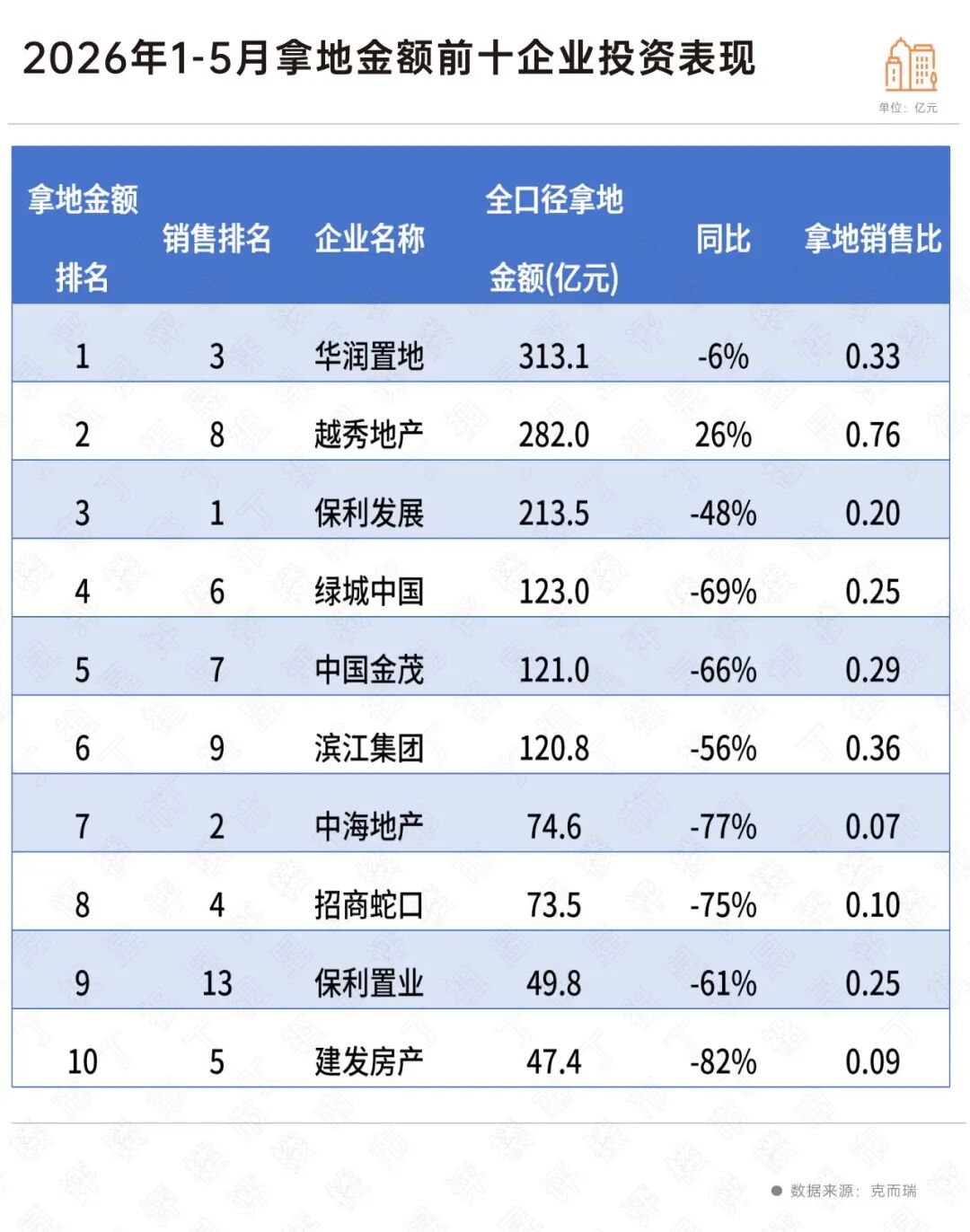
From the perspective of the nature of land acquisition enterprises, among the top ten enterprises in terms of land acquisition amount (full-caliber, the same below), except for Binjiang Group, a private enterprise, the rest are all leading central state-owned enterprises.
In addition, the total land acquisition amount of the top ten enterprises accounts for more than half of the total amount of 100 typical enterprises, and there is an obvious "gap" in the land acquisition amount of enterprises.
Among them, China Resources Land, Yuexiu Property and Poly Developments ranked in the top three, with a land acquisition amount of more than 20 billion yuan. Greentown China, China Jinmao and the private enterprise Binjiang Group had a land acquisition amount of more than 10 billion yuan. The land acquisition amount of the remaining 4 TOP10 real estate enterprises in the first five months was still less than 10 billion yuan.
Among the top 10 enterprises in terms of land acquisition amount, only Yuexiu Property had a year-on-year positive growth in the cumulative land acquisition amount. The land acquisition amounts of the other enterprises all decreased. Leading real estate enterprises are also more cautious in land acquisition and only focus on high-quality plots in core cities. The most typical one is Poly Property. In the first four months, Poly Property's land acquisition amount ranked outside the top 100. On May 29, it defeated eight other bidding enterprises with 3.49 billion yuan and won the combined plot in Nanmatou, Pudong New Area, Shanghai, and entered the ninth place in the land acquisition amount list at one go.
The current trend of the land market is very clear: core cities will continue to focus on the supply of high-quality low-density residential land, which is still the main battlefield for real estate enterprises to compete. With the release of the policy dividends of urban renewal, the land acquisition confidence of real estate enterprises mainly composed of central state-owned enterprises will be steadily repaired. The heat of residential land in core areas will remain high.
At the same time, in order to meet the needs of population inflow and urban function upgrading, two new supply channels are becoming important supplements: the conversion of commercial land to residential land and the redevelopment of low-efficiency stock land.
The pattern of differentiation among cities is still deepening: key cities such as Beijing, Shanghai and Hangzhou, relying on the advantages of industrial development and population agglomeration, will continue the high-premium trend in core areas; ordinary second-tier and third- and fourth-tier cities still need to adhere to the inventory reduction orientation, and the proportion of high-certainty plots with low density, livability and mature supporting facilities will continue to increase.
With the continuous implementation of the policies for high-quality urban development, the coordinated optimization of population, industry and public services, the overall investment certainty of the land market will be further strengthened.
This article is from the WeChat official account “Ding Zuyu's Comments on the Real Estate Market”. Author: Editorial Department, Puri Research. Republished by 36Kr with authorization.