Home prices in first-tier cities have risen for two consecutive months.
In the market, sellers are wailing. Those who bought properties after 2017 and are selling now rarely avoid losses. There are numerous stories of misery on the Internet.
The "negative asset" effect of property ownership has made many people with potential home - buying needs hesitant. However, after the spring of 2026, the trend of the real - estate market is full of uncertainties again.
According to the latest data released by the National Bureau of Statistics, in March and April 2026, the sales prices of new and second - hand houses in first - tier cities increased month - on - month for two consecutive months. The last time both new and existing second - hand houses maintained two - month growth was in early 2025, driven by the panic buying spurred by the "930 New Policy".
Excluding the direct policy stimulus, the continuous growth of new and second - hand houses in first - tier cities driven by the market for more than two months dates back to the spring of 2023, that is, three years ago.
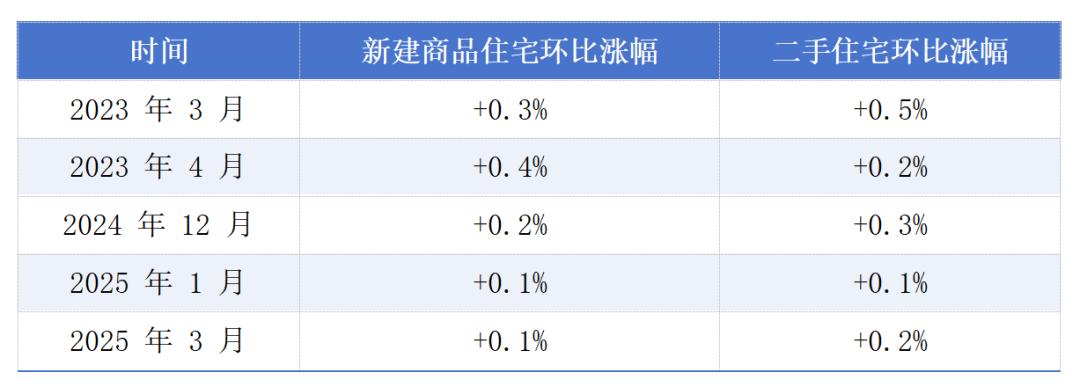
Data source: National Bureau of Statistics
The second - hand housing market, composed of numerous individual players, can better reflect the real reactions of both supply and demand sides.
Since February this year, the price index of second - hand houses in Beijing has increased for three consecutive months, with month - on - month increases of 0.3%, 0.6%, and 0.4% respectively. In Shanghai, where the second - hand housing market is more active, prices have also increased month - on - month for three consecutive months. In Guangzhou and Shenzhen, transaction prices have been rising month - on - month since March.
The "negotiation space", which is crucial for second - hand housing transactions, has been gradually narrowing. Among them, the negotiation space for second - hand houses in Shanghai has narrowed from 10% to 3% - 5%. The supply of high - quality properties in the core areas is tight, and sellers' asking prices have been further raised (data from 58 Anjuke online).
Before this, the second - hand housing markets in the four first - tier cities experienced a nine - month consecutive price decline.
The continuous stabilization of the first - tier city real - estate market during the "spring selling season" this year is characterized by a natural increase in second - hand housing transactions at the bottom and a slow but continuous month - on - month price increase without significant policy stimulus. This indicates a higher probability that first - tier cities will hit the bottom this year.
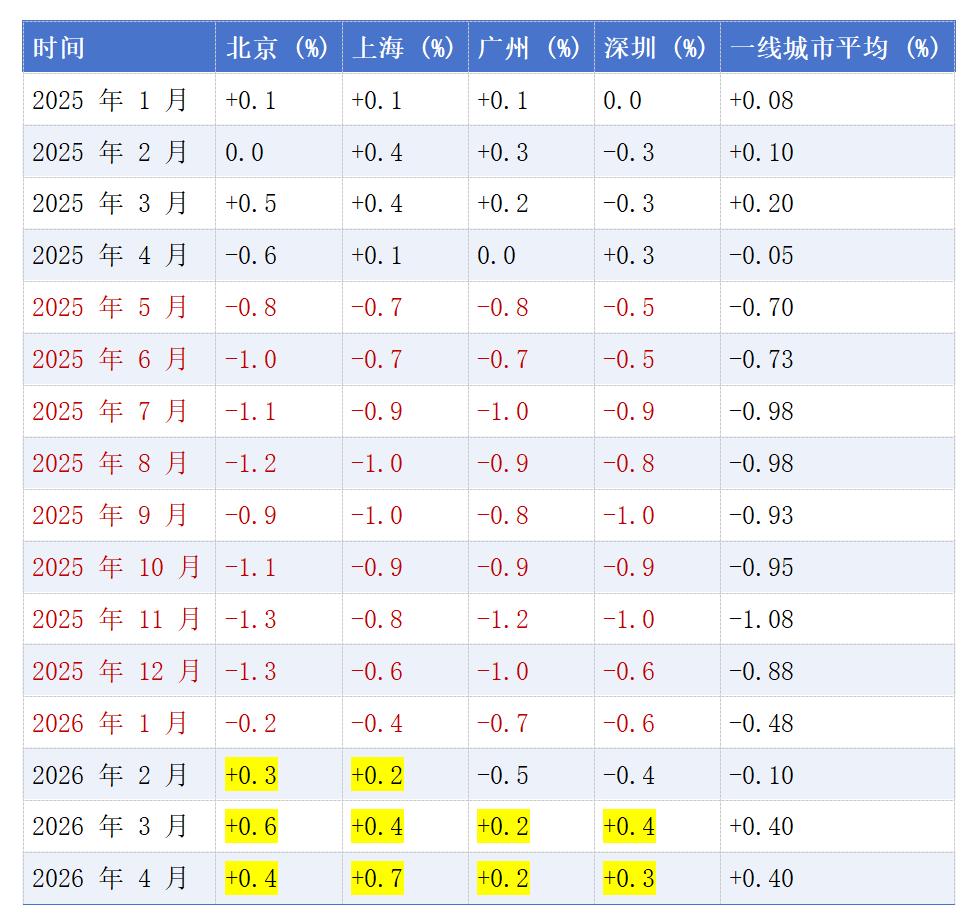
Month - on - month changes in the sales prices of second - hand houses in first - tier cities. Data source: National Bureau of Statistics
However, behind the market recovery, there is still the influence of policies. Currently, policies tend to work "quietly", and the previous approach of using high - profile measures to stimulate a short - term rapid increase in trading volume seems to have been abandoned.
The widely implemented policies can be mainly divided into three categories:
Firstly, trading in old properties for new ones. Since the beginning of this year, more than 40 relevant policies on "trading in old properties for new ones" have been implemented across the country. The government intervenes in the circulation process to ensure that the demand for "selling old and buying new" properties can be promptly met, addressing the bottlenecks in property replacement such as the difficulty of selling old properties and the high cost of buying new ones.
Secondly, targeted demolition. In recent months, Beijing, Shanghai, Guangzhou, Tianjin and other cities have quietly launched a new round of large - scale demolition. Different from the previous "large - scale demolition and construction", this new round of demolition targets dilapidated houses, houses within the red line of major projects, and concentrated urban villages with no conservation value. With multi - channel financial support from central government subsidies, local government special bonds, and social capital, housing vouchers and in - situ reconstruction are preferred, and the locations are precisely selected in areas with relatively strong housing demand such as the city core. On the one hand, it promotes urban renewal; on the other hand, it injects more investment into the real - estate market to support it. For example, in 2026, more than 20 urban villages in Guangzhou are being demolished at an accelerated pace, and Beijing is focusing on implementing 50 comprehensive urban renewal projects in specific areas. 2026 will be a big year for demolition.
Thirdly, a "combination punch" to lower the home - buying threshold, including increasing the housing provident fund loan limit, reducing interest rates, lowering the down payment, raising the maximum loan age, and tax rebates. These measures make it easier for individual home - buyers to enter the real - estate market. In particular, the housing provident fund, which has a relatively high safety margin, has seen a significant increase in loan limits in major cities across the country this year.
These policies are well - thought - out because there is no so - called real "rigid demand" in the current market. The main groups of people who may still buy houses fall into the following categories, and each policy addresses their pain points:
Firstly, improvement - oriented demand. People who want to move from old houses to new ones, from outdated floor plans to four - generation homes, or from the suburbs to the city core. They are "structurally optimizing" their property portfolios.
Secondly, demand for school - district housing. The demand for school - district housing is time - sensitive. When a child reaches school - age, a property must be purchased for school placement and lottery. School - district housing is the main driver of the increased trading volume during the "spring selling season" each year.
Thirdly, demand for family elderly care. When housing prices were high, families could squeeze into one property. Now that housing prices have generally dropped by about 40%, some families are buying a small - sized property near their existing homes for their elderly relatives, making it convenient to take care of them.
Fourthly, people attracted by the rent - to - price ratio. With the decline in second - hand housing prices, the rent - to - price ratio of some old and shabby properties in the core areas of first - tier cities has reached 2% - 4%, significantly higher than the deposit interest rate. Once the rent can cover the monthly mortgage payment, some young people with a down payment may be tempted to enter the market with "zero pressure" and experience being landlords.
Although these policies are implemented "quietly", their intensity is well - guaranteed, with the participation of the national government, local governments, and financial institutions.
The real - estate issue is currently the core issue of the economy, which is related to economic growth, residents' consumption expectations, and the risk of bank bad debts. Therefore, the real - estate market is an area where market forces must be respected, but also needs to be supported.
According to Goldman Sachs' calculations, if housing prices drop by another 10% - 15%, 6 trillion yuan (about 12% of the total) of existing mortgage loans will reach the 80% LTV safety line. If housing prices drop by 30%, 17 trillion yuan (about 33% of the total) of existing mortgage loans will reach the 80% LTV safety line, and the proportion of people selling properties to repay mortgages or defaulting on loans will double. After visiting local banks in Guangzhou and Shenzhen, Goldman Sachs concluded that banks can still withstand a further 20% drop in housing prices in first - tier cities. Therefore, it is estimated that the policy - makers can tolerate a housing price decline of no more than 15% from 2026 to 2027.
To lower the LTV ratio, efforts can be made in two directions: reducing the remaining mortgage loans through interest rate cuts and increasing housing prices by promoting market transactions through measures such as demolition and the acquisition of existing properties.
First - tier cities with the strongest purchasing power are the most ideal markets to measure the effectiveness of policies. According to international experience, the real - estate markets in major first - tier cities experience shorter "bear markets" in the cycle and recover more quickly.
More importantly, the real - estate markets in first - tier cities such as Beijing and Shanghai have only truly declined since 2023. The possibility of these cities bottoming out and stabilizing is based on the fact that a large number of sellers have suffered significant losses in the past three years, rapidly reducing the transaction prices of second - hand houses by about 40% to boost sales volume and gradually stabilize the market bottom. Once buying a house becomes "cost - effective" enough, Chinese people, who are accustomed to "putting down roots", are still more willing to own their own homes.
This article is from the WeChat official account "Future Habitat", written by Future Habitat and published by 36Kr with authorization.