The "Vehicle-Road-Cloud" system kicks off the "submission battle", and the trend of procurement has changed.
In 2026, the year when the first batch of pilot applications for the "Vehicle-Road-Cloud Integration" come to an end, the industry is entering a peak construction period.
Pilot application cities such as Haikou and Chengmai in Hainan, Jinan in Shandong, Changchun in Jilin, Beijing, and Shiyan in Hubei, as well as non-pilot cities like Yibin in Sichuan and Kunming in Yunnan, have intensively released tendering orders worth over 3 billion yuan.
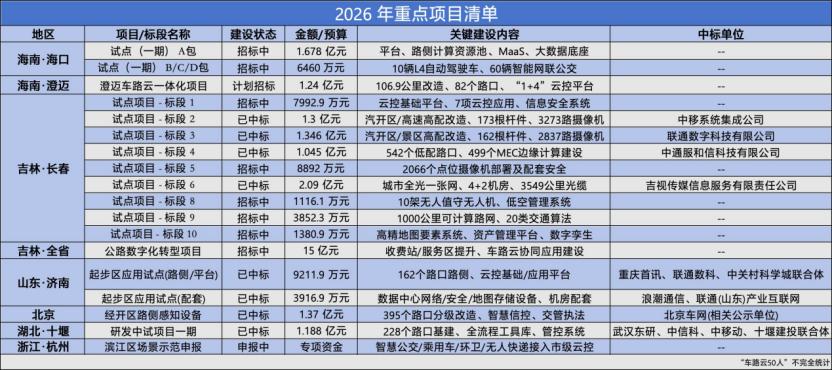
Jilin Province issued a large tender worth 1.5 billion yuan for the digital transformation of highways, bidding for the construction project of the digital transformation and upgrading of highway transportation infrastructure in the province, clearly showing its ambition to build a provincial-level network.
For the pilot application construction project in the starting area of Jinan, with a construction period of only 180 days, it is required to complete the overall delivery of roadside facilities, platforms, and supporting facilities, fully reflecting the urgency of the pilot cities under the pressure of assessment deadlines.
The "Vehicle-Road-Cloud 50 People" carefully sorted out the tendering information and found that some construction logics are changing.
After crossing the threshold of small-scale trials, the construction of the vehicle-road-cloud system is no longer just simple infrastructure investment. Instead, after the industry has entered the deep - water area, it is the collaboration among vehicles, roads, and clouds based on actual application effects.
Bidding farewell to blind infrastructure construction, the construction logic is shifting from undifferentiated stacking to standardized matching of different grades; the investment path is changing from pursuing coverage scale to digging deep into scenario dividends; and the motivation of participating entities is also evolving from one - way government promotion to active collaboration of automobile enterprises.
Bidding farewell to the situation of "roads waiting for vehicles", we should not only build roads but also operate roads that generate value
Looking back a few years ago, infrastructure - first was the main theme of construction in various places.
The vision at that time was very grand. First, build the intelligent connected facilities on the roadside, create a favorable environment, and wait for the large - scale access of autonomous vehicles.
However, the evolution of reality has played a joke.
Looking back at the industry's development, as early as 2016, pilot demonstrations had entered the closed - test field stage; in 2019, the first national - level pilot zone was approved; in 2020, the "Dual - Smart" pilot projects were fully launched.
But it wasn't until 2024 that the penetration rate of basic assisted driving really began to soar. And the high - level autonomous driving that the industry has high hopes for is restricted by the technical bottlenecks of complex urban road conditions and long - tail scenarios, and is also limited by the slow speed of road - right opening, resulting in a serious lag in the process of its large - scale deployment on the road.
Under the dual constraints of technology and policy, the development of vehicle - end is much slower than the construction of roadside facilities. The roadside facilities built at a huge cost are in an embarrassing situation of having no vehicles to use. This also brings a profound industry reflection: The necessity of the vehicle - road - cloud system must be closely linked to the development process of autonomous driving.
Simply emphasizing roads and clouds without simultaneously promoting the large - scale commercialization of autonomous driving will result in over - investment.
The era of extensive spending and sensor stacking is passing. In 2026, the trend of tendering and procurement is shifting towards practical results.
In several tenders in Changchun, the transformation of high - configuration and low - configuration road sections was mentioned; Beijing classified intersections according to actual needs to achieve multiple functions such as full - domain road perception, networked services, and intelligent traffic control; Chengmai County in Hainan also proposed to carry out intelligent transformation of key intersections and configure equipment according to functional requirements at different levels.
At the end of 2025, the China Society of Automotive Engineers released the draft for comments on the "Technical Requirements for Grading of Intelligent Roadside Infrastructure for Vehicle - Road - Cloud Integration (Urban Roads)". According to the plan, the official standard document is expected to be implemented in the first half of 2026. In the future, graded construction will become the core path to improve construction efficiency and play a practical role.
This rational construction idea also drives the concretization of application scenarios.
The most typical example is Haikou in Hainan. Its tender clearly mentioned the construction of smart bus and autonomous driving scenarios, and directly included the procurement of L4 - level autonomous vehicles and intelligent connected buses in the tender package, planning to purchase multiple intelligent connected buses of different specifications.
When organizing the application for demonstration application scenarios, Binjiang District in Hangzhou also clearly listed multiple specific directions such as smart buses, low - speed unmanned delivery vehicles, and smart patrol vehicles.
The concretization of application scenarios forces the infrastructure to be deeply integrated with vehicle operation, traffic management, and urban services.
In the future, the challenge that the vehicle - road - cloud construction needs to face is not only to build roads but also to operate roads that can generate value.
More notably, this transformation is breaking through the scope of the vehicle - road - cloud system and showing the characteristics of cross - border integration.
In the relevant pilot application construction projects in Changchun, there are contents about the construction of a low - altitude drone management system and supporting facilities.
In fact, this cross - border integration has long been supported by top - level concepts.
In 2025, Professor Cheng Chengqi, the director of the Aerospace Information Engineering Center of Peking University, publicly stated: I discussed with Academician Li Keqiang of Tsinghua University. Academician Li has long been committed to promoting China's "Vehicle - Road - Cloud - Network Project". At that time, we proposed whether we could add an "air" element to the "Vehicle - Road - Cloud - Network Project" to form the "Vehicle - Road - Air - Cloud - Network Project", and Academician Li highly recognized this view.
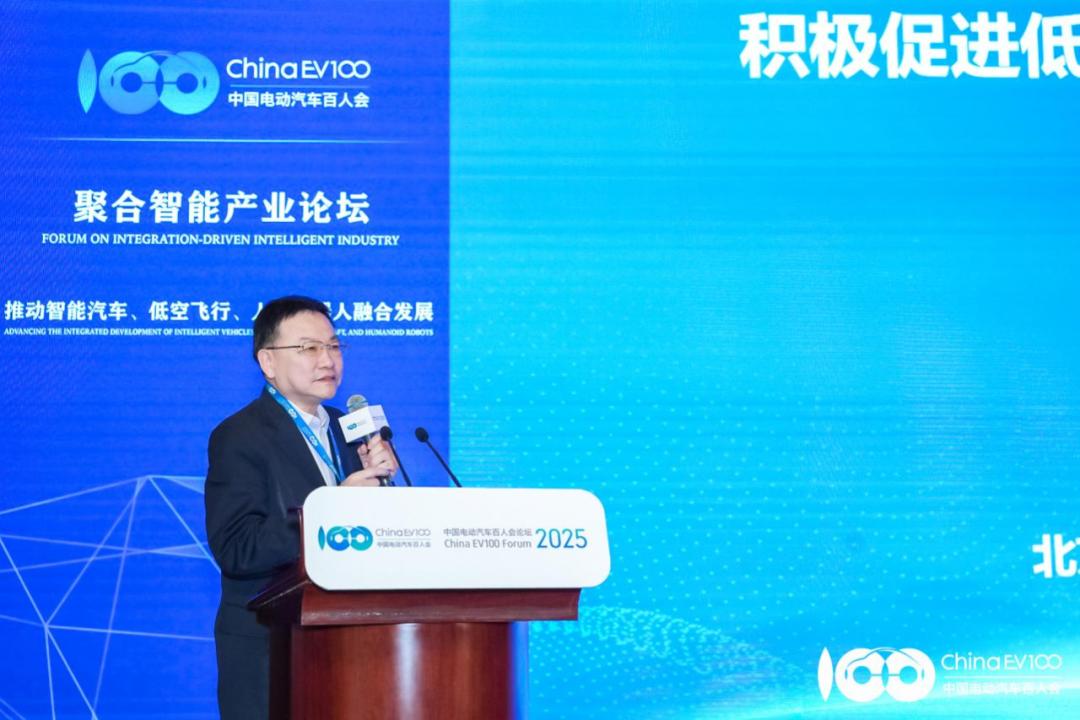
(
Based on this consensus, the two also carried out some preliminary demonstration work on the "Vehicle - Road - Air - Cloud - Network Project" in Jimei District, Xiamen.
Professor Cheng Chengqi believes that these events indicate that there is a high possibility of new development opportunities and breakthroughs in the field of intelligent transportation.
In the future, the vehicle - road - cloud base not only serves ground transportation but also is the digital cornerstone of urban three - dimensional transportation.
While managing vehicles on the road surface, the cloud - control platform can also coordinate the management of drones in the air. The integration of "road surface + low - altitude" will greatly improve the reuse rate of infrastructure investment. The vehicle - road - cloud system supporting the development of the low - altitude economy may become one of the most imaginative trends in the future.
Meanwhile, the refinement of the tendering model also reflects the value extension of investment from "hard infrastructure" to "soft operation".
Observing the bid section division in recent pilot cities, software and service - related bid sections such as algorithm platforms, operation and maintenance services, and asset management have begun to be independently split, instead of the previous large - scale infrastructure packages.
Taking the division of ten bid sections in Changchun as an example, the scope covers multiple professional dimensions from all - optical networks, algorithm platforms to high - precision maps and asset management. This also shows that the industry has begun to attach importance to the continuous iterative ability of algorithms and the asset - based management of data in the later stage.
After all, only by ensuring the real - time nature, accuracy of roadside data and the sustainable evolution of algorithms can the vehicle - road - cloud system generate long - term commercial value in long - term operation.
Behind the shift from extensive construction to intensive cultivation is the industry's awakening to return to practical results and a commercial closed - loop after suffering the bitter fruit of roads waiting for vehicles.
Escape from "intra - vehicle involution", automobile enterprises shift from manufacturing to service
If the return of the tendering logic to practical results and scenarios is the self - correction of the infrastructure end after painful reflection, then the internal driving force that can really open the door to collaboration comes from the deep - seated anxiety of the demand side in crossing the intelligent driving gap.
As the ultimate application party, automobile enterprises are undergoing an identity reconstruction from "hardware manufacturers" to "travel service operators" in the face of L4 - level autonomous driving.
In 2025, the competition in intelligent driving among automobile enterprises reached a white - hot stage, and safety issues became the top priority for the industry.
At this historical turning point, voices in the industry, led by European regulatory agencies and He Xiaopeng, a new - force carmaker, began to point the finger at L3 - level autonomous driving. He Xiaopeng even clearly suggested at the Two Sessions that we should skip L3 and directly move towards L4.
Behind the route dispute lies the industry's concern about the gray area of responsibility.
L3 - level autonomous driving is called conditional autonomous driving. In the state of human - machine co - driving, humans are required to take over in case of system failure. However, it is very difficult for humans to switch from a distracted state to dealing with extreme road conditions within a few seconds.
If a collision occurs, who should be responsible, humans or machines, is in an ambiguous middle area. L4 completely frees humans from the driving task and no longer bears the responsibility.
However, when the technical goal enters the L4 stage, the entire industrial logic undergoes a qualitative change.
At the L4 level, there may be no driver in the driver's seat, or humans no longer bear the actual driving responsibility. Once an unexpected situation occurs, the legal and safety responsibilities will be transferred to the algorithm, system, and vehicle provider .
This shift in the responsible subject promotes the transformation of the identity of automobile enterprises. Since they have to be responsible for real driving behaviors, automobile enterprises are no longer just manufacturers selling hardware products, but travel service operators who bear the responsibility for the full - life - cycle operation and management of autonomous driving.
As the ultimate responsible subject, automobile enterprises inevitably fall into the game of safety, efficiency, and supervision.
The large - scale implementation of high - level autonomous driving is essentially a systematic reconstruction of productive forces and production relations.
In terms of safety, the local sensors of vehicles have inherent limitations in the face of extreme black - swan events, such as sudden landslides, long - distance serial accidents, out - of - sight emergency vehicles, and temporary road reconstruction and construction.
The real industrialization of autonomous driving not only requires vehicles to "see", but also requires "foresight" and "certainty" under the coordination of the cloud.
In addition, the transportation system is a unity of opposites between the "maximization of individual interests" and the "maintenance of system order" - driving behavior is not a pure free will, but a "synthesis" that seeks a balance between real - time road condition strategies and macro - normative instructions.
In the era of AI - dominated autonomous driving, this "synthesis" relationship will undergo a qualitative change.
Since the operation platform bears a higher risk - control responsibility, the weight of macro - regulation will significantly exceed individual decision - making.
Relying on networking technology, the traffic logic will leap from "individual combat based on local probability" to "systematic evolution based on global information coordination", thus laying the efficiency foundation for unmanned operation.
Driven by survival and compliance, it is inevitable for automobile enterprises to actively seek cooperation with roadside and cloud ends.
In February 2025, the "Jiasuo Action" was officially launched.
Six entities, including Toyota Motor, FAW Group, GAC Group, BYD, Huawei Terminal, Guoqi Zhilian, and Tsinghua University, reached a key consensus:
To jointly carry out the R & D and verification of the "Vehicle - Road - Cloud Integration" intelligent connected vehicle technology in China. Through system coordination and mass production applications, achieve the comprehensive driving performance of "safety, reliability, and efficiency" that is difficult to achieve with single - vehicle intelligence, and ultimately move towards the vision of "zero traffic accidents".
In October of the same year, the "Joint Action of Chinese and Foreign Automobile Enterprises" pushed this process to a climax.
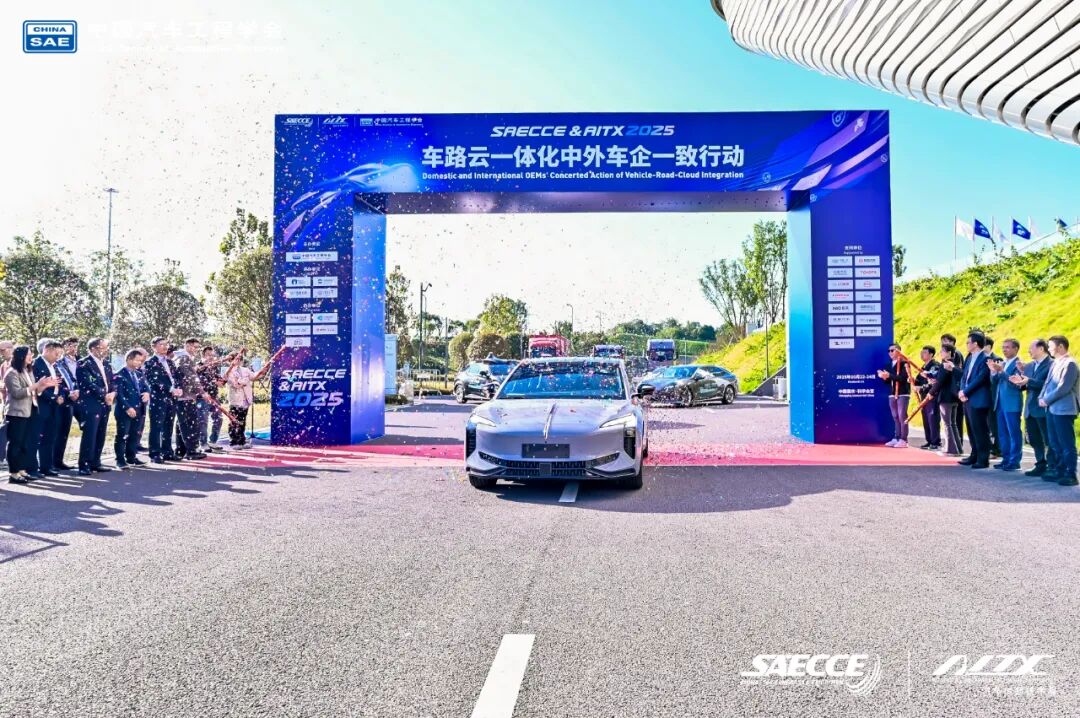
(The departure ceremony of the Joint Action of Chinese and Foreign Automobile Enterprises for Vehicle - Road - Cloud Integration)
The cooperation camp expanded from the initial 6 to 15 Chinese and foreign automobile enterprises. In Beijing and Chongqing, the mass - production scenario demonstrations based on the cloud - control basic platform were successfully implemented, and key functions such as networked collision avoidance and green - wave speed guidance were verified with real vehicles.
Driven by the enthusiastic promotion of industrial practice, the voice at the policy level is becoming louder and louder.
Zhang Tao, the director of the Tiexi Factory of Brilliance BMW and a member of the National Committee of the Chinese People's Political Consultative Conference, emphasized at the 2026 Two Sessions that the government should increase support for the pilot construction of vehicle - road collaborative infrastructure, promote the deployment of the vehicle - to - everything (V2X) system in key cities, form an integrated risk - protection system of "vehicle - road - cloud", and enhance the safety resilience of the overall intelligent driving system.
These actions and suggestions indicate that the integration of automobile enterprises with roads and clouds is no longer just a slogan under policy guidance, but a safety belt that automobile enterprises must hold firmly for the implementation of high - level autonomous driving.
Heading towards "large - scale commercialization", the reconstruction of vehicle scale and regulatory system
The roads are turning to be more practical, and vehicles are accelerating their entry. 2026 is the watershed for autonomous driving to move towards large - scale commercial implementation.
In the international market, leading enterprises such as Waymo have completed over 127 million miles of fully autonomous driving in real cities, and the injury rate in accidents is 81% lower than that of human - driven vehicles; Tesla has accumulated over 8.2 billion miles of driving under the FSD supervision mode; and the total driving mileage of Baidu's Apollo Go in China has also exceeded 190 million kilometers.
Not only the accumulation of test and operation mileage, but also the closed - loop of the business model has been substantially established. As the cost of core hardware such as lidar has dropped by more than 90%, the investment per vehicle has entered the commercially viable range; at the operation end, the ratio of remote - monitoring personnel to vehicles of enterprises such as Pony.ai has reached 1:20, and single - vehicle profitability has turned positive in Guangzhou and Shenzhen.
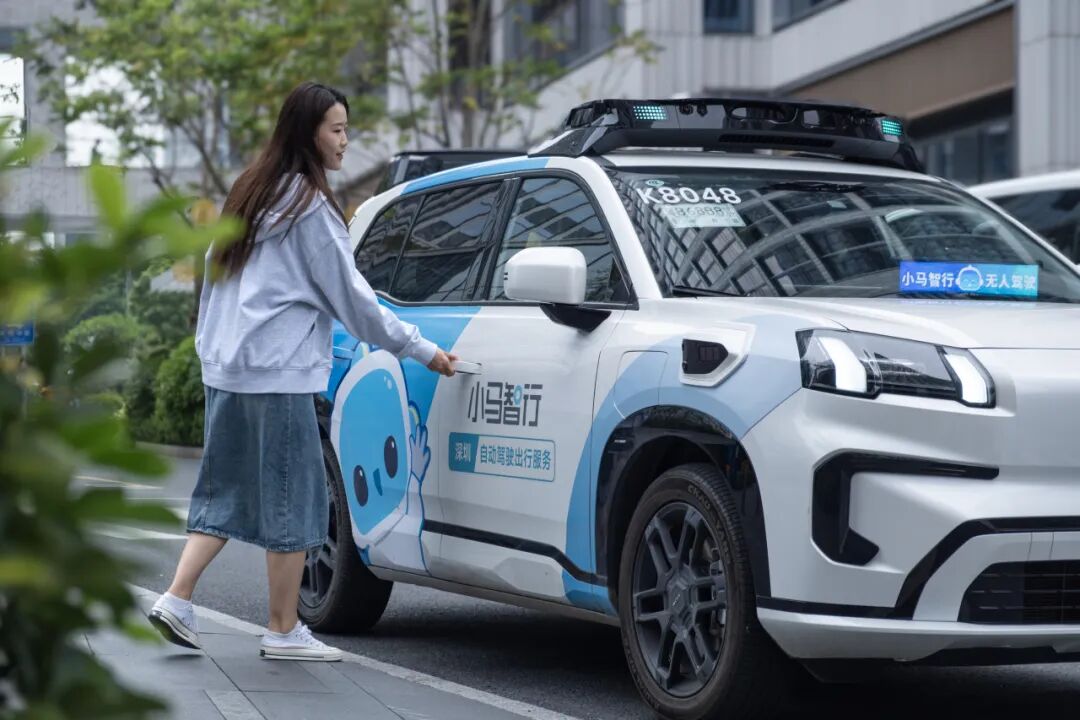
(Autonomous driving operation scenario, source: Pony.ai)