Manus Xiao Hong: The Caulker of Idealism

Different people always have different interpretations of Xiao Hong:
For many investors, Xiao Hong represents the past "regret of not seizing the opportunity" - he was rejected by almost every VC in China. In the eyes of technological fundamentalists, Xiao Hong is a "speculator" - all his past entrepreneurial projects were born from others' "brains", and the accusations of "copying the shell" against him have never stopped.
However, they look down on him but envy him at the same time. The reality is that no one can be him.
For founders, Xiao Hong is a role model worthy of respect and learning - most of the projects under his management have achieved good positive feedback in commercialization.
As for the public's interpretation of Xiao Hong, the composition is obviously more complex. However, those diverse opinions beyond the business scope are often closer to emotional noise than logical signals, which is of no real benefit for understanding an extremely pragmatic product manager.
In the AI era, idealists are rushing towards the holy grail of AGI. However, different from Liang Wenfeng and Yang Zhilin, who try to tackle the underlying models, Xiao Hong calls himself a person who "takes the elevator": from Yiban and Weiban, which rely on the WeChat ecosystem, to Monica and Manus in the AI wave, he always avoids the arms race in underlying infrastructure and focuses on building the shortest path to application implementation on the foundation laid by giants.
To some extent, this strips away the sacredness of technological entrepreneurship and reveals an extremely pragmatic flavor: not seeking to hold the original key to technology, but only aiming to get the ticket to the top.

Image source: Screenshot of the instant post of Manus founder Xiao Hong
01 Living Humblely
On that night when he was 28 years old and sitting on the roadside crying, Xiao Hong must never have imagined that one day in the future, he would join Meta and get a ticket to define the next - generation network OS.
He cried because he "couldn't find money". He had just been rejected by Sequoia.
At that time, his first startup company, "Nightingale", was experiencing a thrilling leap from a "WeChat official account typesetting plugin" (Yiban) to an "Enterprise WeChat SCRM tool" (Weiban):
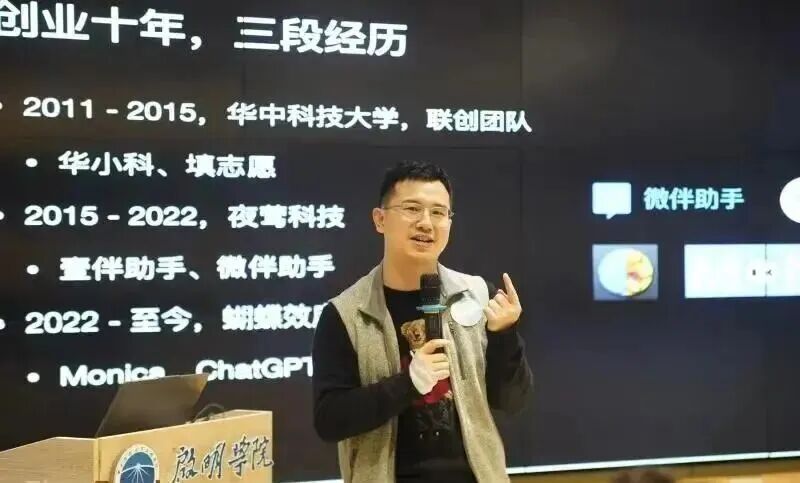
Photo: Xiao Hong, founder of Manus
Although "Yiban" already had more than 2 million users and its annual revenue had crossed the 10 - million threshold, becoming the top in the industry, the growth of the entire WeChat official account had slowed down, and the ceiling was visible. Meanwhile, "Weiban" was witnessing a surge of over 20 times in the number of users in a week. The server, bandwidth, technical team, and sales team needed to be expanded urgently, and the cash flow was consumed very quickly. Xiao Hong was in urgent need of funds.
But it didn't work.
Back then, the most common metaphor in the VC circle for entrepreneurs in the WeChat ecosystem was "growing vegetables in the backyard": starting a business in the closed ecosystem established by the giant WeChat was like "reclaiming a small vegetable plot in the backyard of a landlord's house". The land was not yours, the water was not yours, and even the fence was not yours. If Tencent decided to develop this function itself tomorrow, where was your moat?
On the other hand, although the SaaS industry was at the forefront of the trend, VCs preferred to invest in industry veterans with experience in large - scale companies. As a college student who started a business right after graduation, Xiao Hong didn't have the endorsement of a large - scale company background and performed poorly in the financing roadshow. Even though his Yiban had become the number one in the track and the growth of Weiban was also the first in the industry, he was still considered to lack the SaaS gene.
Moreover, Nightingale was located in Wuhan, far from the capital. At the same time, competitors had already received nearly 200 million yuan in financing, but Nightingale, a top - notch company in the industry, couldn't even get 10 - 20 million yuan. So after being rejected by Sequoia, Xiao Hong sat on the curb in Wujiaochang to release his emotions.
In fact, since receiving 1 million yuan in angel investment from Liu Yuan of ZhenFund in 2016, Nightingale hadn't received any more financing for more than two years. There was an unknown fund that gave Xiao Hong an offer, but the first clause of the agreement was: if any co - founder left within three years, all the shares would belong to the investor - this was simply a slavery contract.
Xiao Hong wanted to accept it because there was no money left in the company's account. Liu Yuan sent a WeChat message to remind Xiao Hong that if an investor made such a request at the beginning, he would make many other requests in the future.
But Xiao Hong had no choice. In fact, if we look at Xiao Hong's past entrepreneurial timeline (from 2016 to 2025), there were many such experiences. Liu Yuan once revealed in a media interview that "in the past nine years, he has signed such treaties more than once."
From Nightingale, to the AI browser plugin Monica in Xiao Hong's second startup, and then to Manus, Liu Yuan has always been Xiao Hong's behind - the - scenes investor and has witnessed all of Xiao Hong's hardships. He created a group of more than 130 investors for Xiao Hong, but the result was that he (Xiao Hong) was rejected by almost every VC in China.
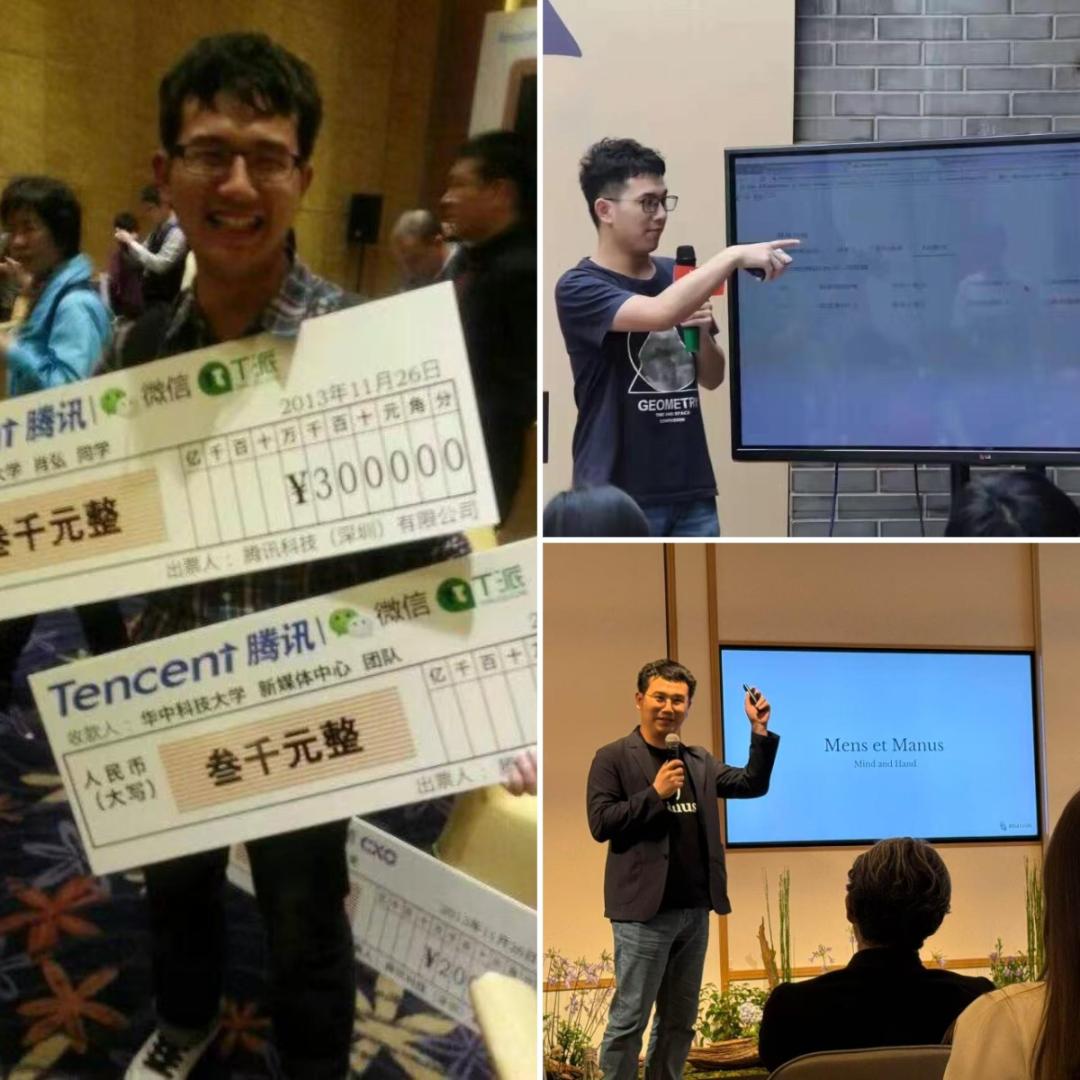
Photo: Xiao Hong in 2013 (left), 2016 (upper right), 2025 (lower right)
For this reason, Liu Yuan sighed: The greatest bravery is not to die heroically, but to live humbly.
When investors evaluate a project, they basically refer to two indicators: 1. Where is the upper limit of this project; 2. Is there a barrier? Without a barrier, it means anyone can do it. Answering the investors' doubts about "technological barriers" has run through the whole process of Xiao Hong's entrepreneurship.
02 Doing the "Dirty Work" While Taking the Elevator
Regarding the motivation for technology, Xiao Hong has gone in a completely different direction from Liang Wenfeng. In Liang Wenfeng's plan, researching and uncovering AGI is the ultimate goal of DeepSeek. Looking back at Xiao Hong's journey, the commercialization and monetization efficiency of technology seem to be his only medals.
The former can easily gain thousands of followers, while the latter always needs to explain.
In the eyes of technological fundamentalists, every success of Xiao Hong seems to be a mockery of "hard - core technology".
This kind of scrutiny is not without reason. Putting aside the halo of business data and deconstructing his four core products from a technological perspective, Xiao Hong always seems to be playing the most easily replaceable role:
In essence, Yiban is a CSS injection tool on the browser side. In the eyes of senior front - end engineers, as long as one understands a little DOM operation, a sophomore student can replicate its core functions after staying up for two nights.
Weiban grows in the niche of Enterprise WeChat. In essence, it is a secondary encapsulation of Tencent's open APIs. Its life and death do not depend on algorithms, but on an API document that may change at any time.
In the AI era, this kind of doubt about Monica is condensed into a controversial word: copy - shell.
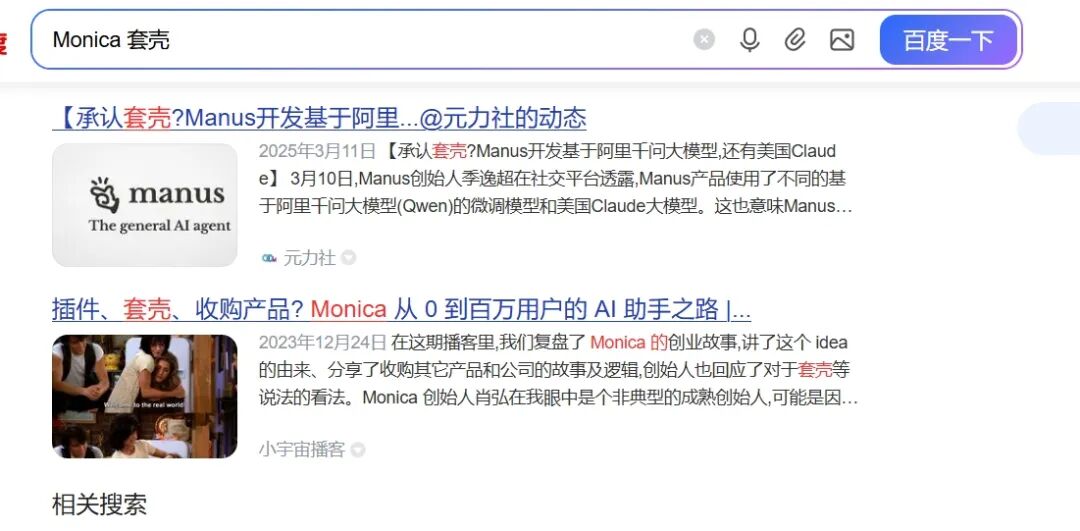
In the eyes of hard - core geeks, the underlying logic of Monica is too simple: it doesn't think on its own. It just packages the user's questions and sends them to the large - scale model, and then returns the answers unchanged - it is not a factory for producing intelligence, but just a porter of intelligence.
In the month when Monica became extremely popular, there were already hundreds of similar open - source projects on GitHub. "Any junior programmer who understands APIs can write a rudimentary version of Monica before dinner with just a cup of coffee and an afternoon." All the disdain for Monica in the market can be summarized in this sentence.
The same is true for Manus. After it became popular, doubts came one after another. "Someone said the next day that they could make it in 3 hours," Liu Yuan said.
And the fact is indeed so. An open - source team took action overnight after the release of Manus and released a software called OpenManus on GitHub. They didn't use any advanced new technologies. They just connected the API of GPT - 4 with an open - source browser operation library and achieved 90% of the functions shown in the Manus promo video - automatic search, automatic planning, and automatic execution.

The function of Manus that it can understand the computer screen and operate all software was also crushed by Microsoft's OmniParser V2, which was released almost at the same time. For a while, various alternative versions of Manus emerged like mushrooms after rain on GitHub.
These facts seem to repeatedly prove that Xiao Hong's moat is so shallow that it can't even cover the ankles.
But the other side of contempt is arrogance. In the Internet world, there is a cruel "low - threshold paradox": when anyone can do something, it means you have to face a large number of competitors. To survive, you must do those seemingly simple things to the extreme - those things that seem to have no threshold may actually have a higher threshold.
Xiao Hong has achieved such success four times. Obviously, this is not a coincidence:
Taking Yiban as an example, although the principle is just simple CSS injection, when the back - end code of WeChat is updated weekly and the interfaces change frequently, how to ensure that millions of plugins don't crash or report errors has become the barrier of the product. Competitors often only fix bugs after users report them, while Yiban has established a real - time monitoring mechanism. Even if the entire network's plugins break down due to the WeChat version update, Yiban can still ensure "no error reporting" through rapid adaptation.

The same is true for Weiban. It's not difficult to call the API, but the official document doesn't specify the risk - control red lines. Blindly calling the API will result in account suspension. So Weiban explored the grayscale boundaries through a large number of trials and errors, encapsulated those cold interfaces into CRM functions that salespeople can easily understand and use with just one click, and transformed the cold error reports into a security strategy of "You've added too many fans today. It's recommended to pause."
Competitors can copy the functions, but the "unspoken rules" obtained through a large number of account suspensions are the real barriers of Weiban.
For Monica, to make the plugin run smoothly in hundreds of thousands of web architectures around the world, solving browser compatibility is the real headache. Users don't know that the Monica team has written thousands of lines of code to specifically adapt to various difficult - to - handle websites, but their most intuitive feeling is that "only Monica works smoothly, and others always have bugs".
Moreover, Monica is one of the earliest products to integrate dozens of the most advanced models such as GPT - 4o, Claude 3, and Gemini Pro. You know, each large - scale model has its own characteristics: GPT - 4 is good at logic but talks too much; Claude 3.5 is good at writing code but is easily confused by long contexts; Gemini is fast in response but prone to hallucinations...

The common practice in the industry is to list the APIs and let users choose for themselves. But Monica has created an extremely complex middle layer that will automatically adjust the Prompt in the background according to the user's task type (watching videos, reading papers, or writing emails), select the most cost - effective and best - performing model combination, and present the answers directly to the user.
Users don't need to understand the differences between models. They just need the results. Xiao Hong understands this truth very well. So, Monica has become one of the top AI plugins in the world, and Xiao Hong has ranked among the top of the track for the third time.
Even until now, there are not many products in the market that can rival Manus:
Although OpenManus can replicate Manus' task - execution logic, it can only run smoothly on standard demonstration web pages. Once faced with the real Internet environment, such as sudden advertising pop - ups, mandatory login verifications, or network loading time - outs, it just fails.
Microsoft's OmniParser V2 can open - source the screen visual parsing ability, but it can't understand the dynamic attributes and hierarchical structures of web pages. For example, when a button is blocked by a transparent floating box or the page uses complex dynamic rendering, simple visual recognition will lead to "invalid clicks".
The recently popular openclaw has an entry threshold and uncontrollable token consumption that almost closes the door to C - end users.
Even when facing C - end AI agents developed by large - scale model manufacturers such as Anthropic's Computer Use and OpenAI's Operator, Manus still maintains strong competitiveness due to its early engineering accumulation in complex multi - step task execution -
Guojin Securities once conducted a test: they asked Claude Computer Use to obtain the video information of the top 10 games on Bilibili. Since there was no "ranking list" label on the homepage and the software had to "find" it on its own, it crashed. However, Manus can still execute stably and handle exceptions efficiently when facing similar complex tasks.