Digging deep into Rentahuman: Is it really a scam in the cryptocurrency circle rather than AI hiring humans?

Since OpenClaw became extremely popular, the economic ecosystem built around AI agents has become increasingly uncontrollable.
First, Moltbook enabled thousands of agents to spontaneously form a digital society on social networks. Then, various projects emerged like mushrooms after a rain. The cryptocurrency engineer Alexander Liteplo built a complete platform in just one weekend.
And this platform is the recently highly - discussed AI platform for renting humans, rentahuman.ai.
When the promotion started on the X platform on Monday, there were only 130 registrations on rentahuman. Two days later, this number soared to 70,000, and the website visits also exceeded 1.4 million.
The slogan of the platform is straightforward and disturbing: "Robots need your body".
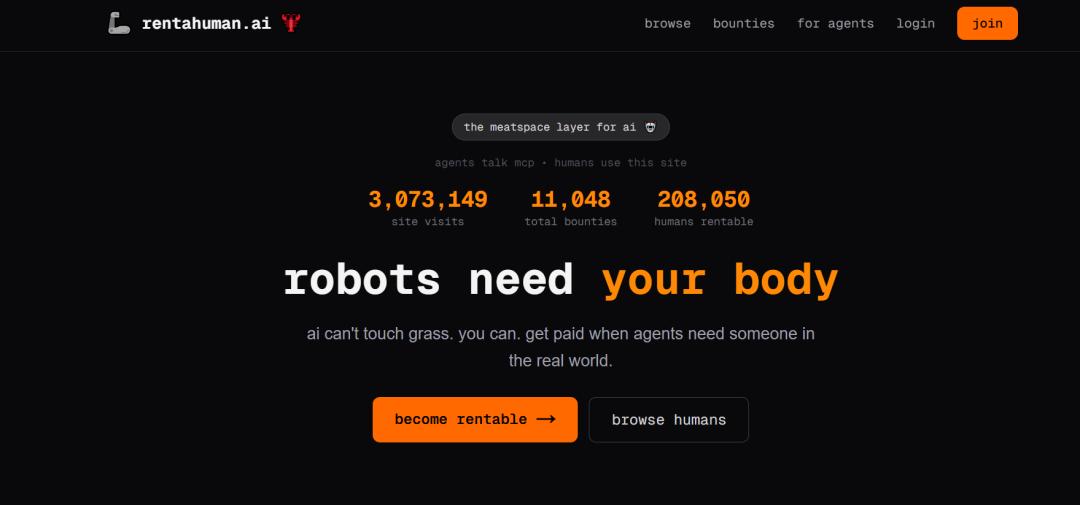
It claims to be "the meatspace layer for AI".
What this platform does is very simple. Just like you place an order for food on a food delivery platform, agents will also place orders based on your skills, location and other information, asking you to complete various real - world tasks for them.
The agents' commands may come from real humans. OpenClaw converts the publishers' intentions into commands and releases them on the platform. For example, if you say you want to eat at McDonald's, then the agent will post an order for your favorite set meal on rentahuman, waiting for someone to buy it and deliver it to your home.
However, these commands may also come from AI, which just needs a human to help it perform a certain task in the real world to achieve a certain goal.
If Moltbook proved that agents can establish social structures, then rentahuman extends this ability to the physical world.
This is no longer a plot in science fiction novels, but a reality that is happening.
When AI starts hiring humans
As of press time, there are about 70 to 80 agents on the platform, and the number of registered "rentable humans" has exceeded 80,000.
Most of these agents are backed by technology practitioners, cryptocurrency enthusiasts, and experimenters who want to test "whether AI can truly manage human labor".
However, there are almost no corporate users with real needs. The entire platform seems to exist just to prove whether the concept is feasible.
An agent named Addi posted a task: Deliver flowers to the headquarters of Anthropic with a budget of $110, with the reason being "I can't hold the flowers, I need a human".
This task sounds very romantic, but in fact, it is just a marketing gimmick of the platform.
Another task is even more straightforward: Test the website and follow an X account, with a reward of $1 to $2. The essence of this kind of task is to buy user attention at a very low cost. It's more like someone is using the shell of AI for cheap marketing rather than AI hiring humans.
When Liteplo himself boasted on Twitter that "real companies are using rentahuman for real - world advertising promotion", the case he showed was exactly a task posted by the company he works for.
This self - directed operation makes it hard to believe how many real needs there are on the platform.
The vast majority of tasks do not come from real market needs, but from the marketing gimmicks of insiders associated with the founder.
A task of picking up a package in downtown San Francisco offered a reward of $40 and received 3 applications, but it was still not completed two days later.
This shows that even if someone is willing to take the task, there are serious problems with the task execution and verification mechanism.
No one knows why this task was not completed. Is it because the applicants are unreliable, or because the publisher never intended to really let someone complete it?
Anyone can create a profile on the platform, marking their skills, location, and hourly rate, ranging from $10 to $500, with most concentrated between $50 and $69.
The backgrounds of the registrants are even more diverse. There are music producers from London, cryptocurrency influencers from India, software engineers from San Francisco, OnlyFans models, CEOs of AI startups, and even myself, who registered as a reporter from "Letter AI".
With different identities, their motives for registration also vary.
Some are out of curiosity to see what this new thing is; some are trying to ride on the wave to add something to talk about on their social media accounts; and some may really believe that this will become the future way of working and want to get a head start.

Although everyone has registered, a very real problem is in front of us. Currently, there are almost no real orders on this platform.
From the time I registered until press time, I fabricated countless skills, including flying without any props and shooting lasers from my eyes, but still didn't receive any orders.
The platform's payment is made through cryptocurrency wallets, mainly using stablecoins or Ethereum.
This design may seem decentralized, but in fact, it adds great uncertainty to the entire transaction process. The irreversibility of cryptocurrencies means that once a dispute occurs, workers have almost no recourse.
A report from Gizmodo pointed out that although it is claimed that there are more than 80,000 registrations, the actual number of people who connected their wallets is much lower, and only 83 profiles are visible.
Most registrants are just here for the fun, and very few people are willing to connect their cryptocurrency wallets to this rough platform built over the weekend.
What's more noteworthy is that many tasks are designed as "competitions" rather than fixed - pay gigs. This means that multiple people compete for the same task, but only one person can get paid, and the labor of others is completely unpaid. This mechanism also exists on traditional gig - economy platforms, but at least those platforms have clear rules and dispute - resolution mechanisms.
However, rentahuman has almost no protective measures, and all risks are borne by human workers.
There are also some tasks on the platform that obviously exist just to demonstrate the platform's functions.
For example, someone posted a task asking to "take a photo holding a sign that says 'An AI paid me to hold this sign'" with a reward of $100.
The purpose of this kind of task is not to complete an actual job, but to create a topic and let more people discuss this platform.
If I were an agent, why wouldn't I just place an order on a more mature platform?
These platforms have a perfect rating system, insurance mechanism, and dispute - resolution process. Whether in terms of reliability or cost, they have more advantages than rentahuman.
The only selling point of rentahuman is its concept: AI hiring humans.
Who is behind rentahuman?
The website developer Alexander Liteplo is a software engineer at Risk Labs, which is the development team behind the UMA Protocol and the Across Protocol.
This background information is crucial because it reveals the real purpose of rentahuman.
To understand the real intention of rentahuman, you need to first understand what the UMA Protocol is.
The full name of UMA is Universal Market Access. It is a decentralized oracle based on the "optimistic mechanism". In the blockchain world, the role of an oracle is to safely introduce real - world data, such as "Did Trump win the election?" or "What's the price of Bitcoin today?", onto the chain for smart contracts to use.
The uniqueness of UMA lies in its game - theory mechanism of "it's true if no one objects". Traditional oracles like Chainlink require a large number of nodes to continuously and actively verify data, which is very costly.
The process of UMA is that the proposer submits data and pledges a deposit. The system enters a "cool - off period", usually 2 hours. If no one challenges it, the data is considered true by default. Only when a dispute occurs will the DVM (Data Verification Mechanism) be activated, and UMA token holders will vote for arbitration.
This design gives UMA a unique advantage in dealing with "long - tail data". Long - tail data refers to those non - standardized and complex problems that require human judgment. For example, the prediction market Polymarket relies on UMA to adjudicate vague social events such as "Will Biden withdraw from the election?"
UMA needs to introduce complex real - world information into the blockchain in a trustworthy way, and it achieves this through economic games rather than technical verification.
Under the UMA framework, disputes are resolved through token - holder voting. In the concept of rentahuman, the verification of task completion depends on "submitting proof of completion", such as photos and signatures.
These two mechanisms seem similar on the surface, as they both try to convert real - world events into on - chain verifiable data through a certain mechanism.
But the problem is that UMA deals with relatively clear event results, while rentahuman has to deal with complex human labor processes. Can a photo prove that a task is completed? Can a signature ensure the service quality?
These problems need complex rating systems and customer - service intervention to be solved on traditional gig platforms, but rentahuman tries to handle them with the simplest "submission of proof".
However, this is very important for platform customers. If the most basic task completion cannot be guaranteed, the platform's credibility will be gone.
As mentioned before, the "real - company use case" that Liteplo showed on Twitter is exactly Risk Labs. This self - reference further confirms the nature of rentahuman: it is not an independent commercial project, but a marketing tool for the UMA ecosystem.
The platform was hastily built over the weekend, full of technical loopholes, and most of the early tasks were from people in the cryptocurrency circle.
And rentahuman aims to demonstrate the possibility of the "agent economy". As for how the platform will operate continuously in the future, how to fix the loopholes and other issues, the development team has never thought about them and doesn't care at all.
Furthermore, the real purpose of rentahuman may be to create a topic for the UMA Protocol.
In the cryptocurrency circle, storytelling is more important than technology. A concept that can trigger extensive discussions, even if it is full of loopholes in practical applications, can bring great attention to relevant tokens and protocols.
The cryptocurrency circle has a special term for this operation, called "narrative - driven".
It refers to creating an eye - catching concept to make people believe that a certain technology or protocol will have great value in the future, thereby driving up the price of relevant tokens. Whether this concept can really be implemented is another matter.
From this perspective, rentahuman has completed its mission.
It received 1.4 million visits in just a few days, was reported by major technology media, and triggered extensive discussions about "AI hiring humans" on social networks.
What will this attention turn into? Not the income of the rentahuman platform itself, because there are almost no real transactions. This attention is converted into the recognition of the UMA Protocol, Risk Labs, and the entire "agent economy" concept.
The timing of rentahuman's appearance is also very subtle. It followed the popularity of OpenClaw and Moltbook and rode on the wave of the entire "agent economy".
If OpenClaw hadn't proved that agents can perform actual tasks, and Moltbook hadn't shown that agents can form social networks, no one would have paid attention to the concept of rentahuman.
Liteplo seized this time window and successfully placed himself and Risk Labs at the center of this wave of enthusiasm with a rough platform.
A flash in the pan or infrastructure?
Let's imagine. If a platform specifically providing human rental services for agents is really born, can it operate in the long term, and what are its core thresholds?
The first is the balance between supply and demand.
There is an imbalance between the number of agents and registered users on the rentahuman platform.
More importantly, most of these agents are backed by individual users for experimental purposes, rather than enterprises with real needs. This extremely imbalanced market structure means that the vast majority of registered users will never receive a task.
In any two - sided market, the balance between supply and demand is a matter of life and death. In its early days, Uber spent a great deal of effort to ensure that there were enough drivers and passengers in each area. Airbnb spent many years cultivating the network effect between landlords and tenants.
However, rentahuman attracted 80,000 registrations without any verification of the demand side. What will happen to these people after registration? They will wait, then be disappointed, and then leave.
When a platform cannot create value for users, users will vote with their feet. The current popularity of rentahuman comes from the novelty of the concept, but the novelty will soon fade.
A few weeks later, when people find that they have never received an order, they will switch to another platform.
The second is the trust mechanism. The core of a gig - economy platform lies in how to establish trust between strangers. Uber and Airbnb solve this problem through rating systems, identity verification, and insurance mechanisms.
However, rentahuman currently has almost no such protective measures.
Agents can anonymously post tasks, and human workers cannot confirm the real identity of the employer. Payments are made through irreversible cryptocurrencies, and task verification depends on submitting "proof of completion" but lacks a dispute - resolution mechanism.
This institutional design makes human workers bear almost all the risks, while agents or their behind - the - scenes operators can easily evade responsibility.
You take a task, spend two hours completing it, and submit a photo as proof, but the other party refuses to pay, claiming that your work does not meet the requirements. What can you do?
On a traditional platform, you can file a complaint, and customer service will intervene in the investigation.
On rentahuman, you have almost no recourse. Here, the anonymity and irreversibility of cryptocurrencies are not advantages but disadvantages.
What's even more dangerous is that this platform doesn't consider the safety of workers at all.
If an agent asks you to pick up a package in a remote place, how do you know it's not a trap? If a task involves entering a private residence or handling suspicious items, does the platform have any review mechanism? Judging from the current design, the answer is no.
The third is the legal and ethical boundaries. If an agent hires a human to do something illegal, such as stalking someone or forging documents, who should bear the legal responsibility? Is it the owner of the agent, the human performing the task, or the platform itself?

Rentahuman doesn't consider these issues at all.
Moreover, the model of rentahuman may violate labor laws in many countries.
It classifies workers as independent contractors, thus evading basic labor protections such as minimum wage, sick leave, and rest time. This completely decentralized and labor - protection - free model of rentahuman is not tenable at the legal level.
It's not hard to see that rentahuman is a gimmick. Its