Chip investment: "Volume up, price down". In 2025, the trading volume reached a five-year high, and capital returned to rational and in-depth development.
"Answer China's Venture Capital and Investment in 2025: Has the 'Fever' of Chip Semiconductors in the Primary Market Subsided?"
In 2025, against the macro - background of the global semiconductor industry's cyclical adjustment and the intensification of geopolitical games, the process of 'domestic substitution' in China's chip industry is shifting from emergency supplementation to all - round in - depth development.
National - level industrial funds and local governments continue to increase their investment, guiding capital to flow into key 'bottleneck' areas, such as photoresists, EDA tools, and high - end equipment materials.
Meanwhile, with the explosion of downstream applications such as AI, smart cars, and the Internet of Things, the market demand for mature processes and application - specific integrated circuits (ASIC) is becoming increasingly strong. Driven by both technology and the market, not only has there been a structural recovery of investment enthusiasm, but the capital layout logic and risk preferences have also been profoundly reshaped.
On the IT Juzi website - Event Library, enter the tags 'chips' and 'integrated circuits', merge and remove duplicates to obtain the latest data.
Investment Trend: The Number of Investment Events Reaches a Five - Year High, and Opportunities in Long - Tail Tracks Stand Out
According to IT Juzi data, after a short - term adjustment, the primary market of China's chip semiconductor industry showed a significant structural recovery in 2025.
From a data perspective, the market shows a distinct feature of 'increasing quantity and decreasing price':
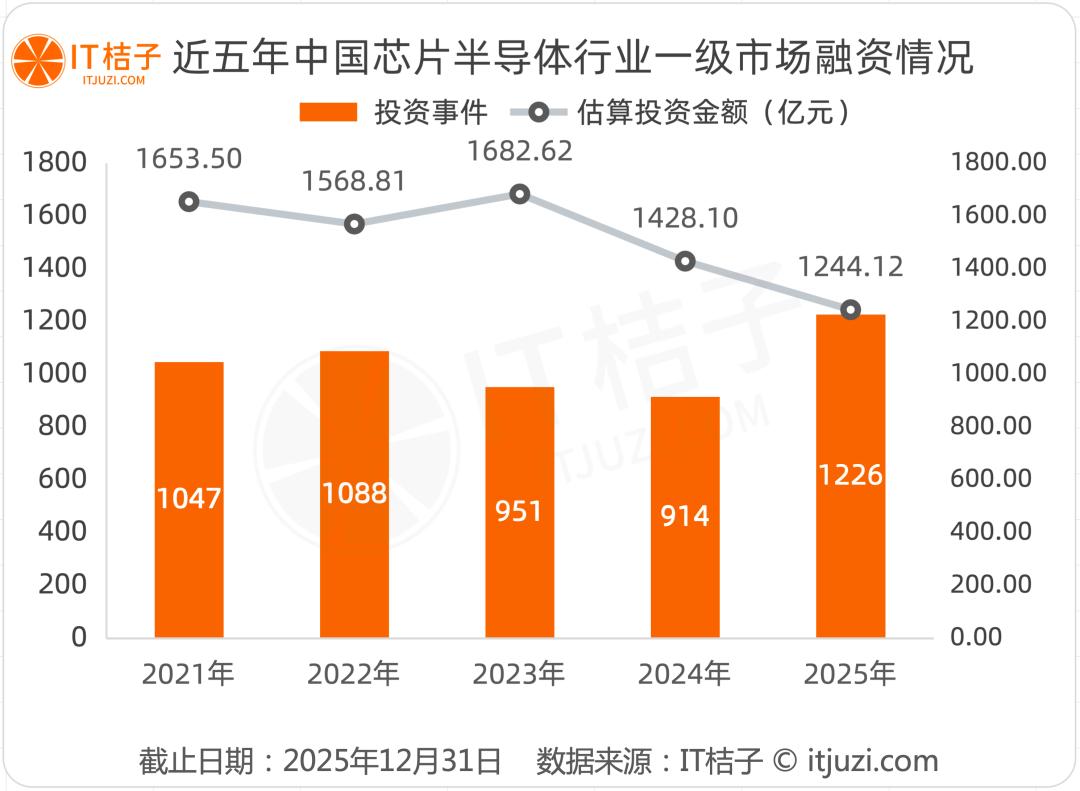
● The number of investment events rebounds from the bottom: After a fluctuating decline from 2021 to 2024, the number of investment events in 2025 increased by 34% year - on - year, reaching 1,226, hitting a five - year high, indicating that the industry's activity and capital attention have climbed again.
● The total investment amount returns to rationality: Contrary to the high number of investment events, the total financing amount has declined for two consecutive years after reaching a peak in 2023, dropping to 124.412 billion yuan in 2025. This reflects that the previous over - heating of capital driven by policy dividends has been effectively controlled, and the market sentiment is shifting from 'crowding into leading companies' to more rational value discovery.
Capital Distribution: Concentration in Leading Companies Coexists with Prosperity in Long - Tail Companies
In 2025, the financing ecosystem in the chip semiconductor field showed a significant 'long - tail' characteristic, that is, a small number of leading companies absorbed a large amount of capital, but a large number of small and medium - sized enterprises also obtained a considerable share of financing.
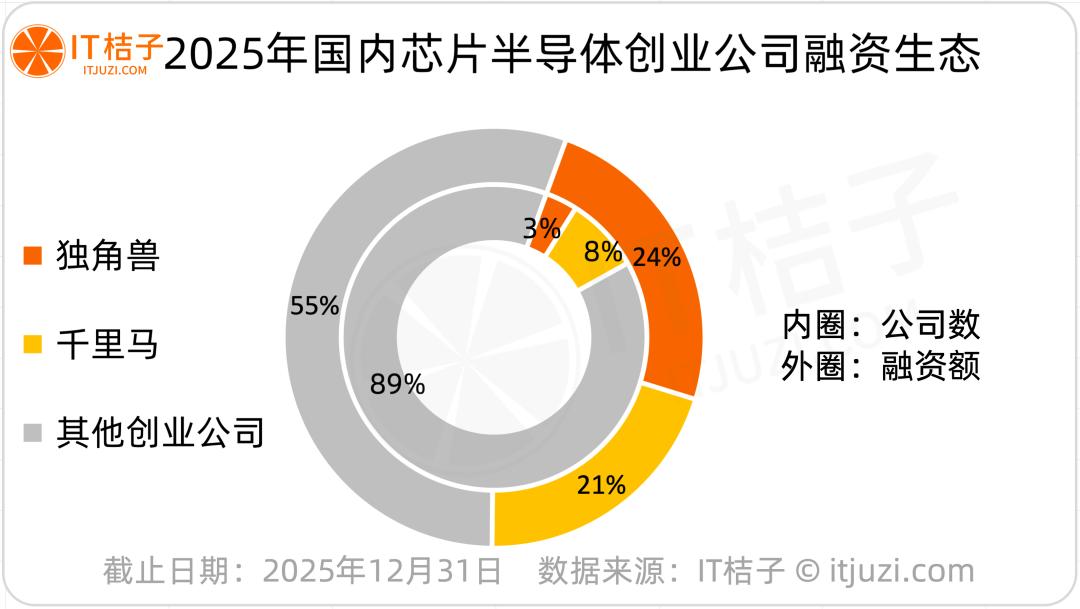
IT Juzi data shows that in 2025, there were 33 chip unicorn companies with new financing, accounting for only 3% of the total, and they attracted nearly a quarter of the financing amount.
And the 'thousand - horse' companies (companies with high growth potential) accounting for 8% also obtained a 21% share. This indicates that leading companies with high - tech barriers and market certainty remain the core targets for long - term capital layout.
However, what is more noteworthy is that more than 800 'other startup companies' (i.e., long - tail companies), accounting for nearly 90%, obtained a total of 55% of the financing amount. This share is much higher than that of emerging tracks such as embodied intelligence (in which long - tail companies' financing amount accounts for only 23%), fully demonstrating that in the chip semiconductor field, capital does not simply 'bet on leading companies' but adopts a 'wide - coverage' strategy, preferring to find small and medium - sized enterprises with technological advantages and implementation capabilities in each segment of the industrial chain.
There are three main reasons for this difference:
1. Differences in industrial maturity and structure: The chip semiconductor industry is a mature industry with a long chain and many links, covering numerous segments such as design, manufacturing, packaging and testing, equipment, and materials, providing a fertile ground for the survival and development of a large number of small and medium - sized enterprises.
2. Differences in capital logic and risk preferences: The national strategic nature of domestic substitution has attracted a large amount of state - owned capital and industrial capital. This type of capital not only pursues financial returns but also attaches great importance to the security and integrity of the industrial chain. Therefore, it tends to make systematic layouts upstream and downstream and support many'specialized, refined, distinctive, and innovative' enterprises.
3. Higher commercialization certainty: The downstream applications of chips (such as consumer electronics, automobiles, and industry) have clear demand. Many small and medium - sized enterprises can achieve stable profits by deeply cultivating specific scenarios or binding with large customers, providing investors with a clearer exit expectation.
Regional Pattern: Low Urban Concentration, and Prominent Cluster Effect in the Yangtze River Delta
According to IT Juzi data, different from tracks such as artificial intelligence that are highly concentrated in a few megacities, the investment in the chip semiconductor industry is more geographically dispersed.
In 2025, the top ten most active cities in terms of investment accounted for 74.2% of the total number of financing events, lower than the 85% concentration in the artificial intelligence industry.
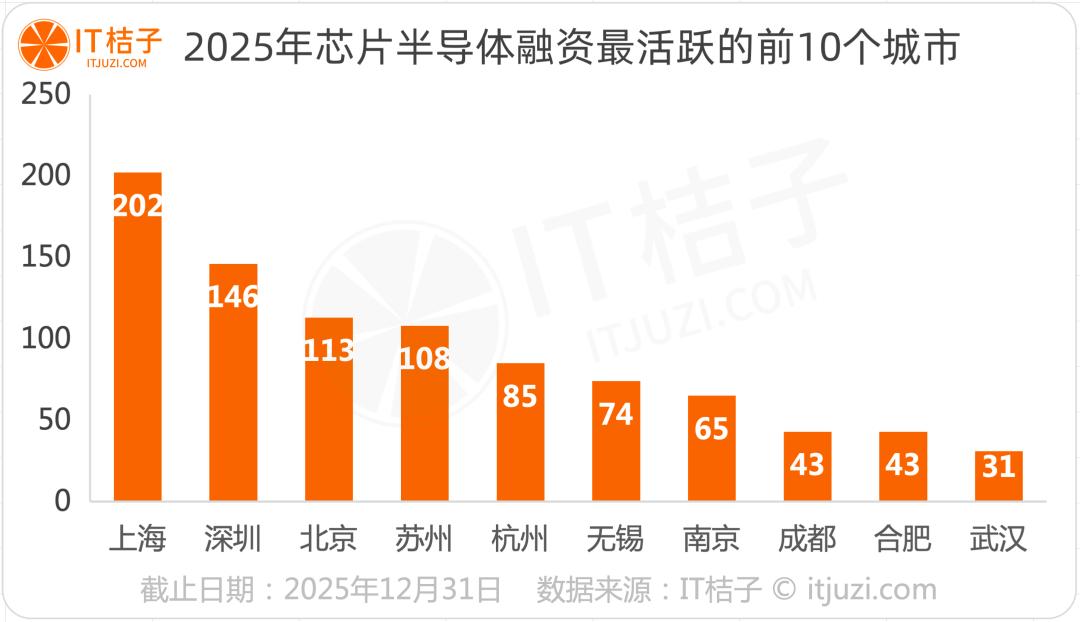
Data shows that the top ten cities have a distinct echelon pattern:
● First Echelon: Shanghai, Shenzhen, and Beijing have a stable position. Shanghai takes the lead with its full - industrial - chain layout in manufacturing, equipment, and materials; Shenzhen follows closely with its strong terminal application ecosystem and chip design advantages; and Beijing leads in terms of scientific research talents and technological innovation.
● Second Echelon (dominated by the Yangtze River Delta) : Suzhou, Hangzhou, Wuxi, and Nanjing form a strong second echelon, highlighting the cluster effect in the Yangtze River Delta region. Relying on a mature industrial foundation, dense research institutions, and active local capital, this region has become the core area for innovation and manufacturing in China's chip industry.
● Emerging Chasers: Mid - western cities such as Chengdu, Hefei, and Wuhan are accelerating their catch - up. In particular, Hefei has achieved a 'leapfrog development' in areas such as memory chips and wafer manufacturing through precise policy support and industrial chain investment promotion, becoming a model for regional rise.
Although the distribution of the number of events is relatively dispersed, the leading effect of the financing amount is still significant. In 2025, 16 cities across the country attracted more than 1 billion yuan in financing, and their total financing amount accounted for 90% of the national total, indicating that high - quality projects and a large amount of capital are still highly concentrated in these core industrial cities.
This article is from the WeChat official account "IT Juzi" (ID: itjuzi521), author: IT Juzi. It is published by 36Kr with authorization.