Invested by Ant Group and China Mobile, this robotics company says, "There will surely be a battle in the delivery market in 2026."
Text by | Fu Chong
Edited by | Su Jianxun
"In 2026, the first battle of delivery will be fought in the embodied intelligence industry. Companies that fail to deliver on time and with quality will be directly eliminated."
In the meeting room of Titanium Tiger Robotics in Shanghai, Yi Gang, the CEO of the company, made this clear judgment at the beginning of an interview with Intelligent Emergence.
Established five years ago, Titanium Tiger is an enterprise in the embodied intelligence supply chain. It mainly produces robot joint modules and also assembles robots. In 2025, after the expansion of its new factory was completed, the company increased the annual production capacity of joint modules from 30,000 to 100,000, tripling it in one year. The assembly capacity of humanoid robots also increased from zero to 3,000 units per year.
On one wall of the company's corridor, the logos of almost all of Titanium Tiger's customers are displayed. From autonomous driving and floor - sweeping robot companies to well - known embodied intelligence enterprises such as Mobile Hangyan and Ant Lingbo, they are all its customers.
At a time when the industry is generally troubled by the mass production and shipment of robots, production capacity has brought orders to Titanium Tiger, as well as investments from well - known institutions such as Ant Group, China Mobile, Matrix Partners, and SenseTime Guoxiang.
Yi Gang is the kind of interviewee who often comes up with quotable quotes.
"Over - promising leads to a trust crisis, and the true nature will be exposed in 2026."
"As a founder, the ability to reject orders is more important than the ability to get orders."
"The difficulty of building a trust chain is far greater than the difficulty of building a supply chain."
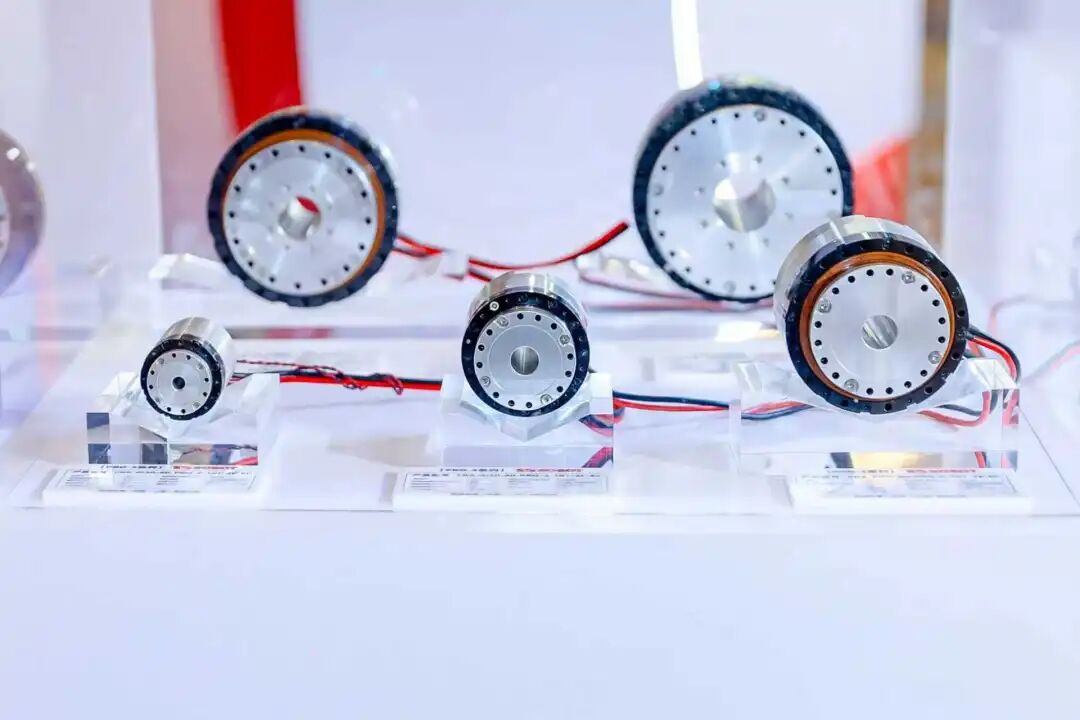
△The joint modules produced by Titanium Tiger. Photo provided by the interviewer.
This post - 1995 entrepreneur with a background in chemistry fell in love with robots when he was a freshman in college. For this reason, he even borrowed money from his tutor to develop his first dexterous hand.
Yi Gang describes his starting point of entrepreneurship as "having nothing at all." With not much experience in business management, he likes to draw inspiration for company strategies from major historical events.
For example, when talking about "whether just doing supply - chain business is a bit unappealing," he cited the strategy of "encircling the cities from the countryside" during the revolutionary period. This is used to illustrate that choosing a direction that is difficult at present but may have broader prospects and going deeper into it is more valuable in the long run.
As a practitioner close to the delivery side in the embodied intelligence industry chain, Yi Gang pointed out that the industry was in a frenzy of "taking large orders" in 2025 but seriously underestimated the complexity of the entire chain from design to mass production and shipment.
He gave two examples from his personal experience.
One is about the construction period. In 2024, a supplier of Titanium Tiger promised to "pack and ship the goods during the National Day holiday," but the goods were not delivered until April of the following year, which also led to a delay in Titanium Tiger's delivery to its customers.
The other is about quality. After a batch of components performed well in the initial tests, Yi Gang decided to purchase them in large quantities for mass production. However, the defective rate of the second batch of components from the same supplier was as high as 85%, directly affecting the trust relationship between Titanium Tiger and its downstream customers. The supplier repeatedly promised to improve but failed to do so.
The supplier's repeated empty promises were extremely painful for Yi Gang. This is also the main reason why he ran through the entire process himself and then built his own production line: to have the "guaranteed" ability in his own hands.
"In 2024 and 2025, if a robot company fails to deliver the ordered products, it may still have a 'chance to revive,'" Yi Gang said. "But in 2026, a delivery default will not only damage the reputation but also the company's cash flow."
In his opinion, the survival rule of this "delivery battle" is not to chase more and more orders but to ensure that there are as few "hiccups" as possible.
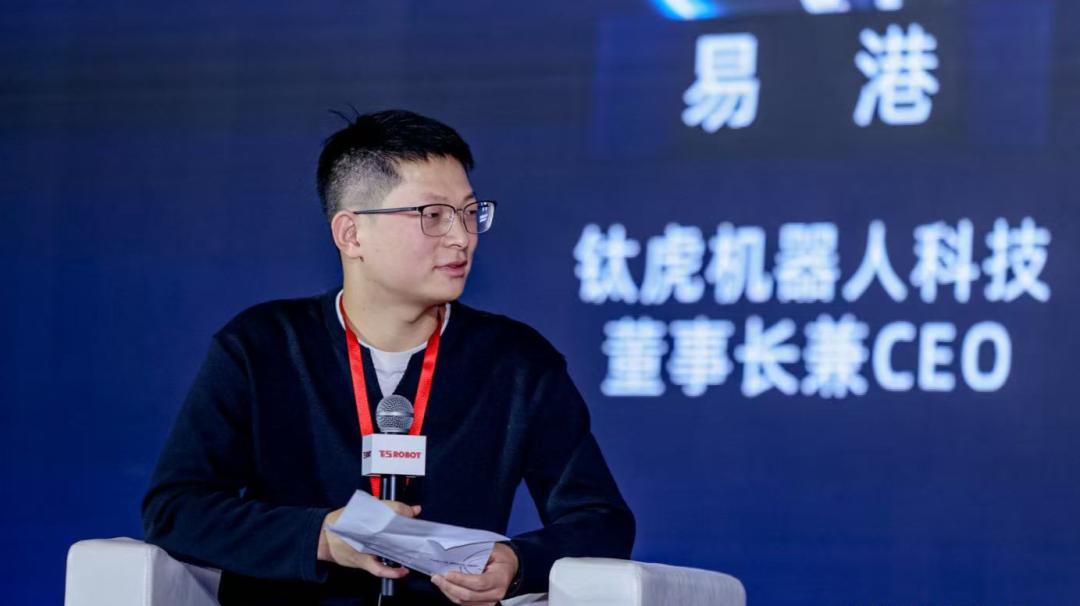
△Yi Gang, the CEO of Titanium Tiger. Photo provided by the interviewer.
The following is a dialogue with Yi Gang, with the content organized by the author:
Robots Can Walk, but the Delivery System Stumbles
Intelligent Emergence: Why will 2026 be the critical node for the "first battle of delivery"?
Yi Gang: In 2025, many orders were disclosed in the industry, but there was a widespread problem of "easy to take orders but difficult to deliver." In the past two years, since everyone was still exploring, customers were relatively patient, and investors were willing to continue to inject funds.
However, judging from the actual situation in the second half of 2025, some embodied intelligence companies have found it difficult to raise funds. In 2026, if enterprises still "stumble" in delivery and have no cash flow input, their capital chains may break. At that time, they will face a test of survival.
Intelligent Emergence: What are the core difficulties in current robot delivery?
Yi Gang: Delivery is not simply a "production" process but a "funnel - shaped" process — it includes the entire chain of design, procurement, assembly, testing, joint debugging, rework, and after - sales service. The problem is that this chain is too new. Each link has its own pitfalls, and there is a lack of coordination between links.
Moreover, many products have not even completed the "small - batch ramp - up" of 50 or 100 units before directly taking on large orders. As a result, problems such as chaotic production line scheduling and shortage of personnel break out concentratedly.
Intelligent Emergence: Last year, the industry often disclosed "orders in the thousands." How did Titanium Tiger perform? Did you feel anxious when seeing others getting large orders?
Yi Gang: We shipped about 170 large - sized humanoid robots last year. Seeing the order numbers of others, I did doubt myself. But my investors told me that many companies couldn't produce the products even after taking the orders, and our delivery ability is among the top in the industry.
Now, I'm not anxious anymore. The market is like the Big Bang. The space expands faster than the speed of light. You can never catch up, nor do you need to. As long as you can deliver products in reality, there will be no shortage of market in the next decade.
Intelligent Emergence: Do you mean that it's difficult to produce all the disclosed orders?
Yi Gang: Yes. You can see that some of these are framework agreements, which mainly indicate the customers' intention to place orders, but not all of these orders will be or can be produced.
Intelligent Emergence: So "rejecting orders" has become the core ability?
Yi Gang: Yes. First, the founder should be able to screen orders. Second, he should dare to resist the temptation of orders. One must be clear about the company's ability boundary.
Some companies "over - promise" in terms of delivery cycle, production volume, and performance in order to raise funds and create a stir. This is like borrowing usury from the sky. The most terrible thing is that you can't pay it back after borrowing. Once you lose the customers' trust, you lose everything.
Intelligent Emergence: Judging from after - sales service, what's the current product delivery level in the industry?
Yi Gang: Even the best - performing 1.7 - meter humanoid robots currently need to be returned to the factory for maintenance frequently. There are many fault points because the working conditions of robots are extremely complex. Cars mainly vibrate up and down, but robots have six - dimensional vibrations in the up - down, front - back, left - right directions, and three attitude angles. In such an environment, various problems such as bolt breakage and cable failure may occur. So when taking orders, I tend to let customers know the real situation. I not only avoid over - promising in terms of quality but also lower the customers' expectations.
Intelligent Emergence: Did you choose to build your own production line because you were "cheated" by suppliers?
Yi Gang: Yes. In 2024, one of my component suppliers told me in October that the goods would be "packed and shipped soon," but they were not actually delivered until April of the next year. This led to our over - promising to customers. Eventually, the delivery was delayed by one or two months, and there were other various problems later.
Fortunately, my customers had some leeway in their time planning, so there was no major loss. But this incident made us realize that we must have our own guaranteed ability and cannot completely rely on others for production.
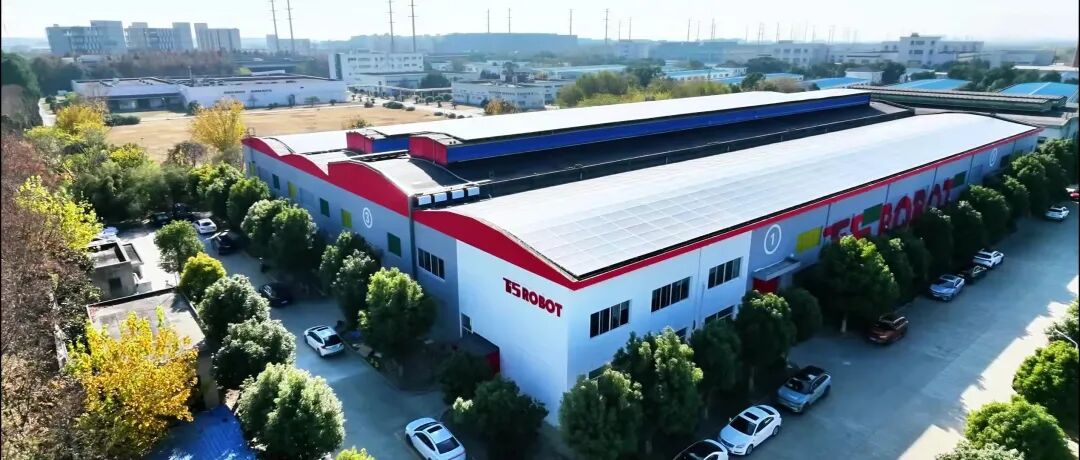
△The new factory established by Titanium Tiger in 2025. Photo provided by the interviewer.
In the Early Stage of the Industry, First Build a Good "Bottle"
Intelligent Emergence: Titanium Tiger also assembles complete robots, such as the 1.7 - meter - tall "Yaoguang." Aren't you afraid of competing with your customers?
Yi Gang: No. We only assemble hardware but don't develop models ourselves. That is to say, we build the "bottle" but don't do the business of the "water."
What we provide is a hardware reference solution, just like a chip company providing a development board or a Raspberry Pi. The purpose is to lower the threshold for customers to use, rather than selling robots ourselves.
Intelligent Emergence: What's the specific use of this "bottle" for customers?
Yi Gang: Customers can put forward requirements based on "Yaoguang," such as making it taller or more flexible at the hips. In this way, a robot can be made in as fast as two months, and small - batch mass production can be achieved in half a year.
We have solved the underlying problems from motor selection, structural design to wiring. Customers don't need to start from scratch. Without this solution, customers would have to grope among thirty or fifty motors and various configurations, and the process would be very long.
Intelligent Emergence: Large companies have abundant resources. Can they sometimes be slower than startups in making robots?
Yi Gang: Yes. This involves the problem of understanding and integrating new businesses.
Some manufacturing giants have a high degree of automation but lack an understanding of robot technology and the supply chain. They may estimate the time too optimistically with a traditional rhythm. I've seen cases where teams were required to "make a robot walk from scratch in two months" because they were used to the iteration speed of consumer electronics.
In addition, large companies may acquire top - notch teams in Europe and the United States. Each part is world - class. However, during integration, since the internal departments are "brother departments" rather than in a client - contractor relationship, they are prone to disputes and internal strife. Glueing top - notch organizations together may take more time than the technology itself.
As a result, often, after two years of running - in, no results are achieved, and the team is laid off; or when results are finally achieved, the leadership changes, and the new leader prefers other solutions. Then, the cycle of recruiting new people and re - integrating starts again.
Intelligent Emergence: Joint modules are often regarded as a "sold by weight" business, seemingly with limited technological barriers and lower valuations than complete robots. Why did you choose this "unappealing" track?
Yi Gang: I don't agree with this view. Going deeper into joint modules is a deep engineering area. The currently appealing fields may lose their luster quickly as competition intensifies.
I have two metaphors. One is the strategy of "encircling the cities from the countryside" during the revolutionary period: in areas where the enemy's ruling power is relatively weak, although the current conditions are difficult, the prospects may be broader, and it is more valuable in the long run.
The other is the lithium - ion battery. I studied chemistry in college and know that it only takes one day to synthesize an electrode material, which seems simple. However, to increase the energy density, reduce the cost of an automobile battery pack from 400,000 to 40,000, and achieve the ultimate reliability requires hundreds of billions of investment and a long - term effort. This is where the real barriers and profits lie.
Intelligent Emergence: How do you judge the rhythm of the humanoid robot market?
Yi Gang: I think there are two critical nodes:
The first wave will be from 2026 to 2028. The global shipment volume may reach one million units. After the "battle of delivery," some companies will go out of business, and dozens of excellent enterprises will emerge.
The real explosion of the industry should be from 2030 to 2035. It will be a social - level transformation. This also explains Titanium Tiger's strategy, that is, to serve customers well in the upstream and first ensure survival until that era, rather than exhausting energy in the early - stage red - ocean competition of complete robots.