XPeng 2026 Volume 1: Launched 4 new car models, the extended - range driving range broke the record, and Robotaxi and robots will be mass - produced this year.
It's quite a big move in the first week of the new year.
Just now, XPeng Motors launched four new car models in one go, including the all - electric and super extended - range versions of the XPeng P7+, the all - electric and super extended - range versions of the XPeng G7, as well as the all - electric versions of the 2026 XPeng G6 and G9.
Since the super extended - range versions of the P7+ and G7 are all new products, it's equivalent to XPeng launching six new products in a row.
With so many models, directly check the prices in the following picture:
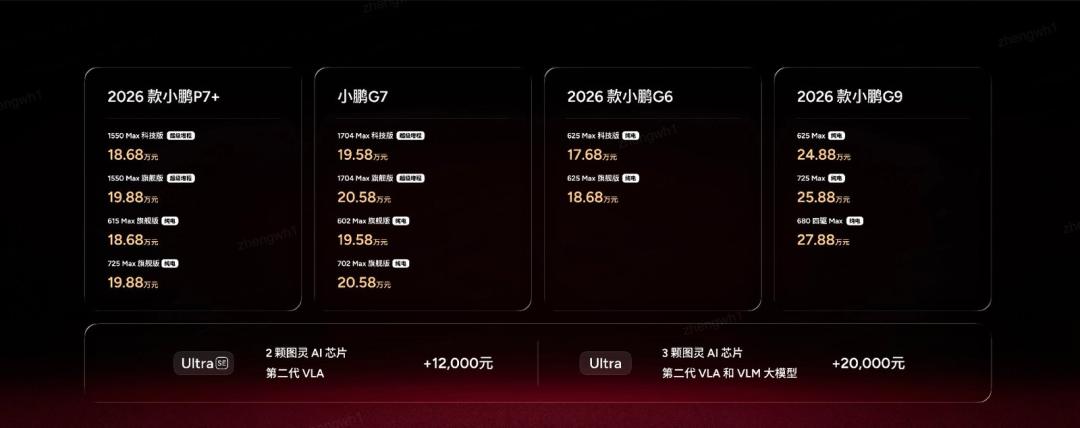
As XPeng Motors' first press conference in 2026, besides introducing the new cars, He Xiaopeng also revealed the next - step plan, with two key words: Physical AI and Globalization.
Globalization is easy to understand. XPeng Motors is also going global. More importantly, in 2026, XPeng Motors will witness the implementation and large - scale mass production of Physical AI, officially starting the leap from "technological exploration" to practical application.
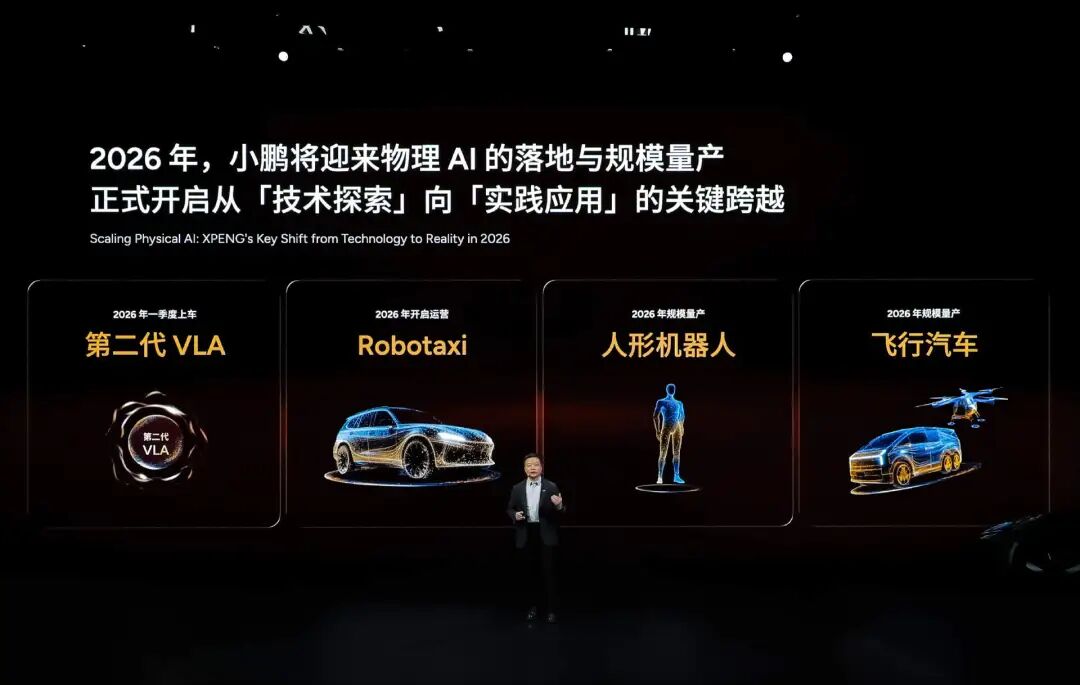
For example, in the first quarter of 2026, the second - generation VLA will be installed in cars, Robotaxis will start operation, and robots and flying cars will also achieve large - scale mass production in 2026.
XPeng Motors will be very busy in 2026.
Second - Generation VLA in One Hand, VLM in the Other
In the first half of the press conference, He Xiaopeng focused on technology.
First is the second - generation VLA. According to He Xiaopeng, the second - generation VLA can truly understand the physical world like humans and is the optimal solution for full - scenario L4 autonomous driving, or rather, the optimal solution for dealing with the infinite complexity of the physical world.
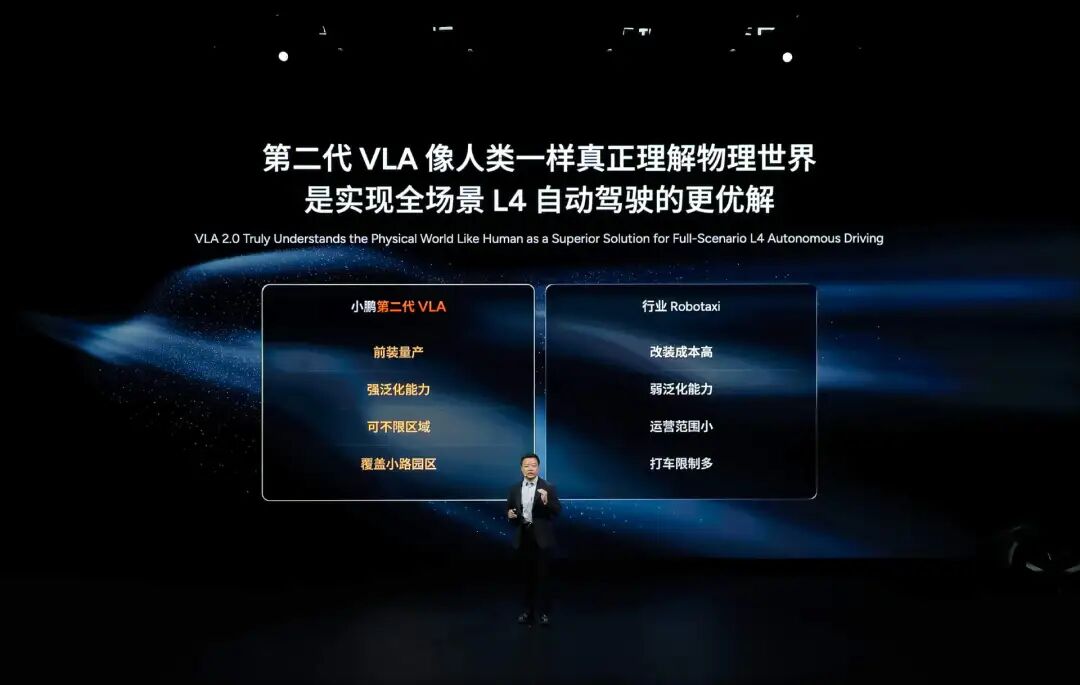
In his view, with the support of the end - to - end small model, one may be able to handle 80% of the roads well, but the remaining 20% of scenarios will never allow for truly autonomous driving.
The second - generation VLA subverts the previous intelligent driving logic. In the past, when talking about VLA, the three steps of "Vision (V) - Language (L) - Action (A)" were always inevitable. The core evolution of the second - generation VLA lies in the elimination of "L, language" in VLA.
Removing the "language translation" link, that is, achieving end - to - end direct generation from visual signals to action instructions, reducing information loss and making the system's "thinking" closer to that of humans.
Behind this, He Xiaopeng has invested 30,000 GPU computing power, deployed four self - developed Turing A chips on the vehicle, and used a large - scale foundation model with 72 billion parameters. He has spent more than 2 billion yuan on training costs and used nearly 100 million video clips covering various extreme long - tail scenarios around the world, which is equivalent to the driving experience accumulation of human drivers for 65,000 years. This gives He Xiaopeng the confidence to say that XPeng's second - generation VLA can quickly bring an intelligent driving experience close to L4.
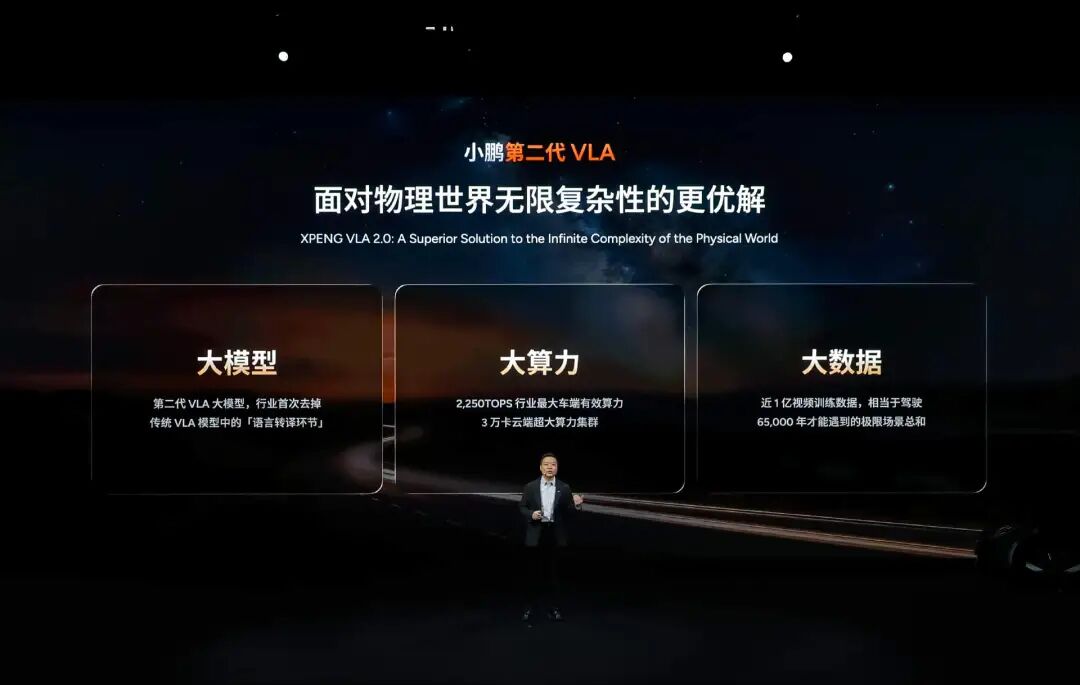
This subversion of the architecture not only brings an improvement in technical parameters but also a qualitative change in the ability of intelligent driving to handle complex scenarios, emerging with the ability to handle various non - standard complex scenarios.
It is not restricted by regions and can cover small roads and industrial parks. For example, it can recognize special - shaped vehicles occupying the road during construction, detour and avoid from the oncoming lane across the solid line; in large - blind - spot S - shaped curves, it can defensively decelerate in advance and safely pass through the curves; when creeping into the main road, it can ensure safety while maintaining commuting efficiency; it can recognize gestures and actively stop.
Even in some complex scenarios that even experienced drivers rarely encounter, such as learning how to drive correctly on roads with blurred lane lines, the second - generation VLA can handle them more skillfully than many novice drivers.
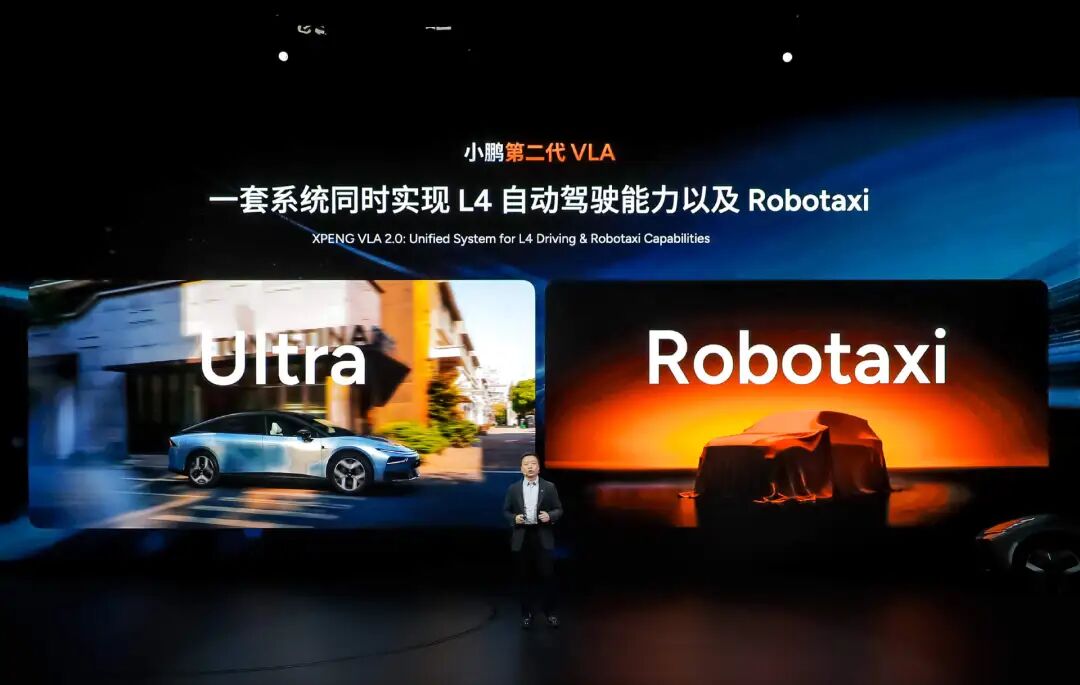
He Xiaopeng also revealed that XPeng's second - generation VLA is being trained for more L4 autonomous driving capabilities, such as starting in place, pulling over and parking, recognizing various speed bumps, and even offering multiple intelligent driving style options. The Robotaxis equipped with XPeng's second - generation VLA software have passed the field tests of third - party testing agencies and will soon start public road tests.
This also means that XPeng's second - generation VLA can simultaneously achieve L4 autonomous driving and Robotaxi capabilities with one system. He Xiaopeng even said bluntly that with the emergence of the second - generation VLA, 2026 will be the real first year of autonomous driving in China and the United States.
Most importantly, the Ultra versions of the four new cars launched today will all be equipped with XPeng's second - generation VLA, and the first batch of software pushes will start in the first quarter of this year.
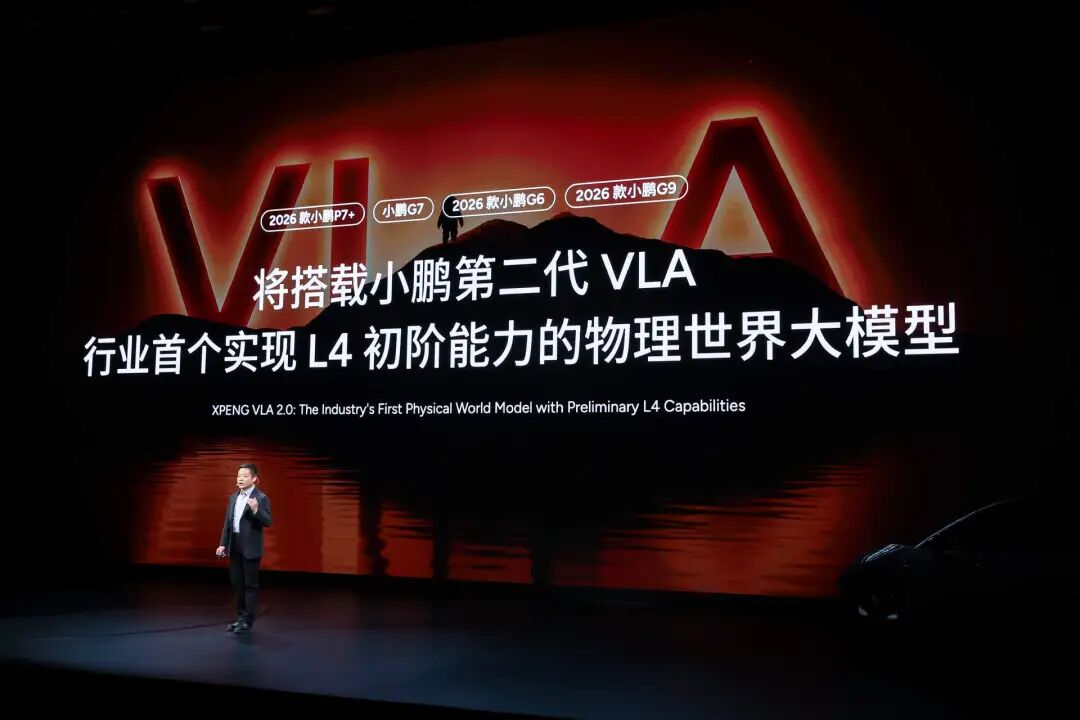
In addition, for the intelligent cockpit, XPeng Motors officially launched the Tianji AIOS 6.0 system and the XPeng VLM, which serves as a bridge for human - vehicle interaction.
To put it simply, the car - machine interface has been further upgraded. The navigation interface has been upgraded to a 3D stereo lane - level SR navigation, which is also the industry's first 3D navigation map available nationwide. There is also 3D emerging over - the - horizon perception, which can provide early warnings for road anomalies, electronic eye road prompts, distance to the vehicle in front, and traffic light changes, allowing drivers to know about abnormal road conditions in advance. In addition, there are functions such as cross - scene multi - round dialogue capabilities and a new game center.
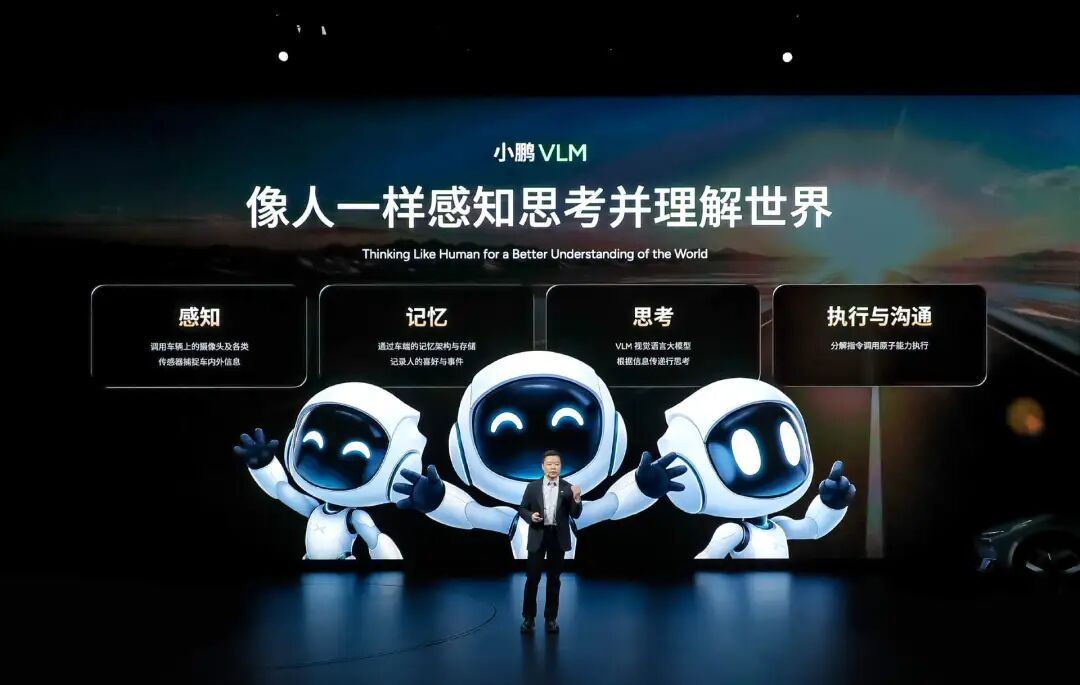
The VLM is said to be able to perceive, think, and understand the world like a human, making the cockpit proactive. The vehicle can sense the occupants' states and adjust the environment. For example, when it detects a child in the back row, the central control screen will automatically switch to the monitoring screen; when it senses that the passengers are wearing thick clothes, it will suggest adjusting the air - conditioning temperature.
The four new cars launched today will all be equipped with the above - mentioned new technologies. At the same time, to be compatible with the second - generation VLA and VLM, XPeng's intelligent hardware has also undergone an upgrade.
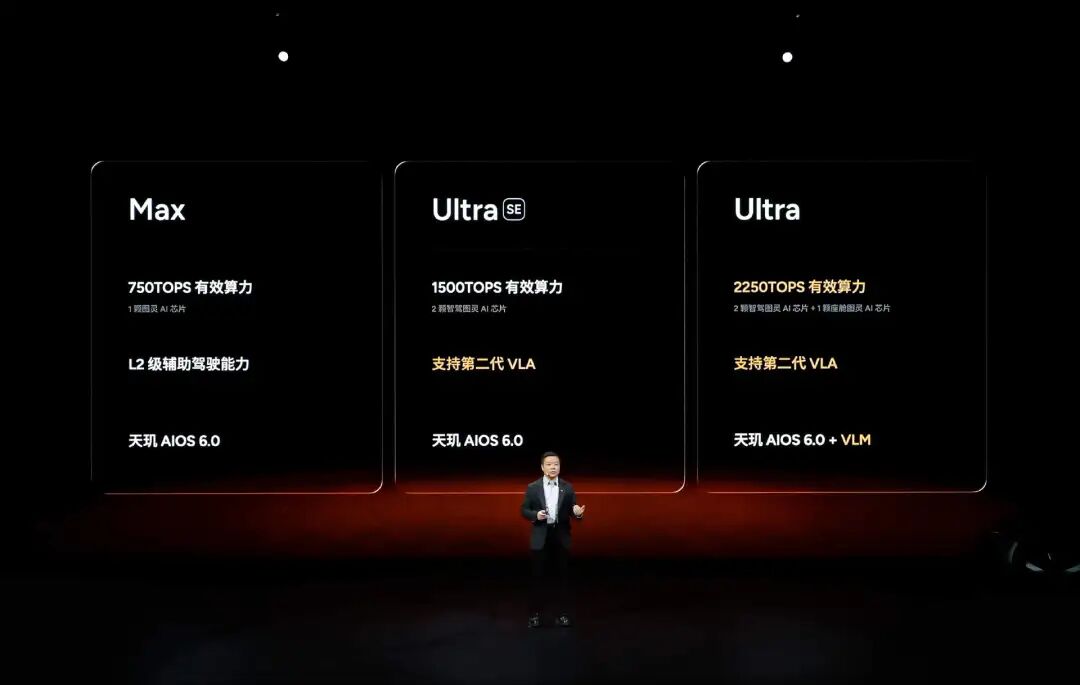
The Max version has been upgraded from the original Orin X chip to a single Turing AI chip, with a computing power of 750 TOPS, L2 - level assisted driving capabilities, and support for the Tianji AIOS 6.0. In addition, a new Ultra SE version has been added, which is equipped with two Turing AI chips and supports the second - generation VLA + Tianji AIOS 6.0.
The top - of - the - line Ultra version remains unchanged, equipped with three Turing AI chips, fully loaded with the second - generation VLA, Tianji AIOS 6.0 + XPeng VLM large - scale model.
Entering the Era of One Car with Dual Capabilities
Although multiple cars were launched simultaneously, the "one car with dual capabilities" of the XPeng P7+ and XPeng G7 was clearly the highlight of this press conference.
For XPeng Motors, the significance of the extended - range system is not only about "being able to use both gasoline and electricity". As He Xiaopeng mentioned when the X9 super extended - range version was launched, there are still many "dead zones" in overseas markets that are unfavorable for the popularization of electric vehicles, and extended - range models can also better penetrate the northern regions of China.
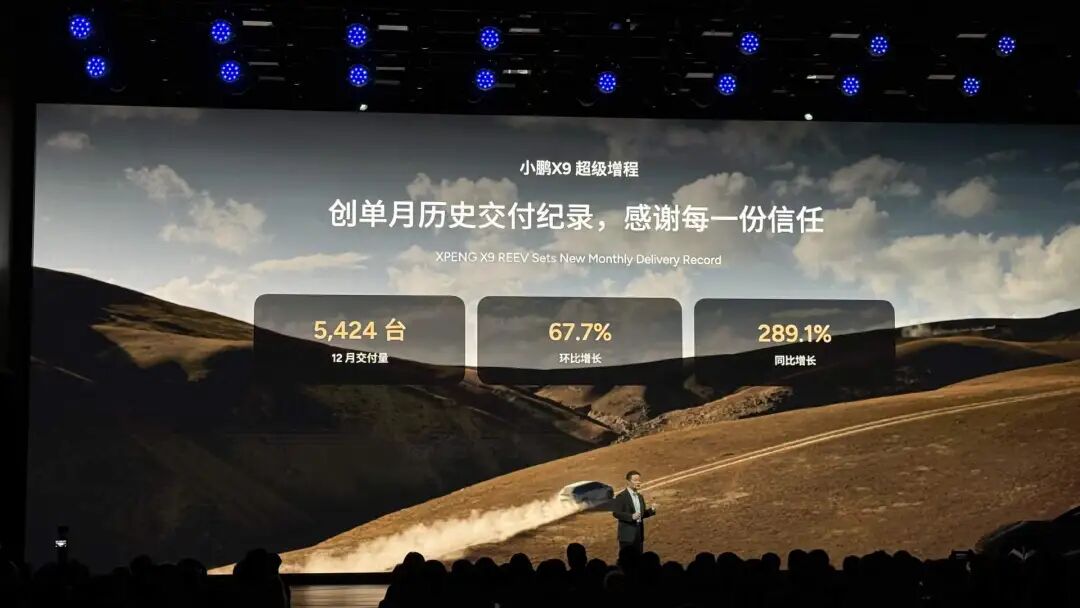
Previously, within one hour of the launch of XPeng's first extended - range vehicle, the X9 super extended - range version, it broke the X9's all - time single - day large - order record. In November, its sales increased by 161% month - on - month, ranking first in both the high - end all - electric and extended - range MPV segments in China. In December, with the "super extended - range" system, it delivered 5,424 units, setting a new historical high. Among the 60 countries and regions in its global layout, XPeng became the best - selling new - energy brand in 10 overseas countries from January to November.
This is why, just as 2026 began, XPeng Motors took the lead and played two aces: the extended - range versions of the P7+ and G7.
Let's take a look at the specific parameter configurations.
Extra - Long Range
First, let's talk about the two new super extended - range models.
XPeng's extended - range concept can also be seen from the previous X9 extended - range version. It has optimized and upgraded the existing extended - range products on the market, mainly covering four dimensions: range, safety, quietness, and space.
The XPeng P7+ is equipped with a 5C ultra - fast charging AI battery with a capacity of 49.2 kWh, and its CLTC all - electric range reaches 430 kilometers. This means that in most daily commuting scenarios, users can use it completely as an all - electric vehicle. This also makes the P7+ super extended - range version the extended - range sedan with the longest all - electric range in the world.
Coupled with a 45 - liter fuel tank, its CLTC comprehensive range can reach 1,550 kilometers. In addition, the range extender supports 92 - octane gasoline, and the maintenance interval has been extended to once every 20,000 kilometers or two years, which further reduces the long - term ownership cost of the vehicle.
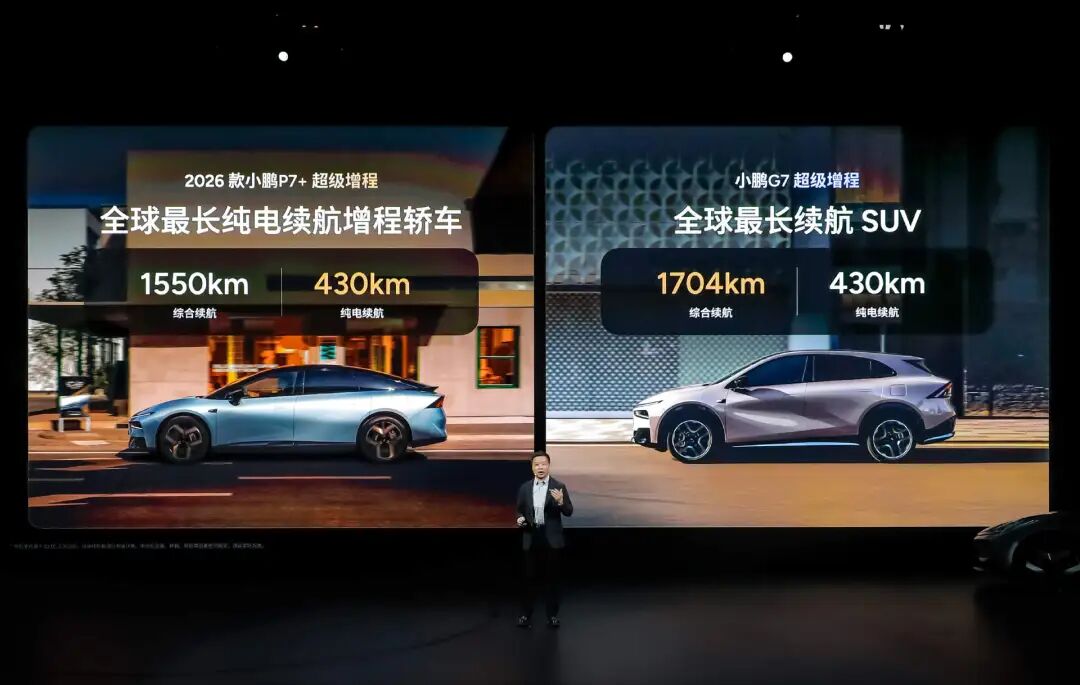
In all - electric mode, the minimum power consumption is 10.9 kWh/100 km, and in extended - range mode, it is only 12.5 kWh/100 km. Thanks to the full - domain 800V high - voltage silicon carbide platform, the P7+ supports a maximum DC fast - charging power of 435 kW. It only takes 12 minutes to charge the SOC from 10% to 80%, and it can replenish 277 kilometers of range in 10 minutes.
The XPeng G7 super extended - range version is powered by a 55.8 kWh 5C ultra - fast charging AI battery and a 60 - liter large - capacity fuel tank. It is also the only extended - range SUV in its class equipped with an 800V high - voltage platform and a 5C ultra - fast charging battery.
Its CLTC all - electric range reaches 430 km. There's no need to emphasize the value of this all - electric range. In comparison, its CLTC comprehensive range reaching 1,704 km is even more remarkable, which has earned it the title of the SUV with the longest range in the world. Note that the qualifier is SUV, not just extended - range SUV.
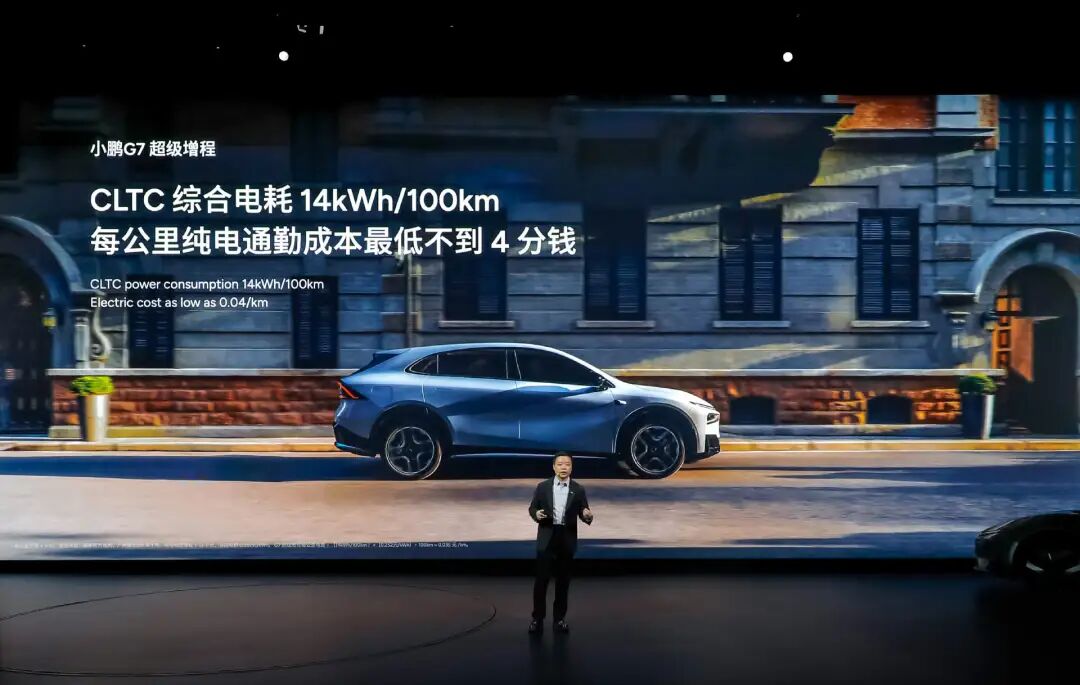
He Xiaopeng also said on - site that he had repeatedly checked the data and confirmed that it is indeed the SUV with the longest range in the world. Its CLTC comprehensive power consumption is only 14 kWh/100 km, which means the lowest all - electric commuting cost per kilometer is less than 4 cents. In addition, thanks to the full - domain 800V high - voltage silicon carbide platform and the 5C ultra - fast charging AI battery, it only takes 12 minutes to charge the SOC from 10% to 80%, and it can replenish 314 kilometers of range in the fastest 12 minutes.
XPeng Motors also conducted a real - world test. Under the condition of minus 20 degrees Celsius, the actual range can still exceed