Anthropic will become the most profitable company in the world, and the 167-page top-secret letter from the 25-year-old AI stock guru has gone viral.
The AI stock trading prodigy is back!
Earlier this August, 25-year-old OpenAI wunderkind Leopold Aschenbrenner held his wedding in Carmel, California, with Avital Balwit, Chief of Staff to the CEO of Anthropic, as his bride.
The very week of his wedding, the $100 billion fund he managed received a margin call, and lost 450 billion in a single night due to forced liquidation.
Four months later, this young man who fought his way back to the table from the brink of liquidation handed investors a full 167-page long letter.
The letter is packed with hardcore calculations and deductions, with extremely high information density.
The moment it leaked out, the entire Silicon Valley and Wall Street were completely blown away.
Countless investors and leading figures in the AI circle dissected it overnight, calling it the most worthy "AI Bible" to read carefully this year.
To be honest, it's hard not to gasp in shock after reading this letter. Leopold almost completely overturned all existing perceptions on Wall Street:
In 2027, AI will see super acceleration, Recursive Self-Improvement (RSI) has already ignited, and one year of R&D will yield as much output as the past three years.
By the end of 2027, the top AI labs are expected to exceed $1 trillion in annualized revenue, and Anthropic will become the most profitable company in the world.
In 2028, humanity will face "full superintelligence" head-on, and all traditional tech giants that build moats relying on human resources will face a major reshuffle.
Why can Anthropic become the most profitable company in the world?
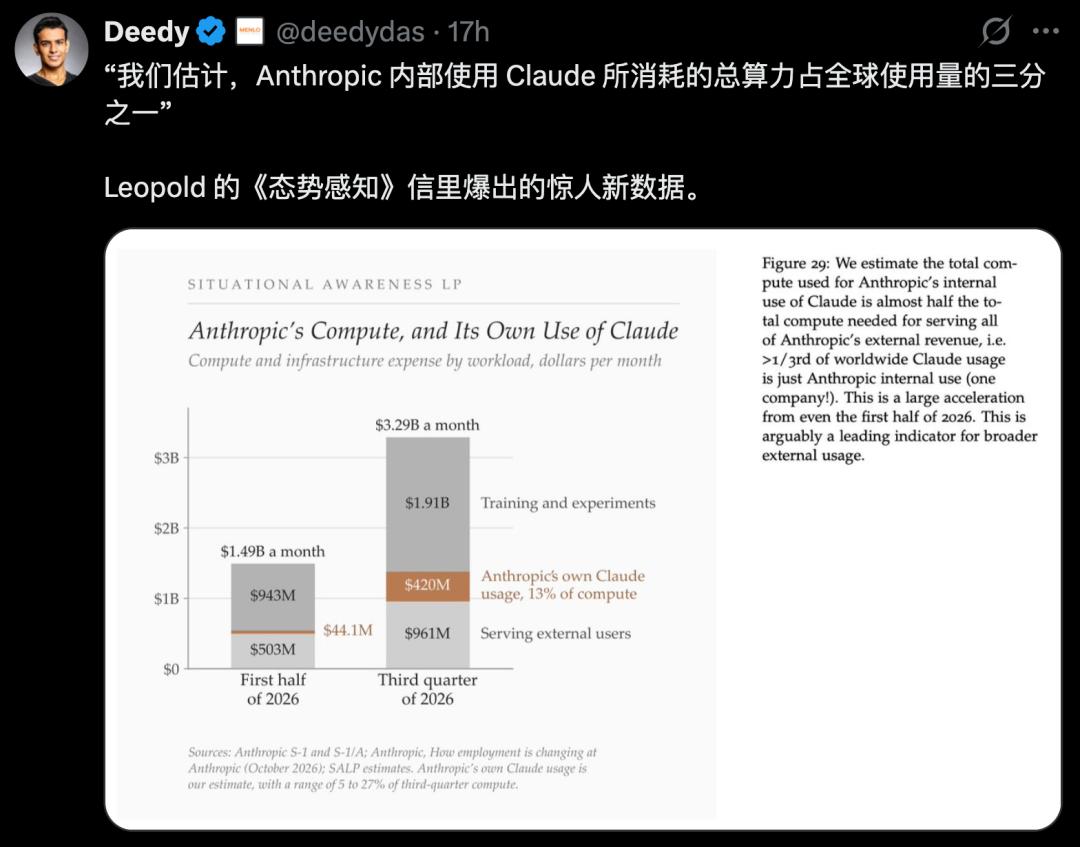
The letter reveals the core secret: internally, over 1/3 of the world's Claude usage is consumed by its own staff, AI directly acts as "General Manager Assistant", managing subordinate virtual departments on its own and organizing next-generation R&D independently.
Precisely because he saw the terrifying self-evolution speed brought by "AI becoming the main body of the company", the most sharp point in the long letter directly targets all tech giants.
Global tech giants including NVIDIA, Apple, Microsoft, Tesla, SpaceX and others are all facing brutal re-pricing.
A major reshuffle in the tech industry has already begun!
Two years ago, Leopold accurately bet on the AGI computing boom with "Situational Awareness" and became a legend overnight.
After surviving the near-death experience of a 67% single-month drawdown in July this year, he made a 14.8x windfall (net return of 88.5% for the year) by holding Anthropic firmly, and returned to the table in full force.
Now his investment logic has completely changed. He no longer only focuses on computing power sellers, but starts to look for the "survivors" that truly turn AI into the main body of the company in the superintelligence era!

Anthropic Will Become The Most Profitable Company In The World
Anthropic is exactly the benchmark position that Leopold holds the most heavily!
Why does he dare to assert that Anthropic will top the list of the world's most profitable companies next year?
1/3 of Global Claude Usage Is For Internal Use, "AI Chief of Staff" Governs Virtual Departments
For this 167-page long letter, let's first look at the internal computing power data that has sparked heated discussions across the entire network.
In the first half of this year, Anthropic only spent 44.1 million USD per month on computing power for its own models internally.
By the third quarter, this figure surged nearly tenfold, reaching 420 million USD per month.
If we break down Anthropic's total monthly computing power of 3.29 billion USD, 1.91 billion USD is used for model training and experiments.
Among the remaining inference computing power, serving all external customers around the world consumes 961 million USD per month, while the computing power reserved for internal use alone is as high as 420 million USD.
Converted, about 1/3 (30.4%) of the world's Claude inference computing power is entirely consumed by Anthropic's own employees (accounting for 13% to 15% of the company's total computing power).
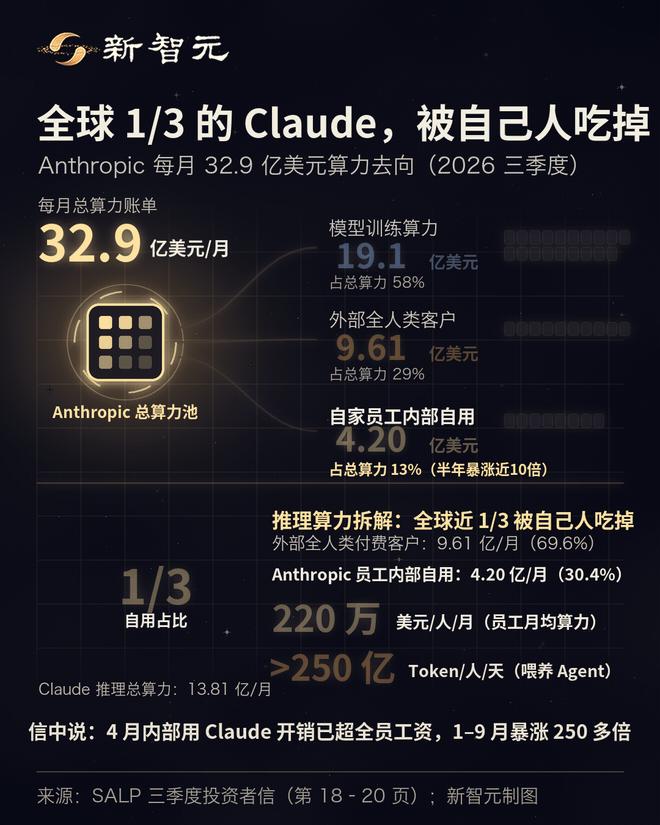
Averaged out, each employee consumes more than 20 million USD of computing power a year, burning over 25 billion Tokens per day.
As early as April this year, the Token cost of using Claude within Anthropic (converted at the external listed price) has exceeded the total compensation of all employees.
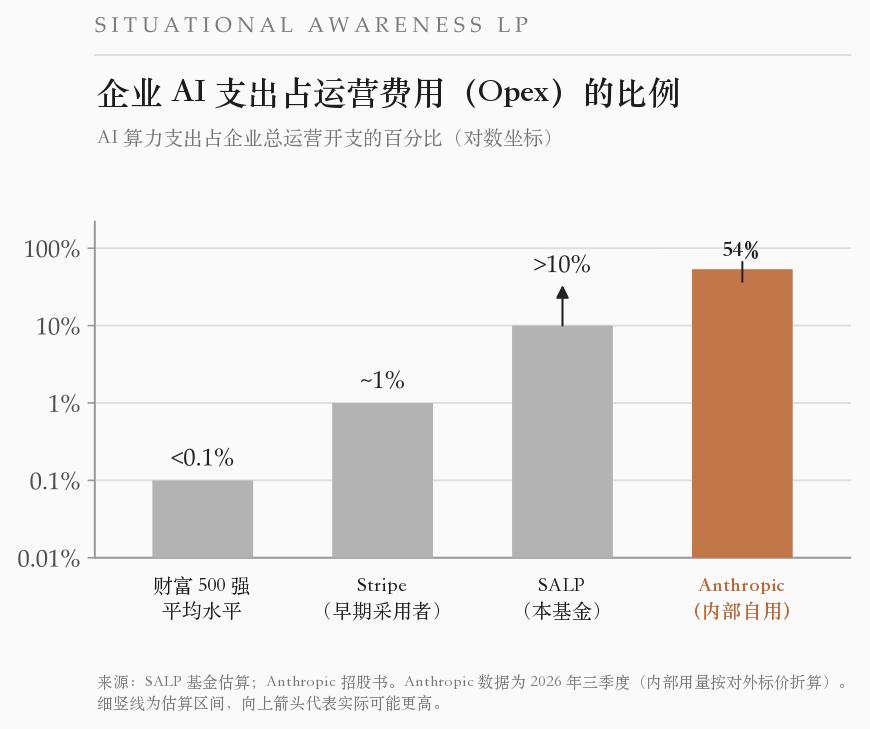
Currently, this AI expenditure accounts for as high as 54% of the company's operating expenses, while the average figure for traditional Fortune 500 companies is less than 0.1%.
Relying solely on humans to write Prompts and read responses, one can never use up the 25 billion Token daily quota in a lifetime.
The only reason for consuming such a huge amount of computing power is that the internal work and organization form of the lab has completely changed.
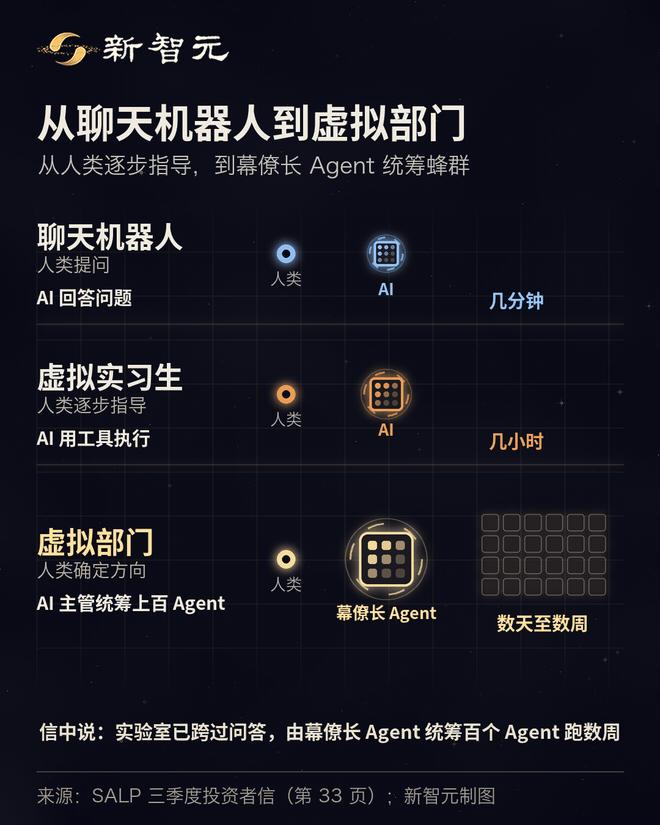
Most of the Agents that the public uses externally are still "virtual interns", which require humans to monitor them every few hours.
But behind the closed walls of OpenAI and Anthropic, what is already running at full computing power is the next-generation organizational paradigm, namely HPMA (Highly Persistent Multi-Agent System), also known as "virtual department".
Under this architecture, each employee no longer works alone, but is equipped with an "AI Chief of Staff" that is online 24/7, and the entire department under it is managed by the AI Chief of Staff on your behalf.
Humans only need to set the overall direction and make decisions on the most difficult issues.
This "AI Chief of Staff" will command and coordinate coordinator Agents to break down tasks, dispatch hundreds of execution Agents under it to write code and run experiments 24 hours a day for consecutive weeks, and automatically connect with the AI Chief of Staff of colleagues across departments.
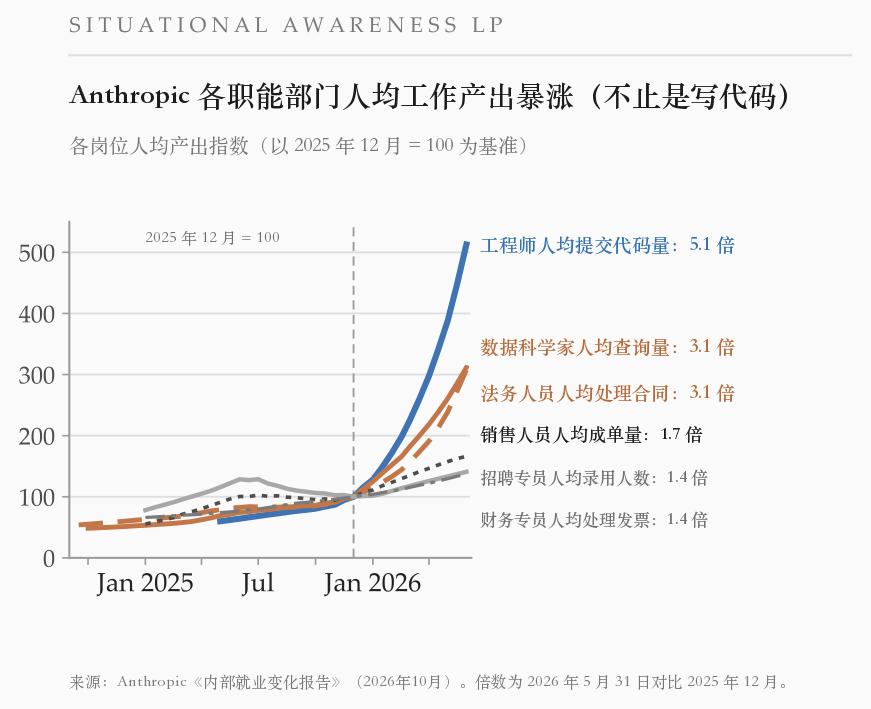
This "AI virtual department" is also rapidly spreading from code writing to all functional departments of the company.
Inside Anthropic, not only the efficiency of engineers has skyrocketed, but the average daily query volume of data scientists and the average daily contract processing volume of the legal department have both surged by 3.1 times, and the per capita output of sales (1.7 times), finance and recruitment (1.4 times) has also increased across the board.
This also leads to the most core business judgment in the letter:
Anthropic's current internal usage is the leading indicator for the rest of the world tomorrow.
Code Output Surges 45 Times, RSI Speed Outpaces OpenAI
When the "virtual departments" composed of AIs start to participate in the R&D of next-generation AI in turn, the flywheel of Recursive Self-Improvement (RSI) is officially ignited.
The deeper AI participates in its own R&D, the faster its evolution speed will be.
The letter uses multiple sets of internal data to directly compare the RSI R&D acceleration of Anthropic and OpenAI on the table.
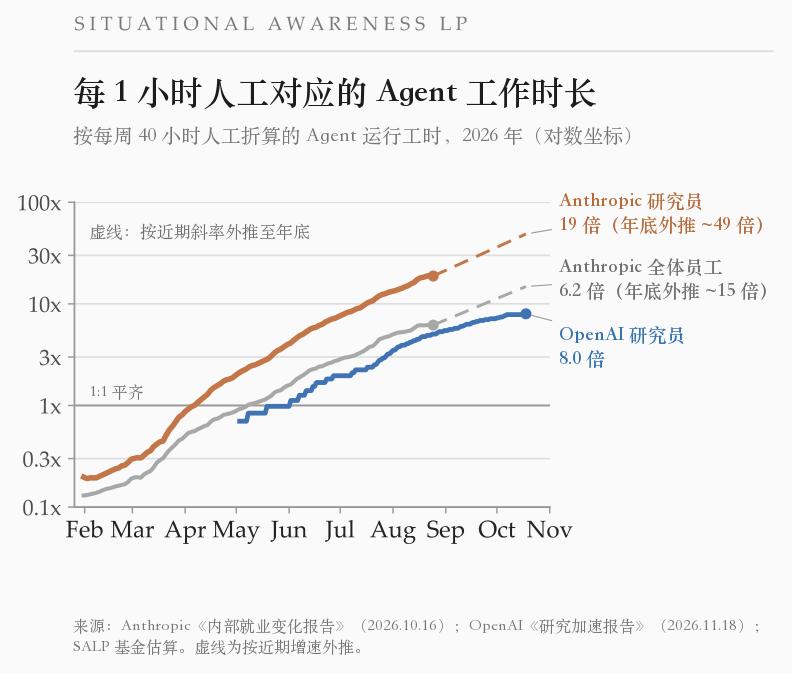
First look at the Agent working hours leveraged by 1 hour of human work. In February this year, for every 1 hour an Anthropic researcher worked, the called Agent only worked for 0.2 hours.
By the end of August, for every 1 hour an Anthropic researcher works, the Agent behind him will work continuously for 19 hours on his behalf (extrapolated to the end of the year, this figure will reach 49 hours), and the company-wide average has also reached 6.2 times.
The trend of OpenAI's research department is also very similar, rising from 0.7 times in early May to 8 times in the same period.
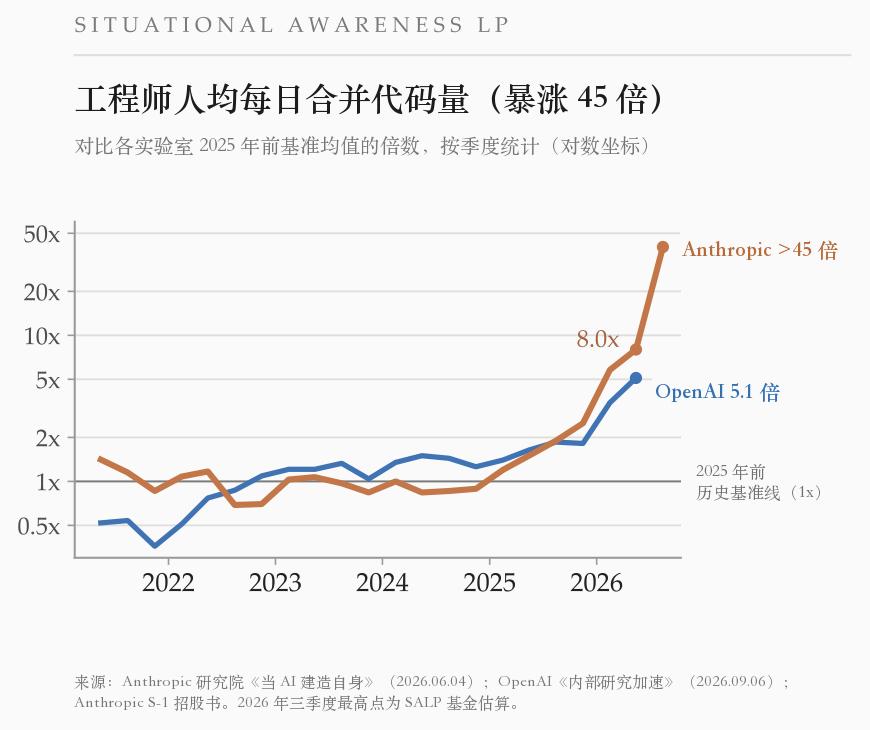
Then look at the daily code merge volume per engineer, which directly reflects the speed of R&D iteration.
The per capita code output that has remained gentle for many years suddenly saw a steep rise in early summer this year.
By the third quarter, the daily code merge volume per Anthropic engineer has soared to more than 45 times the baseline before 2025, and OpenAI also reached 5.1 times at the disclosed node in the same period.
According to the fund's calculation, each researcher and engineer is like having thousands of tireless AI engineers behind them, so that the mere thousands of people in the lab can deliver as much code every day as a 100,000-person super engineering legion.
What supports this output gap is the computing power firepower allocated to each researcher.
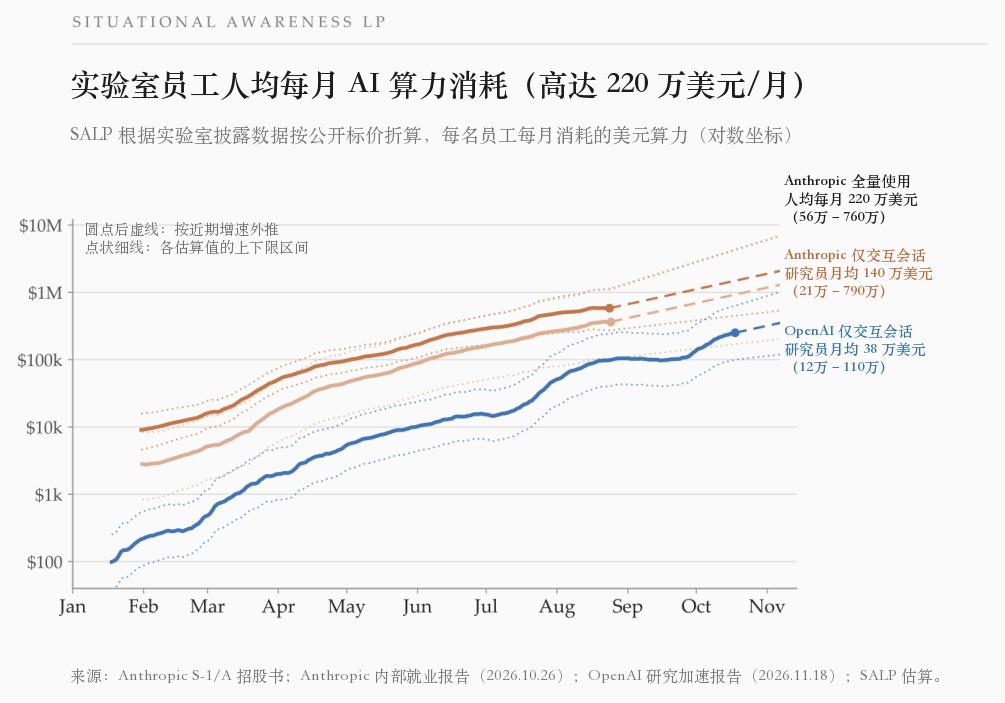
The per capita monthly AI computing power consumption for interactive sessions alone of Anthropic employees reaches 1.4 million USD, and when including the background autonomously running Agent sessions, it is as high as 2.2 million USD per month, and the median self-assessed efficiency improvement by researchers is 12 times.
In comparison, the per capita monthly AI computing power consumption of OpenAI employees is about 380,000 USD, and the gap in computing power investment intensity between the two sides is nearly 4 to 6 times.
This leading position in R&D will soon spill over to computing power monetization efficiency and cross-domain general capabilities.
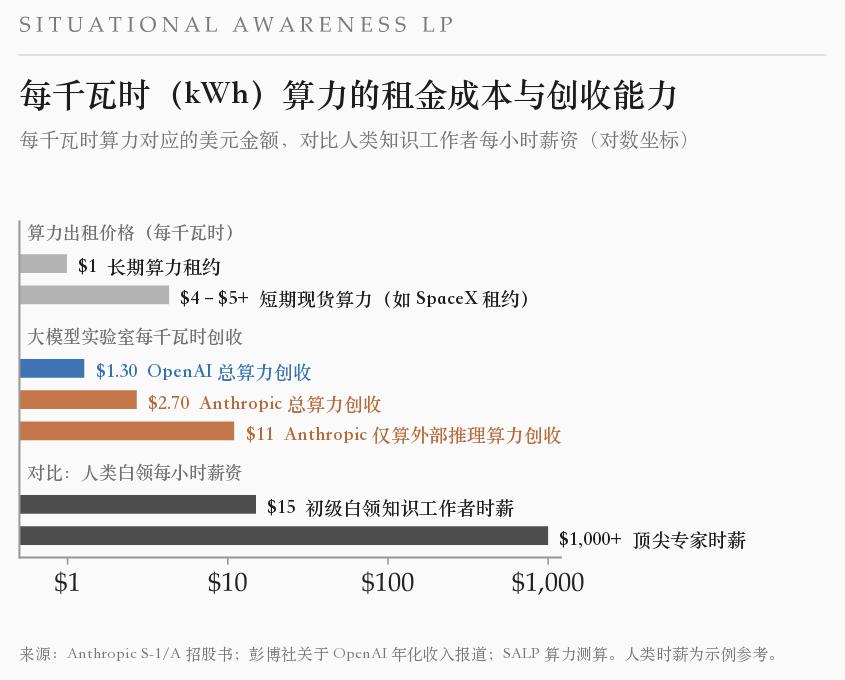
For the same consumption of 1 kilowatt-hour (kWh) of computing power, Bitcoin mining only generates 0.15 USD in profit, OpenAI can generate 1.30 USD in revenue, while Anthropic can already earn back 2.70 USD per kWh of computing power (as high as 11 USD/kWh for pure external inference).
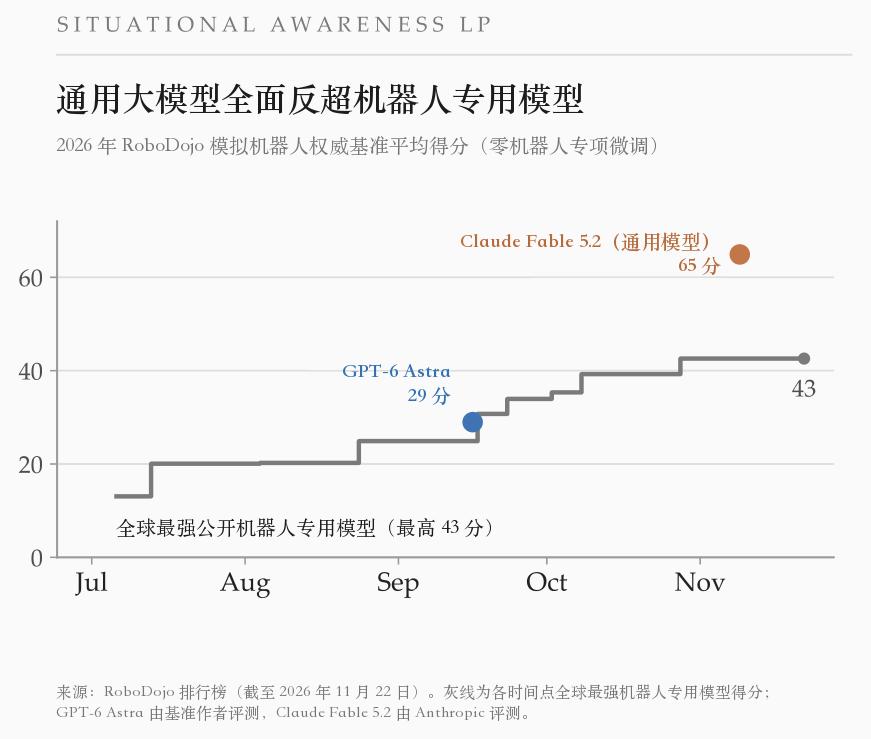
On the RoboDojo embodied intelligence benchmark with zero dedicated robot fine-tuning, Anthropic's general model Claude Fable 5.2 scored 65 points in one go.
This result not only surpasses all dedicated robot models (the highest is 43 points), but its score is more than twice that of OpenAI GPT-6 Astra (29 points).
The fund clearly points out in the letter that Anthropic is currently a few months ahead of OpenAI in "using AI to accelerate its own R&D".
After Recursive Self-Improvement is launched, a stronger model will build the next-generation model faster, and a few months of leading edge will easily widen like a snowball under compound interest.
Of course, the overall explosion of the two major labs after RSI is ignited has already begun to break through the upper limit of human intelligence.
After Claude assisted mathematicians in proving the Riemann Hypothesis, OpenAI's internal model also mobilized 10,000 simultaneously running Agent clusters to conquer the Navier-Stokes equation, one of the Millennium Prize Problems.