Lei Jun's alma mater is queuing up for IPO.
Introduction
By the shore of East Lake and at the foot of Luojia Hill, a lively and festive atmosphere fills the air as Wuhan University celebrates its 133rd birthday.
It is worth noting that just a few days ago, Xiaomi Group, led by Lei Jun, an alumnus of the 1987 Computer Science Department cohort of Wuhan University, released its performance report. The company recorded a revenue of 107.24 billion yuan in the third quarter of 2026, with new energy vehicle deliveries exceeding 100,000 units. From smartphones to automobiles and then to artificial intelligence, 35 years after leaving Luojia Hill, Lei Jun is still exploring new growth directions.
Apart from Lei Jun, a group of Wuhan University alumni have led their respective enterprises to achieve new progress in the capital market.
Liangzhi Intelligent Manufacturing, led by alumnus Zeng Fangqin, was listed on the Hong Kong Stock Exchange, completing its dual A+H listing. As a representative of self-made female entrepreneurs, Zeng Fangqin ranks 9th on the 2026 Hurun Richest Women in China List with a personal wealth of 56 billion yuan. Northcore Life, founded by Song Liang, rang the bell on the Sci-Tech Innovation Board at the beginning of this year.
Meanwhile, a newer generation of entrepreneurs is also making their presence felt in the capital market. In fields including AI, robotics, and satellite remote sensing, a group of post-1995 and post-2000 students from Wuhan University are bringing their own projects to investors.
From listed companies to startup teams, from entrepreneurs to investors, Wuhan University alumni who graduated from Luojia Hill are active on various stages of the industrial and capital markets.
Wuhan University Alumni Marching Towards IPOs
One year ago, Zeng Fangqin, a Wuhan University alumna and head of Liangzhi Intelligent Manufacturing, was leading the company in its push for a Hong Kong stock listing.
In November 2025, Liangzhi Intelligent Manufacturing submitted its prospectus to the Hong Kong Stock Exchange. Around the same time, Zeng Fangqin was appointed as a director of Wuhan University. A year later, the company's Hong Kong listing plan came to fruition. On June 26, 2026, Liangzhi Intelligent Manufacturing was listed on the Hong Kong Stock Exchange, making this precision manufacturing enterprise, which had long been listed on the A-share market, enter the A+H capital market.
Starting from Shenzhen, Zeng Fangqin led Liangzhi Intelligent Manufacturing into the field of consumer electronics precision manufacturing. Today, the company's business has expanded to sectors such as new energy vehicles, and it continues to make layouts in AI terminals, robotics and other directions.
Similarly, Liangzhi Intelligent Manufacturing was not the only Wuhan University alumni-owned enterprise that was pushing for a Hong Kong stock listing last year.
On December 23, 2025, Hansi Aitai, an innovative pharmaceutical enterprise, was listed on the Hong Kong Stock Exchange at an issue price of HK$32 per share, with a global offering of approximately 18.32 million shares, raising a total of about HK$586 million.
Zhang Faming, the founder of Hansi Aitai, was born in Tianmen, Hubei Province. In 1980, he was admitted to the Department of Chemistry of Wuhan University, graduated with a bachelor's degree in 1984, and obtained a master's degree in physical chemistry two years later. After leaving Wuhan University, Zhang Faming went on to pursue his doctorate and engaged in research overseas. Later, he embarked on the path of pharmaceutical R&D and entrepreneurship, and finally led Hansi Aitai to enter the capital market.
Similarly, in February this year, Northcore Life, founded by Song Liang, a 2003 undergraduate alumnus from the School of Physics and Technology of Wuhan University, was also listed on the Sci-Tech Innovation Board.
From founding the company to ringing the listing bell on the Sci-Tech Innovation Board, Northcore Life has attracted a group of investment institutions. Public information shows that well-known financial investors and industrial investors including HSG affiliated institutions, Qiming affiliated institutions, SDIC Chuanghe and Tigermed are on the company's shareholder list.
Apart from enterprises that have completed their listing, some Wuhan University alumni are still exploring the path to public listing.
In June this year, Junsai Bio, which focuses on solid tumor cell therapies, submitted its listing application to the Hong Kong Stock Exchange for the second time. The company's founder Jin Huajun obtained a bachelor's degree in life science from Wuhan University in 2001 and a doctorate in genetic science from Wuhan University in 2006. Many years after leaving campus, he translated his research direction into industrial applications and founded Junsai Bio in 2019.
From precision manufacturing and medical devices to innovative drugs, these Wuhan University alumni have chosen different industries. Over the past year, some have led their enterprises to complete listing, while others continue to promote R&D and seek opportunities to enter the capital market.
Young Wuhan University Entrepreneurs Announce Financing One After Another
While alumni including Zeng Fangqin, Song Liang and Zhang Faming are leading their enterprises into the capital market, a group of younger Wuhan University students are also bringing their own startup projects to look for investors.
Among them, some started from campus to bring artificial intelligence technology to industrial applications, while others continue to dig deep into Wuhan University's advantageous disciplines, trying to bring remote sensing technology into more application scenarios.
In September this year, Mars Landing announced the completion of tens of millions of yuan in angel round financing, with participation from Lihe Venture Capital, Optics Valley Financial Holding, Ruijiang Investment, Wuhan High-Tech and MiraclePlus, among other institutions.
This is an enterprise founded by post-2000 entrepreneurs. Zhu Yuhan, the founder of Mars Landing, was born in 2001 and is currently a postgraduate student at Wuhan University. In 2025, he chose to suspend his studies to devote himself full-time to entrepreneurship, and Mars Landing was established in April of the same year.
Zhu Yuhan and his team focus on the underlying issues behind embodied intelligence: after robots enter the real environment, how they can understand their location, the tasks they are performing, and what to do next. Centering on this direction, Mars Landing tries to build a "brain-like" intelligent architecture to enable robots' capabilities in perception, memory, task organization and execution to work in a coordinated manner.
During the entrepreneurial process, Zhu Yuhan also received help from his fellow alumni.
According to reports, when Mars Landing applied for investment from MiraclePlus, it was referred by Chang Yuanhe, a Wuhan University alumnus. The two met through academic competitions during their university years and later both embarked on the path of entrepreneurship.
Chang Yuanhe, who is also a Wuhan University alumnus, started his entrepreneurial journey earlier than Zhu Yuhan, and is the co-founder and COO of Modality Transition.
Modality Transition, an AI enterprise also located in Wuhan Optics Valley, was co-founded by three post-2000s in 2023. Among them, CEO Bing Longzhi graduated from the e-commerce major of Wuhan University and started entrepreneurship at the age of 18; COO Chang Yuanhe and CTO Ding Zhenyu are from the School of Computer Science of Wuhan University.
Shortly after Modality Transition was founded, the team secured investment. Data from Qichacha shows that the company has completed two rounds of financing totaling tens of millions of yuan, with investors including MiraclePlus, Changchuang Industrial Investment Fund, Lihe Venture Capital, Wuhan Science and Technology Investment, Shenzhen High-Tech Investment, Shenzhen Rongruihe Investment and other institutions.
From getting to know each other during university to referring each other after starting businesses, the experience of Zhu Yuhan and Chang Yuanhe gives a more concrete picture of the connections among Wuhan University alumni.
If Mars Landing and Modality Transition target artificial intelligence applications, then another enterprise founded by young Wuhan University entrepreneurs sets its sights on a broader space.
In October this year, Hengkong Technology completed its angel round financing, with investors including funds under Xuhui Science and Technology Innovation Investment and Optics Valley Science and Technology Innovation Investment. Cao Wei, CEO of Hengkong Technology, was born in 1998, and holds a master's degree in photogrammetry and remote sensing and a doctorate in communication and information systems from Wuhan University. Surveying and mapping and remote sensing are distinctive disciplinary directions of Wuhan University. Founded in 2025, Hengkong Technology tries to apply spatial perception technology to fields such as emergency response, fire protection, water conservancy and agriculture.
There is also robot entrepreneur Peng Rui who has moved his technology from the laboratory to industrial applications.
In March this year, Featherwing Technology, a bionic flexible robot company, completed tens of millions of yuan in angel round financing, led by Tencent Investment, with continued additional investment from old shareholder MiraclePlus. Founder Peng Rui graduated from the Department of Electronic Information of Wuhan University with bachelor's and master's degrees, later obtained his doctorate from the University of Hong Kong, and once worked on embedded engineering related work at DJI.
Now, he brings his accumulated research and industrial experience to Featherwing Technology, hoping to solve the adaptation and collaboration problems faced by robots when entering the real environment through flexible robot technology.
From artificial intelligence to robotics, and then to satellite remote sensing, these young Wuhan University affiliated entrepreneurs have chosen different directions. After leaving the classroom, they bring the technology, experience and partners they accumulated on campus into the capital market, and will continue to push for IPOs in the future, injecting their own strength into the Wuhan University alumni ecosystem in the secondary market.
The Capital Relay at the Foot of Luojia Hill
While young Wuhan University entrepreneurs bring their projects into the primary market, some alumni who have long established a firm foothold in the business world have also become investors, providing financial support for new startup teams.
In the venture capital network of Wuhan University alumni, an institution named "Luojia Juxin" is noteworthy.
According to the introduction of Luojia Juxin, this institution was initiated by the Special Committee of Wuhan University Semiconductor Alumni, carries out investment around the semiconductor industry, and has received support from the School of Microelectronics of Wuhan University and many alumni-owned enterprises. At the Wuhan University Alumni Entrepreneurs Symposium in 2025, Luojia Juxin also signed a letter of intent for cooperation with the talent fund under Wuhan Talent Group.
Qichacha data shows that Luojia Juxin manages a total capital of 4 billion yuan, has invested in 6 projects, and has made a total of 11 investment transactions.
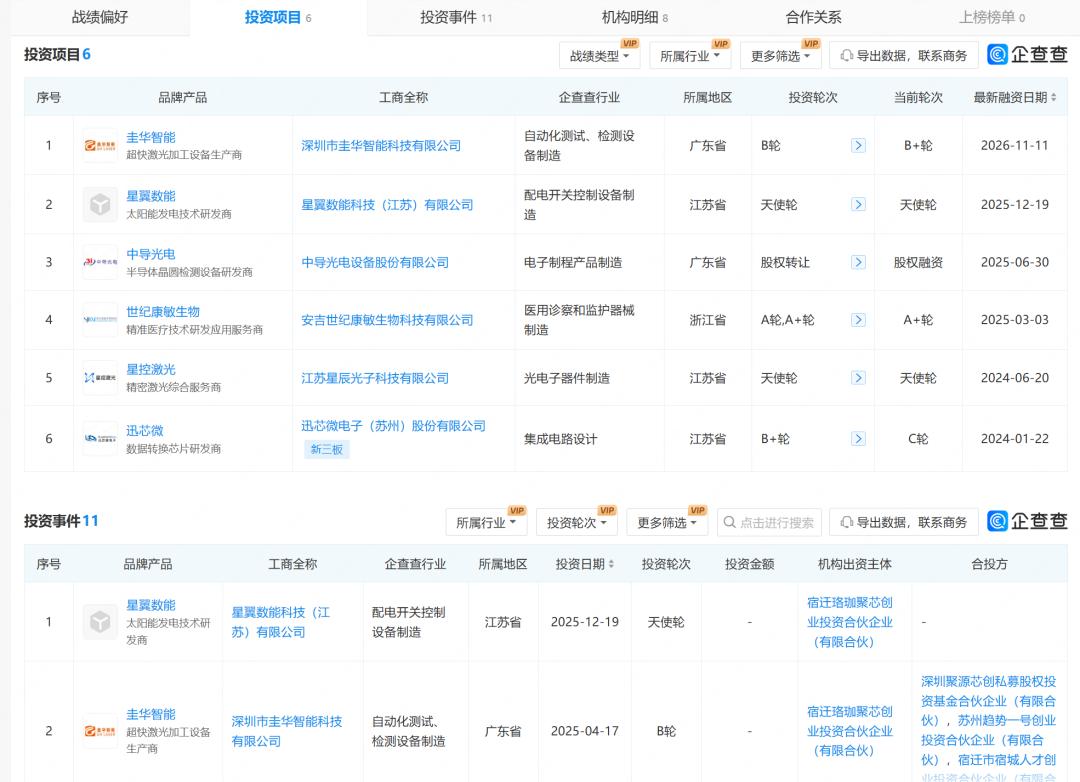
Looking through the investment list, the enterprises invested by Luojia Juxin are mainly distributed in sectors such as chips, laser equipment and medical care.
Before the establishment of Luojia Juxin, a group of Wuhan University alumni had jointly set up an angel fund to support entrepreneurship by teachers, students and alumni.
In 2015, Wuhan University, the Wuchang District Government of Wuhan and the Wuhan Luojia Alumni Enterprise Alliance proposed to jointly establish the Luojia Innovation Angel Fund. When the fund was officially established in 2016, the first phase raised about 150 million yuan. The funds came from multiple parties including the university, local government and alumni.
Ten years later, new funds have joined in to support entrepreneurship of Wuhan University teachers and students and the transformation of scientific and technological achievements.
In 2025, Wuhan University signed a cooperation agreement with Jiangcheng Fund to promote the construction of the Jiangcheng Wuhan University Science and Technology Innovation Fund. According to the plan at that time, the first phase would set up a 100 million yuan "Spark Fund" to support 20 early-stage science and technology innovation projects of Wuhan University. In July this year, Wuhan University jointly initiated the establishment of the Wuhan University Self-Improvement Science and Technology Innovation Seed Fund with multiple venture capital institutions. According to media reports, the fund has a total size of 200 million yuan, focusing on supporting the university's cutting-edge hard technology, emerging technology achievement transformation projects and youth entrepreneurial teams of teachers and students.
From joint investment by alumni to the establishment of funds through cooperation between the university and venture capital institutions, funds are continuously looking for startup projects that originated from campus. For those alumni who have achieved success in the business world, there are more ways to give back to their alma mater than just making investments.
On November 29, 2023, the 130th anniversary of Wuhan University, Lei Jun, an alumnus of the 1987 Computer Science Department cohort, donated 1.3 billion yuan to his alma mater in his personal name to support basic scientific research, technological innovation and student training. Also during the 130th anniversary celebration of Wuhan University, five alumni including Mao Zhenhua, Wang Linpeng, Zhang Bo, Luo Aiping and Jiang Liming donated a total of more than 300 million yuan to the university.
This year, Wuhan University alumni's support for their alma mater continues.
In March, the School of Electronic Information of Wuhan University held an alumni donation event. Alumni including Wu Yadong, Chairman of Jiangxi Blueprint Intelligent Manufacturing Technology Co., Ltd., and Zhou Hu, a private securities fund investor, signed donation agreements with the university to support talent training and development of the school. At the event site, the "Tongdaxin Hall" and "Zhilai Lecture Hall" were officially inaugurated. In August of the same year, Shi Bingfa, a 1991 master's alumnus of Wuhan University and General Manager of Shanghai Heyojia Technology Co., Ltd., jointly donated with Professor Ma Feicheng of Wuhan University to establish the Information Management Education Development Fund, which is used to reward outstanding young teachers and students in the field of information management.
Through investment, donation and referral, the connections between Wuhan University alumni and their alma mater are sustained in various forms.
Today, another group of young people on Luojia Hill are heading to the market with their technology and ideas. Some have obtained referrals from alumni, some have received support from investment institutions, and some are still waiting for their first round of financing.
They start from campus and head to different industries. As these entrepreneurial stories continue to unfold, the connection between Wuhan University and generations of alumni has taken on new content.
This article is from the WeChat Official Account "Rongzhong Finance" (ID: thecapital), written by Feng Xiaoting, and published with authorization from 36Kr.