In the post-AI era, those who have never used AI
I recently read a long article by Feng Ji "The Most Important Question in the Post-AI Era". He mentioned the moment he slumped dizzily in his chair, a moment that many people including me have experienced this year: math problems are solved by AI, games are developed by AI, what should humans do if one day no job requires human labor at all?
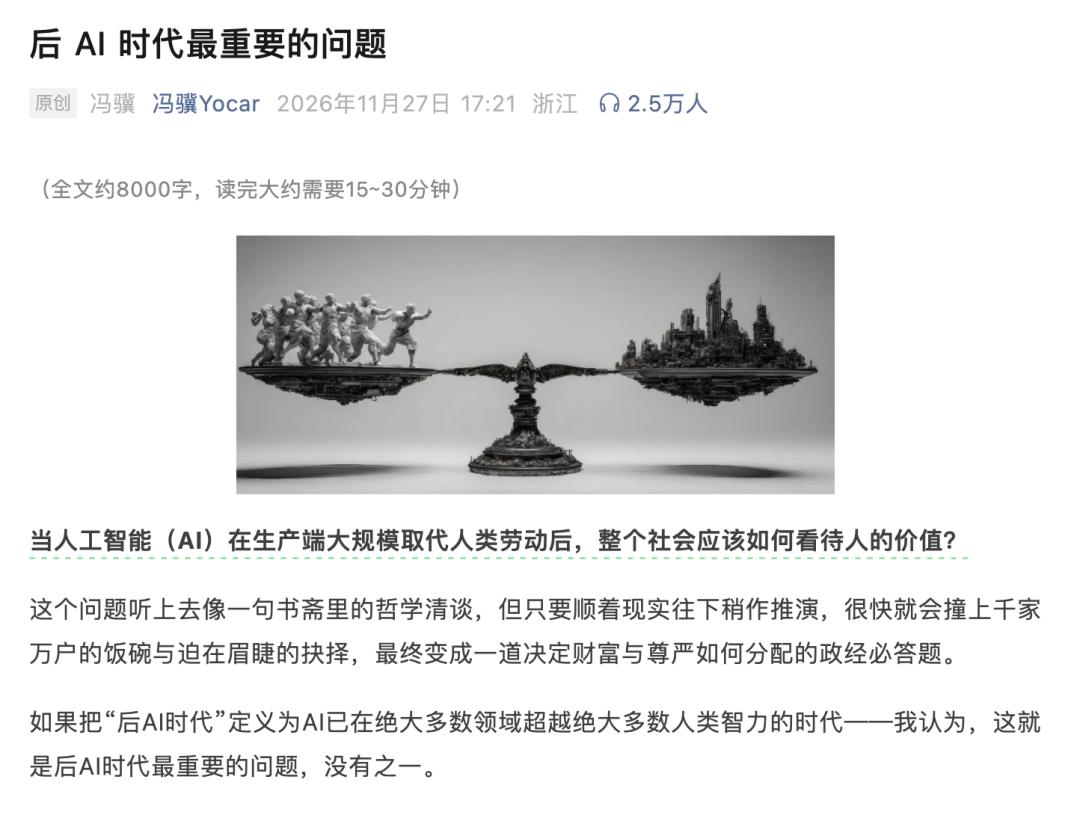
Suddenly, another group of people popped up in my mind — those who have never used AI at all, standing right at the threshold of the "Post-AI Era".
Are there really such people?
The other day I scrolled across a post, where the poster said he met a girl working in the film industry who had never used ChatGPT. She worried that once she started using AI tools, she would lose her own ability to think. She hates the AI-generated answers that pop up automatically in Google search results, thinking they are uninvited and extremely annoying.
You may think this girl is a little out of step with the times. ChatGPT already has more than 800 million active users per week worldwide, and Claude, Gemini, and Copilot each have a huge user base of their own.
In the tech industry where I work, greetings like "What model are you using?" and "Has your account been banned?" have become common ways to say hello.
Having never used AI is just like saying you didn't have WeChat 15 years ago, or saying you don't use email 20 years ago, which will draw a slightly confused look from others. In the workplace, you are even very likely to be despised and eliminated.
However, the ubiquitous narratives of "efficiency improvement" and "value creation" in the tech circle do not hold water at all for some people, or in other words, they have good enough reasons to doubt whether these narratives are valid.
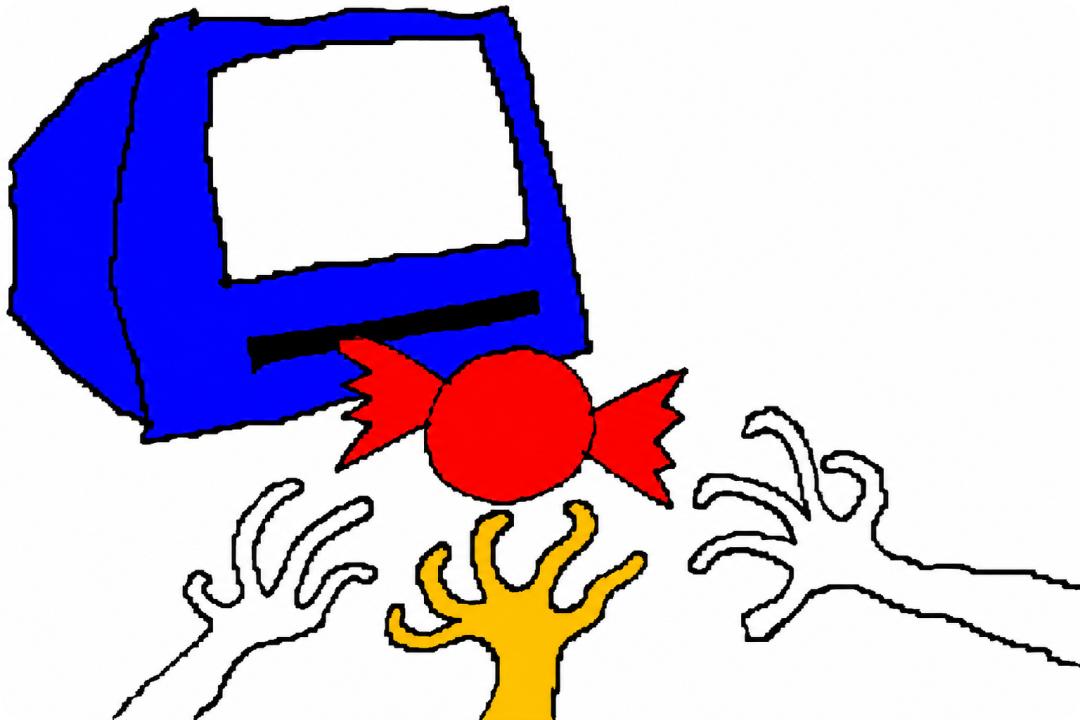
Feng Ji said that every time you feed content to AI, it immediately gives you a candy of efficiency. But "when there are enough candies, the sweetness will turn into compulsion". When your peers double their efficiency and cut their quotes in half with AI, the optimists step on the gas, and the pessimists, to protect themselves, step on the gas even harder than the optimists.
I couldn't agree more. Burning a large number of Tokens does not necessarily help you create greater value, but it may generate more dopamine than binge-watching short dramas, leaving you unable to extricate yourself.
It is exactly in this trend where the whole world is scrambling for candies, that those who do not reach out — are they stubborn, or sober?
Helen Coffey, a reporter from the UK's *The Independent*, wrote an article introducing herself as a "ChatGPT virgin": she has never opened ChatGPT, Claude, Gemini or any other generative AI tool, and is not even sure exactly where these tools are located on the Internet.
She can't quite explain why, but she feels surprisingly at ease.
Another writer who posted on *Writing Cooperative* said he is not deliberately fighting against AI, nor is he proud of it. He just missed the initial window of trying it out for the first time. Later, the pace got faster and faster, colleagues around him, his children, and even friends who barely understand technology started using AI, but he still didn't.
Gradually, the focus of discussions shifted from "Is it easy to use?" to "Will AI destroy humanity?". She said she doesn't think she is smart or firm, she just simply feels that she is "getting old".
As content creators, we also noticed that studies have found : the widespread use of AI does improve individual creative output, but on a larger scale, it reduces the overall diversity of creation.
Everyone who uses AI thinks they are "creating", but the gains AI brings at the individual level come at the cost of the loss of diversity at the group level — when millions of people call the same probabilistic model, human expressions seem to surge, but in reality, they are collapsing towards the same mean.
Not to mention, as Feng Ji put it, "Creation tools have indeed achieved equal access, but distribution entrances have not, computing power allocation has not, and the way of distributing benefits is even less equal". The vast majority of people who are proficient in using these tools may, with every tiny operation on the screen, contribute free corpus to the system that is about to replace themselves.
A study by New York University on 25 professional writers with an average of 17 years of writing experience found that some writers who resist AI regard AI as a competitor and actively adopt "adversarial strategies". They deliberately strengthen their own human attributes, focusing on developing local narratives, individual life experiences, and specific emotional textures that AI cannot easily replicate.
"AI confrontation as a craft" also requires skills, a clear awareness of what you are competing against, and where your irreplaceability lies. One interviewed screenwriter said: "If I let AI do my job, I will feel pain in my heart."
We keep introducing tools into our lives, and the tools are getting more and more powerful. The narrative that "refusal or lagging behind means loss" has been repackaged in the AI era as "people who cannot use AI will be replaced by those who can", which spreads in various versions on social media.
This statement mixes real professional anxiety and the habitual optimism of the tech circle. Although it only describes a very partial reality, it is cited everywhere as a universal law.
When "intelligence is separated from the physical body for the first time in history, changing from a labor factor to a capital factor". It is clearly the capital that can directly purchase intelligence in bulk by paying electricity bills, but in the end, it turns into us blaming ourselves for not learning fast enough, not keeping up closely enough, and having to jump into the sea even if we can't swim.
This is indeed a quite divided era.
The Riemann Hypothesis is a problem that the top minds in the world have devoted their entire lives to over the past 150 years, but now a 34-year-old mathematician, working with Claude, has "proved" it in roughly six weeks.
Jack Clark, co-founder of Anthropic, said on his blog today that we have officially stepped into the singularity. AI is conducting scientific research so fast that humans need to create a brand new discipline called "machine hermeneutics" just to understand what AI has discovered.
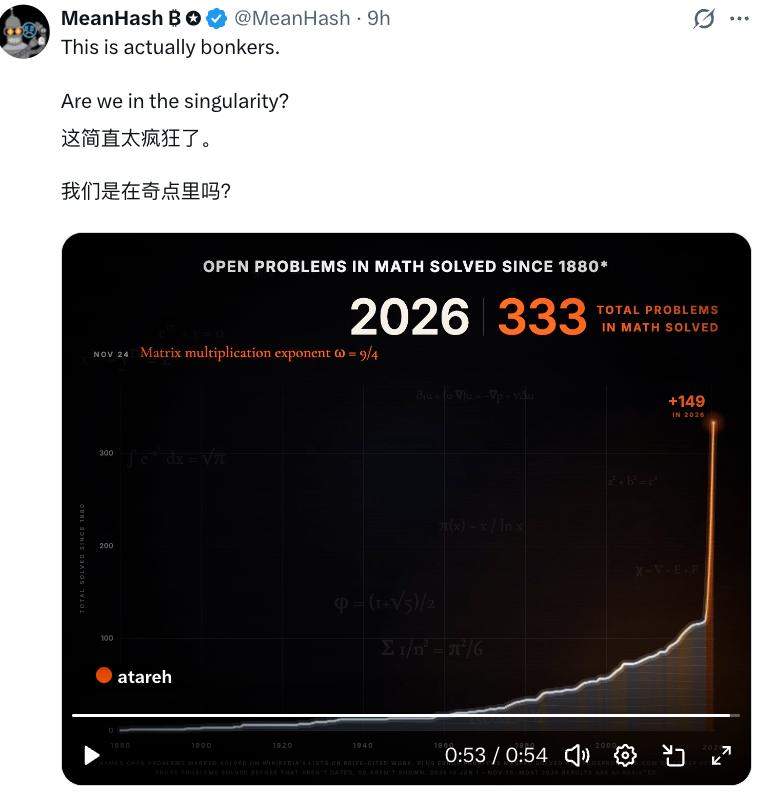
Take this year's AI-generated math papers as an example. The time we spend understanding them may be dozens or hundreds of times longer than the time the machines spend writing them.
As a result, an atmosphere has gradually formed around us, as if if we don't embrace AI soon, we will become illiterate in another form.
But even the mathematical holy grail that the top human minds have spent their entire lives pursuing can be broken through in just six weeks, how much stronger can the professional defense line built by ordinary people memorizing a few more prompt words be than a sandcastle on the beach?
I myself often feel a little divided: on the one hand, I think this is very cool, but on the other hand, I faintly feel a sense of emptiness.
This sense of emptiness is probably, as Feng Ji said, that we are too used to " tightly tying a person's sense of security and dignity to their indispensability in the production chain ".
In fact, people who live outside the grand narrative of AI are also living perfectly well.
Some people say they are "not interested", which does not mean they are ignorant or backward. It only means that this tool has not constituted a sufficiently convincing reason for their current life. Those who have never opened the AI dialog box are not missing the future, they just refuse to let the future take over their present in advance.
Feng Ji believes that the real freedom in the post-AI era should include "the freedom not to prove to others that you are 'useful'" — you can be a happy ordinary person who is considered useless by the old standards with a clear conscience, without any ruler of meritocracy pointing fingers at you.
Indeed, being able to say "not interested" to a global efficiency carnival, and not having to prove to any algorithm that you are still "useful", in itself, may be the most decent freedom for human beings in the future.
This article is from the WeChat official account "APPSO", written by the publisher of tomorrow's products, and published with authorization by 36Kr.