Everyone who sells OA software ends up becoming a general contractor.
Anyone who has ever worked a full-time job has definitely dealt with OA systems.
Applying for leave, submitting expense reimbursements, getting official stamps affixed — sometimes if you want to spend 200 yuan of the company's money, you have to let five different people know about it first.
However, I recently went through the financial reports of two listed companies that develop OA systems, and found that this business is far more interesting than I expected.
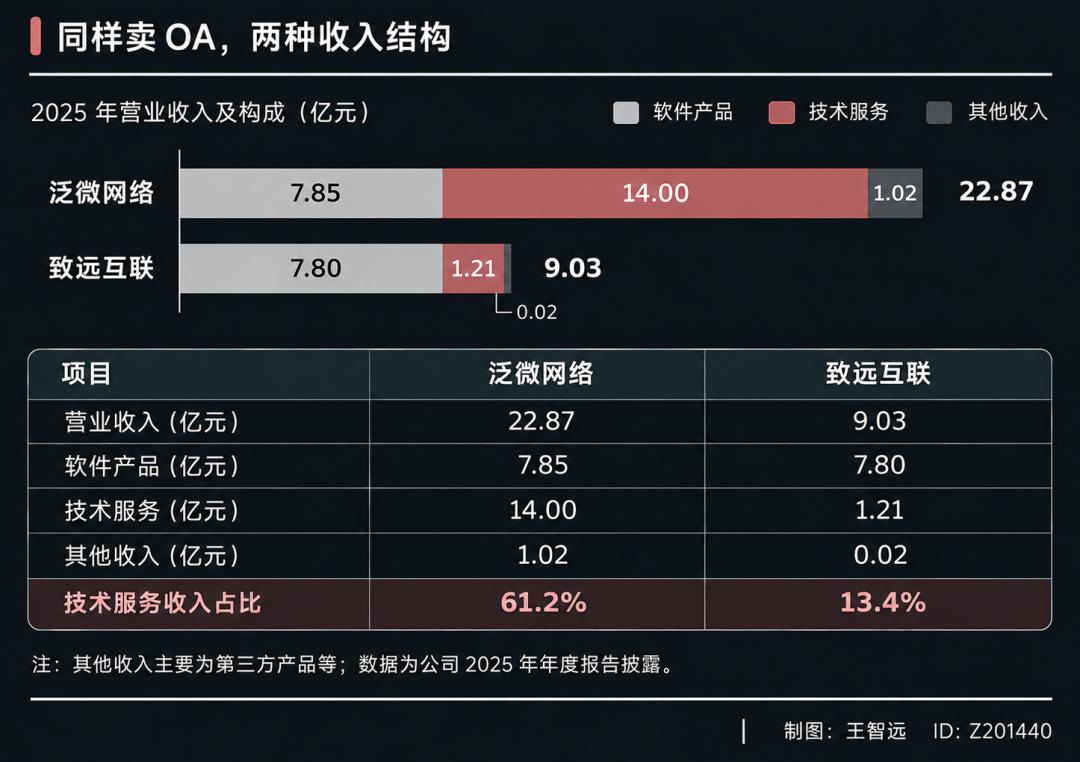
In 2025, Weaver Software recorded a product revenue of 785 million yuan, while Seeyon posted 780 million yuan, with a gap of only 5 million yuan between the two. But looking further down the reports, Weaver's total annual revenue hit 2.287 billion yuan, while Seeyon's was 903 million yuan. One made a net profit of nearly 300 million yuan, while the other suffered a considerable loss.
If you only look at the software product revenue, the two companies seem very similar, but a full review of their financial statements shows their business operations are completely different.
So what exactly do OA vendors rely on to make money?
……
I found a procurement order on China Government Procurement Network.
In November this year, Southwest Petroleum University purchased an OA system, and Seeyon won the bid with a quotation of 649,000 yuan. The list only has three lines: 630,000 yuan for the OA system, 15,000 yuan for Dameng database migration, and 4,000 yuan for TongTech middleware.
Spending 630,000 yuan on a set of office software — can you start using it right after purchase?
It's definitely not that simple.
Take expense reimbursement as an example: in some companies, you only need the department leader's signature to approve a 500-yuan claim; in others, the finance department has to sign off, and some even need to verify which department's budget the money is drawn from.
Just think about how many different rules of this kind a single company can have.
When OA implementation teams arrive at the client's site, they have to fully understand all these rules first, then configure them into the system one by one. The exact same set of software, when deployed in a university and a manufacturing enterprise, will end up looking so different that they barely seem related.
Besides, once the system is deployed, replacing it is extremely troublesome.
China Post's national centralized office system stores 35TB of data, has 300,000 registered users, and 60,000 people use it for work every day. It is involved in every process from issuing official documents, affixing official stamps, to following up on pending tasks.
In 2025, China Post carried out localization transformation, even replacing the underlying Oracle database, but the OA system on top is still in use. It's like keeping the whole house occupied while completely replacing its foundation.
How troublesome is it to replace an OA system? You can get a clear idea by looking at how much data another enterprise had to migrate when switching systems.
When an aviation manufacturing enterprise replaced its OA system, there were more than 400 workflows to migrate, 150,000 historical process records, and 3 million document attachments.
You can buy brand new software, but all the signed documents and approved files from past years still need to be accessible for future queries.
Even if the system is not replaced, it does not mean there is no more work for the vendor.
When a company sets up a new department, the approval process needs to be adjusted; when it acquires a subsidiary, the system may need capacity expansion; if the financial software is replaced one day, the two systems have to be re-integrated.
According to the quotation description on Seeyon's official website, software licenses cost from hundreds of thousands to two or three million yuan, implementation services are generally priced at 50% to 100% of the license price, and annual maintenance fees are charged at 10% to 20% of the license price. As for system upgrades and capacity expansion, additional fees may apply.
Therefore, in the OA business, signing a client is only the starting point. How many years a set of system can be used by the client, and how many new demands will emerge in the following years, all determine how much revenue the vendor can generate from this enterprise.
……
Then which account do all these revenues go to in the end?
There is an item called "technical services" in the financial statements. For this exact same item, Weaver recorded 1.4 billion yuan in annual revenue, while Seeyon only recorded 121 million yuan, a gap of more than ten times.
Let's first take a look at how the two companies generate their revenue.
Weaver's total revenue in 2025 was 2.287 billion yuan, of which more than 60% came from technical services, more than 30% from software products, and the remaining part mainly came from selling third-party products.
Seeyon presents a completely different picture: its 2025 revenue reached 903 million yuan, up 6.69% year on year. Most of its revenue comes from collaborative management software products, accounting for 86%, while technical services only account for around 13%.
If you only look at the revenue composition of the two companies, you may even doubt whether you are studying the same industry.
Weaver's revenue structure was not formed overnight.
In 2022, its software product revenue was 931 million yuan, and technical service revenue was 1.215 billion yuan. By 2025, the former dropped to 785 million yuan, while the latter rose to 1.4 billion yuan.
Software product revenue decreased by 146 million yuan, while technical service revenue increased by 185 million yuan instead. After delivering a set of software to the client, how much more business can the vendor possibly develop?
The Shanghai Stock Exchange also asked Weaver about this account. The company replied that its technical service revenue mainly comes from three segments.
First, annual maintenance: someone will be available to troubleshoot when the system malfunctions; second, system upgrade: old versions need to be updated to keep up with new iterations; third, secondary development: when clients demand new features, the vendor has to carry out customized development work.
The first revenue stream is recognized on an annual basis, while the latter two are recognized upon project acceptance. The company did not specify the proportion of each of the three revenue streams.
Therefore, when you see 1.4 billion yuan in technical service revenue, do not assume Weaver is sitting in the office collecting 1.4 billion yuan in rent every year. When clients want to add a new feature today or modify a workflow tomorrow, someone has to do the work to earn that money.
Looking at Seeyon, its technical service revenue dropped from 131 million yuan in 2023 to 121 million yuan in 2025. There was little change over the three years.
Does that mean none of Seeyon's existing clients are purchasing additional services?
Not exactly. In the first half of 2026, over 80% of Seeyon's contract increment came from existing clients' system upgrades and additional purchases. Existing clients' demands are still there, but the financial report does not specify how much of these contracts will eventually be recorded as software product revenue and how much as technical service revenue.
However, two figures disclosed by Seeyon itself are worth considering. In 2025, its gross margin for software products was 51.42%, and the gross margin for technical services was 91.38%.
Calculated based on the figures in the report, for every 100 yuan of revenue, selling software generates a gross profit of more than 51 yuan, while providing technical services can generate a gross profit of more than 91 yuan. Of course, sales expenses and R&D expenses are not deducted here.
Why do I think this set of figures is important?
OA vendors should not only figure out how to sell their software to an enterprise, but also consider how much money this enterprise will spend on the software in the next ten years, and how much cost they need to pay to earn that money.
After all, when a client has new demands, is the vendor guaranteed to make money? There is still a group of people who need to do the actual work standing between the demand and the revenue.
This leads to the question of how the two companies organize their teams to get the work done.
……
There was a figure that I thought I had misread when I first saw it.
In 2025, Weaver's gross margin was 93.75%, while Seeyon's was 56.84%, a gap of nearly 37 percentage points.
A company that needs to install software, configure workflows and conduct implementation for clients, with an operating cost of only over 6 yuan for every 100 yuan of revenue — this business sounds a bit like selling air.
But air does not need anyone to install, while OA systems do. So where are the people doing the work?
Weaver has a number of regional authorized operation centers across the country. These centers are independent companies that help Weaver sell software, and also take charge of implementation, maintenance and other related work.
In 2024, 93.36% of Weaver's revenue came from the authorized operation model, and direct sales only accounted for 6.64%. In other words, a lot of the work at the client's site is done by its partners.
The project implementation fees Weaver pays to its partners are recorded in sales expenses. In 2025, its sales expenses reached 1.523 billion yuan, accounting for 66.61% of the annual revenue, of which 1.306 billion yuan was project implementation fees. For every 100 yuan of revenue, there is a corresponding 57 yuan in project implementation fees.
At this point, that 93.75% gross margin no longer seems so magical. Part of the expenses that were not seen in the operating cost section can be found further down in the sales expenses.
Seeyon adopts a different organizational model.
In 2025, 85.92% of its revenue came from direct sales. It has more than 2,300 full-time employees, and also cooperates with over 1,000 implementation and delivery partners and more than 600 sales partners.
Both companies leverage external resources to develop their business, but they differ in how much work they handle in-house, how much work they outsource to partners, and where the labor costs for the work are recorded.
If the 1.3 billion yuan in project implementation fees were all counted into operating costs, Weaver's gross margin would drop from 93.75% to around 37%.
Of course, this sum of money also includes sales-related work, and the company did not break down the details. We are just making a hypothetical calculation here. As you can see, focusing only on gross margin can easily lead to misjudgment.
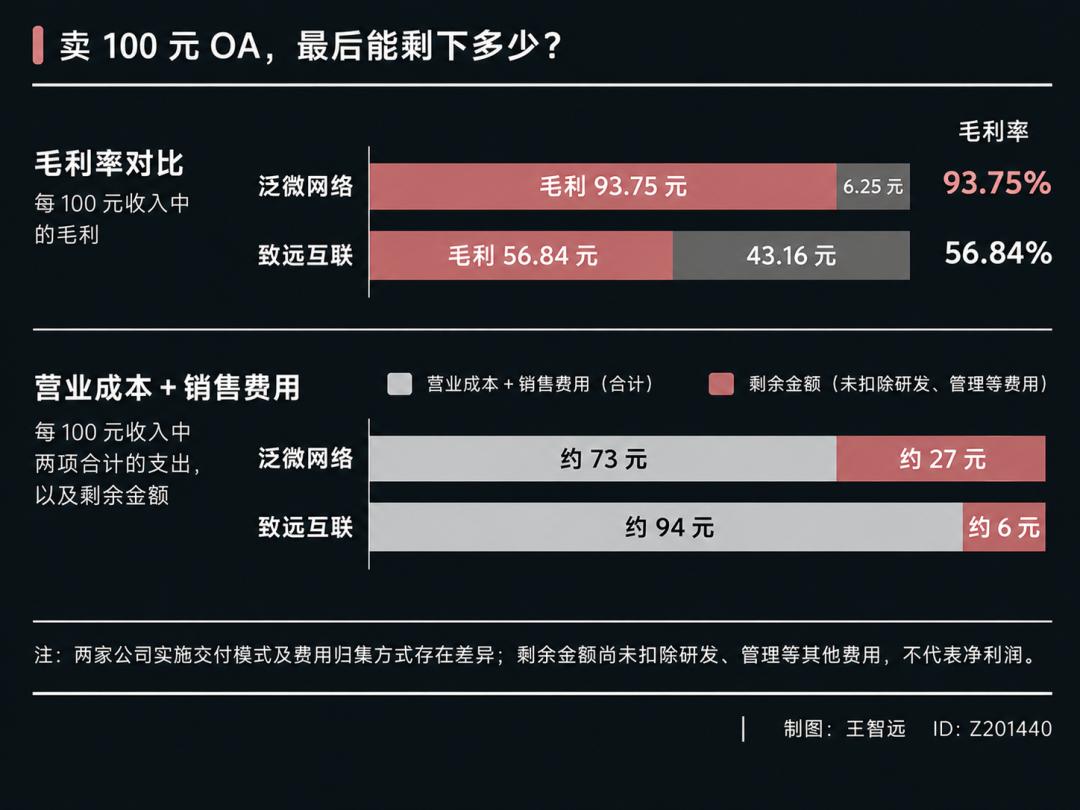
Therefore, we need to change the calculation method and look at operating costs and sales expenses together.
For every 100 yuan of revenue Weaver earns, the two items combined cost nearly 73 yuan; for Seeyon, the figure is nearly 94 yuan. R&D expenses, administrative expenses and other expenditures are not included yet.
This gap can no longer be explained simply by different accounting methods.
There is another easily misleading figure called labor efficiency. Calculated based on the number of employees of the listed companies, each Weaver employee generates 2.08 million yuan in revenue per year, while each Seeyon employee generates 390,000 yuan, a gap of more than five times.
At first glance, every Weaver employee seems to be a superman. But as we mentioned earlier, the staff of the authorized operation centers are not counted in the number, and Seeyon's external delivery partners are not counted either.
All the work is done by all the people involved together, but when calculating revenue per capita, only part of these people are counted.
If you really want to compare who is more efficient, you need to know the total number of people in the entire delivery chain and the total cost. Unfortunately, the financial reports do not provide such data.
I believe this is exactly where the OA business truly tests a company's operational capability.
After the software is sold, clients have all kinds of different demands. Vendors have to figure out clearly which demands can be solved by standard products, which require on-site staff to do customized work, and which can be handed over to partners.
When you take on one more client, can you earn an extra profit? When existing clients put forward ten more demands, does the vendor need to recruit more employees?
If every time revenue increases by a certain margin, the number of working staff has to increase by the same margin, then the software business can hardly benefit from economies of scale.
How to make the product handle more work and reduce redundant human input is one of the key points to generate profits in this business.
At present, there are far more than these two companies trying to make money from the enterprise office business.
……
I originally wanted to find out how big the collaborative office market actually is, but after going through several industry reports, I got more and more confused.
iResearch says the market size of China's collaborative office platform reached 10.2 billion yuan in 2023, and is expected to hit 16.3 billion yuan in 2026; iiMedia Research estimates that the entire collaborative office market will reach 41.48 billion yuan in 2025.
Wow, before you even start studying this business, you have to figure out how these research institutions calculate their numbers first.
A closer look shows that some reports only count collaborative office platforms, while others have a broader statistical scope that includes other office products and services.
Everyone is talking about collaborative office, but what they have in mind may be completely different sets of software. This is not entirely the fault of the research institutions, because even software vendors themselves are starting to step into each other's business areas now.
Roughly speaking, there are four entry points for the enterprise office business.
Companies like Weaver and Seeyon that focus on OA systems cut into the market from official document management, approval workflows and process management; vendors that develop collaborative platforms hope enterprises can meet all their office demands in one single place.
Products like DingTalk and WeCom cut into the market from the communication needs between employees; there are also ERP vendors that naturally integrate relevant approval functions when enterprises manage their finances and procurement through their systems.
Previously, everyone focused on their own business, but now they are more or less starting to step into each other's territory.
OA vendors are starting to sell expense control, contract management and HR management software. Weaver now has more than a dozen product lines outside the scope of traditional OA systems.
Enterprise communication tool vendors are also starting to develop approval and workflow functions, aiming to cover every scenario from employees clocking in in the morning to clocking out in the evening, so that users never need to open a second software.
This makes perfect sense from the perspective of enterprise owners.
If the company already has an office platform that supports expense reimbursement and approval, and the financial software can also do these things, the next time they make a procurement, the boss will definitely ask: how many times