Can't even the dumbest person become the CEO of NVIDIA?
On the day Jensen Huang resigned, Nvidia closed 4.34% lower. He returned to his position 11 days later, and Nvidia's share price rose by 31.5%. The capital market's evaluation of Mr. Huang is both brutal and unvarnished.
During the period when Mr. Huang was out of office and completed GTA6, Nvidia delivered a stunning quarterly report, with single-quarter revenue exceeding 100 billion US dollars, and the first quarter of mass production of Vera Rubin generated nearly 20 billion US dollars in revenue. Holding the better-than-expected financial report left by Mr. Huang, the board of directors' attitude was to keep the party going.
At the earnings call, interim CEO Kress routinely repeated that "business is as usual", and customers and suppliers continue to support Nvidia; Chairman Harvey Jones explicitly stated that "there is no intention to let Jensen Huang return". Every word implied that anyone can do the CEO job.
Indeed, can't even the most mediocre person learn calculus?
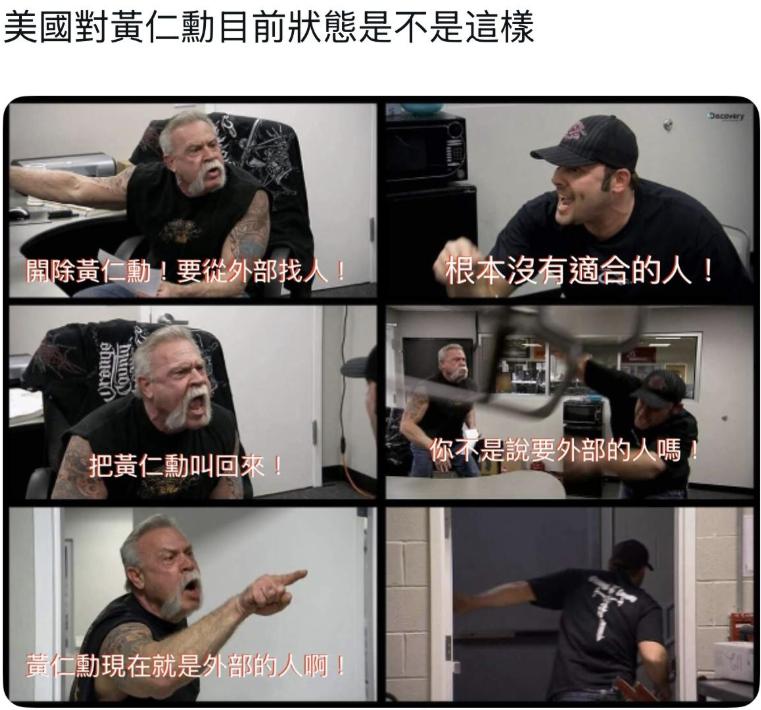
The headhunting firm Heidrick & Struggles hired by the board of directors also has an impressive track record: it helped Google recruit Eric Schmidt, helped Microsoft evaluate successor candidates, and completed three major deals with Steve Jobs:
In 1983, Steve Jobs wanted to find a marketing-savvy executive. Heidrick & Struggles found John Sculley, then president of PepsiCo, and the two were once extremely close. But anyone familiar with Apple's history knows that two years later, Jobs was ousted from Apple, and Sculley personally orchestrated the move.
In 1998, Jobs, who had returned to Apple, urgently needed a second-in-command to manage production and supply chains. Heidrick & Struggles recommended Tim Cook, a senior executive at Compaq. This service fee was extremely cost-effective, as they found the successor 13 years in advance.
In 1997, after Apple acquired NeXT, Jobs returned as a consultant, and at the same time hired Heidrick & Struggles to launch the selection process for a new CEO. Jobs later recalled that he was not satisfied with any of the candidates provided by the headhunter, and finally decided to take the position himself.
Back then, the board of directors begged Jobs to take over the company, but Jobs was uninterested. This time, Mr. Huang sincerely wanted to fight for the company again, but the board of directors said the reason was that Mr. Huang was not candid enough.
Everyone has their own understanding of how similar Jensen Huang is to Nvidia, compared to Steve Jobs to Apple. But history is a patient teacher, and if you don't learn the lesson, it will teach you over and over again.
The Value of a Leader
During Jensen Huang's departure, the US stock market opened for 7 trading days, and Nvidia's stock price did not rise even once. By the close of November 20, its share price had fallen 27.7% from before the resignation, and its market value evaporated by 1.16 trillion US dollars. This "tuition fee" was clearly beyond the board of directors' expectation.
As we mentioned in previous articles, the core reason why Nvidia grew from a gaming graphics card seller to today's semiconductor empire is Jensen Huang's belief and persistence in "general-purpose computing":
If a chip can compute millions of pixels at the same time, why can't it compute millions of problems at the same time?
In 2019, Nvidia acquired Mellanox, and the industry could not understand why Nvidia wanted to buy a network communications company. But Jensen Huang believed that AI requires a large number of servers to work in collaboration, and network communication capabilities are the key, so it is necessary to make layout in advance.
Nvidia's core business is "computing". For more than 30 years, Jensen Huang has continuously predicted where the bottleneck of future computing systems will be, turned the predictions into technology R&D directions, and built moats in advance.
Even employees who opposed Jensen Huang's reinstatement cannot deny his importance.
After the resignation incident, most Nvidia employees asked Mr. Huang to return, but there were also dissenting voices, such as Bryan Catanzaro, Vice President of Deep Learning Research. Catanzaro immediately drew a clear line with Mr. Huang, sided with the board of directors, and strongly supported interim CEO Kress.
After Mr. Huang returned to his post, Catanzaro was immediately targeted by netizens who demanded to remove the officials around the emperor.
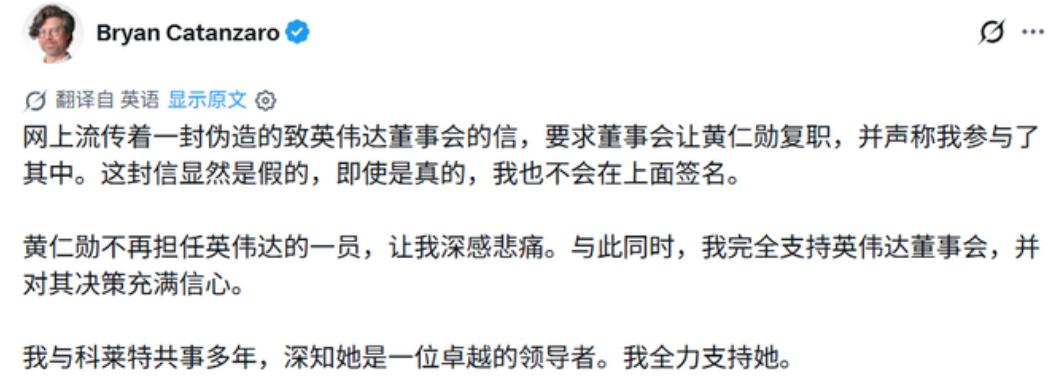
Catanzaro started his career at Nvidia. In 2013, he handwrote a neural network operator library cuDNN for CUDA, and showed the prototype to Nvidia's software team, but the software team did not value it, and Catanzaro's performance review was delayed for a long time.
With little influence, Catanzaro decided to meet Jensen Huang directly. Mr. Huang attached great importance to this project, and spent a whole weekend cramming deep learning. When the two met the next week, Catanzaro was shocked to find that his boss had taken a crash course, and his understanding of neural networks had caught up with his, even surpassing him in some aspects.
A few months later, Jensen Huang, who had deepened his understanding of deep learning, showed his domineering corporate leader style:
He called Catanzaro to the conference room, where the whiteboard was written with O.I.A.L.O. (Once in a Lifetime Opportunity). Mr. Huang told him that his cuDNN was the most important project in Nvidia's 20-year history.
Catanzaro later recalled: He asked me to imagine that he gathered all 8,000 Nvidia employees in the parking lot, and I could choose anyone to join my team.
However, Catanzaro jumped to Baidu the next year to work on deep learning speech recognition. In 2016, Jensen Huang personally called to invite him back. The first project Catanzaro worked on after returning was DLSS, which is very familiar to game players.
In a 2023 interview with The New Yorker, Catanzaro looked back on the good old days and said that Mr. Huang "scolds you because he cares about you": "I’ve been afraid of Jensen sometimes, but I also know that he loves me."
Catanzaro's career experience is also the point of view expressed by Jensen Huang's supporters: Who can replace Jensen Huang to judge Nvidia's Once in a Lifetime Opportunity?
On the day of the resignation incident, SemiAnalysis published the landmark article "Nvidia and the World Without Jensen", stating that Nvidia's supply chain advantages, customer trust system, and open source ecosystem all depend on Jensen Huang, and no successor can inherit these assets.
SA gave a very specific example: they estimated that in 2027, SK Hynix's HBM4 quote for Nvidia is $3–3.3 per Gb, while for key customers such as AMD and Broadcom, the quote is $3.7–4.1 per Gb. Without Mr. Huang, this favorable price cannot be negotiated.
SA also put forward a conclusion that would make Tim Cook want to call the police: without Jensen Huang, Nvidia will gradually become Apple-like. Although the company can still make money, the money will definitely be used to repurchase stocks instead of making bold technology bets.
Almost all supporters expressed similar views, including Trump, who bought Nvidia stocks at a high position in September. In an interview with CNBC, Trump said that the capital market only focuses on Vera Rubin, while Mr. Huang is already thinking about the next three chips.
It remains unknown why Catanzaro did not support Jensen Huang's reinstatement. Since he rejoined Nvidia in 2016, Nvidia's revenue scale has increased 66 times, and its market value has increased 100 times. I really can't figure out what dissatisfaction he could have working for such a boss.
There is no place to park the yacht? The house is too big to walk around without getting lost? Neighbors can't tell that my Porsche is the latest model? Or is the capital gains tax too high to bear?
The Young Industry
During the 11 days when Mr. Huang was out of office, American media showed their "brilliant journalism moments" one after another.
The Opinion section of The New York Times published a guest commentary by Alex Kantrowitz, with the title "Jensen Huang Is Gone. Good."
The Information founder Jessica Lessin wrote an article personally, with the title "Jensen didn't create the AI boom, it created him".

Nov 12: Charles de Gaulle once said: The graveyards are full of indispensable men.
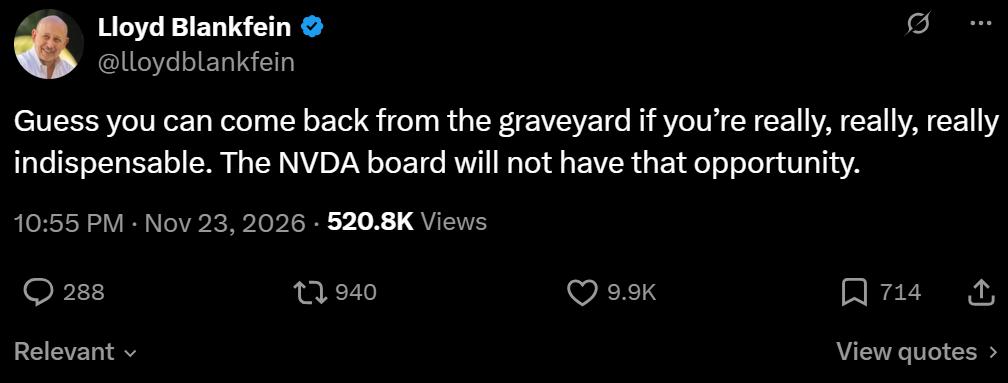
Nov 23: Fine, indispensable men can crawl out of the graveyard.
It is a topic worth discussing whether this era belongs to Jensen Huang.
Artificial intelligence is a young discipline, and its industrialization time is even shorter. There is no clear research direction in cutting-edge technology fields, and exploration in any direction will generate a large number of verifications and trials and errors. The tacit knowledge accumulated from verification and trial and error will provide reference for the next exploration, and people will gradually find the right direction.
Before the industrialization boom and the gathering of talents and capital, the choices made by the first batch of pioneers often determine the direction of the entire industry.
Geoffrey Hinton, the grandmaster of artificial intelligence, understands this truth better than anyone else.
Hinton has been fighting on the front line of artificial intelligence since the 1980s. In 2012, he went to Google as a "summer intern" to guide work. After learning the technical details of Google's deep learning project, he immediately found the flaw: they were running the wrong neural network, and using the computing power in the wrong way.
Then, Hinton took two students and two Nvidia GTX580s, dominated the ImageNet image recognition competition, and kicked off the deep learning era. Google then realized what it had missed. To bring Hinton back, Google spent a whopping 44 million US dollars to acquire the shell company that Hinton had just established.
Jensen Huang's greatest contribution is ensuring Nvidia participates in every key link of artificial intelligence industrialization.
In 2006, Nvidia launched the CUDA platform and released the first CUDA-enabled graphics card 8800GTX. Jensen Huang later explained that millions of graphics cards were sold every year at that time. If CUDA was integrated into them, the new computing platform could be promoted with the sales volume of gaming graphics cards.
In 2016, Nvidia combined eight P100 GPUs to form DGX-1, and the first unit was personally delivered to OpenAI by Jensen Huang. At the end of the year, Nvidia and Mellanox used 124 DGX-1 units to build the SaturnV supercomputer, using NVLink for communication inside the cabinets and Mellanox's solution for communication between cabinets, laying the groundwork for the subsequent acquisition.
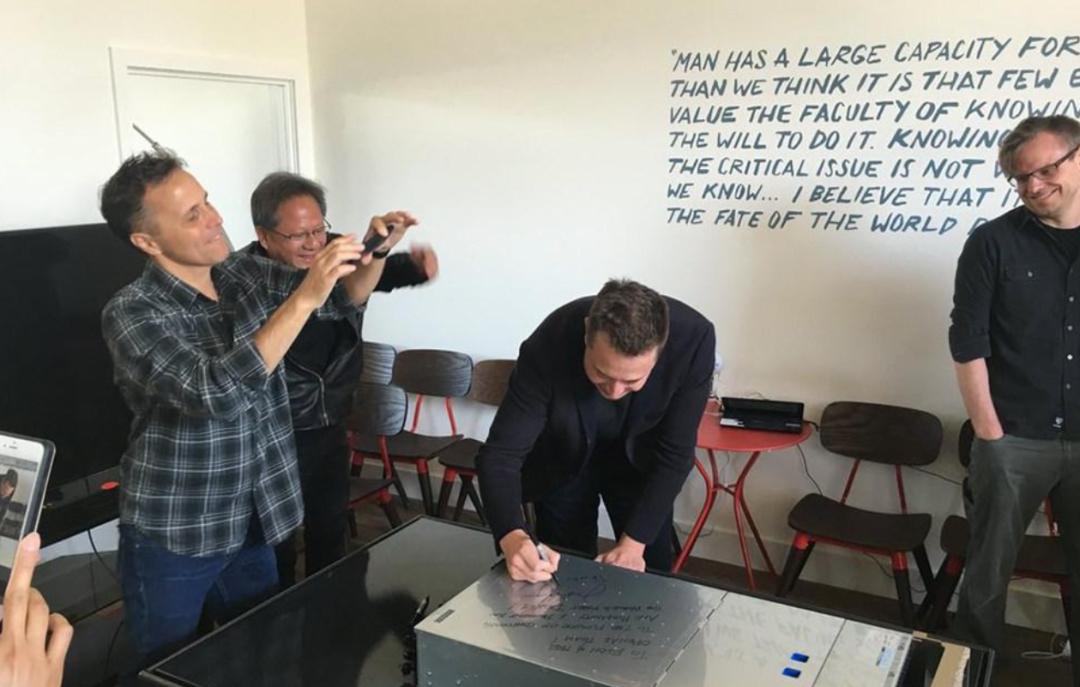
In 2016, Elon Musk signed for the DGX-1
In 2017, Nvidia launched the Volta GPU architecture designed for deep learning, which introduced TensorCore specifically for matrix operations for the first time, one month earlier than the famous Transformer paper was published.
Every major decision during this period relied on Jensen Huang's personal participation in the industrialization of artificial intelligence. When acquiring Mellanox, Mr. Huang once again showed his domineering leadership style:
The founder of Mellanox met Jensen Huang at The Ritz-Carlton, saying that several companies wanted to acquire us. Mr. Huang chatted with him for an hour, and before leaving, he told the other party: No matter how much others offer, Nvidia will give the highest bid.
Jensen Huang later recalled that many times he had already made up his mind, but in order to convince the board of directors and the management, he used every new research result and engineering progress to discuss with them, so that everyone could see what he saw. So when the acquisition of Mellanox was proposed, everyone's reaction was "Why didn't you say this earlier".
Nvidia went public in 1999, and the dual-class share structure with different voting rights was not a popular modern tool back then. After continuous equity dilution, Jensen Huang can control the company with a 3.56% stake, because he has seized every Once in a Lifetime Opportunity that belongs to Nvidia.
Some people think that Nvidia can operate well without anyone, because we already know that Nvidia's series of technology investments starting from 2006 have finally achieved amazing returns. This is just hindsight.
The so-called inevitable result is a collection of a series of accidents.
Era of Heroes
In 1927, the 5th Solvay Physics Conference was held in Brussels, leaving this famous group photo:
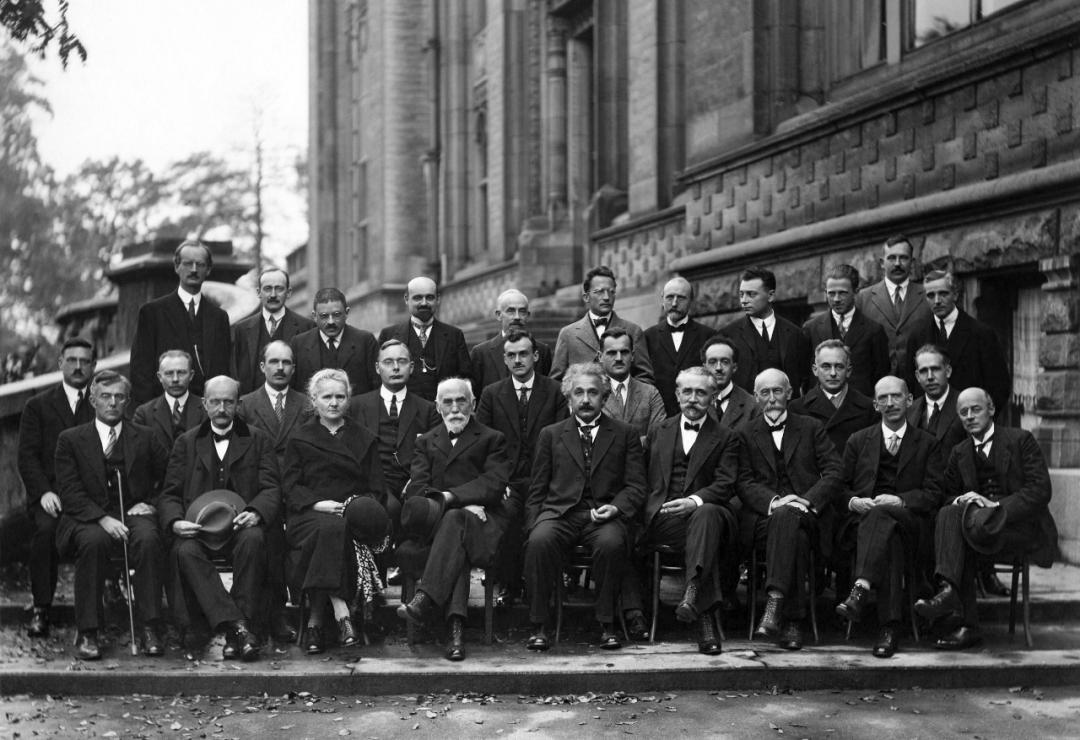
Among the 29 people in the photo, 17 of them had won or would win the Nobel Prize. All of them later became the names of physics units, theorems, and multiple-choice options in history exams.
The person in the middle of the second row is Paul Dirac. In a lecture in Italy in 1968, Dirac recalled that he and Werner Heisenberg were about the same age, and studied the same problem when they were young. He failed to solve it, but Heisenberg succeeded, which kicked off the golden age of theoretical physics:
"In the following years, even second-rate students can easily do first-rate work."
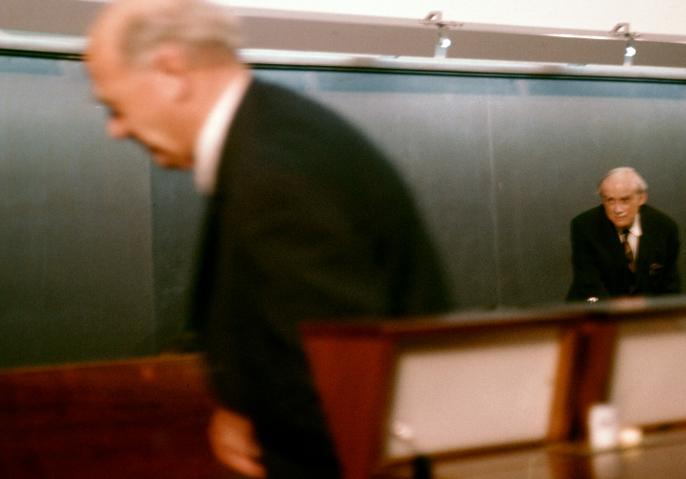
In 1968, Dirac (right) introduced Heisenberg (left), who was about to