Latest: The proof of the Riemann Hypothesis has passed independent verification!
Just now, the 76,000-line formalized Lean proof of the Riemann Hypothesis —
has passed independent verification by researchers from MIT and the University of Waterloo!
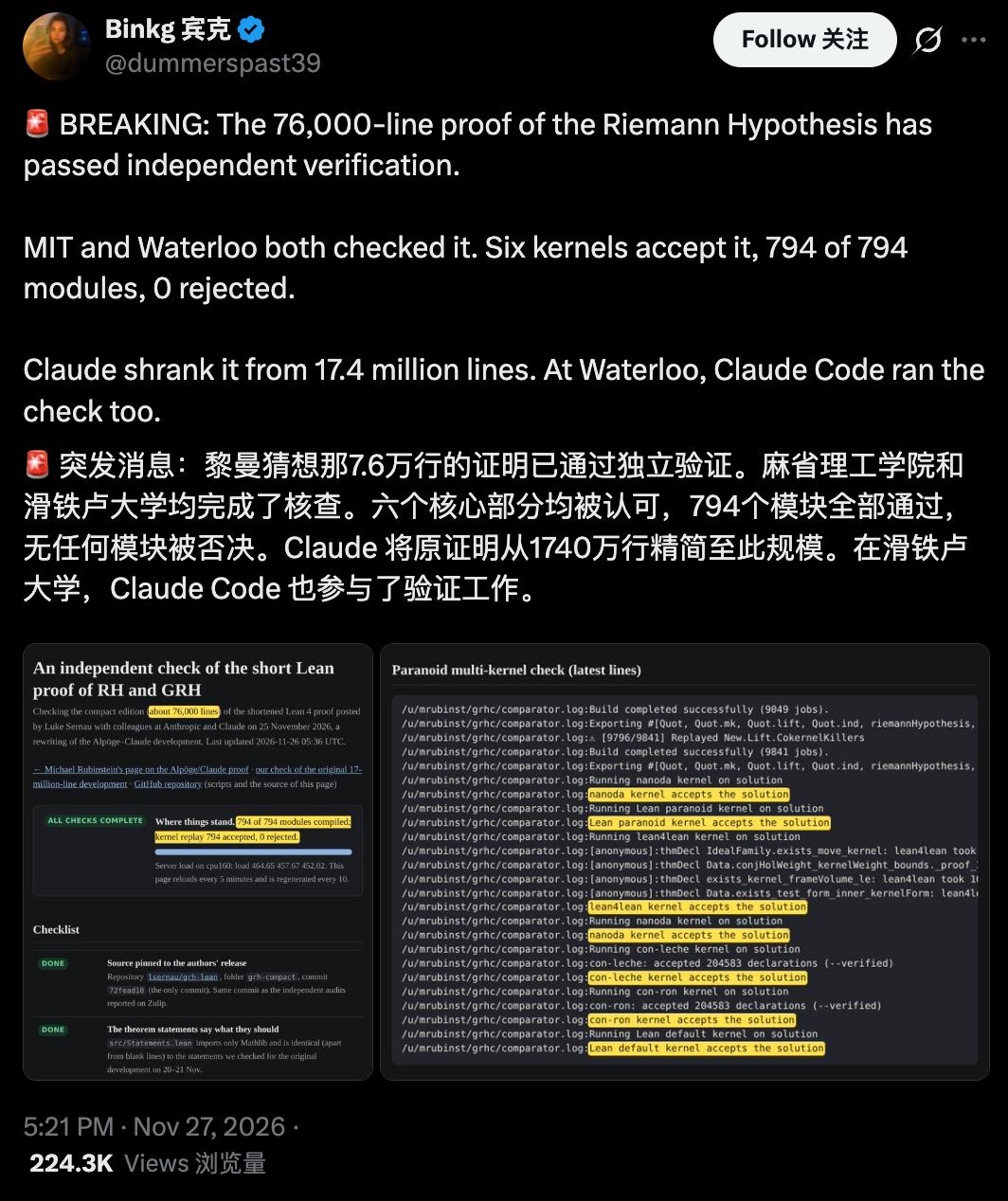
Yes, it is exactly the streamlined version released a couple of days ago.
This time, two teams of researchers downloaded the exact same copy of the code respectively, compiled it from scratch, and then cross-checked which theorems it actually proves and which axioms it depends on.
At the University of Waterloo, all 794 modules were compiled successfully, and each of them was submitted to the Lean kernel for recheck with zero rejections.
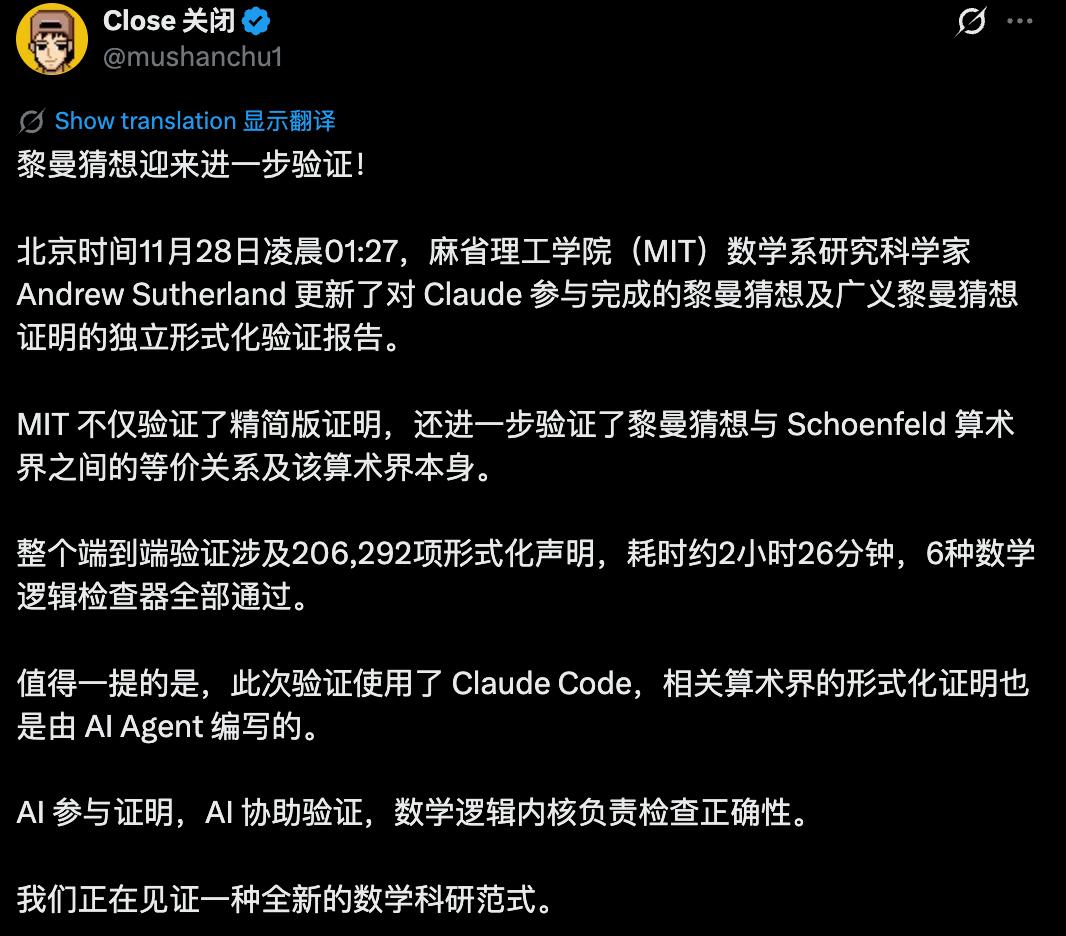
At MIT, researchers ran the full workflow twice on two separate machines.
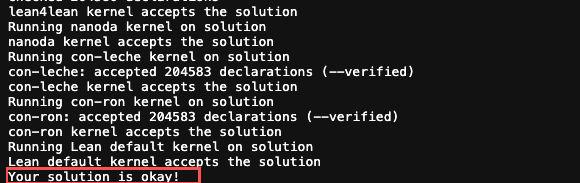
After both runs, the exact same line popped up on the screen:
「Your solution is okay!」
How did this 76,000-line proof pass independent verification?
Andrew Sutherland, a researcher from the MIT Department of Mathematics, pulled the source code of the streamlined version on two separate machines, and compiled it in an isolated offline environment.
The two machines each exported a proof file of about 5.17GB, and the results were completely identical byte for byte.

The team led by Michael Rubinstein at the University of Waterloo rebuilt all 794 modules from the source code on their own server.
So what exactly does the code prove?
Taking the Riemann Hypothesis as an example, the problem statement requires that the real part of all non-trivial zeros of the Riemann zeta function is equal to 1/2.
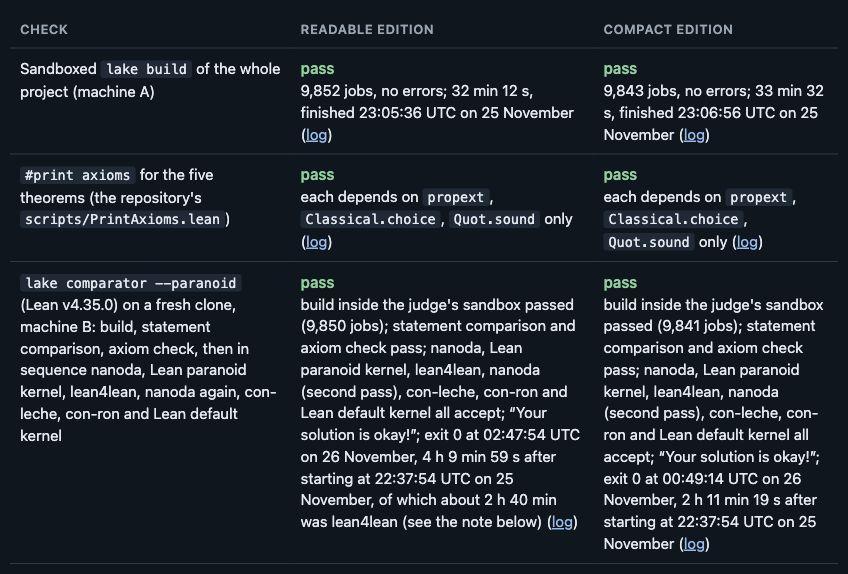
The verification tool Comparator will compare the propositions proved by the code with the separately listed problem statements one by one.
All five theorems match completely, covering the classic Riemann Hypothesis and its generalization to Dirichlet L-functions.
The inspection also confirmed that these five theorems only rely on three standard axioms of Lean.
After the problem statements are matched, it is also necessary to check whether every step of the proof can be derived from the previous propositions and inference rules.
Both teams ran the strict mode of Comparator, and submitted the exported proofs to the default Lean kernel, the strict version of the Lean kernel, as well as nanoda, lean4lean, con-leche and con-ron for recheck.
Finally, all six checks passed.
Both teams used Claude Code to assist the verification process, and tools such as the Lean kernel were responsible for checking whether there were missing steps in the mathematical derivation.
Sutherland also used this streamlined proof to derive a classic conclusion in Lean: Schoenfeld error bound.
It answers the question of what the maximum possible error is when estimating the distribution of prime numbers with a formula — this bound was given by mathematician Schoenfeld in 1976.
Sutherland first verified the relationship between the two in Lean: the Riemann Hypothesis and this error bound can be derived from each other.
In this way, with the verified proof of the Riemann Hypothesis, Lean can follow this derivation to verify whether the error bound holds.
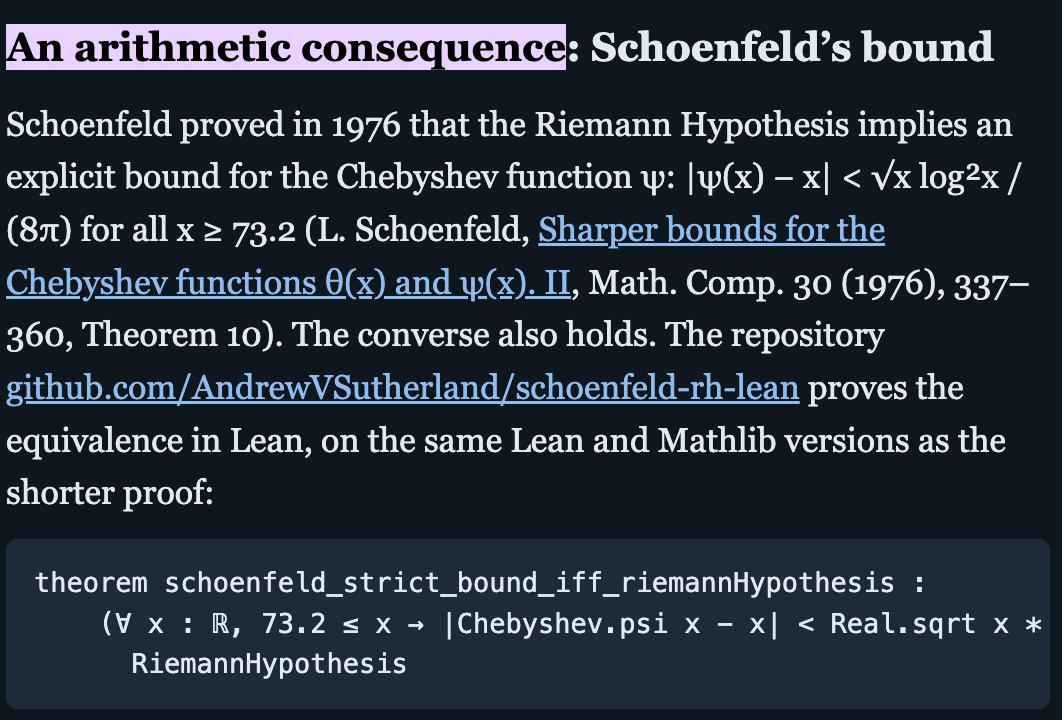
This additional verification involves 206,292 formal statements, and the end-to-end process takes about 2 hours and 26 minutes.
From the original version to the streamlined version, what is the current progress of the verification?
On November 20, the original version was released to the public.
Mathematician Levent Alpöge announced the Lean proof completed in cooperation with Claude. The original version has a total of about 17.37 million lines, containing 175,187 modules.
After that, researchers from MIT and the University of Waterloo started compiling and checking respectively.
On November 21, Lean FRO and the Mathlib Initiative issued a joint statement.
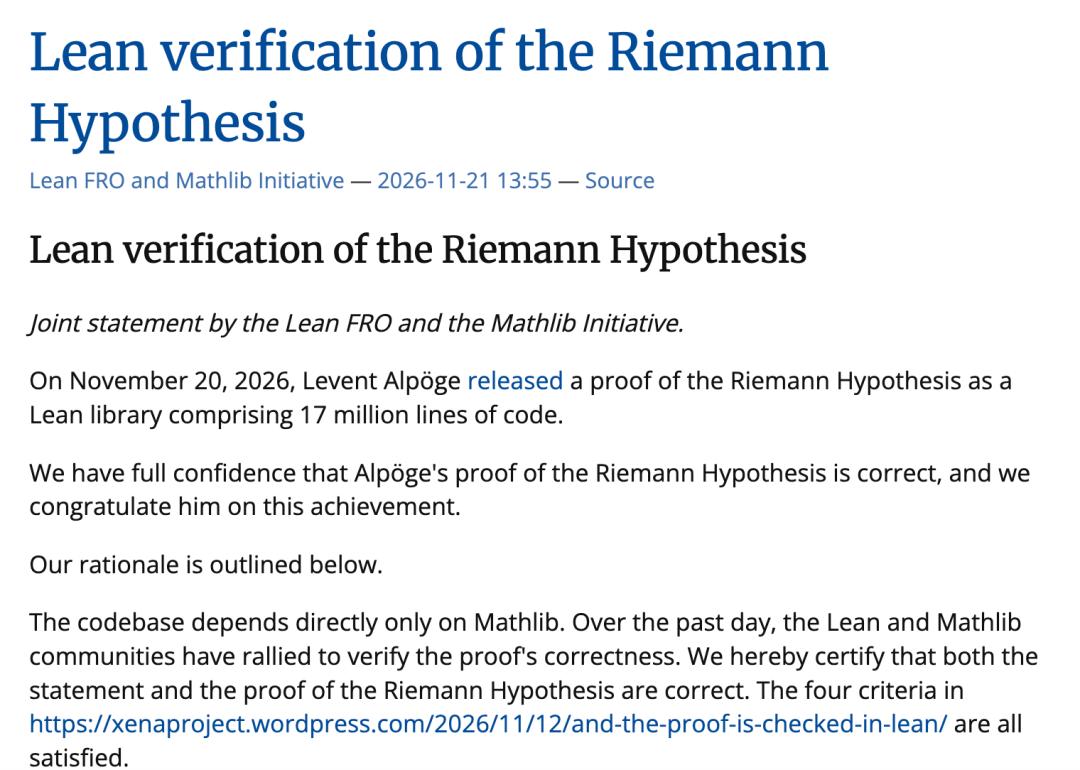
On the basis of code compilation, problem statement comparison and recheck by multiple checkers, the two parties confirmed the formal statement and proof of the classic Riemann Hypothesis in the original version.
After that, MIT completed another round of Comparator check on the original version with the standard problem statement, and all five theorems matched.
In the early morning of November 26, Beijing time, the streamlined version was released to the public.
Anthropic researcher Luke Sernau, together with his colleagues and Claude, rewrote the proof, releasing a readable version of about 300,000 lines and a streamlined version of about 76,000 lines.

On the morning of the same day, MIT successfully ran the full check of the streamlined version on two machines one after another. In the afternoon, the University of Waterloo also completed its own verification.
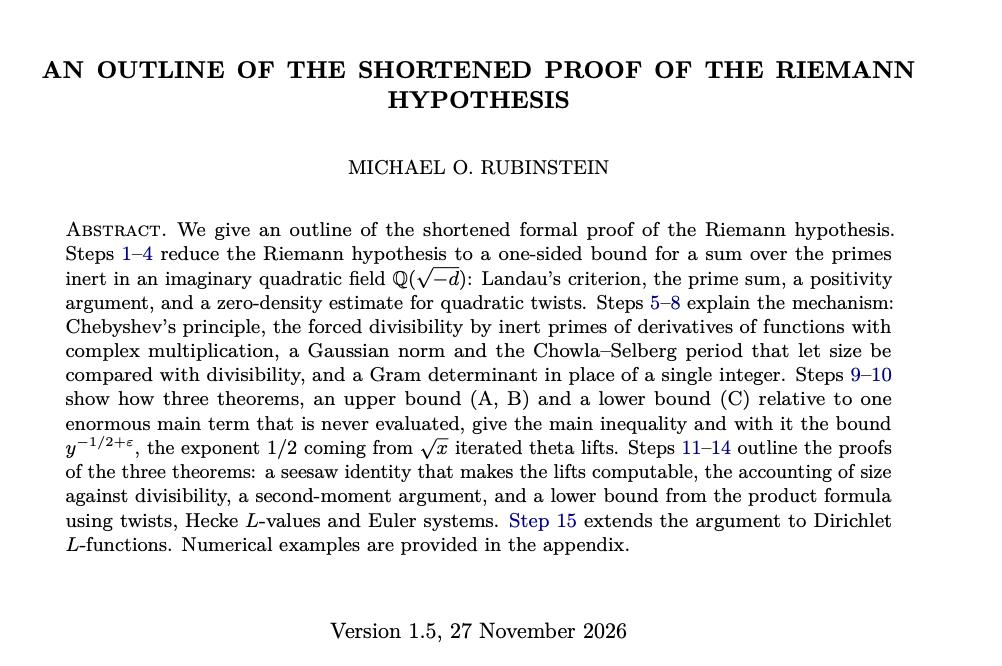
Meanwhile, Michael Rubinstein, the mathematics professor at the University of Waterloo who participated in the independent verification, also organized the main ideas of this Lean proof into a 45-page reading guide.

At present, Rubinstein has sorted out the main line of the proof, and explained how to derive the Riemann Hypothesis from three intermediate results.
As for how each of these three results is proved, the guide currently gives the general idea, but the complete derivation still needs to be found in the Lean code.
However, as of now, the official website of the Clay Mathematics Institute still marks the Riemann Hypothesis as 「Active」.

Now that the streamlined version has passed two independent verifications, mathematicians have begun to translate the derivations in the code into arguments that can be read by peers.
We are really getting closer and closer to the complete proof of the Riemann Hypothesis...

Reference links: [1]https://x.com/mushanchu1/status/2126450581724401720[2]https://x.com/mushanchu1/status/2126450581724401720[3]https://x.com/dummerspast39/status/2126244917554905423[4]https://riemannhypothesissolved.com/timeline/
This article is from the WeChat Official Account "QbitAI" (ID: QbitAI), author: Focus on cutting-edge technology, published with authorization from 36Kr.