Having raised tens of millions of yuan in financing, Rhythm Maker aims to bring material AI from the laboratory into factories.
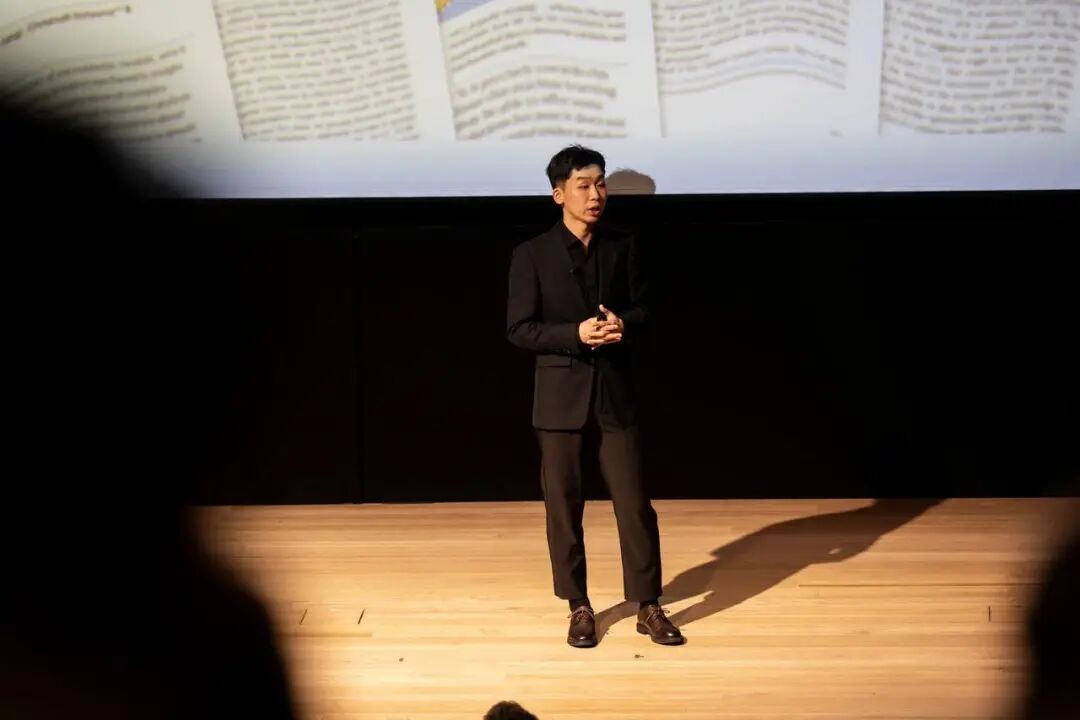
Xie Tong, Founder of Lyricz Dynamics
By | Zhao Rui
Edited by | Zhang Yuxin
In recent years, AI is evolving from helping scientists search for materials and process data, to directly participating in scientific research, and even attempting to independently design and conduct experiments. This direction is also known as AI for Science (AI4S).
Materials science is one of the fast-growing tracks in AI4S. In the past, scientists had to conduct repeated trials from a huge number of material combinations to find new materials that meet requirements; today, AI is already capable of helping predict material properties, screen formulas, and design experiments, shortening the early-stage R&D process.
However, at present, a key challenge facing AI4S in materials science is how to move from laboratory settings to industrial production.
After materials developed in the lab enter factories, the production scale may expand from several grams to several tons. The original experimental conditions such as temperature and raw material ratio cannot necessarily be directly replicated. Even if the material can be produced, factors including cost, product quality stability, and the possibility of passing downstream customers' verification still need to be considered.
AI can help scientists find promising new materials faster, but there are still high barriers to turning these achievements into real industrial production.
Lyricz Dynamics is an AI for Science company that aims to bridge this gap.
The company was registered in Shanghai in June this year. Founder Xie Tong has nearly six years of research experience in the field of AI-driven materials R&D. In 2020, when Xie Tong was pursuing his doctorate at the University of New South Wales in Australia, he began to study how to use natural language processing technology to accelerate the discovery and synthesis of nanomaterials. Since then, his research has advanced along two lines.
The first line is scientific model R&D. Starting from 2021, he and his academic team began to organize materials science research data for AI training; in 2023, he led the release of the scientific language model DARWIN, using AI to accelerate the discovery and design of new materials. In 2025, he led the R&D of the chemical reasoning model Chemist, and during this period, he also participated in the U.S. Department of Energy's large scientific model research project and the European large chemical model training project.
The second line is experimental automation. Also starting from 2021, he participated in the construction of an automated laboratory for perovskite nanomaterials, gradually replacing manual experiments with machines to improve experimental efficiency and accumulate real material experimental data.
These researches also form the foundation of Lyricz Dynamics' scientific research and technology transformation. Today, the company centers on the self-evolving material R&D software ByteScience, with supporting self-developed automated laboratory ByteFactory and underlying technical system Byte Infra, hoping that AI can not only design materials, but also participate in real experiments, and improve subsequent R&D plans based on experimental feedback.
At present, Lyricz Dynamics has completed two rounds of financing totaling tens of millions of yuan, with investors including Linear Capital, Inno Fund, Yuanqi Yicai, University of New South Wales (Wuxi) Industrial Innovation Center, and others.
From AI-Assisted R&D to Automated Experiments
In 2019, Xie Tong, who was still an undergraduate, was researching a perovskite material for solar cells.
To make the material properties more stable, he needed to constantly adjust the ratio of raw materials, prepare samples, and then verify the effect through experiments. He recalled that he entered the laboratory at 7 or 8 o'clock every morning, spent the whole morning preparing reagents, and cleaned the instruments in the afternoon, leaving only a few minutes of time to collect data.
This is also a long-standing challenge in materials R&D: the discovery of a new material requires researchers to conduct repeated trial and error, with a time cost starting from several months.
After the emergence of AI, it can predict the properties of different material formulas by analyzing existing data, helping researchers screen out more promising solutions and reduce blind trial and error. Enterprises such as Citrine Informatics in the United States and Deep Potential in China are exploring along this direction, studying how to use AI to improve the efficiency of materials R&D.
However, the fact that AI can quickly design formulas does not mean that these materials can definitely be produced. Even if samples are successfully prepared in the laboratory, repeated performance tests are required; when entering the factory, factors such as cost, quality stability and mass production conditions still need to be considered.
New problems have also prompted a number of AI for Science companies to shift their focus from material design to real experiments.
Lila Sciences, Periodic Labs in the United States, and Wuge Intelligent Research in China are all exploring the integration of AI models with automated laboratories, so that AI can not only design experiments, but also call equipment to perform experiments and adjust the next round of plans based on results. The goal of these companies is to turn AI from a tool that assists scientists in analyzing problems into a scientific research system that can participate in the entire experimental process.
Lyricz Dynamics chooses to combine the two tracks of AI-driven material design and automated experiments. They believe that the model is responsible for thinking, and the automated laboratory is responsible for execution, but these two alone are not enough. Experimental results are usually slow to obtain, expensive and mixed with noise. What is scarce is a set of systems that can convert experimental results into model learning signals, making AI smarter as it conducts more experiments.
At present, Lyricz Dynamics has developed a material R&D system consisting of scientific models, automated laboratories and underlying infrastructure.
According to its introduction, the core product ByteScience is a set of AI material R&D tools, and also a self-evolving "AI scientist". Composed of a large scientific model and Agent Harness, it can screen formulas, design experimental schemes according to customers' requirements for material properties, costs and other aspects, and generate new scientific ideas from the results of each round of experiments.
In addition to software, the company has also built the ByteFactory automated laboratory, which uses robotic arms, material synthesis and testing equipment to prepare real samples from AI-designed formulas and verify their properties.
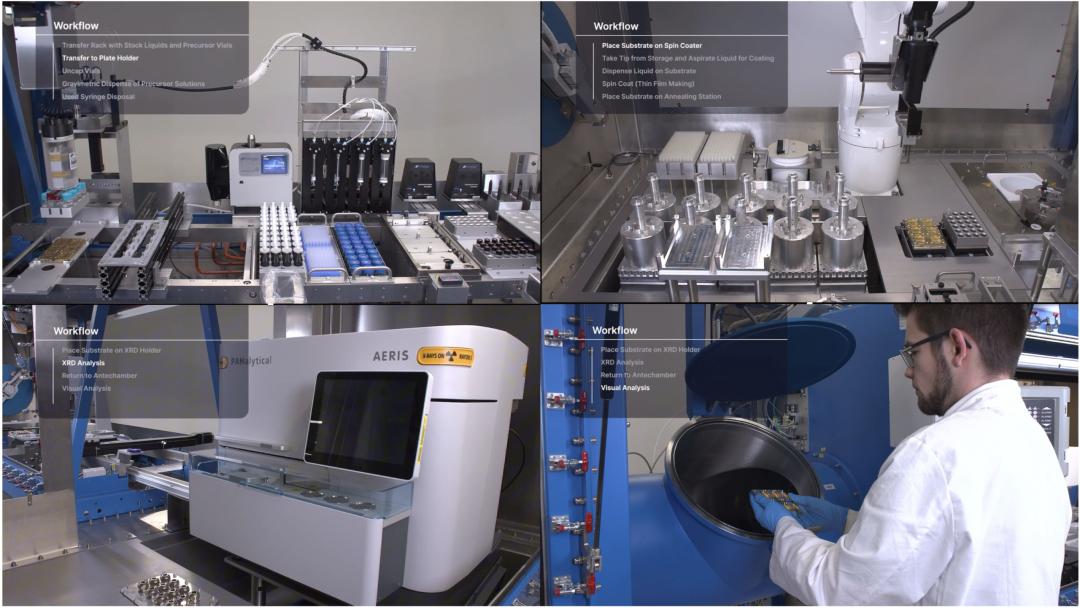
Lyricz Dynamics Automated Laboratory
Connecting the two is Byte Infra, the base of the entire system. It is responsible for scheduling models and experimental equipment, converting the continuously returned experimental results into signals that the model can learn from, and improving the model with feedback from each experiment.
From material R&D software to automated laboratories, it also corresponds to two commercialization paths in the material AI industry: one is to sell R&D tools to enterprises to help customers improve efficiency; the other is to go deep into the material R&D process, jointly develop pipelines for preparing new materials with customers, and share subsequent commercial benefits.
Lyricz Dynamics is currently exploring both models at the same time.
For material enterprises with mature production lines, the company mainly provides the ByteScience software system to help them speed up the formula iteration of existing products; for customers who need to develop new materials and enter new markets, the company uses ByteScience and ByteFactory to complete the pilot synthesis and testing of materials, and then the customer will advance the pilot scale-up, mass production and downstream verification. The two parties jointly bear part of the R&D investment, and Lyricz Dynamics will get a share of subsequent material sales orders.
According to Xie Tong, Lyricz Dynamics has completed a ten-million-yuan level commercial order from a customer with a ten-thousand-ton production line, and helped partner enterprises promote the mass production of multiple materials in new application scenarios.
Through this system, Lyricz Dynamics hopes to change the speed and R&D method of material design. The process will evolve from AI providing formulas and scientists adjusting through experiments, to AI independently proposing solutions, completing experiments, and continuously improving based on real results.
From Laboratory to Factory, What Else Does AI Need to Learn?
For material AI companies, designing a material with excellent performance is only the first step. Whether the material meets the real industrial production environment and can be scaled up for mass production is another difficult problem.
This is also where Lyricz Dynamics hopes to differentiate its AI material models from others.
Xie Tong believes that scientific papers and theoretical calculations can help AI understand the properties of materials, but they may not tell it exactly how a material should be manufactured in a factory.
For example, a material can be synthesized in the laboratory, but when placed on the production line, it may be restricted by factors such as equipment temperature, production scale, cost and environmental protection requirements. These specific conditions usually can only be understood by entering real industrial scenarios.
To this end, Lyricz Dynamics has gradually accumulated three types of data in past researches.
The first type comes from public scientific research materials. Since 2021, Xie Tong and his academic team have been organizing information such as material papers, patents and experimental charts, converting them into data that AI can learn, to help AI understand the composition, properties and preparation methods of materials.
The second type comes from real experiments. In the early days, the team participated in the construction of an automated laboratory for nano-film materials, gradually replaced manual operations with machines, and recorded a large number of successful and failed experimental results. These data can help the model understand which material solutions are not only theoretically feasible, but also likely to be prepared in experiments.
The third type comes from industrial customers. Compared with scientific research experiments, factories have more practical requirements for materials. In addition to performance, enterprises also need to consider whether existing equipment can produce the material, whether the cost of raw materials is acceptable, whether product quality can remain stable, and whether the material can pass the testing of downstream customers.
Xie Tong introduced that Lyricz Dynamics will learn about these practical restrictions through cooperation with material enterprises and their upstream and downstream partners, and collect experience from equipment engineers and industry experts. Customers can provide standards for whether a material can be used, and also help AI eliminate some solutions that do not meet production requirements at the design stage.
In order to generalize capabilities to different materials and customers, Lyricz Dynamics develops models and experimental equipment around the material process system, rather than a specific material. At present, Xie Tong said that it has established strategic cooperation with several leading international chemical enterprises, the first batch of cooperations has entered the stage of commercial acceptance, and nearly 10 AI-natively developed materials have achieved mass production.
The next step Lyricz Dynamics hopes to achieve is to further systematize this accumulated experience.
The company is exploring closer collaboration between ByteScience and ByteFactory: AI proposes material solutions, the automated laboratory performs preparation and testing, and then feeds the experimental results back to AI to help it adjust the next round of solutions. The underlying Byte Infra is responsible for connecting these links, and exploring how to make the model continuously evolve in experimental feedback.
According to Xie Tong's vision, after completing each round of material R&D in the future, AI will not only be able to find a better formula, but also accumulate experience from it to help the next R&D process.
This is also the competitiveness that Lyricz Dynamics is trying to build: it is not just an AI tool that can design materials, but through long-term experiments and industrial cooperation, AI can gradually master the experience from material design to actual manufacturing in the real material R&D process of the industry.
AI for Science Needs Its Own Infra
In early 2025, when Xie Tong and his team were training the large model Chemist, they found that the model often crashed halfway through training.
At first, the team repeatedly adjusted parameters and retrained. Sometimes they tried more than ten or twenty times to find a set of relatively feasible training parameters. Later, they gradually found that the problem was not only in the model itself, but also related to the previously used Infra (underlying system).
Current large model training systems are mainly designed for tasks such as programming and mathematics. The characteristic of these tasks is that AI can get feedback quickly. For a piece of code, you can run it to see if there are errors; for a math problem, you can also check the answer quickly.
But if the material designed by AI is a new material, the situation is completely different. The material can only get results through real experiments. And different materials require different experimental time: some can be completed in a few minutes, while others take several hours.
This means that the speed at which AI designs materials is far faster than the speed at which the laboratory verifies materials.
This difference brings a dilemma to model training: if you wait for all experiments to finish and then use the results to train the model uniformly, a lot of waiting may occur, slowing down the training progress; but if the experimental results are returned one after another to participate in training, the model may have been updated, and the earlier feedback is different from the current model, which will further cause training instability or even crash.
Therefore, to allow AI to truly learn continuously from material experiments, it is not possible to simply copy the past training methods. It is also necessary to transform the underlying system so that the model can efficiently and stably use these experimental results returned one after another.
In March 2026, Xie Tong and his team decided to carry out targeted transformation on the original infra, and later set up a dedicated Infra team.
On the one hand, they readjust task scheduling and computing resource allocation to minimize unnecessary waiting and resource conflicts between tasks; on the other hand, they reduce the risk of severe fluctuations during model training by removing abnormal training signals and controlling the magnitude of parameter adjustment in each round.
The team continued to conduct tests on graphics cards to find a more stable training method. According to Xie Tong's estimation, the stability of related training has been improved by about 10 times compared with half a year ago. This project has gradually become the technical base of Lyricz Dynamics: Byte Infra.
Xie Tong believes that as AI begins to enter real laboratories, the training systems that were mainly designed for the digital world in the past cannot directly meet the needs of scientific research. In his view, what scientific AI needs to solve next is not just how to make the model propose more experimental schemes, but how to obtain reliable experimental feedback at lower cost, and let the model truly learn from it.
This also means that building an automated laboratory does not mean completing the closed loop of AI R&D.
If the machine only conducts experiments according to AI's requirements and then saves the results, what is mainly improved is the experimental efficiency. Xie Tong hopes to go a step further, allowing experimental results to truly participate in the next round of model training, so that AI can not only know where the problem is in this plan, but also make better judgments when encountering similar tasks in the future.
At present, the partial improvements achieved by Lyricz Dynamics are mainly concentrated at the software level, and the complete closed loop of experiment and model training is still under construction. Recently, the team also jointly released a feedback system for large model training, AISLE (AI Scientists' Last Exam), with dozens of top AI4S laboratories around the world.
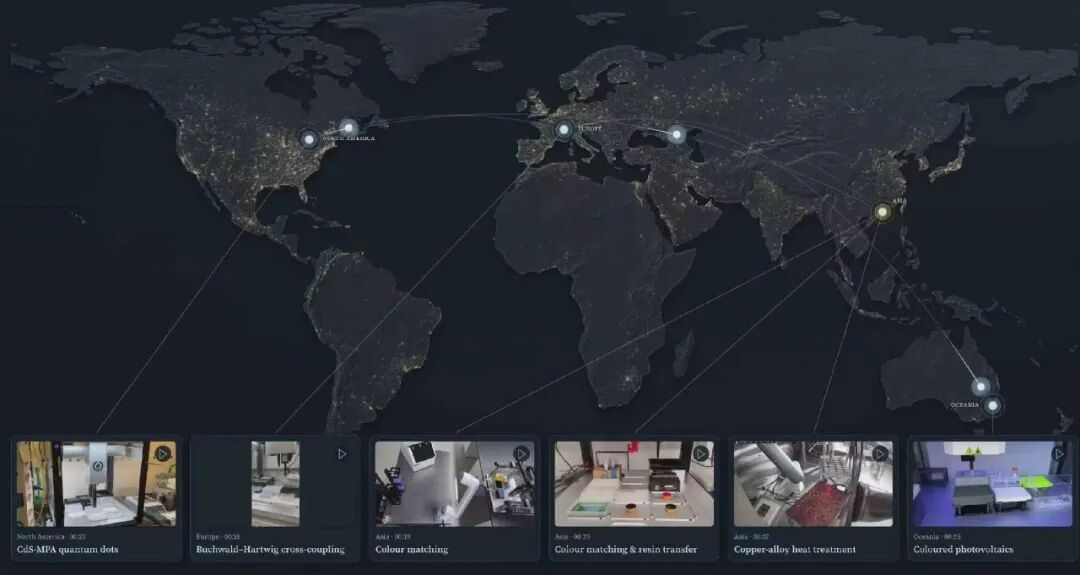
AISLE's Global Automated Laboratory Network
The general large model training system is designed for digital world tasks such as programming and mathematics that can quickly get virtual feedback. This closed loop is a self-developed exclusive iteration system adapted to AI for Science by Lyricz Dynamics, targeting the feature that material AI needs to rely on real physical world experiments to obtain slow feedback.
This is not just to let