Jiang Peng, Co-founder & CEO of Honghu Future Energy: The Underlying Infrastructure of AI Infra — Leveraging the stellarator to provide ultimate energy for AI and humanity | 36Kr 2026 WISE King of Business Summit
In the business world of 2026, the focus is shifting from "judging trends" to "answering questions". From November 26 to 28, 36Kr held the WISE2026 Business King Summit with the theme "Call Me By My Name" in Yizhuang, Beijing. This marks the 14th year of the event, and for the first time, we have extended the session to three days, aiming to return the leading role in business back to specific individuals and enterprises in an era where speed has become the norm.
This year's WISE is no longer a traditional industry summit, but a recalibration of business narratives: from the establishment of the Embodied Intelligence Industry Alliance where participants from the upstream, midstream and downstream of the industry sit at the same table for the first time, to solo entrepreneurs taking the stage and Gen Z geeks sharing their hackathon experience — we hope to present not only trends, but also the repeatedly verified answers that have been proven on the front line of the industry.
As AI moves from the cloud to the physical world, related demands are extending downward: under the model lies computing power, and under computing power lies energy. In this discussion about "answers", some are answering what AI can do, while others are answering what AI relies on to operate. The answer given by Honghu Future Energy is to build "the Infra of AI Infra" — using stellarators to supply clean, nearby and continuous ultimate energy for AI and human beings, while leveraging AI to accelerate every iteration on this path. On stellarators with extremely complex design spaces, this acceleration effect is further amplified, making it no longer necessary to wait 50 years for fusion to generate real power.
Next, 36Kr, as a faithful on-site recorder, will fully document all the speeches delivered on the stage during these three days — every name mentioned deserves to be recorded word for word.
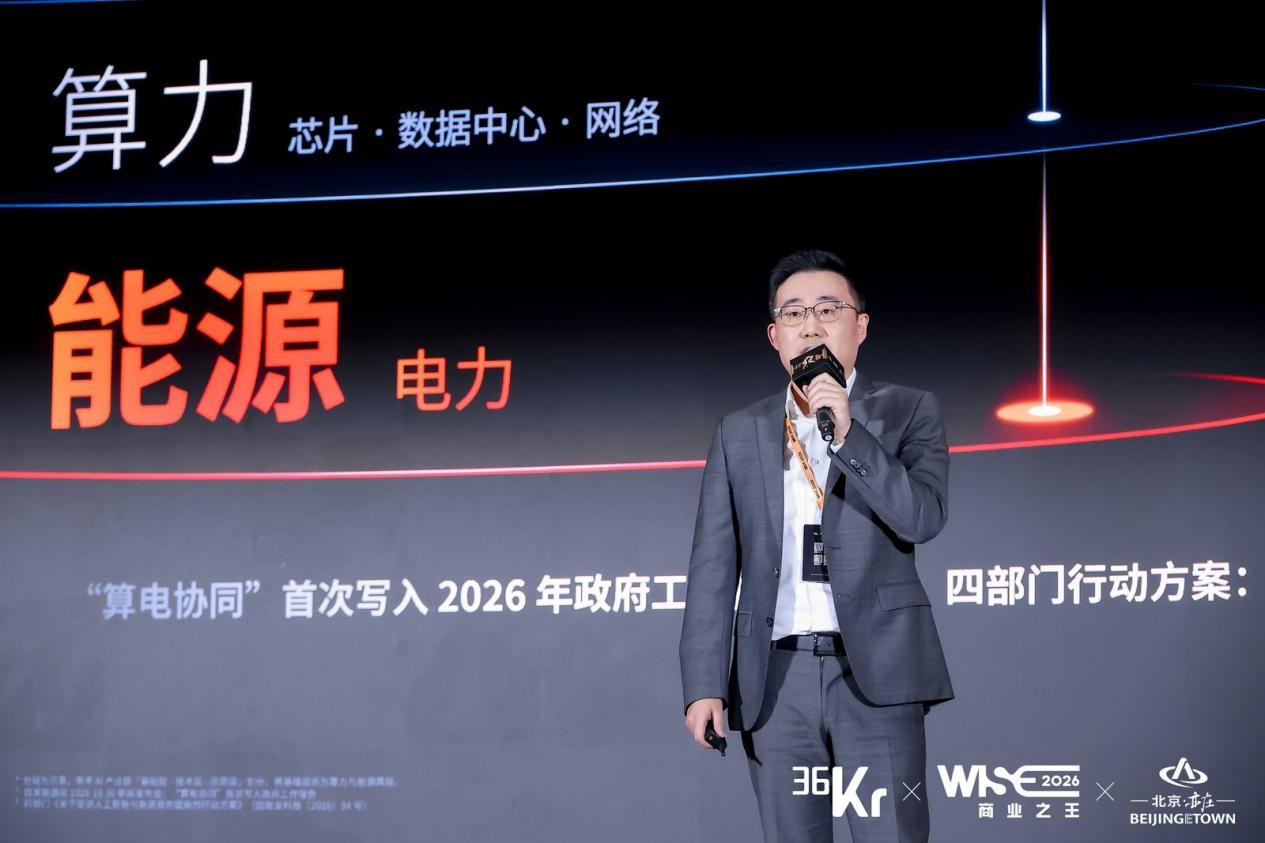
Speaker: Jiang Peng, Co-founder & CEO of Honghu Future Energy
Thank you for the invitation from 36Kr. Good afternoon everyone, I am Jiang Peng, Co-founder and CEO of Honghu Future Energy.
The theme of my sharing this afternoon is — The Infra of AI Infra: Using Stellarators to Supply Ultimate Energy for AI and Human Beings.
First let's take a look at what Honghu Future Energy is doing. To make an analogy, what Honghu is doing is creating a power-generating star on Earth. Our product is a high-temperature superconducting stellarator. As the name suggests, a stellarator is a machine that mimics stars: it uses a magnetic field to create a "cage" that stably confines fuel at hundreds of millions of degrees Celsius, so that it continuously generates heat and electricity just like a star.
As AI is gradually moving towards the physical world, previous speakers this afternoon have also shared topics about autonomous driving and robots. I would like to share with you what is happening at the very bottom layer, the energy layer.
If we make a simple layered diagram of the AI industry, the top layer is applications, the next layer is models, followed by the traditional AI Infra including computing power, chips and data centers. The bottom layer is energy and power, which we call the Infra of AI Infra.
This year, the government work report included the "coordination of computing power and power" for the first time. Four government departments including the National Development and Reform Commission and the National Energy Administration also issued the Action Plan for Promoting Two-Way Empowerment of Artificial Intelligence and Energy, to strengthen the fundamental supporting role of energy for the development of artificial intelligence.
It is widely acknowledged that energy can support the development of AI. Today I would like to highlight another point from the action plan: to give full play to the superimposed and multiplier effect of artificial intelligence on energy transition, that is, to use AI to empower the transformation and development of the energy industry.
From the perspective of Honghu's actual practice, we have already seen that AI has played a significant accelerating role in fusion R&D, especially in the design of stellarators.
Back to AI, what should the ideal energy look like? We have three keywords as the answer: clean, nearby and continuous.
Clean means converting green power into green computing power. The Chinese government requires that the proportion of green power consumption in newly built data centers at hub nodes should be further increased on the basis of 80%.
Nearby means that as AI moves deeper into the physical world, some AI application scenarios need to be closer to users, with increasingly higher requirements for low latency. According to the relevant action plan for national computing power infrastructure, the latency between important computing power facilities in urban areas should not exceed 1 millisecond, and services such as telemedicine and AI inference also need to be deployed close to users. As computing power moves towards customers, the corresponding power supply also needs to be close to the computing power.
The third keyword is continuous and all-weather. According to the 2026 annual outage analysis of Uptime Institute, an international data center research organization, 45% of the most serious outages experienced by surveyed data centers in 2025 were caused by power problems. What AI needs is not just power, but stable and continuous power.
Combining the three keywords together, let's see what the answer is. Honghu believes that the magnetic confinement fusion stellarator route is expected to become one of the ultimate energy solutions for AI and even all human beings.
There are three reasons for this.
The first is cleanliness. The fusion process does not emit carbon dioxide, and the fuel deuterium can be extracted from seawater.
The second is proximity. Because fusion has an extremely high energy density, the energy released by 1 gram of deuterium-tritium fusion fuel is equivalent to that of about 8 tons of petroleum or more than 10 tons of coal. It is not limited by physical transportation conditions and can be deployed nearby. At the same time, the reaction threshold of fusion is very high: once the conditions are not met, the reaction will stop automatically and will not get out of control, so it has the potential to be deployed close to end-user computing power.
The third is continuity and stability. Fusion has many technical routes with their own advantages. Among them, the magnetic field of the stellarator is completely generated by external coils, which does not rely on plasma current for maintenance, making it naturally suitable for long-term steady-state operation.
At present, leading stellarator experimental devices abroad, such as Germany's W7-X, have achieved long-time plasma discharge of about 8 minutes. Combining the three advantages of cleanliness, proximity and steady-state operation, the stellarator is expected to become one of the ultimate energy solutions.
Stellarators also have their own difficulties. The whole device is very complex, with 3D high-temperature superconducting magnets, which brings certain challenges to the design. The stellarator is indeed more complex than other technical routes in the design and construction stages.
But the advantage is that once the design and construction are completed, the subsequent operation will be more stable. To sum up: the difficulty lies in design and construction; the reliability lies in long-term operation.
The advent of AI has accelerated the development of the entire fusion industry. In the past, people often asked a question: do we still need to wait 50 years for fusion? Honghu's answer is that we don't need 50 years, and this timeline will be greatly shortened. On the one hand, there is a double helix mutual empowerment relationship between the fusion stellarator route and AI: fusion supplies ultimate energy for AI, and AI accelerates every iteration of fusion technology.
Therefore, the combination of fusion and AI is not a simple addition, but a multiplication effect. Before the emergence of AI, people thought it would take a very long time, and a very important reason was the iteration speed. Each iteration of fusion would take several years just for design, and require an investment of tens of billions of yuan, making the speed extremely slow. The emergence of AI has changed this iteration process and accelerated the occurrence of iterations.
Some progress has already been made. For example, DeepMind used AI to control high-temperature plasma in fusion, which was published in the journal *Nature*. This year, the National Natural Science Foundation of China listed "AI-accelerated optimal design of stellarators" as a key support direction. The Honghu team recently published a paper on using AI to design stellarators, and has just obtained the AI stellarator design project from the Shanghai Science and Technology Commission. In the words of our team, in the past, fusion research was more like driving a car, but now with the help of AI, it is more like riding a rocket. We no longer need 50 years in the future, and we expect that controllable fusion power generation will become possible in 10 to 20 years.
What is Honghu doing in this process? Honghu hopes to finally realize stellarator power generation through three generations of machines. We did not start from scratch. At present, we have manufactured a full-size high-temperature superconducting stellarator test magnet, and won the 2026 Industry Fair Innovation Leading Award. This means that the "skeleton" of our stellar device has been completed. The first-generation device "Honghu Zhiyuan No.1" is planned to be completed and put into operation in 2028.
The high-temperature superconducting stellarator needs to solve one problem: to make the "star" light up and keep burning stably.
The second generation is an engineering verification device, whose goal is to make the output energy exceed the input energy. It aims to solve the problem of making the stellarator not only light up, but also economically viable to operate.
The third-generation device is a power generation demonstration reactor, which needs to solve the problem of usable power generation. It will be connected to the power grid for demonstration power generation, then move towards commercial power generation, and finally supply ultimate energy for AI and all human beings. The data accumulated behind each generation of devices will be fed back to AI to support the design of the next generation of devices.
This path is not short. Why can Honghu complete this path on its own? The answer lies in three advantages: professional team, high speed and high accuracy.
Professional team: Honghu is a newly established company, but our team has deep roots in this field for a long time. Honghu is led by international fusion scientists who have been deeply engaged in the field of nuclear fusion for decades, with profound academic and scientific research accumulation in China, the United States and other regions around the world.
Our team, especially the R&D team, has been engaged in fusion research for more than ten years. The whole team has four characteristics. The first is full-chain capability: to realize the final implementation of the device, we have mastered full-chain capabilities covering design, high-temperature superconducting magnet manufacturing, general assembly of engineering and experiments.
The second characteristic is that we are a practice-oriented team. Our members have participated in the design, construction and operation of large-scale fusion devices at home and abroad, including the ITER (International Thermonuclear Experimental Reactor) program.
The third characteristic is strong computing capability. In addition to practical experience, we have the world-leading, self-developed first-principles simulation program GTC, which can help us simulate the physical processes inside the stellarator at low cost. Now we have started to use AI to design stellarators.
The fourth characteristic is the integration of industry, university and research. We have in-depth cooperation with the Institute for Future Energy of Shanghai Jiao Tong University, and jointly built the "Shanghai Jiao Tong University - Honghu" joint laboratory, where schools and enterprises cooperate to tackle key problems in the optimization and implementation of the "Honghu Zhiyuan No.1" stellarator.
High speed: why can AI accelerate stellarator research?
Let's take an example. The left side shows the comparison of two devices with different technical routes. Tokamak, the current mainstream technical route, is a bit like a "doughnut". If you cut it from the middle, every cross-section is the same, and only a few parameters are needed to describe its configuration. A stellarator is a bit like a twisted ring made of fried dough twist. If you cut it from the middle, every cross-section is different, which means it requires hundreds or even thousands of parameters to describe, making it extremely complex.
AI helps us converge the whole design to the most feasible final solution, which is a bit like looking for a needle in a haystack.
Specifically, the process is divided into three steps.
The first step is to narrow down the scope: AI reduces the more than 700 parameters describing the configuration to three key dimensions, removes the parameters that are not suitable at the very beginning, speeds up the screening, and shrinks the "sea" into a "pond". The second step is fast calculation: originally, evaluating a configuration required large-scale GPU computing for more than ten hours, but now using our deep learning surrogate model trained with more than 15,000 sets of GTC global simulations, we can compress this time from more than ten hours to a few seconds. In the last step, we check more than ten physical indicators one by one for the screened configurations. We have also developed AI agents to complete the initial screening, which gives results to support automatic iteration.
At present, we have a complete set of agents assisting our experts in the overall design of the entire design process, to accelerate the design process.
It is also a problem whether the configuration designed theoretically can be applied in the real world. Our principle is: leave the speed to AI, and leave the accuracy to physics. We have set up two checkpoints. The first checkpoint is quality inspection in the virtual world. Our team has self-developed the GTC program, which is a parallel device that can simulate the physical processes of the real world in the virtual world. We first run the simulation through GTC to check whether it can meet the requirements of physical parameters.
This shows one of the configurations, which is used to observe the phenomenon of microscopic instability through GTC.
After the virtual quality inspection, we go back to the physical world to build a real model. We have manufactured a 1:1 high-temperature superconducting double-pancake coil unit, completed liquid nitrogen tests and 4 thermal cycles, and then completed the development of the full-size test magnet. In the future, we will build the "Honghu Zhiyuan No.1" high-temperature superconducting device to better verify each configuration we design. The data generated in the whole process will be fed back to the AI model to accelerate the iteration of the entire device design.
Let me briefly summarize our judgments.
There are three core judgments.
First, AI requires ideal energy that is clean, nearby and continuous. Controllable fusion and stellarators are likely to become one of the solutions to supply ultimate energy for AI and human beings. The multiplication effect of fusion and AI makes it no longer necessary to wait 50 years on this path.
Honghu's confidence comes from our three advantages: professional team, high speed and high accuracy. We believe we can achieve the final goal.
Finally, I would like to invite everyone to prepare the ultimate energy for AI and human beings together. We welcome cooperation with Honghu to define the effective intelligence per megawatt, open up part of the design benchmarks and data, and carry out cooperation in computing power and data, to cultivate interdisciplinary talents who master both physics and AI.
Honghu's mission is to provide clean, zero-carbon, all-weather and stably supplied energy for China and even the whole world, and reshape the paradigm for human beings to obtain energy.
Finally, we hope to work with partners across the entire industrial chain, under the guidance of national policies, driven by AI and technological innovation, to contribute to a cleaner and more abundant future. Thank you all!