The post-90s mathematician who used Claude to prove the Riemann Hypothesis has received a death threat.
The Anthropic mathematician Levent Alpöge, who solved the Riemann Hypothesis with 17.37 million lines of Lean code, has just publicly stated on X:
He has received death threats.

After the proof was made public, a flood of comments poured into his X posts, each receiving hundreds to thousands of replies, with opinions sharply divided between praise and criticism.
Some say he has made a groundbreaking, era-defining achievement, while others call him a thief who is helping AI subvert his own discipline, which is deeply offensive.


Others argue that it was Claude that proved the Riemann Hypothesis, and Alpöge simply pulled the trigger.

So who exactly is this person who cracked the Riemann Hypothesis?
Levent Alpöge, 34 years old, works at Anthropic.
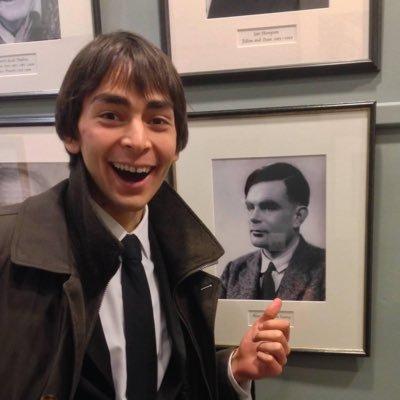
He graduated from the Department of Mathematics at Harvard University with the highest GPA in his cohort, won the Morgan Prize for his undergraduate thesis, later obtained a PhD in mathematics at Princeton University, and can speak six languages...
He was also one of the two people who once tried to solve the Navier–Stokes problem, only to have the proof of that hard problem released earlier by OpenAI.
Why was it him that conquered the Riemann Hypothesis? How did he do it?
How did Alpöge break through the Riemann Hypothesis?
Around 4 a.m. on November 20, Alpöge returned to his temporary residence in New York City.
It was almost done. He could finally go to sleep.
He had not slept for days in order to prove the Riemann Hypothesis. In fact, many of his collaborators had also noticed this issue: he barely slept.
That very night, he uploaded the 17 million lines of code that broke through the Riemann Hypothesis. A few hours earlier, Anthropic had just completed its IPO, setting the highest valuation in stock market history, which made Alpöge an overnight millionaire.
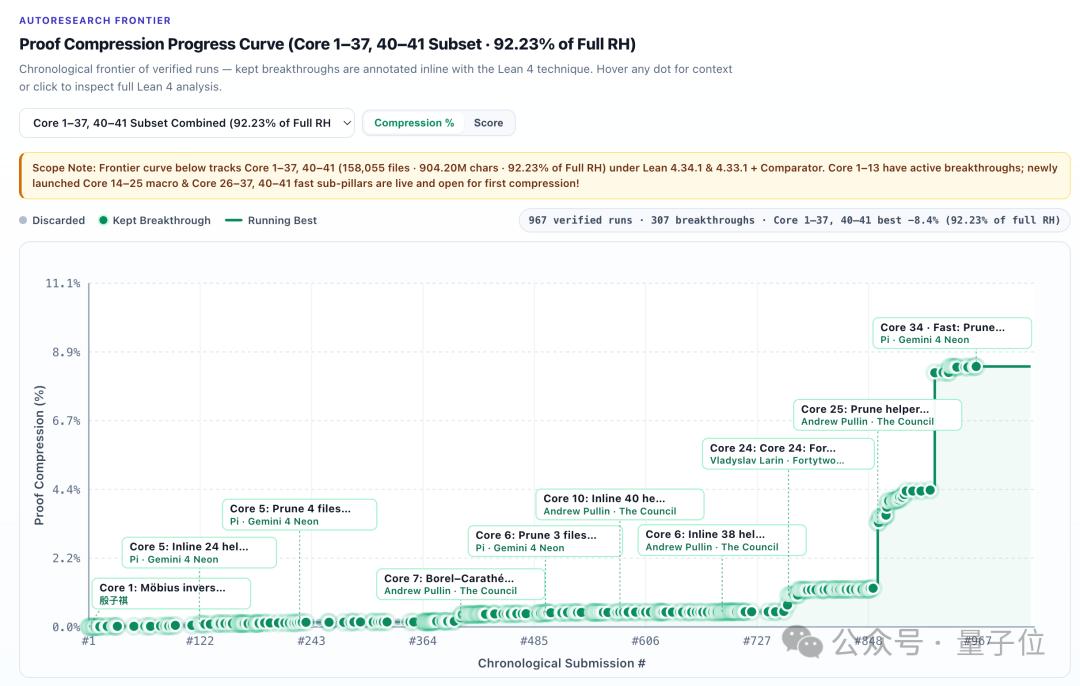
△ Compression progress of the Riemann Hypothesis Lean code
Once the code upload was completed, he would immediately become one of the most famous mathematicians in the history of mathematics.
The Riemann Hypothesis was first proposed by mathematician Bernhard Riemann in 1859. The conjecture holds that the positions of prime numbers that appear seemingly randomly on the number line are actually determined by a complex and meaningful pattern.
Since then, this conjecture has become the North Star of the entire field of number theory, as well as the most famous unsolved mystery in the mathematics community.
In 2000, the Clay Mathematics Institute, which funds mathematical research, announced seven "Millennium Prize Problems", each with a $1 million reward, and the Riemann Hypothesis was one of them.
Progress in solving the Riemann Hypothesis has also been quite slow, and most top experts hardly spend much time actually studying it, because there is no clear path to prove the Riemann Hypothesis at present.
How long did it take Alpöge and Claude — the peak of human intelligence and the pinnacle of current artificial intelligence — to join forces to crack the Riemann Hypothesis?
Six weeks.
In the self-statement published along with the code, Alpöge made this timeline public:
The following is a rough timeline provided by Claude after a thorough search.
2026/10/6: Stepanov determinant.
2. 2026/10/9: For p inert in K, Dp ≡ 0 on CM curves, where D is the invariant derivative; and D_a − θ(0)/Ω_a is divisible by p^a + p^(3a) + ⋯ − O(log a).
3. From 2026/10/19: qN = Mk + R, using x₁·x₂ + ⋯ + x_{k−1}·x_k; hoping N has "automorphy", since µ is automorphic via θ (as the period integral of theta) on the six-fold cover of GL₅; quadrics have a natural interpretation on the corresponding CM curves (e.g. C/Z[ω]), namely Weil's interpretation⁵; place Poincaré bundles on the edges to obtain θ.
4. From 2026/10/6: Obtain W(1_S) ≥ 0 via determinant, re-interpreted as Stepanov of "multiplicity one"; bootstrap!!!
5. 2026/10/20: Fully shift to Λ, i.e. ∑{n≤X} Λ(n)·(X/n − 1)+ − X log X + (1 + γ)·X; Guinand–Weil masters the signs, the trick of variance test functions makes things look like a trace formula (but how do I apply the pigeonhole principle / Turán argument to n? To X?); Mehta-type integrals over twists, or at infinity...
6. 2026/10/8: W(1_(0,1] + (∼ X^η)·1_(0,1/X]) ≥ 0 gives > 1 − η.
7. 2026/10/14: Construct determinants for W(·) containing the required periods (indeed GGP periods), whose values 0, 1 imply interleaved weights, or up to m non-interleaved weights.
8. 2026/11/15: Iterated theta lift U(X₀) → U(X₁) → ⋯ → U(X_m) between totally definite unitary groups, π ↦ π ⊞ µ_j[t], winning multiplicity m. It is time to take m on the order of √X...
9. 2026/11/15: The norm and level of the lift, plus divisibility proven via Chowla–Selberg, Weyl and Siegel mass formulas, give cancellation of m-th order terms.
10. 2026/11/15: Sufficient lower bound for divisibility of the m-fold iterated lift.
11. 2026/10/6: Iwasawa tower via analogy to the pigeonhole principle over F_q^n / F_q.
12. 2026/11/15: Seesaw: the period of the iterated lift is a Bessel period independent of Hecke characters, Rallis.
13. 2026/10/6: Bost slope inequality.
14. 2026/11/15: Precisely calculate the "cost" of each lift, showing a priori that it stops at 2/3; try to capture the main term and shift the constants to the function field, or eliminate them via twists; "division" is required.
15. 2026/11/15: Glue the integral structures across Hecke characters to get a "greatest common divisor" (gcd), i.e. extra averaging.
16. 2026/10/14: Relative trace formula — see in the argument on the other half-plane: via automorphy of µ on the six-fold cover of GL₅, and use Cauchy–Schwarz to reduce to bounds on the norm of Poincaré series for appropriate projections; approximate orthogonality of the columns of the integral structure.
17. 2026/11/15: Seek significant weakening of the Vandiver conjecture for classes in H¹(o_E[1/ℓ], ℚ_ℓ/ℤ_ℓ(−e)) that cannot be eliminated by twists.⁶
18. 2026/11/15: Calculation of co-volume, exponents of theta series, congruences between lifts and forms.
19. 2026/10/19: Precisely choose the Iwasawa tower, specifically use Behrend!!⁷
20. 2026/11/16: GRH (Generalized Riemann Hypothesis).
According to Alpöge's self-statement, he is mainly responsible for controlling the overall ideas and direction, and Claude is responsible for execution.
He and Claude first tried to connect the two lines of thought in a simplified scenario, and then looked for places where the same ideas could be applied to the integer problem.
One line of clues came from Soviet mathematician Stepanov. The version of the Riemann Hypothesis corresponding to curves over finite fields had already been proven. A key tool in Stepanov's method is called "multiplicity", which can be used to measure how thoroughly a function vanishes at a point.
When it comes to the integer problem, the original method of constructing multiple zeros is difficult to copy directly. Alpöge made an analogy: it is like trying to take the derivative of an integer.
He and Claude instead tried to string together another kind of mathematical operation, so that the effects stack up again and again. But how many times do you need to do this to get a similar effect?
Claude proposed that if the length of the weighted sum is X, repeat this operation about √X times.
This is a very critical step. "This single line alone is enough to make colleagues jump out of their chairs in shock," Alpöge wrote. He has experienced dozens of such moments where he was stunned by Claude's ideas.
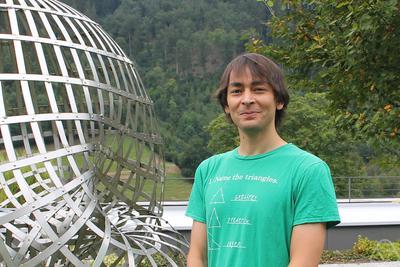
Alpöge described that when the proof was approaching the finish line, Claude had run far ahead of him. "Claude is speeding, dancing, and glowing near the finish line."
In the end, the two of them wrote the entire set of arguments into Lean code.
Why only upload the Lean code? Because Alpöge admits that he himself has not fully mastered much of the mathematics involved in the argument.
He wrote in his self-statement:
I have not yet mastered the vast mathematical neighborhood surrounding this argument, yet I have presented a complete argument to the world. It is obviously inappropriate to post a huge, unreadable thing that is literally like "AI slop", so I decided to only present the Lean code.
The timing of the release also troubled him, as Anthropic was about to go public at the time. Alpöge recalled that late at night, he sent a message to CEO Dario Amodei asking when he could make it public:
The specific timing was terrible. If it were up to me, I would have finished all this long ago. Hell, it would definitely have been better to get it done before I reached this age. All this happened late on Sunday night, I messaged Dario saying "Suppose, if I..." and finally asked whether I had the right to publish it.
Dario asked him to wait until the company went public before making it public. Eventually, the version that everyone sees now came into being.
Scientific American commented on this:
He beat everyone with the help of a machine. But he himself is the most critical part of this process.
In his self-statement, Alpöge also specifically emphasized his own subjective initiative:
"The secret of my student days was that my plans were specifically prepared to solve this problem (the Riemann Hypothesis)."
Proving the Riemann Hypothesis has been his dream for more than a decade
Alpöge wrote in his self-statement: "Since my childhood, this problem has occupied an almost sacred place in my heart."
Back in his student days, he planned to spend many years preparing for the Riemann Hypothesis, learning as many mathematical tools as he might use in the future, so that when he was really able to solve this problem, he would be able to work it out.
In 2014, the 22-year-old Alpöge had just graduated from Harvard. In an interview with Turkish TV station CNN Türk, he said that his dream was to solve the Riemann Hypothesis.
Now he has realized this dream. How did he do it?
Alpöge declined media interviews. Scientific American found dozens of people who knew him, and asked his friends, mentors, and research collaborators to talk about the Alpöge they knew.
Mathematician Scott Armstrong is one of Alpöge's few close friends. He said: "He has the determination to conquer the world and win everything, and this determination is extremely strong."
Even the Holy Grail of mathematics — the Riemann Hypothesis — may not be able to limit him.
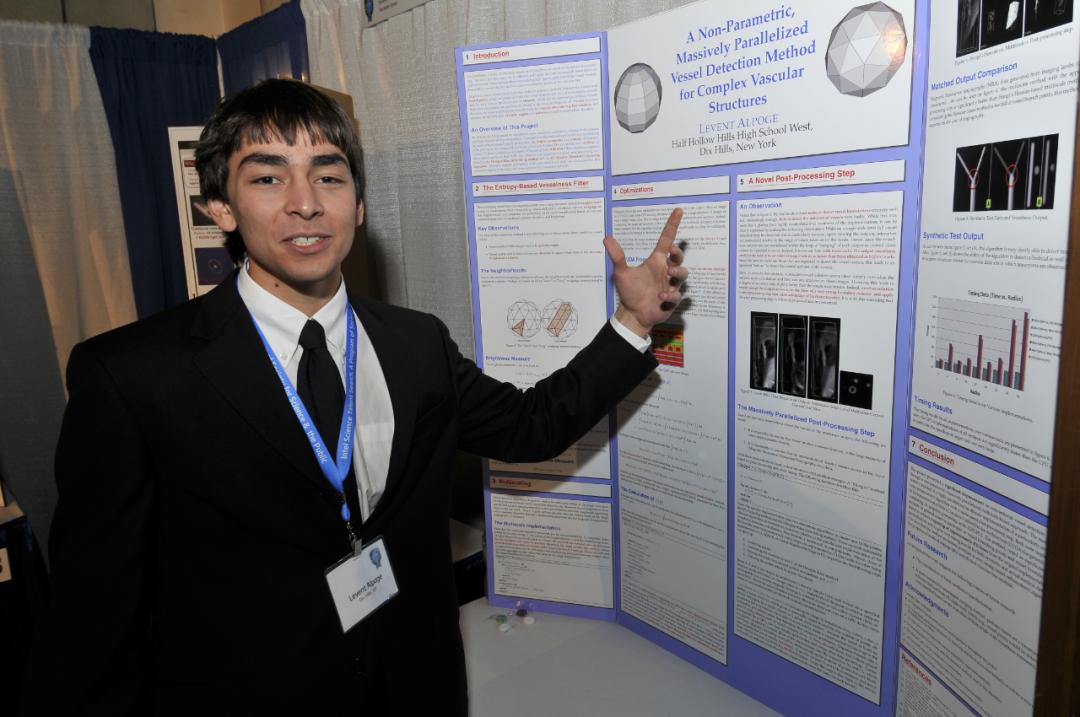
In 1992, Alpöge was born on Long Island, New York, USA. That day happened to be April Fools' Day.
His parents are both Turkish immigrants, and they realized when he was only three years old that their son