Meituan has finally realized that it is running a for-profit business.
Meituan has finally made profits again.
Last night, Meituan released its Q3 financial report. It recorded a loss of 18.6 billion yuan in the same period last year, while earning nearly 2.1 billion yuan in the same period this year; this is already the second consecutive profitable quarter for Meituan, though the profit is slightly lower than that of the previous quarter.
I went through the financial report and the meeting minutes of the earnings call, and found a very interesting thing. According to the estimate of sell-side institutions, the number of food delivery orders of Meituan in Q3 still declined year on year, but the customer unit price picked up instead.
Last year, everyone was eager to make the whole nation order four food delivery meals a day, but this year the number of orders has decreased, while the financial performance has turned better.
What on earth has changed in this business?
……
Simply put, Meituan finally has time to calculate its accounts. It used to be busy counting orders, but now it is busy calculating how much money is left from each order.
Let's start with this financial report.
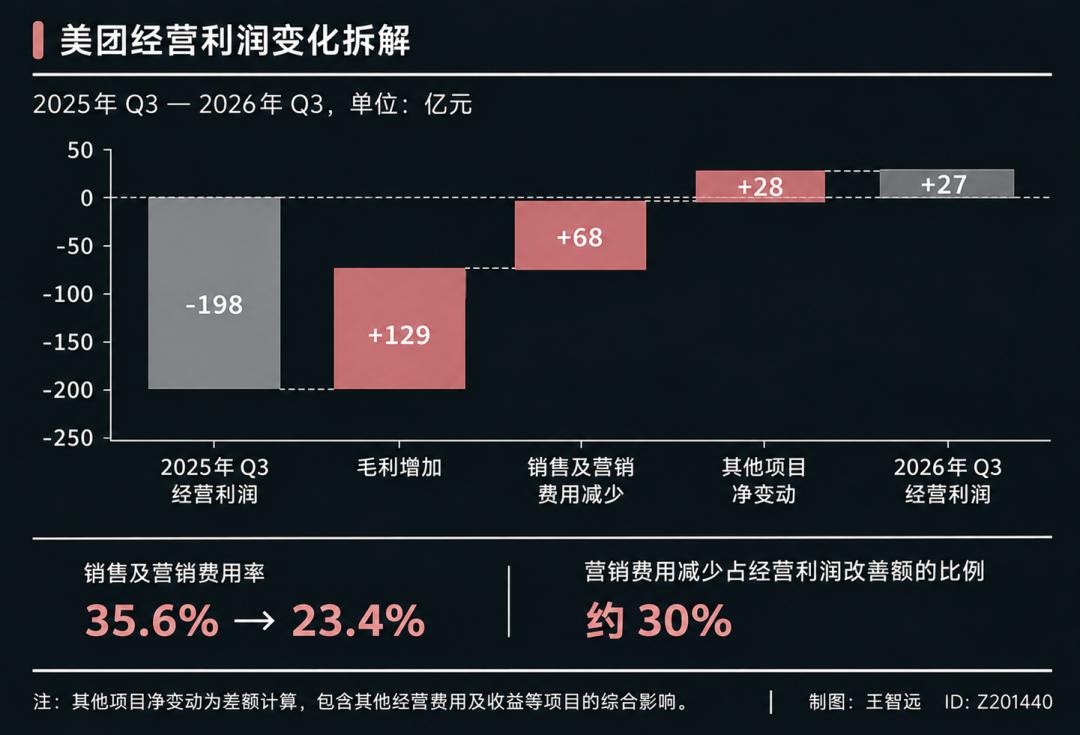
In Q3, Meituan's revenue reached 115.5 billion yuan, up 21.6% year on year, hitting a new all-time high for a single quarter. Its operating profit turned from a loss of 19.8 billion yuan in the same period last year to a profit of 2.7 billion yuan; its net profit was 2.07 billion yuan, and the adjusted net profit was 1.85 billion yuan.
After more than a year of the food delivery war, Meituan's profit statement has finally changed from a combat report back to a real account book. How did the profit come back? I broke down the accounts into three parts, which are completely different in nature.
First, the business has become a bit easier to run.
The revenue of core local commerce increased by 16.8%, and the gross profit of the whole group was 12.9 billion yuan more than that in the same period last year. The revenue is growing, and the money retained from operations is also increasing.
Second, the company is no longer spending money so aggressively.
The sales and marketing expenses in the same period last year were 33.8 billion yuan, while the figure in this quarter is 27 billion yuan, saving 6.8 billion yuan. In the past, for every 100 yuan of revenue, more than 35 yuan had to be spent on marketing, but now it only needs to spend more than 23 yuan. As the subsidy war cools down, the expense sheet has also become leaner.
There is also an extra non-recurring income. Some of Meituan's investments brought 2.347 billion yuan of book gains from valuation changes, plus 1.016 billion yuan of other income, totaling about 3.36 billion yuan, all included in the operating profit. This sum of money should be viewed separately from the profit earned from food delivery business.
For the 22.5 billion yuan change in operating profit, the majority comes from the increase in gross profit, and the saved marketing expenses account for about 30% of the total.
Of course, reducing subsidies may also improve gross profit. Simply looking at how much marketing expenses have been saved cannot explain the whole process of turning losses into profits.
Then why has the business become easier to run with fewer orders? Because part of those orders in the past were bought by the platform with money.
For example:
A food delivery user pays 8 to 9 yuan for an order, the platform subsidizes several yuan, and also has to pay the rider's delivery fee. If the account cannot be balanced, the more orders the business department takes, the more materials it has to write good news reports, while the finance department has more materials to write self-criticism reports.
When subsidies are reduced, part of the orders that come only for low prices will naturally disappear.
For consumers, the lunch that used to cost only 8 to 9 yuan may now cost more than 10 yuan; for the platform, doing fewer loss-making businesses may make its operation much easier.
Meituan's management also mentioned on the earnings call that the proportion of low-price orders is getting lower and lower, the customer unit price is higher than that in the same period last year, and after the summer vacation, all platforms are no longer distributing subsidies so aggressively.
Interestingly, the two neighboring platforms have also remembered that they are running companies.
In the same financial reporting season, JD's new business recorded less loss than the same period last year, and its marketing expenses are also decreasing; Alibaba said that Taobao Flash Purchase has achieved better account performance for each order, and the whole business is also reducing losses.
In the past, everyone talked about nothing but market share, and in this quarter, they started to figure out how to reduce losses and earn more profits one after another. Common business sense has become popular again.
However, the fact that several platforms stopped burning money one after another is not entirely out of their own consciousness.
In January this year, the regulatory authority launched an investigation into the competition situation of the food delivery industry; in June, the State Administration for Market Regulation also solicited public opinions on the new regulations of food delivery subsidies, proposing to restrict long-term and large-amount subsidies, and platforms are not allowed to force merchants to bear the cost of subsidies.
On the one hand, enterprises themselves need to calculate their accounts, on the other hand, regulators are also drawing boundaries for burning money to grab orders. Up to now, there are fewer reasons to continue burning money, but more constraints.
In the past, everyone took the peak daily order volume as a combat report, the one with larger number spoke louder. Now platforms are paying more and more attention to whether they can retain profit after completing the whole process from order placement to delivery for each order.
The number of orders and the value of orders are two different things. The peak daily order volume can be used to hold a celebration party, but cannot be used to pay salaries.
……
There is another very interesting account of Meituan:
In Q3, the core local commerce business generated nearly 6.7 billion yuan more revenue than the previous quarter, but the operating profit only increased by 36 million yuan, rising from 5.668 billion yuan to 5.704 billion yuan.
Wow, after generating tens of billions yuan more in business, the profit only increased by a tiny fraction.
What happened? Meituan is running multiple businesses at the same time, some are making profits back, while some are still spending money. To put it in detail, there are three things worth discussing.
First, the in-store business still needs investment.
The in-store, hotel and travel business is a cash cow in Meituan's portfolio. Theoretically, during the summer vacation when people go out for dinner, travel and stay in hotels, it is a good time to collect money, but Meituan is increasing its investment in this business instead.
Even a cash cow needs to be fed, especially when Douyin is also eyeing this market.
For Meituan, it is certainly important to earn more money in peak season, but it is also very important for consumers to still want to open Meituan when they plan to eat out or book hotels next time.
After waiting for the peak summer season for so long, it is impossible to just sit at home counting money and watching others take away customers.
The management also mentioned on the earnings call that part of the benefits brought by business growth was offset by the increased investment in the in-store business.
Second, the food delivery business has not fully recovered.
Calculated by month, the profit retained from each food delivery order in September has exceeded the average level of Q2, and the performance got even better in October. However, when calculating the whole Q3, the profit retained from each order was slightly lower than that in Q2.
Summer is the peak season for food delivery, and also the peak season for delivery costs. Consumers do not want to go out, but riders do not have that option. With the addition of high temperature subsidies, the cost of delivering one order has risen.
Therefore, the food delivery business in September and October is indeed improving, but Q3 also includes the accounts of July and August that need to be counted together.
The flash purchase business, which also belongs to core local commerce, has not completely got rid of losses. The food delivery business has just recovered, while the instant retail business still needs continuous investment.
Several other businesses of Meituan also need capital.
In Q3, the revenue of new businesses increased by 32.9% year on year, and the loss decreased from 1.74 billion yuan in the previous quarter to 1.31 billion yuan. Xiao Xiang Supermarket is still opening new stores, and the overseas food delivery business is still expanding its market.
Reducing losses by more than 400 million yuan is certainly worth celebrating, but reducing tuition fees and getting a scholarship are still two different things.
Third, the profit on the account sheet should also be viewed separately.
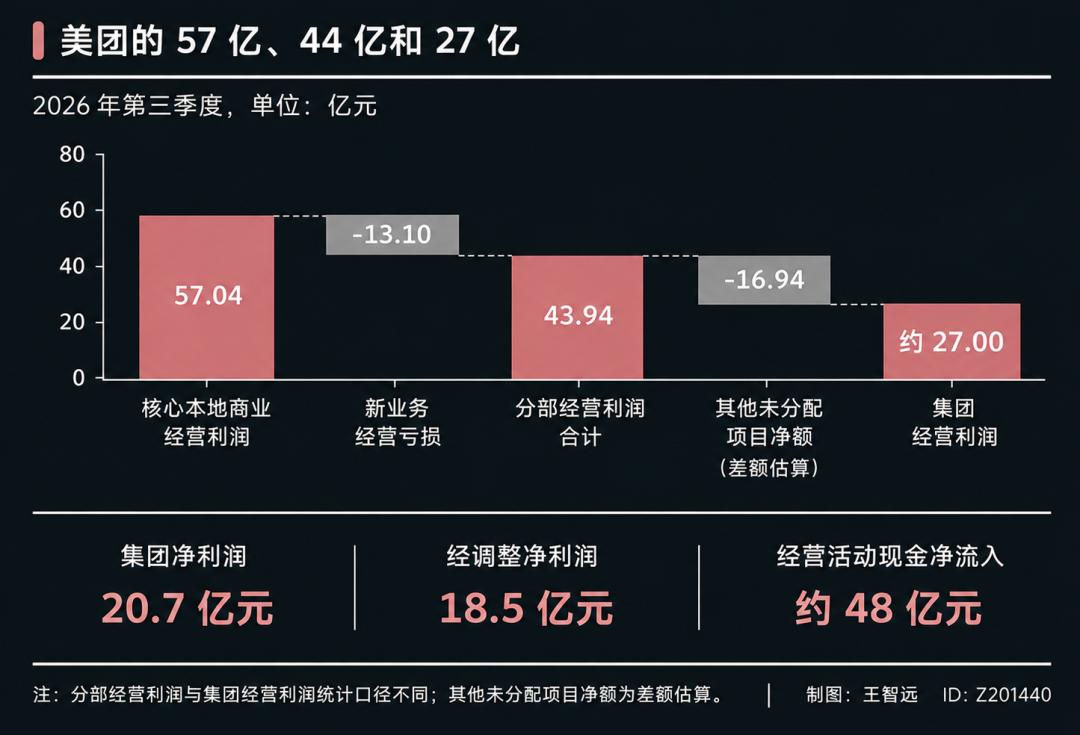
How much money has Meituan actually made? The figures 5.7 billion yuan, 4.4 billion yuan and 2.7 billion yuan can all be found in the operating profit accounts.
For financial reports, the difficulty sometimes does not lie in arithmetic, but in that you have to know first which account you are calculating.
The core local commerce business earned 5.7 billion yuan, the new business lost 1.3 billion yuan, and the two businesses together retained 4.4 billion yuan; after deducting the headquarters expenses and adding the aforementioned investment gains, the operating profit of the whole group is 2.7 billion yuan.
Of course, the headquarters staff also need to get paid, so the 4.4 billion yuan cannot be directly regarded as the operating profit of the whole company.
There is another figure I think is worth paying attention to, that is cash flow.
In this quarter, the net cash inflow brought by Meituan's daily operations is close to 4.8 billion yuan, which is higher than the net profit of more than 2 billion yuan.
Although the cash flow of a single quarter will also be affected by the time of payment collection and disbursement, at least for now, there is profit on the profit statement, and cash is also coming in from daily operations.
This is more reassuring than just looking at the single figure of turning losses into profits.
In fact, when a company runs multiple businesses at the same time, the improvement of its most profitable business does not necessarily mean that the whole company can safely sit back and count money. It also needs to check the development status of other businesses and how much money they need to invest.
When the company is small, it worries about no business. When it becomes large, it worries that every business needs money.
……
The food delivery war has cooled down, but there are no fewer places where Wang Xing needs to spend money.
At this earnings meeting, Wang Xing first admitted a mistake, when talking about community group buying, he said that Meituan made a very big mistake on Meituan Youxuan in the past.
On occasions like earnings meetings, people are usually busy giving themselves awards, but Wang Xing took out an old report card.
When running community group buying in the past, Meituan used its familiar strategy: spend money to increase orders first, expand the scale, and then make profits slowly.
This strategy worked for the food delivery business, but when applied to the fresh grocery business, the accounts were not that easy to balance. Vegetables cannot be sold at high prices, and unsold vegetables will go bad. Every link from the warehouse to consumers needs to spend money. The larger the business scale is, it does not necessarily lead to less losses.
What is more troublesome is that if a business cannot make profits for a long time, the company has to continuously invest money and manpower, and the management also has to divert their energy, which could have been used for other businesses.
What Meituan Youxuan has invested in these years includes not only money, but also time. Money can be earned back later, but time cannot be reimbursed anywhere.
Wang Xing also mentioned at the meeting that in 2027, the company should pay attention to ROI, that is, how much returns the money spent can bring.
In the past, when running a business, people might first think about how large the scale can be. Now they have to ask one more question: after the scale is expanded, can the business support itself?
Let's take a look at how Meituan plans to spend money next:
Some money has to be spent continuously.
Keeta in Saudi Arabia has achieved profitability for the whole quarter, which at least shows that Meituan's expertise in food delivery also has the opportunity to make profits when applied overseas. Xiao Xiang Supermarket has expanded to 85 cities and is still opening new offline stores, and the company has no intention to stop investing in the instant retail business.
The R&D investment has not decreased either, which reached 7.7 billion yuan this quarter. The management said that the AI-related capital expenditure next year will be less than this year, because the company has locked in part of the computing power in advance this year.
Reducing this part of expenditure does not mean that Meituan does not attach importance to AI. Besides, the company still has many places that need capital investment, such as opening new stores, building warehouses, purchasing equipment and so on. The total of such investments next year will not necessarily be less than that of this year.
Some money does not need to be spent in a hurry.
For the overseas food delivery business, while Saudi Arabia has already made profits, Meituan does not plan to expand all over Brazil in the short term. The newly entered cities are mainly small cities, and the business is mostly operated with the help of local agents.
A few years ago, when running overseas business, people were eager to plant flags all over the world map. But now, the company will first check whether it can make profits in the new market after the flag is planted.
Even if one business has made profits in one place, it does not mean that the same strategy can be copied directly in another place. With different markets and different competitors, the speed of spending money can naturally be different.
Meituan has no shortage of money on hand. The total of cash on account and short-term wealth management products is 157.5 billion yuan.
The company did not carry out share repurchase or dividend distribution this quarter. At the end of October, Meituan also announced an 8 billion yuan note issuance, which is used to replace the previous overseas debts with higher interest rates.
Borrowing money even when there is sufficient cash on hand sounds weird at first glance, but after replacing the expensive old debts with cheaper new debts, the cash on hand can still be retained for business operations.
Of course, whether Wang Xing can calculate his accounts as planned also depends on whether other players will cooperate.
If peers start to distribute a large number of coupons again one day, Meituan's profit statement which has just recovered may suffer again. After all, for the food delivery business, it is not enough for only Meituan to want to run its business well.
In addition, occupational injury insurance and pension subsidies for riders are being rolled out across the country, and the new regulations on consumer finance will also affect Meituan's lending business, bringing new constraints on how much interest can be earned and how to share profits with banks.
According to the estimate of the post-performance meeting minutes of CITIC Securities, the relevant adjustments may affect the profit intensively in Q4, and may reduce Meituan's profit