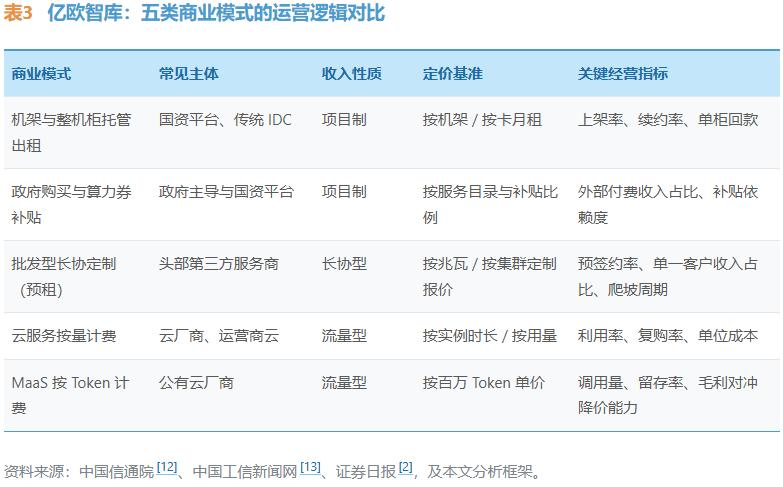
The profit differentiation of AI computing power infrastructure is intensifying, and the nature of market entities and revenue determines who can achieve profitability first.
The same intelligent computing center, if funded and constructed by a local state-owned capital platform versus co-built and operated by a cloud vendor in partnership with a chip manufacturer, will be accounted for under two completely different sets of books from the very first day of project approval:
The former draws capital from fiscal funds and fixed asset investment, with revenue coming from rack leasing, government procurement, and subsidy policies; the latter draws capital from operating cash flow, with revenue tied to the usage volume of its own businesses and settled on a pay-as-you-go basis.
In 2026, two sets of data laid this difference bare: statistics from the National Data Administration show that there are over 500 intelligent computing centers already in operation across China, with nearly 400 under construction or in the planning phase, bringing the total close to 1000, while industry estimates put the average utilization rate at only 20% to 30% [7][14]; at the same time, leading cloud vendors have repeatedly publicly disclosed that their computing power utilization rate is at a high level and server resources are tight [1]. The root of this difference does not lie in technical routes, but in who the operating entity is, where the capital comes from, and who generates the demand.
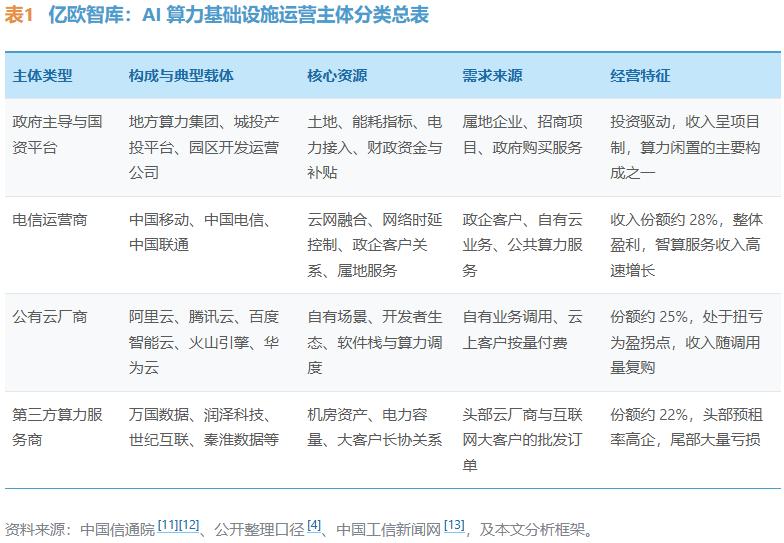
The operating entities of AI computing power infrastructure have diverged into four categories: government-led state-owned capital platforms, telecom operators, public cloud vendors, and third-party computing power service providers, all with different resource acquisition methods, demand generation mechanisms and profit logic; applying the same evaluation system to all four categories of entities is the source of the distorted operational judgment of most current intelligent computing centers. The next key step is to convert "who is operating" into "who pays, who uses, and who benefits", then assess what kind of business model the resource conditions can support.
The divergence of the four types of entities is not a matter of leading or lagging at the same starting point, but the coexistence of four distinct business models. Operators sell a combination of network and computing power, cloud vendors sell access to scenarios and platforms, third-party providers sell data center assets plus long-term cooperative services, and state-owned capital platforms undertake the function of industrial infrastructure construction. To evaluate an intelligent computing center, you must first confirm which category it belongs to and according to which category's logic it operates, which is the premise for all subsequent judgments.
State-owned capital platforms hold advantages on the resource side, while the separation of procurement, usage and benefit parties drives down utilization rate
Government-led and state-owned capital platform entities include local governments, local computing power groups, urban construction investment platforms, and industrial park development and operation companies. The core resources of such entities are concentrated on the supply side: land, power access, energy consumption quotas, special fiscal funds and discount interest policies are all prioritized for intelligent computing centers. Public statistics show that local investment in computing power infrastructure reached about 4000-450 billion yuan in 2026, which together with the special computing power investment of the three major telecom operators of about 142 billion yuan (up 61.8% year on year) constitutes the main investment volume on the investment side [4]; Hubei Province's 2026 computing power voucher plan allocates 50 million yuan in total, with a maximum subsidy of 30% based on actual incurred expenses, while Liaoning offers a maximum subsidy of 30% based on contract value with a cap of 2 million yuan — the subsidies fall on the demand side, but the local government is still the one distributing the funds [5][6]. Beijing, Shanghai, Sichuan, Hubei and other regions have successively established controlling stakes or set up new intelligent computing center operating entities through local state-owned capital platforms, and energy-based state-owned groups such as JIANTou Hebei are also entering the computing power service market leveraging their advantages in the core energy business [13].
Having resources does not equal having demand. Land, energy consumption quotas and fiscal funds can enable intelligent computing centers to be built quickly, but cannot guarantee that there will be users after completion that can consume the computing power at scale. Industry estimates put the average utilization rate of intelligent computing centers in operation across China at only 20%-30%, while an intelligent computing center usually needs to reach an occupancy rate of about 40% to break even [7]; the procurement entity is the platform company, the user side is settled enterprises or local public institutions, and the beneficiaries are scattered in industrial investment attraction targets, and the three parties often do not overlap. Among medium-sized 1000-card level projects, most state-owned and western China projects have a utilization rate of only 25%-45% and suffer long-term losses [12]. It is worth noting that Hubei's computing power voucher plan has explicitly excluded scenarios where "the purchased computing power service is not used by the entity itself, and there is transfer, gifting, trading or lending" from subsidy eligibility, and requires submission of contracts, payment vouchers, usage records and service results [5] — policy makers have begun to identify the separation of procurement, usage and benefit parties.
The value of government-led entities does not lie in their own profitability, but in driving industrial development; but the driving effect must be verified by external payment and local application results, and cannot be replaced by the scale of completed construction. For such entities, occupancy rate, the proportion of externally paid revenue and contract renewal status better reflect operational quality than total investment amount.
Cloud vendors generate demand from their own native scenarios, with hundreds of billions of yuan of investment covered by their own usage volume
Public cloud vendors are the only category of the four entities with "native scenarios": the usage volume of their own businesses is the demand itself. In 2026, Alibaba's capital expenditure in the second quarter was 67.68 billion yuan, up 75% year on year; Tencent's capital expenditure in the same period was 52.78 billion yuan, up 176% year on year; Baidu's capital expenditure reached 11.39 billion yuan, up nearly 200% year on year; ByteDance raised its 2026 AI infrastructure expenditure to 200 billion yuan, of which about 85 billion yuan is allocated for chip procurement [1][4][8]. The direct driver of these investments is the usage volume of their own businesses — enterprises have disclosed that current computing power utilization is at a high level and server resources are tight, so they need to lock in hardware production capacity in advance. Tencent invested about 18 billion yuan in new AI products in 2025, and plans to at least double that amount in 2026 [1].
The forms of cooperation with chip manufacturers have become standardized in 2026: first, cloud vendors deploy self-developed chips on the cloud, using their own businesses to complete large-scale verification; second, cloud vendors and chip manufacturers co-build customized intelligent computing clusters, and carry out joint optimization around the software stack; third, use all-in-one machines to sink the capabilities verified on the cloud to industry customers. The common point of the three paths is that chip manufacturers get large-scale verification scenarios, and cloud vendors get guaranteed supply — the procurement party, usage party and benefit party are integrated into one, and repurchases are driven by business volume growth rather than budget cycles.
This model has clear boundaries: the premise is that native scenarios can absorb newly added computing power. The investment pace follows product revenue. Once the growth rate of scenarios slows down, heavy asset expansion will directly erode the profit statement. To judge the operational quality of such entities, we should look at whether the ratio of AI product revenue to capital expenditure is stable, rather than the absolute scale of capital expenditure.
Operators and third-party service providers occupy two ends of the market, with hidden risks behind 130% growth rate and 57% concentration ratio respectively
Telecom operators: Their advantages lie in the existing resources of cloud-network integration. The three major telecom operators take intelligent computing centers and computing power networks as their development direction: China Telecom builds the "2+3+7+X" public intelligent computing resource pool, China Mobile coordinates the layout of intelligent computing centers relying on the "4+N+31+X" resource layout, and China Unicom builds intelligent computing clusters on the basis of its "5+4+31+X" data centers [11][9]. Network latency control, government and enterprise customer relationships, and localized service capabilities are the endowments that distinguish operators from the other three categories; their shortcomings lie in the flexibility of cloud service capabilities and software ecosystems. The budget for operators' special computing power investment is highly stable, but the authenticity of demand still needs to be verified afterwards by occupancy rate and computing power usage results.
Third-party computing power service providers: They sell data center assets and long-term agreements with large customers. According to China Merchants Securities, the top 5 service providers account for more than 50% of the total market share, with GDS ranking first at 17% with a cabinet utilization rate of 73.8% and a pre-signing rate of 93.0%; Runze Technology's mature computing power centers have an occupancy rate of over 90%, and its largest end customer ByteDance contributes about 57% of its revenue [14]. The China Academy of Information and Communications Technology summarizes the models of third-party service providers into three categories: wholesale IDC operation and maintenance, mixed retail and wholesale, and AIDC intelligent computing as the main business — the third category has realized the transformation from "leasing cabinets" to "leasing computing power and supporting operation and maintenance", with the value per megawatt reaching 3-5 times that of traditional IDCs [13]. The common feature of leading players is "pre-locked resources + deep binding with large customers + customized wholesale", and they sign long-term contracts in the early stage of project construction; small and medium-sized service providers are at a comprehensive disadvantage in these three links.
The operational risks of the two types of entities are located in different positions: the risk of operators lies in demand-side verification, while the risk of third-party service providers lies in customer concentration. Runze Technology's single customer accounts for about 57% of its revenue, which indicates that the high occupancy rate of leading third-party players essentially transfers operational risk from "finding customers" to "binding large customers"; the willingness of long-term agreement customers to renew contracts and expand capacity is the variable that such entities need to continuously verify.
The shortcomings of the four types of entities are precisely the strengths of others
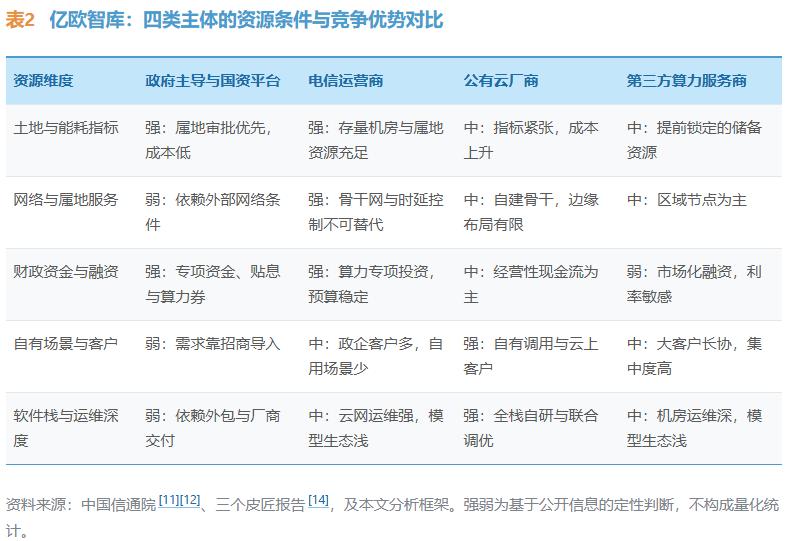
Comparing the resource conditions of the four types of entities in the same table, we will find that their strengths lie in different positions. Government-led state-owned capital platforms have advantages on the resource side — land, energy consumption quotas, power access and fiscal funds are resources that market operating entities cannot obtain or cannot afford; telecom operators have advantages on the network side — backbone network, latency control and localized services make them irreplaceable in the integrated "cloud-edge-end" delivery; public cloud vendors have advantages on the demand side — native scenarios, developer ecosystem and pay-as-you-go system; third-party computing power service providers have advantages on the asset side — data center assets, power capacity and execution capability of wholesale long-term agreements.
Various types of cooperation that emerged in 2026 are essentially mutual complementarity of shortcomings between entities: cloud vendors cooperate with local governments to build regional clusters, which makes up for the shortcomings on the resource side; local governments introduce cloud vendors to operate local intelligent computing centers, which makes up for the shortcomings on the demand side; third-party service providers customize data centers for cloud vendors, which uses their asset-side capabilities to undertake the demand-side capabilities of others [15].
The competitive advantages of the four types of entities cannot be ranked on the same dimension, and we can only compare the matching degree between resource conditions and demand. Government-led state-owned capital platforms are suitable for undertaking regional public computing power and supporting industrial investment attraction, operators are suitable for undertaking government and enterprise integrated cloud-network demand, cloud vendors are suitable for undertaking native business expansion and industry cloud services, and third-party service providers are suitable for undertaking customized wholesale demand from leading customers.
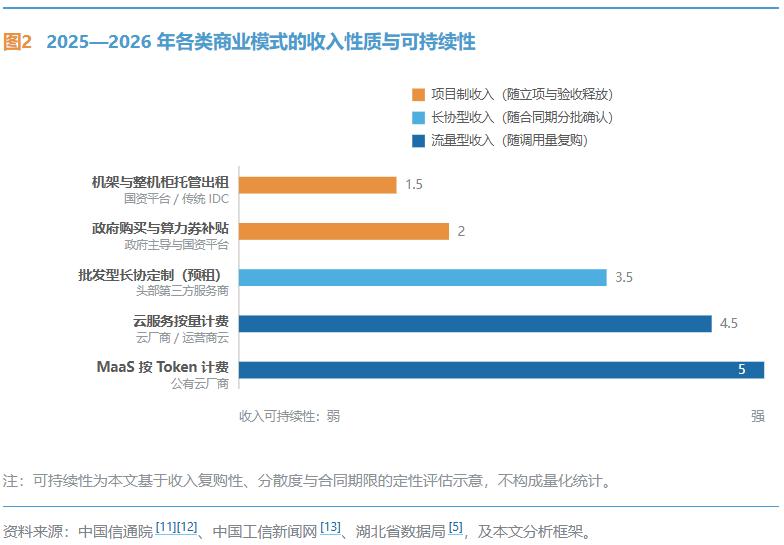
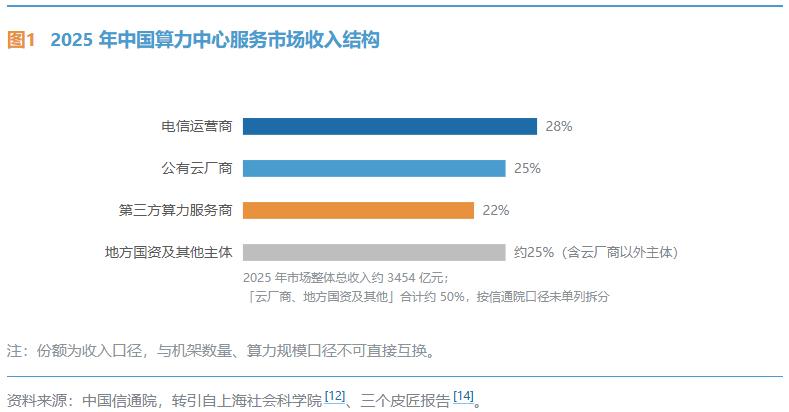
The essence of business model difference is the nature of revenue, and the ability to achieve repurchase determines sustainability
The business model of government-led state-owned capital platforms revolves around "how to charge for completed assets": rack and whole cabinet hosting and leasing are billed per cabinet, with stable revenue but low ceiling; government procurement of services and computing power voucher subsidies can cover first purchase and trial use, but are constrained by budget cycles and acceptance progress; joint venture and co-construction amortizes investment in installments, and returns depend on subsequent operational results. The common point of these models is that revenue is project-based — released in batches following project approval, acceptance and assessment cycles, rather than growing continuously with business volume.
The business model of leading third-party service providers revolves around "how to lock in long-term agreements": in the early stage of project construction, they sign wholesale customized contracts with leading cloud vendors and large internet customers, with a pre-leasing rate of 70%-80%, greatly shortening the ramp-up cycle [12]. Long-term agreement based revenue falls between project-based revenue and traffic-based revenue — revenue is highly certain during the contract period, but customer concentration is high, and contract renewal and capacity expansion determine the second growth curve. Large-scale 10000-card cluster intelligent computing centers generally achieve an occupancy rate of over 70%, but the investment return period usually takes 6-8 years, and the loss risk in the first 2-3 years of operation is extremely high [12].
The business model of cloud vendors revolves around "how to bill by usage volume": cloud services are billed on a pay-as-you-go basis, MaaS is billed per Token, and industry solutions are subscription-based. Alibaba's AI-related product revenue has maintained triple-digit growth for 12 consecutive quarters, with an annualized revenue of about 49.5 billion yuan [1][4]; since March 2026, many domestic cloud vendors have raised the prices of AI services, and industry estimates show that computing power leasing costs have increased by 30%-40% year on year [2], the proportion of inference in computing power load is still rising [3], and the National Data Administration's statistics show that the daily average Token call volume has ranked first in the world [10], indicating that demand intensity has been transmitted to the price side. This type of revenue is traffic-based — repurchases follow usage volume, and the decline in unit price can be hedged by the growth of usage volume.
The nature of revenue determines the sustainability of the business model. Project-based revenue has high concentration and poor predictability. If the occupancy rate cannot cross the break-even line of about 40%, depreciation and financial expenses will continuously squeeze profits [7]; long-term agreement based revenue locks in cash flow during the contract period, at the cost of giving up pricing flexibility; traffic-based revenue is decentralized and repurchasable, but highly sensitive to unit cost — the unit cost of inference is decreasing year by year, and models that rely mainly on hardware rental and sales margins face the most obvious pressure. The hybrid model of basic leasing plus value-added services that emerged in 2026 is essentially an intermediate route for state-owned capital platform entities to move closer to long-term agreement based and traffic-based revenue, and its effectiveness still needs to be tested by the proportion of externally paid revenue.