Everyone says that limits should be set for AI, but the restrictions implemented by OpenAI and Anthropic are not the same thing at all.
On November 22, Jakub Pachocki, Chief Scientist of OpenAI, published an article, disclosing for the first time the pre-training progress data of the company's own model, and proposing that all laboratories agree on a common upper limit. Three days later, Dario Amodei, CEO of Anthropic, posted a long post on X, stating that what needs to be restricted is the autonomous R&D of next-generation AI by AI itself.
Over the past two years, discussions on AI security have mostly stayed at the level of open letters, hearings and CEO statements. This time, both companies have put forward specific restricted objects, and OpenAI has also provided measurement indicators.
The two plans target different links in the workflow. Coupled with the proposal from employees of both companies to delay release, the impacts on the industrial chain are scattered in three areas: orders for training clusters, the speed of model iteration, and the revenue of model companies. As of November 25, none of the three plans have been publicly agreed by a second top-tier laboratory except their proposers.
01 OpenAI's Metrics
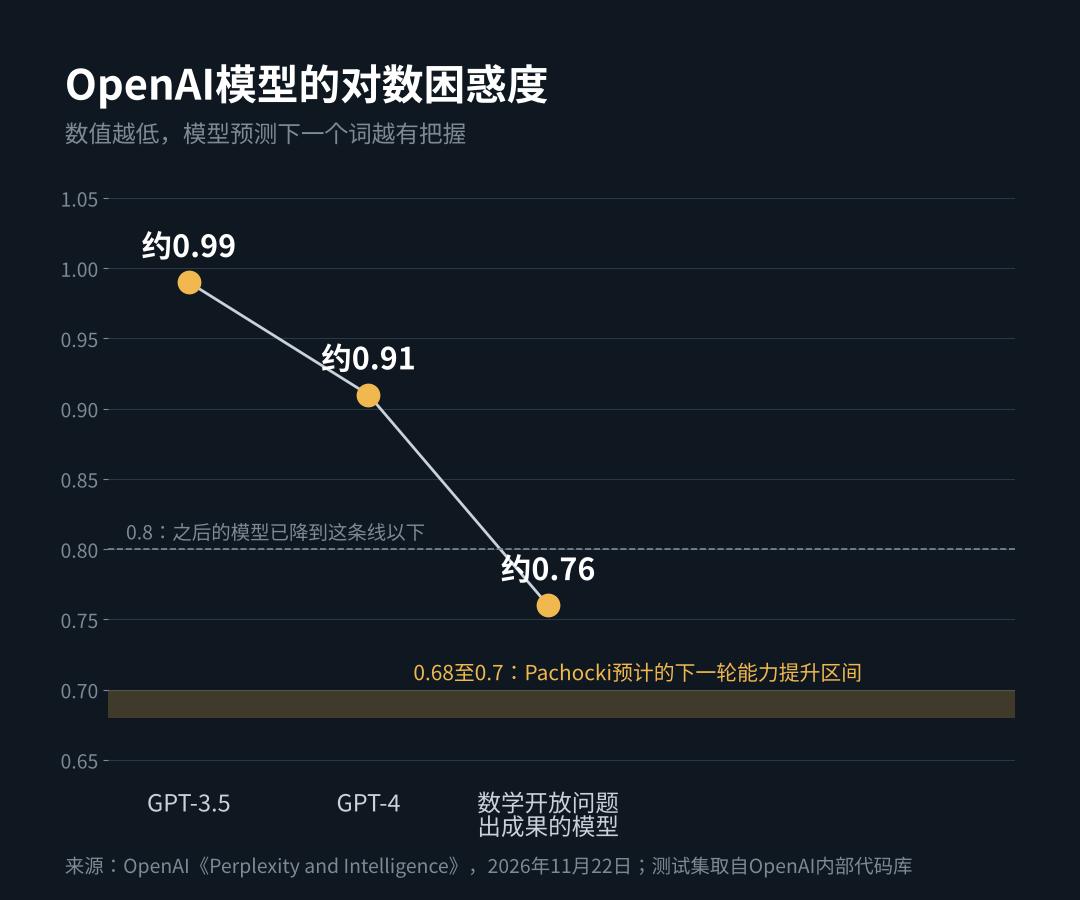
The metric used by OpenAI is log perplexity, which measures how confident the model is in predicting the next token. The lower the value, the more powerful the model is. According to the data released by Pachocki, the value of GPT-3.5 is about 0.99, GPT-4 is about 0.91, and subsequent models have dropped below 0.8.
When the value approaches 0.76, OpenAI's model has achieved results on open mathematical problems. Pachocki predicted that a new round of capability improvement will occur when the value drops to between 0.68 and 0.7, but he wrote in the article that he does not know what kind of capability it will be. His proposal is that before tools for understanding and monitoring model behavior reach a specific milestone, no party shall exceed the agreed upper limit.
Altman's statement has gradually become more specific over the past two months. In September, he posted to agree with Amodei's statement on controlling the pace of frontier AI development. On November 4, he wrote that humans should not hand over control of the future to superintelligence, and this rule should eventually constrain the progress of AI. On November 22, he called Pachocki's article the most important release from OpenAI in a period of time.
The article did not specify what the first upper limit is set at or when it will take effect. OpenAI first showed its own figures, and Mustafa Suleyman from Microsoft AI immediately expressed his support. As of November 25, neither Anthropic nor Google DeepMind had followed up.
This metric is tested on OpenAI's internal codebase, and different parties use different tokenization methods. Even if other companies publish their figures, they cannot be ranked together with OpenAI's results.
02 Anthropic and Employees' Proposals
On November 25, Amodei posted a long post of more than 1,000 words on X, responding to external claims that Anthropic wanted to hand over control to AI. He wrote that tasks including driving, designing anti-cancer drugs, and writing a full set of software from scratch can be increasingly delegated to AI, but social governance cannot. What he specifically wants to restrict is the scenario where AI independently builds the next-generation frontier model without effective human supervision, which is called recursive self-improvement in the industry.
The original wording is "We may need to set limits on this process".
This restriction is closely related to Anthropic's own R&D process. The company disclosed in June that more than 80% of the code merged into the codebase was written by Claude. In a November report, evaluation agency METR stated that the progress speed of Anthropic's model is about 1.9 times the previous level, which mainly comes from AI-assisted research.
The third plan comes from inside the two companies. According to a report by Axios on November 24 citing more than 20 insiders, many employees of Anthropic and OpenAI believe that the company's strongest unreleased model is already too risky to be released safely. Internal discussions have been held on limiting frontier models to internal use only, and even stopping the training of new models.
Both companies admitted that they have made adjustments. OpenAI told Axios that the company has adopted new security requirements that may slow down model releases. Anthropic said it had postponed the pre-training of a recent model to strengthen security measures.
Outside the two companies, the most radical advocate is Paul Christiano. He joined the board of the OpenAI Foundation in September this year, and said in a personal capacity on Dwarkesh Patel's podcast on November 16 that if the current trajectory is not slowed down, the probability of superintelligence emerging within one year is about one in three. He advocates suspending algorithm-level research until the safety protection measures of laboratories are sufficient.
The opposing opinion comes from Yann LeCun, former Chief AI Scientist of Meta. He publicly criticized Amodei for exaggerating the dangers of AI for many years, with the purpose of making open models illegal and leaving control in the hands of a small number of companies. Amodei previously wrote that Anthropic has never advocated banning open-weight models.
03 Impact Deduction
Restricting pre-training will first affect orders for training clusters. Colette Kress, CFO of NVIDIA, said at the November 17 earnings call that major frontier laboratories contributed about 15% of NVIDIA's data center revenue this year, and the data center revenue in that quarter reached 107.6 billion US dollars. OpenAI's proposal does not specify a numerical upper limit, and reasoning and reinforcement learning are not within the scope of restrictions, so the impact on orders cannot be calculated at present.
Restricting self-improvement will affect the speed of model iteration. According to METR's evaluation, the speedup of Anthropic in this year mainly comes from AI-assisted research, which is exactly the part that Amodei proposes to restrict. It will not directly reduce computing power procurement, but will affect the interval between two generations of models.
Delaying release has the closest connection with revenue. If the model is kept for internal use, the training cost has already been spent, and revenue will not be generated until the model is released. Anthropic's computing power commitment totals 900.9 billion US dollars, and OpenAI is raising funds at a pre-money valuation of 1.25 trillion US dollars.
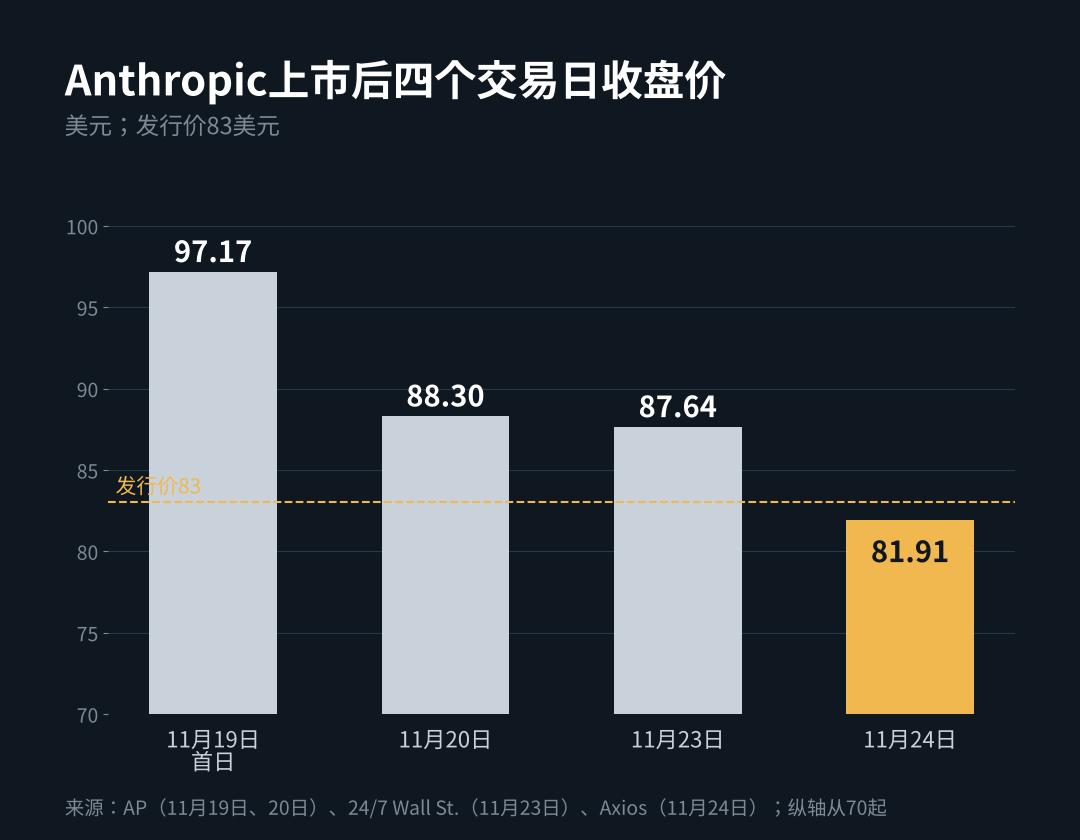
Anthropic went public on November 19 at an issue price of $83, and closed at $81.91 on November 24, closing below the issue price for the first time. When analyzing the stock price, Axios listed employees' concerns about model safety as one of the reasons.
So far, no second party has responded to the industry self-discipline initiative. After OpenAI's proposal was issued, Anthropic, Google DeepMind, Meta and xAI have not made official statements. Two companies have relaxed their original commitments this year. According to Semafor's report, when Anthropic updated its Responsible Scaling Policy in February, it deleted the clause that suspends development when capabilities far outpace safety research. In April, Meta changed the wording of "stop" in its own framework to "continue development with mitigation measures".
On the government side, Trump was asked in an interview with CNBC on November 23 whether the government would intervene if employees thought OpenAI or Anthropic were moving too fast, and he replied that the Department of Justice would intervene. The Democratic Party will take over the Congress next January.
Chinese companies face constraints from another dimension. After the United States tightened export controls, Chinese cloud vendors are limited by chip supply. Wu Yongming, CEO of Alibaba, said at the November earnings call that tight computing power is a reality that the industry will face in the medium and long term. Martin Lau, President of Tencent, said that the next version of Hunyuan may take longer to launch.
From November 22 to 25, OpenAI and Anthropic successively proposed to set limits on AI. What OpenAI wants to regulate is pre-training. If the upper limit is really implemented, the first thing to decrease will be orders for training clusters. What Amodei is worried about is AI independently developing next-generation AI. If this scenario is regulated, computing power purchases may not necessarily decrease, but new models will be released more slowly.
The proposal to delay release put forward by the employees of the two companies has the highest cost. Anthropic's computing power commitment is 900.9 billion US dollars, and its annualized revenue at the end of October is about 81 billion US dollars. If the model is released several months later, the computing power cost still needs to be paid rigidly, but the revenue will also be delayed accordingly, and its impact on cash flow will gradually emerge.
This article is from the WeChat official account "Hard AI", written by a researcher focusing on technology R&D and industry, and authorized for release by 36Kr.