Bessent pulls another U-turn: The U.S. Department of the Treasury becomes the new rival of America's AI industry
Recently, the US stock market has witnessed drastic fluctuations, especially AI concept stocks that have experienced extremely volatile ups and downs. Since the start of 2025, numerous analysts in the capital market have repeatedly asserted that "the AI bubble has emerged", whose scale is comparable to the Internet bubble back in 2000.
Recently, in various online groups and offline gatherings, discussions about the AI bubble have always been the most heated topic. Quite a number of people hold the view that the recent performance of capital is also a reflection of the industry's bubblization. However, opposing voices immediately refute that a series of anomalies have occurred in the US recently (especially after the mid-term elections), and the root cause of capital market turmoil is these anomalies rather than a bubble.
So does the US AI sector really have a bubble, and what is the root cause of this round of capital market fluctuations? The core viewpoints of this article are as follows:
First, the massive expansion of capital expenditure by AI enterprises has led to increased supply of corporate bonds, driving up US Treasury yields and exacerbating the federal government's fiscal pressure;
Second, Bessent originally intended to cool down AI investment;
Third, the US Department of the Treasury will become a new rival for AI development in the next phase.
AI Corporate Bonds and Bessent Competing for Capital
Among the series of news surrounding NVIDIA recently, US Treasury Secretary Bessent has taken the most peculiar attitude. At first, he even publicly called on NVIDIA's board of directors to carry out a "thorough restructuring" and find new leaders "from outside the company", but around November 22, his stance softened completely, and he publicly stated that he "will not oppose Jensen Huang's return to NVIDIA".
As the US Treasury Secretary, why did Bessent take such an abnormal move? In this article, we will put ourselves in Bessent's position to look at this issue.
In January 2025, Trump took office as the new President of the United States, and reducing the fiscal deficit is one of his core governance goals. Later, he cooperated with Musk to launch DOGE (Department of Government Efficiency) to ease the cost pressure of the federal government, but this plan did not succeed in subsequent operations.
The pressure fell on Bessent's side, let's take a look at the scale of the fiscal deficit of the Ministry of Finance.
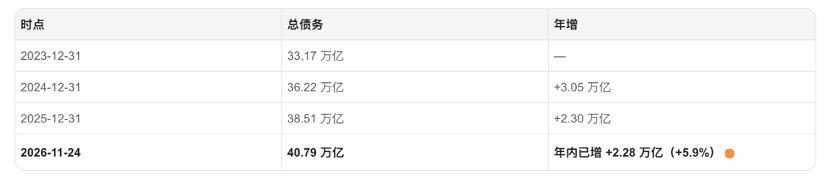
As of November 24, the total debt of the US Department of the Treasury has reached as high as 40.79 trillion US dollars, roughly 1.27 times of GDP. At the end of 2024 (when the Biden administration handed over power), this figure was only 36.22 trillion. After two years of Trump's governance, the federal government's debt scale has risen instead of falling, which is obviously contrary to Trump's promises.
Let's look at the following chart:
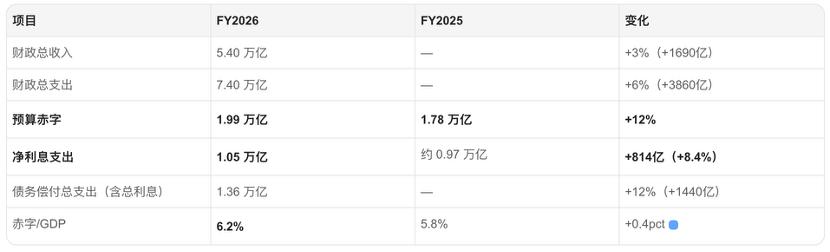
Focus on the following indicators:
Net interest 1.05 trillion ÷ Deficit 1.99 trillion = 52.8%: that is to say, more than half of this year's deficit is a "passive deficit" formed by the interest on existing debt.
Net interest ÷ Fiscal revenue 5.40 trillion = 19.4%: for every 5 US dollars of tax collected, 1 US dollar is used to pay interest.
Net interest ÷ Fiscal expenditure 7.40 trillion = 14.2%.
Debt interest has become the third largest expenditure item of the federal government after social security and medical insurance, and its expenditure growth rate is significantly higher than the revenue growth rate.
The US federal government is now facing severe debt burden. On the one hand, the operation of the previously huge and complex government still consumes a large amount of funds (geopolitics also consumes national finance), on the other hand, trillions of dollars in interest expenditure also leave the Ministry of Finance with much less room for maneuver.
So the question arises, what exactly causes this phenomenon?
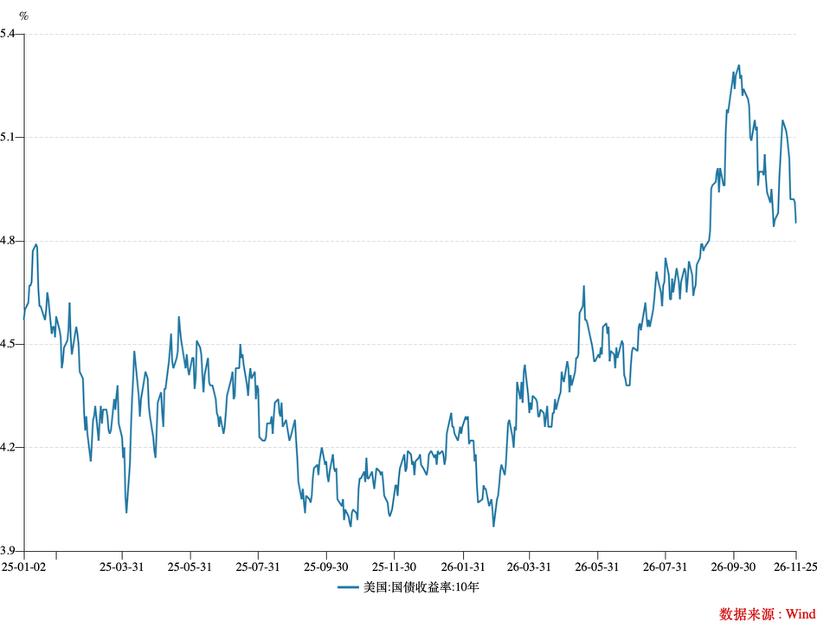
The 10-year US Treasury yield is an important indicator to measure the US bond market, and it is also the anchor indicator of the global risk-free discount rate. In the chart above, we can see that after 2026, the above indicator has been rising all the way, with its peak close to 5.3%, which is almost the highest level in the past 20 years.
The surge in Treasury yields will inevitably raise the federal government's financial cost, which will subsequently increase the difficulty for the US to solve the fiscal deficit. For the Ministry of Finance, in order to reduce the cost of interest expenditure, it has to increase the issuance of short-term bonds (with lower interest rates), which leads to:
The federal government issues a large number of short-term bonds (bonds with a maturity of less than one year account for more than 86%), and the imbalance between long-term and short-term bonds leads to insufficient supply of long-term bonds with high interest rates, so the market begins to reallocate capital.
After AI became the mainstream narrative, technology enterprises began to accelerate the increase of capital expenditure and build data centers. According to the latest news from Wall Street, AI-related industries have contributed 25% of the GDP increment.
Against this background, leading enterprises have successively issued ultra-long corporate bonds for financing, as shown in the figure below:
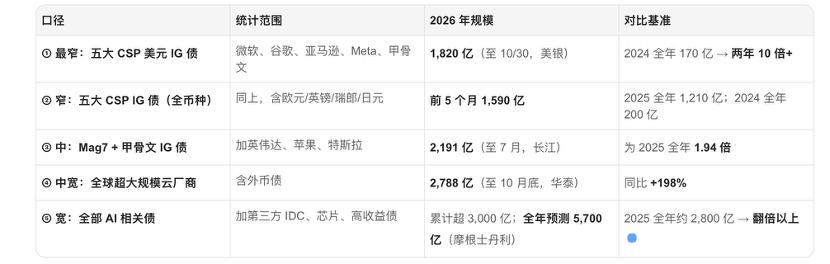
In the figure above, we use different calibers to demonstrate the issuance of AI-related bonds in different dimensions. No matter which caliber is adopted, the issuance scale of corporate bonds in 2026 is several times that of the previous year. In particular, the duration of these bonds is quite long. For example, Tesla's 30 billion US dollar AI investment-grade bond, due to its long term, is equivalent to about 360 billion US dollars of "10-year equivalent duration supply", which is 1/8 of the US Treasury duration supply in the same period. Google issued a 100-year pound sterling "century bond", and Oracle issued a large number of 30-year bonds.
As we explained earlier, in order to ease the pressure of interest expenditure, the federal government issued a large number of short-term bonds, leading to insufficient supply of long-term bonds in the market. At this time, enterprises issued a large number of long-term bonds, which made up for this part of the shortage, thus forming the following closed loop:
The Ministry of Finance issues a large number of short-term bonds — insufficient supply of long-term bonds — sharp increase in supply of long-term bonds from AI enterprises — capital flows to enterprises — insufficient purchase of Treasury bonds — shrinkage of bond par value — rise in yield — sharp increase in pressure on the Ministry of Finance's interest expenditure.
Bessent Shows His Original Intention: To Cool Down AI Investment
From the perspective of Bessent's short-term KPI, the vigorous rise of AI investment not only fails to ease the fiscal pressure, but also the competition between corporate bonds and the Ministry of Finance for capital increases the fiscal pressure of the Ministry of Finance. Especially after the Federal Reserve starts the interest rate hike cycle again, it is undoubtedly adding insult to injury for the Ministry of Finance. Therefore, when various fluctuations occur in NVIDIA, out of professional instinct, Bessent stated that he called on NVIDIA's board of directors to carry out a "thorough restructuring".
Since NVIDIA adopts a flat organizational structure, Jensen Huang is highly involved in business details. If NVIDIA is restructured and Jensen Huang leaves NVIDIA completely, there will be major adjustments to the enterprise's strategy and tactics in the short term. Especially since last year, NVIDIA has continuously invested in the large model industrial belt, accelerating the involution of the industry and capital consumption, which has caused great pressure on the Ministry of Finance.
But later, Trump renegotiated with the board of directors for various reasons, and Jensen Huang returned to NVIDIA. As an important member of the cabinet, Bessent could only change his stance. But we must admit that Bessent's previous statement was completely out of his "original intention", and the subsequent change was mainly out of "obedience".
So what path will US AI enterprises take next? Due to space limitations, we only show our analysis context:
1) In the short term, the massive bond issuance by US technology companies will not only deteriorate the financial statements of enterprises, but also affect the Trump administration's election commitments. After the Federal Reserve's interest rate hike is on the schedule, the government is unlikely to stand by and ignore the expansion of AI enterprises;
2) Some friends may still question that when AI competition has been raised to such a high level, how could the US government put on the brakes manually? But I would like to remind everyone that after the Democratic Party won a big victory in the mid-term elections, there is not much time left for the Democratic Party, and Trump's decision-making will gradually become short-sighted.
The recent ups and downs of technology stocks are exactly the reflection of the above differences.
This article is from the WeChat Official Account "Sibian Investment Research", author: Tong Zhibin, published with authorization from 36Kr.