In the past two months, 643 companies have launched share repurchases, with the total amount exceeding 45 billion yuan. CATL, Midea and GREE rank the top three, while Eoptolink and GigaDevice rank in the top ten.
Since the fourth quarter, repurchase announcements of A-share listed companies have been intensively disclosed. Companies including CATL, Innolight, Salt Lake Co., Ltd. have successively carried out repurchases, with the amount of a single repurchase ranging from tens of millions of yuan to tens of billions of yuan, and many of them have explicitly used the repurchased shares for write-off.
Wind data shows that as of November 26, since the fourth quarter, 643 A-share companies have implemented repurchases, with a total repurchase amount of about 45.331 billion yuan and a total repurchase volume of about 2.733 billion shares.
Industry Leaders Take Action
Among the 643 companies that have implemented repurchases, 4 have repurchase amounts exceeding 1 billion yuan, 88 have repurchase amounts between 100 million yuan and 1 billion yuan, and 551 have repurchase amounts below 100 million yuan.
In terms of industry distribution, repurchases are mainly concentrated in materials, capital goods, technology hardware and equipment, semiconductors and semiconductor production equipment, with most of the companies from the manufacturing and technology sectors.
In terms of the actual repurchase amount, large-value repurchases are concentrated in a small number of leading enterprises. The total repurchase amount of the top ten companies reached 16.546 billion yuan, accounting for about 36.5% of the total 45.331 billion yuan of repurchase amount; the total of CATL, Midea Group and GREE Electric amounted to 11.592 billion yuan, accounting for about 25.6%.
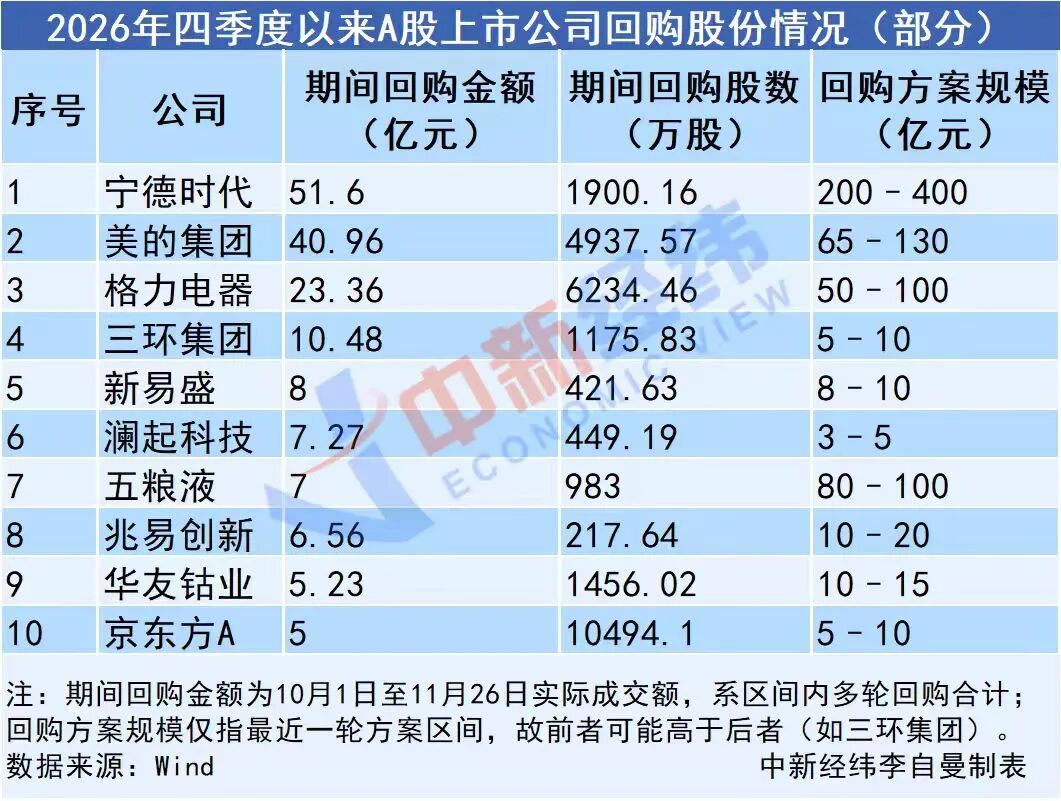
As of November 26, since the fourth quarter, CATL ranks first with a repurchase amount of 5.16 billion yuan. On July 24, CATL issued a share repurchase announcement, planning to repurchase 20 billion to 40 billion yuan, which is the largest single repurchase plan of A-shares within the year, and all the repurchased shares will be used for write-off to reduce the company's registered capital.
Midea Group's repurchase amount since the fourth quarter reached 4.096 billion yuan. On March 31, Midea Group disclosed a repurchase plan of 6.5 billion to 13 billion yuan. The repurchased shares were originally used for "implementing equity incentive plans and/or employee stock ownership plans", and were changed to "being used for legally writing off to reduce registered capital" in April.
GREE Electric ranks third with a repurchase amount of 2.336 billion yuan. Technology companies such as Tricer Group, Eoptolink, Montage Technology, and GigaDevice have also entered the top ten.
Write-off Type Repurchase Gains Momentum
According to the sorting of China News Finance, write-off repurchase is becoming the choice of more and more companies.
Data from the China Securities Regulatory Commission shows that in the first 10 months of this year, 645 listed companies on the Shanghai and Shenzhen stock exchanges disclosed 700 share repurchase plans totaling 237.7 billion yuan, of which the amount of repurchase for write-off was 115 billion yuan, accounting for nearly 50%, and both the amount and proportion of repurchase for write-off hit a record high.
Write-off type repurchase refers to that the company buys back shares and permanently removes them from the total share capital. Under the premise of constant net profit, the reduction of total share capital will push up earnings per share and net assets per share. According to the Rules for Share Repurchase of Listed Companies, shares repurchased for the purpose of reducing registered capital shall be written off within 10 days from the date of repurchase; shares used for equity incentives and other circumstances that have not been transferred according to the disclosed purpose within three years shall also be written off before the expiration of the period.
Wind data shows that since the fourth quarter of 2026, a total of 104 companies have completed their repurchase plans and marked the purpose as "equity incentive write-off". This type of write-off is mainly passive write-off — when the incentive object leaves the company or fails to meet the performance standards, the company recovers the shares according to the rules and writes them off, which is essentially different from the active capital reduction write-off that specially launches a repurchase plan to give back to shareholders.
Large-scale active write-offs are concentrated in leading companies, mainly in two forms: One is that it is clearly specified at the time of the release of the repurchase plan that all the repurchased shares will be written off. For example, BOE A, the leader in the display field, completed the repurchase and write-off of 191 million shares worth about 1 billion yuan on November 11, reducing the total share capital from 37.044 billion shares to 36.853 billion shares.
The other situation is to adjust the purpose of the existing repurchased shares, changing the repurchased shares that have been completed from the original intended purpose to write-off. For example, on October 29, Innolight passed the review of the board of directors, planning to change the 5.6531 million shares repurchased in September from the original intended use for employee stock ownership plan or equity incentive to write-off to reduce registered capital.
Changxin Technology announced on November 19 that it raised the repurchase scale from 1 billion to 2 billion yuan to 2.5 billion to 5 billion yuan. The adjusted plan shows that 500 million to 1 billion yuan is used for equity incentive or employee stock ownership plan, and another 500 million to 1 billion yuan is used for write-off to reduce registered capital. The newly added 1.5 billion to 3 billion yuan is used to maintain the company's value and shareholders' rights, and will also be written off after the repurchase is completed.
Zhang Cuixia, chief investment consultant of Jufeng Investment, told China News Finance that the increase of write-off type repurchases has three positive effects on A-shares: First, the return mechanism is upgraded, and a new tax-free channel to increase shareholders' equity is added in addition to dividends; second, funds are concentrated on high-quality assets, and the write-off by leading enterprises forms the effect of good money driving out bad money; third, the market pricing logic is switched, and funds shift from liquidity game to the game of intrinsic enterprise value.
The Gold Content of Repurchase Depends on the Purpose of Shares
On November 2, the People's Bank of China, the State Administration of Financial Regulation and the China Securities Regulatory Commission held a symposium and proposed that the re-lending for stock repurchase and share increase be changed from a phased arrangement to a long-term institutional arrangement, and the re-lending interest rate be reduced from 1.25% to 1%. On the same day, the relevant person in charge of the CSRC said that it plans to optimize the rules for market-stabilizing repurchases, and add the situation that the stock price "falls below the issue price" as one of the circumstances that can carry out market-stabilizing repurchases.
Zhang Cuixia pointed out that the core signal of intensive repurchases by listed companies is that industrial capital votes with real money at the bottom of the market, providing supporting power and alleviating the negative feedback of decline; the reduction of the re-lending interest rate for repurchase and share increase and its transformation into a long-term system have enabled many high-quality companies to obtain the conditions for counter-cyclical repurchase.
She also reminded that the public repurchase scale is mostly the theoretical upper limit of the plan, and there will be a discount in actual implementation due to the stock price; borrowing for repurchase may cover up the cash flow pressure, and the repurchase only has a pulse effect of announcement, and the medium and long-term effect depends on the industry prosperity. To identify the gold content of repurchase, we should pay attention to the purpose, source of funds and implementation progress, be alert to pie-in-the-sky repurchases, under-expected implementation, and repurchase combined with share reduction, and prevent using repurchase to hype market sentiment.
Bai Wenxi, chairman of Zhonghe Kunlun (Beijing) Asset Management Co., Ltd., told China News Finance that this round of intensive repurchases by A-share listed companies is the confidence expression of industrial capital under valuation correction, superimposed with policy support, which can ease the irrational market decline sentiment in the short term, but the policy focuses on expectation management, and the market stabilization ultimately depends on the improvement of fundamentals.
In Bai Wenxi's view, the gold content of repurchase depends on the purpose of the shares. Write-off type repurchase reduces share capital and increases shareholders' earnings, with stronger sincerity; repurchases used for equity incentives have subsequent share selling pressure, and the incentive signal is weak. Hard technology enterprises mostly carry out repurchases to bind R&D talents, while leading enterprises in consumer and resource sectors prefer write-off repurchases.
Bai Wenxi reminded that investors should focus on checking the write-off ratio, implementation progress and capital sources, be alert to "deceptive repurchases" with slow implementation, and the situation where major shareholders sell shares to cash out synchronously during the repurchase period. Debt-funded repurchases should also be treated prudently, as there is a risk of crowding out R&D investment.
Bai Wenxi said that repurchase is more of an emotional catalyst, and its pulling effect on stock prices varies. Only the write-off repurchase targets with solid implementation and stable cash flow are more likely to be recognized by funds.
This article is from the WeChat Official Account "Xinjingwei" (ID: jwview), written by Li Ziman, and published with authorization from 36Kr.