Watching short dramas on TV, is Hongguo vying for the next screen?
After cashing in on the mobile screen dividend, Red Fruit's next target has apparently become the large screen in the living room.
Previously, Red Fruit was exposed to have 168 million daily active users, which is more than the total 155 million daily active users of the four platforms iQiyi, Tencent Video, Youku and Mango TV. This figure is enough to make any long-video platform feel a chill down its spine. After all, these platforms have spent more than a decade burning money on copyright fees, building massive content teams, and producing countless S+ blockbuster dramas, only to be outperformed in terms of user opening frequency by a latecomer that started with the "free + ad" model.
The key point is that Red Fruit's ambition does not stop there. Relevant reports show that ByteDance is recruiting an "OTT Product Manager - Red Fruit Short Dramas" to take charge of building the OTT (large screen/TV end) product of Red Fruit Short Dramas from scratch. To put it bluntly, users will be able to watch Red Fruit's short dramas on TV in the future.
This sounds simple, but behind it is a redistribution of user attention: no matter how addictive the mobile screen is, it has its limits. Users squeeze in short viewing sessions during commutes, lunch breaks, and before bed, and their fragmented time has been almost fully exploited. But the large screen in the living room is different. It is tied to the family scenario, the prime two-hour time slot after dinner, and the collective decision of the whole family huddling on the sofa. What Red Fruit aims to do is to turn "one person watching short dramas" into "the whole family watching short dramas", upgrading fragmented consumption into scenario-based sustained engagement.
The problem is that the market Red Fruit wants to enter from scratch has already been fully divided and heavily guarded by all existing players. Whether it can truly crack this hard nut depends on how it makes its next moves.
The large screen is the entry point, and membership fees are the real test
"I think it's totally feasible for Red Fruit to develop the TV end, and the launch of AI-generated dramas will make this a sure success." Liu Qin, a long-time Red Fruit user, confirmed from her personal experience that the current short drama content is already very suitable for horizontal screen viewing in the living room.
"Back when short dramas were all live-action, their aspect ratio was adapted for mobile screens. Many users found the small-screen viewing experience unsatisfying and chose to cast the content onto large screens, only to end up with two huge black borders that took up more space than the drama frame itself, which severely ruined the viewing experience. I remember that for this reason, TVs that could rotate to vertical orientation were once wildly recommended, but later people found that the rotating structure of vertical-screen TVs had an extremely high failure rate and unaffordable maintenance costs, so they gave up on that idea." Liu Qin believes that the horizontal screen adaptation is essentially not a hardware problem, but a matter of whether the content production side is willing to readjust the aspect ratio for the new screen.
Different from live-action short dramas, most AI-generated comic dramas are in horizontal screen format, which naturally fits the TV end, eliminating the biggest content threshold for Red Fruit to enter the living room market.
More importantly, it solves the advertising problem that most troubles Red Fruit users. "Free services always come at a cost, and the endlessly refreshing ads on mobile phones are exactly that cost. There are very detailed tutorials online teaching people how to avoid short drama ads: you can click 'report' when the ad pops up, or use the floating window playback function, and you can always find a way to bypass the ads." But screen casting is different. Even if users can tolerate the two huge black borders on the screen, the ads will also be enlarged to fill the entire screen after casting, which creates a disastrous experience. "When you are totally absorbed in the drama, an ad suddenly pops up, and you can't just swipe it away with your hand. By the time you pick up the remote control and close the ad, the immersive vibe is completely gone. If Red Fruit launches the TV end, it definitely won't use ads to break the immersion of drama viewing, otherwise the advantages of the large screen will turn into disadvantages."
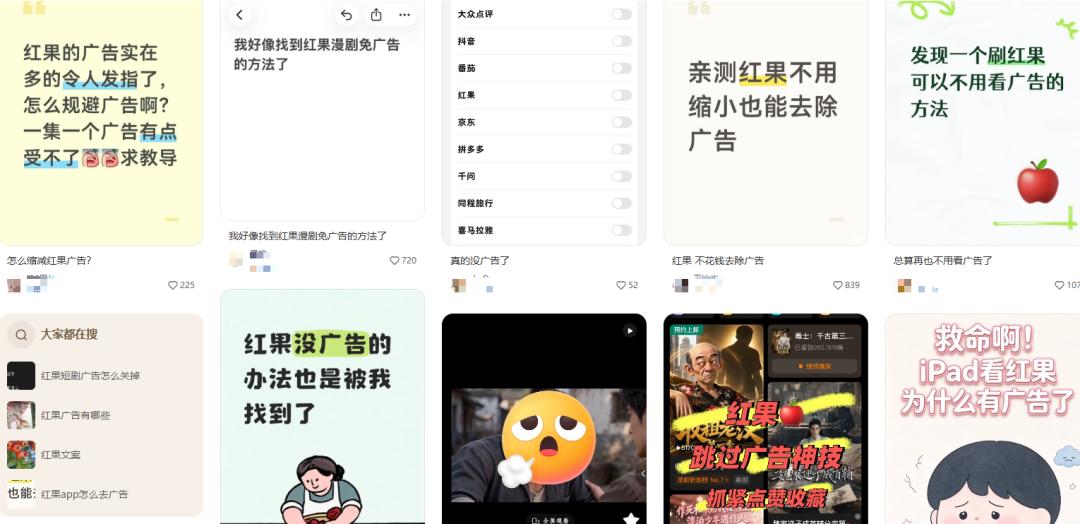
Image source: Xiaohongshu
In other words, if Red Fruit really wants to gain a firm foothold on the TV end, it cannot simply copy the "free + ad" logic from the mobile end. It must redesign a business model adapted to the family scenario. It could be longer but less frequent pre-roll ads, a membership package with revenue sharing with content providers, or interactive family scenario-based marketing that turns ads into engaging experiences. In short, it needs to make the "whole family watching" scenario commercially viable.
According to relevant media reports, the "OTT Product Manager - Red Fruit Short Dramas" position recruited by ByteDance not only needs to optimize the large-screen viewing experience, but also needs to explore monetization methods such as screen casting membership, subscription and derivative benefits. That means the product manager will be responsible for product planning, interface and playback adaptation on the TV end, build functions including home page recommendation, category navigation, search, and drama following, and promote the synergy between the mobile end and the TV end. The user scale, viewing duration and membership revenue on the TV end are also included in the job responsibilities.
Obviously, once Red Fruit Short Dramas officially steps into the TV battlefield, what it faces is far more than simply "porting the APP to the large screen", but a comprehensive reconstruction covering content form, interaction logic and business model.
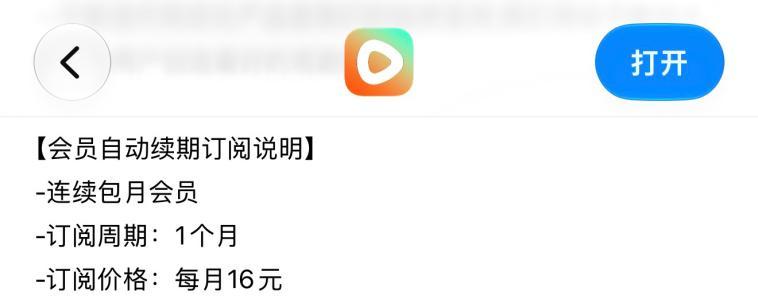
The "free + ad" logic that works on mobile phones is inherently incompatible with the living room scenario, but completely removing ads means finding a new revenue anchor. Judging from the information revealed in the recruitment notice, screen casting membership, subscription and derivative benefits are clear signals — Red Fruit is very likely to take a hybrid path of "basic content for free + ad-free viewing / exclusive content unlock via membership + derivative benefits".
For example, insert less frequent but longer brand pre-roll ads for ordinary users, while members can skip ads and unlock the early access right to some AI comic dramas; or share the TV membership revenue with content producers based on viewing duration to incentivize the production of more high-quality horizontal screen content. It is even possible to turn ads into interactive marketing under the family scenario, such as popping up brand mini-games that can be operated with the remote control when playback is paused, which does not affect the immersion of the main content, and allows advertisers to pay a premium for the large screen scenario.
But whether all these assumptions can work out ultimately depends on whether Red Fruit can truly build a collaborative closed loop between mobile and TV on the TV end. The mobile end is responsible for fragmented reach and content preheating, while the TV end undertakes in-depth viewing and family sharing. Only when accounts on both ends are connected, viewing progress is synchronized, and membership benefits are interoperable, can users feel that "screen casting is not a makeshift solution, but an upgrade".
Otherwise, the TV end will most likely only become another playback outlet for the mobile end, rather than an independent growth engine.
Competition between short and long videos: a positional warfare of two-way penetration
Back to the original question, why is Red Fruit targeting TV at this moment? Is it just because its daily active users have surpassed that of iQiyi, Tencent Video, Youku and Mango TV, making it dominate the video market?
We first need to clarify what has already happened on the mobile end. According to QuestMobile's mobile internet monitoring data for September 2026, the independent APP of Red Fruit Free Short Dramas has reached 203 million daily active users and 430 million monthly active users, with active users spending 165.98 minutes on it per day on average, which is higher than the monitoring duration of Douyin and WeChat in the same period; another July 2026 internet tracking report from Nomura Securities shows that the user duration of long video platforms iQiyi, Tencent Video, Youku and Mango TV decreased by 24% to 47% year on year.
But the setback on the mobile end has not made long video platforms lose all their chips. According to iQiyi's financial report for the third quarter of 2026, the proportion of large-screen viewing duration on the platform has exceeded 50%, and data from Gouzheng Data shows that it ranks first in the industry in terms of large-screen market share. Its membership service revenue reached 3.97 billion yuan, a year-on-year decline, but the value of a single member continues to rise, and market estimates show that the average monthly revenue per member has reached 15.54 yuan, with high-tier large-screen membership as the core source of premium. According to QuestMobile's large-screen monitoring data for June 2026: Galaxy Kiwi has 141 million monthly active devices and 50.42 million daily active devices, which is higher than the 45.14 million daily active users of iQiyi's mobile APP in the same period; Tencent Cloud Aurora and Youku Cool Cat Film & TV have 130 million and 121 million monthly active devices respectively.
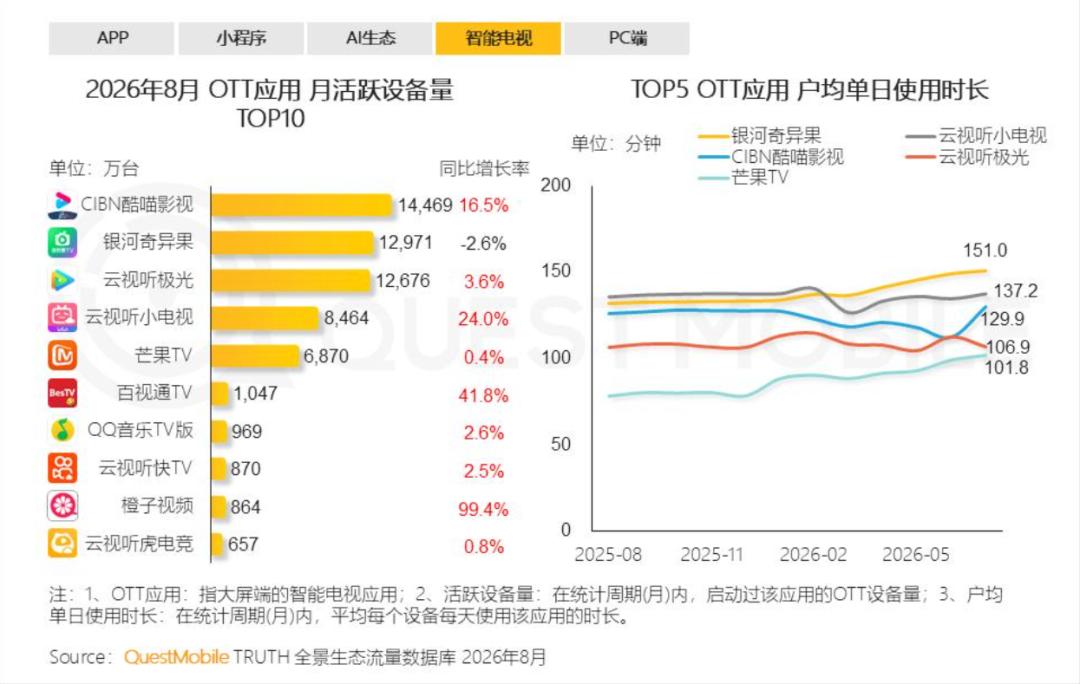
Image source: QuestMobile
The greater significance of large screens for long videos lies in their higher customer unit price. There is limited room for price increase of basic membership on mobile phones, while the TV in the living room is tied to the whole family's block of leisure time. Once users form the habit of watching on large screens, their willingness to pay higher membership fees for benefits such as 4K resolution and multi-device access will be significantly stronger. Even with the decline in total membership revenue, iQiyi can still push the average monthly revenue per member to 15.54 yuan, and high-tier large-screen membership is the core source of the premium.
As Liu Qin said, Red Fruit's offensive on large screens is not without user base. According to the 2026 Short Drama Industry Insight Report, among all users of short drama APPs in May 2026, users born in the 1970s and 1980s accounted for 47.2% in total, and users from tier-2, tier-3 and tier-4 cities accounted for 63.1%, whose demographic structure highly overlaps with the traditional middle-aged and elderly audience of TV large screens; monitoring data from February 2026 shows that Red Fruit Short Dramas has 40.745 million monthly active elderly users aged 50 and above, accounting for nearly 90% of all elderly users in the short drama track, who are exactly the core viewing group of the living room large screen.
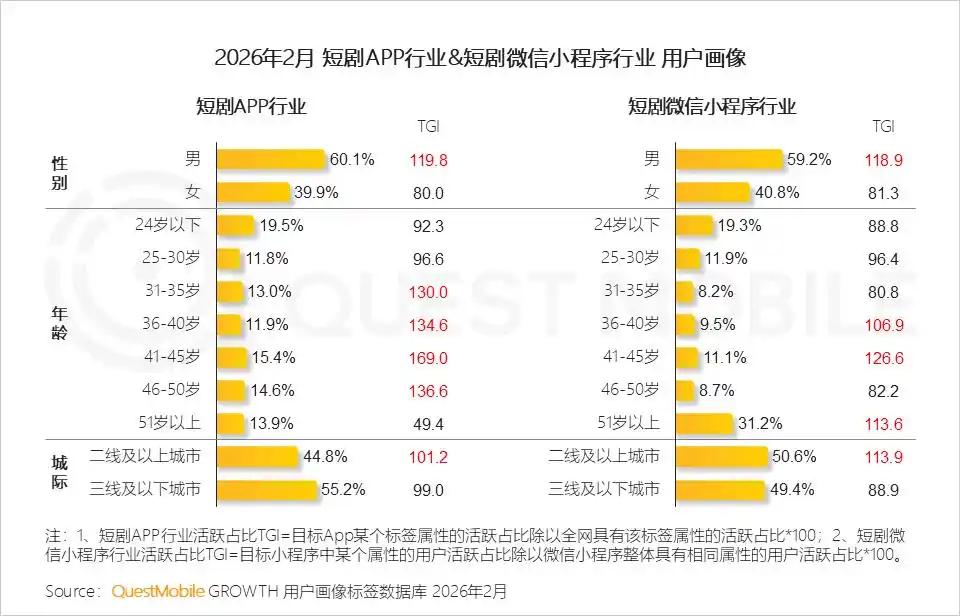
Image source: QuestMobile
But the foundation of Red Fruit on the mobile end is the "free + ad" model. It is phasing out the gold coin function, indicating that the early stage of acquiring new users through profit-earning incentives is over, and the platform needs to maintain user stickiness without relying on subsidies. However, the monetization efficiency per user under the ad model has a ceiling. Even if it has opened membership services before, it cannot break the user's established mindset that "Red Fruit short dramas are free to watch". Users are used to watching short dramas for free, so the psychological threshold for them to suddenly pay for the same content on TV is much higher than iQiyi's upgrade path from "paid viewing" to "higher-priced paid viewing".
How to make its target users pay for the large screen will be the core proposition that Red Fruit has to answer. The key point is that this requires not just a TV version APP, but a re-cultivation of users' payment habits. Even the difficulty of this cultivation is far greater than what Red Fruit experienced when it grew from scratch to 200 million daily active users on the mobile end.
It is worth mentioning that Red Fruit's entry into the TV end is not only a reshaping of the platform itself, but also a test for its content suppliers.
"I downloaded Red Fruit from Tencent App Store on my computer before, which allowed me to unlock the ad-free large-screen viewing experience for free, but the larger screen made the problems in the content more obvious. First, the picture quality is rough. Even when I set it to the maximum 1080P, I still feel the picture is a bit blurry; second, the AI production often malfunctions. Many bugs that can be easily overlooked on small screens when users are highly focused, such as repeated faces of AI extras, extra fingers on characters, obvious splicing traces during scene switching, will be very distracting when shown on large screens." Liu Qin believes that porting short drama content to large screens requires more refined adaptation and reconstruction, rather than simple "screen casting-style" migration.
After all, the high definition and immersive experience of large screens will amplify all the shortcomings of short dramas in production, which means Red Fruit must push upstream suppliers to improve the picture quality standards, standardize the AI generation process, and even re-edit the rhythm for large screens (the mobile end pursues strong stimulation of "a reversal every 3 seconds", while TV audiences have different requirements for narrative coherence and picture quality).
From this perspective, if Red Fruit really goes head-to-head with iQiyi, Tencent Video, Youku and Mango TV on the living room large screen, it is more like a positional warfare of two-way penetration, rather than a one-sided final crush of long videos by short dramas. Red Fruit is attacking the profit fortress of long videos, while long videos are fighting back by improving the content quality and payment conversion capability of short dramas.
The outcome does not depend on who has more daily active users, but on who first internalizes the core capability of the other side on its own weak position.
This article is from the WeChat Official Account "Zinc Scale" (ID: znkedu), written by Zinc Scale, and published by 36Kr with authorization.