Suppose Yu Minhong and Dong Yuhui appear on the show "Goodbye, Boss"
Luo Yonghao has once again pushed Yu Minhong to the top of the trending search list.
The trigger is that the recent variety show See You Soon has become a huge hit, and the similar show Goodbye, Boss that focuses on bosses and their employees is about to be released soon. Netizens who love gossip are enthusiastically nominating candidates for the show.
Some netizens proposed that Luo Yonghao and Yu Minhong should participate in the variety show Goodbye, Boss. Luo Yonghao immediately responded: "Well... I have no problem with it, it depends on Teacher Tie (Yu Minhong)'s side."
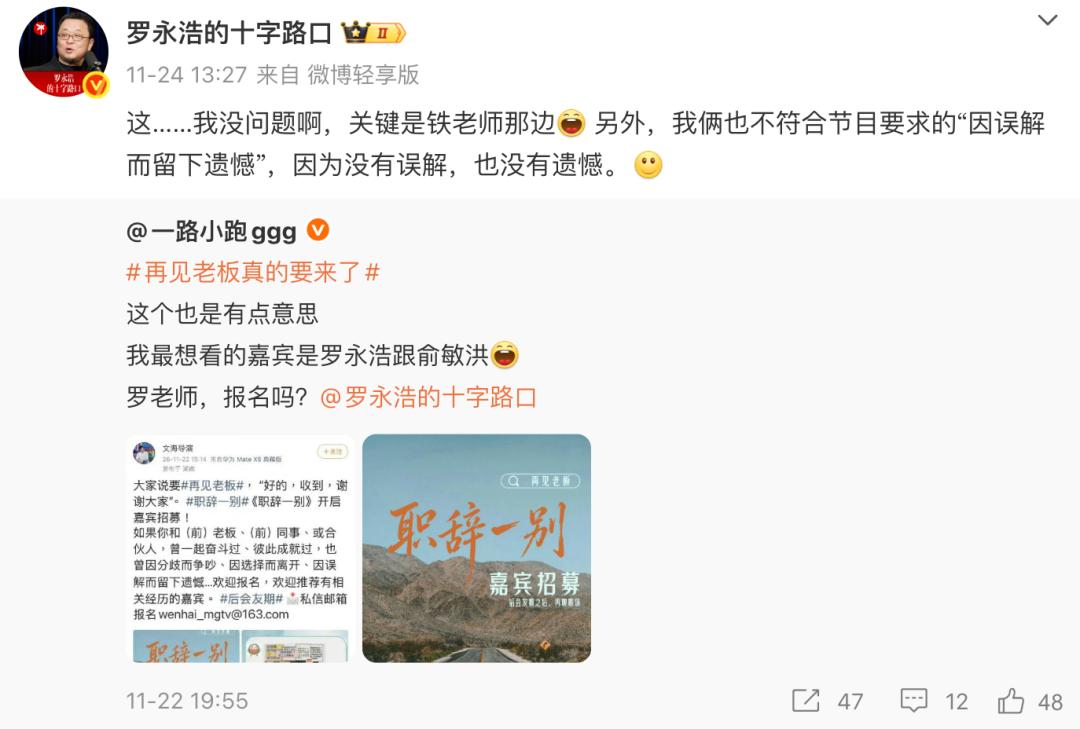
This single sentence once again brought up the years-long grievances and entanglements between the two. But Yu Minhong will most likely not accept the invitation. Luo Yonghao also said that the two do not fit the setting of Goodbye, Boss, there is no misunderstanding between them, nor any regret.
Even if the two parties involved do not take the offer, the gossip-loving audience never gets tired of discussing the topic.
In fact, in the history of Chinese business, apart from the underdog stories of people getting rich overnight, what netizens pay the most attention to are the love and hate entanglements between entrepreneurs. They once cherished each other and trusted one another, but with the development of their companies and problems in benefit distribution, they eventually fell apart.
For example, Yu Minhong and Dong Yuhui, Zhou Hongyi and Fu Sheng, Luo Yonghao and Zheng Gang, Zhu Xiaohu and Yang Zhilin.
If they get the chance to sit together again, can those unfinished words finally be clarified? How will those unsettled scores be settled?
But in reality, these groups of people will most likely not really sit in front of the camera. The grievances in the business world involve interests, dignity and public opinion, and most people are unwilling to lay out the details for the public to watch. But we can make an interesting assumption: if they really appear on this show, it will undoubtedly become a huge hit.
01
The separation between Yu Minhong and Dong Yuhui is probably the most high-profile boss-employee split in recent years.
The story of the two is very familiar to the public. To put it simply, in 2022, Dong Yuhui rose to fame for his knowledge-based live streaming sales, and once made East Buy a huge success. Yu Minhong publicly expressed his recognition of him many times, and even considered letting Dong Yuhui take over the company.
But as Dong Yuhui's personal influence continued to expand, internal management conflicts intensified. After the "short essay controversy" at the end of 2023, Yu Minhong promoted Dong Yuhui to a higher position and helped him set up a personal studio. But eventually, the two parted ways in July 2024.
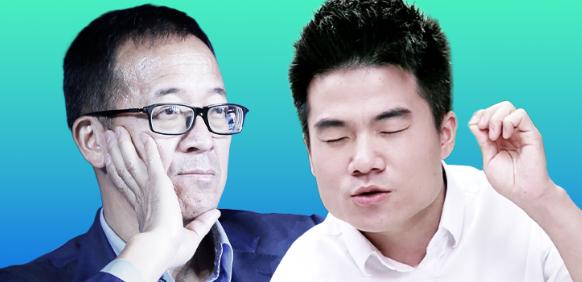
After leaving East Buy, Dong Yuhui runs his own venture Yuhui Peer, while Yu Minhong continues to lead East Buy.
The interesting part of this relationship is that: The boss who once wanted his employee to take over the company finally saw the employee leave the company; the employee who once said "a true gentleman will die for someone who knows his worth" finally chose to start his own business.
From a business perspective, this separation can be regarded as relatively decent. But it still hasn't stopped the public from speculating: Did they really part on good terms, or are there still things that have never been talked through?
The reason why this relationship is so complicated is that there are too many third parties involved.
The first one is Sun Dongxu, former CEO of East Buy. After the short essay controversy back then, Yu Minhong was once in a dilemma, wanting to keep Dong Yuhui while also protecting Sun Dongxu. As a result, both of them eventually left East Buy.
The second party is the fans of both sides. There was even a rumor online that Yu Minhong paid people to attack Dong Yuhui. Later, Yu Minhong specifically posted a statement to deny it, saying that he never provided any money, information, authorization or instructions to relevant people.
A boss-employee relationship that was originally built on the grace of recognizing a talent has finally reached a point where the boss has to clarify that "he did not pay to attack his former employee".
This also leaves many thought-provoking questions about this separation.
Did Yu Minhong really understand Dong Yuhui's demands? After the short essay controversy, Yu Minhong gave him positions, resources and greater autonomy, why still failed to retain him? What Dong Yuhui really wants, is it more space for development, or a career that he can fully control?
Neither of the two has ever talked about these questions openly.
Are there any unspoken grievances between them? Does Yu Minhong have any regrets? Did Dong Yuhui get enough respect?
These questions did not disappear just because the two parted decently, but instead left some public topics: How should entrepreneurs get along with star employees? When an employee grows into an IP with independent influence, how should this relationship continue?
If the two appear on Goodbye, Boss, they probably both have their own knots in their hearts:
Yu Minhong's knot is: I gave you opportunities, and also gave you dignity, why in the end I am still the one being blamed?
Dong Yuhui's knot is: I created value for the company, but does the company really recognize my value?
02
Compared with Yu Minhong and Dong Yuhui, the story of Zhou Hongyi and Fu Sheng spans more than 20 years of China's Internet industry.
Fu Sheng was once a key right-hand man promoted by Zhou Hongyi, and the two were once as close as master and apprentice.
In 2005, Fu Sheng joined the Qihoo team founded by Zhou Hongyi, and later took charge of core products such as 360 Security Guard. Under Zhou Hongyi's leadership, Fu Sheng gradually grew into a manager who could take charge of his own work independently.
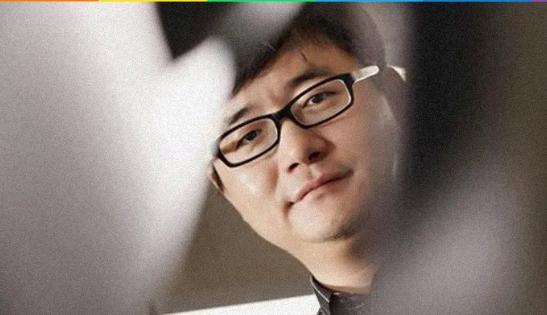
But the cooperation between the two did not last forever.
In 2008, due to differences in ideas, Fu Sheng left 360. Later, he founded Kanu Network, which was merged with Kingsoft Security under the promotion of Lei Jun, to establish Kingsoft Network, which was later renamed Cheetah Mobile.
This means that Fu Sheng, who used to make security products under Zhou Hongyi, turned around and became a competitor of 360.
This change intensified the conflict between the two. Zhou Hongyi once publicly called Fu Sheng a "traitor", and the relationship between the two deteriorated rapidly, and they even took each other to court for a time.
In 2011, 360 sued Fu Sheng in court, accusing him of violating the non-disclosure agreement to develop competing products; Fu Sheng fought back with an article titled 19 Lies Fabricated by Zhou Hongyi, denying accusations such as stealing technology. The two had completely different explanations for the same incident.
For many years after that, the two were in a confrontational state in public opinion. Everyone thought it was almost impossible for this grievance to be resolved.
Unexpectedly, the two staged a "century reconciliation" in 2024, and both said the past was gone. But facts proved that the past has not really passed.
In March 2026, Fu Sheng contacted Zhou Hongyi after drinking but was rejected. In an agitated mood, he accused Zhou Hongyi of "owing money and refusing to pay" in multiple groups, and even used extreme insulting words.
It seems that even after more than ten years, both sides have their own careers, but the two still cannot really let go of the past.
The most thought-provoking part of this relationship is: leaving to start a business, even becoming a competitor of the former employer, is a very common thing in the Internet industry. Why when some people leave to start a business, it is normal talent flow; but when Fu Sheng left 360, he was called a "traitor" by Zhou Hongyi? Why did Zhou Hongyi care so much about Fu Sheng's departure to start a business?
Especially during the on-stage conversation in 2024, Zhou Hongyi said he would look forward, and Fu Sheng also expressed his gratitude. The two seemed willing to give the past an explanation. But if they really let it go, why two years later, an unanswered call can still push the two back to the center of public opinion?
The story of these two people goes beyond personal grievances, and behind it is a more realistic business proposition: What exactly can talents cultivated by the company take away after they leave?
This is probably also the reason why Zhou Hongyi and Fu Sheng are worth sitting down and talking again.
03
The story of Luo Yonghao and Zheng Gang is a 15-year-long entanglement of grievances, and also a settlement of old scores between investors and entrepreneurs.
Zheng Gang was an important early investor in Smartisan, and he invested a total of 175 million yuan starting from the Series A round. At that time, Zheng Gang was known as the "number one Smartisan fan", praising Luo Yonghao as China's Steve Jobs, and did not hesitate to argue with all critics. In the most difficult time, Zheng Gang even mortgaged his own house to lend money to Smartisan.
Luo Yonghao also helped Zheng Gang before, and the two once had a rock-solid relationship, which was once a much-told story of grace of recognizing a talent in the venture capital circle.
But later Smartisan failed in business, Luo Yonghao was burdened with 600 million yuan in debt, and started live streaming sales. In 2022, Luo Yonghao founded Redline, proposing to give 5% of the equity to compensate old shareholders, but required them to give up part of the repurchase rights for Smartisan. Zheng Gang did not agree with this, and the two fell out.
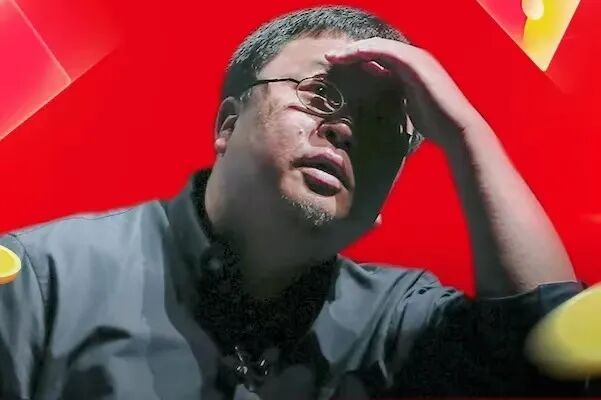
The two once fought a war of words online. The most representative event was that Zheng Gang pursued a 15 million yuan loan from Luo Yonghao, Zheng Gang won the lawsuit, and the court ruled that Smartisan should repay the 15 million yuan principal and interest.
In September 2026, the two clashed again. Zheng Gang said that Luo Yonghao still owed him 25 million yuan and reported Luo Yonghao for tax evasion. Luo Yonghao said this was a false accusation. The two stuck to their own versions of the story.
From the full support in the past, calling each other "China's Steve Jobs", to the mutual abuse now, even insults like "Luo Shimei in the venture capital circle" have come out.
The most complicated part of this relationship is that both sides have their own accounts in mind.
In Zheng Gang's account, there is about 175 million yuan of equity investment loss, the unsolved 25 million yuan, and the unresolved shareholder rights issue. The knot in his heart is probably: I was willing to give you money to support you back then, now the company failed, why is it so hard to get a clear explanation?
In Luo Yonghao's account, after the company failed, he has paid off the debts he should take. He may want to ask: After the business failed, I did not deny the investors' losses, but should all the losses be borne by the founder alone?
Perhaps, the two lack a calm and sincere communication.
04
The dispute between Zhu Xiaohu and Yang Zhilin is a much-watched investment dispute in the AI industry in recent years.
Yang Zhilin was once the co-founder of Cyclic Intelligence, Zhu Xiaohu is the investor of Cyclic Intelligence, and GSR Ventures invested in the company from Pre-A round all the way to Series C round.
At the end of 2022, Yang Zhilin decided to found the large model company Moonshot AI. But the problem arose right at this new startup.
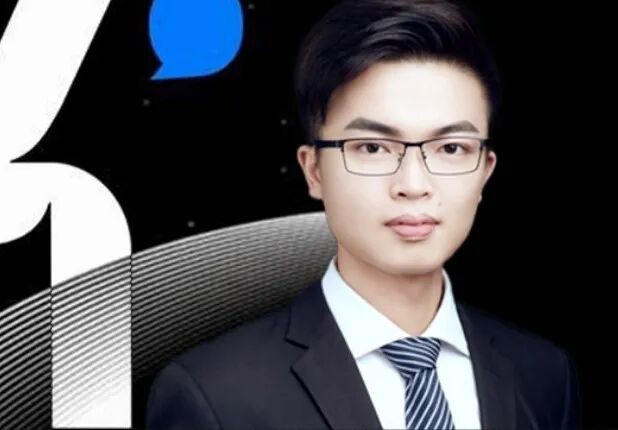
According to Yang Zhilin, in accordance with the agreement in the transaction documents of Cyclic Intelligence, he completed all the necessary procedures to leave the former company and start Moonshot AI.
But Zhu Xiaohu and other old shareholders did not agree. They believed that there were problems with the spin-off procedures, Yang Zhilin and others started financing for the new company without obtaining the necessary exemption, so they filed arbitration at the Hong Kong International Arbitration Centre in 2024.
The two sides have their own statements. Yang Zhilin believes that the board of directors of Cyclic Intelligence has passed the arrangement for the establishment of Moonshot AI, and there is no problem with the procedures.
Zhu Xiaohu believes that written communication alone is not enough, and it is necessary to strictly follow the company's articles of association and shareholder resolutions.
This relationship is so complicated that it involves another person, Zhang Yutong. She was a partner at GSR Ventures at that time, and also a director of Cyclic Intelligence, and later held shares in Moonshot AI. Zhu Xiaohu believes that Zhang Yutong concealed her equity interests in Moonshot AI, which constituted a conflict of interest.
Up to now, the two sides have not reached a settlement, and the arbitration has not been withdrawn.
The most thought-provoking part of this relationship is, between Zhu Xiaohu and Yang Zhilin, who exactly did not abide by the original agreement?
This dispute also touches on an unavoidable problem in China's venture capital industry: when a founder decides to leave the original company to start a new business, how should the boundary between the investors' rights and interests and the entrepreneur's autonomy be drawn? How to spin off a company in a legal and compliant way?
If the two can sit on the show Goodbye, Boss, perhaps the most worth talking about is what exactly in the original investment agreement was not made clear. For both investors and entrepreneurs, this may be a lesson worth learning.
If they can sit down and clarify this old score before Moonshot AI goes public, it can be regarded as giving the past a proper conclusion.
Extra Note
If Goodbye, Boss has an international version, there will be no shortage of guests.
Elon Musk and Sam Altman are a ready-made pair. The two once co-founded OpenAI, later Musk left to found xAI, and the two turned from former allies to public rivals. Altman and Ilya Suts