Traditional passwords are easily cracked, and 6G is faced with an unavoidable security challenge that must be addressed.
With the rapid iteration of quantum computing technology, traditional public key cryptography systems such as RSA and ECC are facing unprecedented security challenges.
Taking 5G as an example, its security mechanism is built on traditional public key algorithms, which faces the risk of being quickly cracked and the core security mechanism failing under quantum computing attacks. 6G adopts dynamic networking and multi-form access modes, and its attack exposure surface is greatly expanded compared with 5G. Without anti-quantum attack capability, there is no basis for security, and future development will be nothing but a fantasy.
That is why the industry regards post-quantum security as the core pillar of 6G endogenous security. Ericsson believes that 6G will fully support Post-Quantum Cryptography (PQC) from its first version, with anti-quantum attack capability, to build a long-term and sustainable security foundation for the new generation of networks.
However, the implementation of this goal is no easy task, and a series of challenges such as PQC algorithm performance optimization, standardization promotion, and cross-device interoperability remain to be overcome.
The foundation of traditional security is shaken
In a sense, today's digital world is built on cryptography systems. Functions such as identity verification, data encryption, and signature tamper-proof all rely on cryptographic capabilities. Traditional public key cryptography such as RSA based on large number factorization and ECC based on the elliptic curve discrete logarithm problem are the cornerstones supporting the current trust system of the digital world.
The rapid development of quantum computing is shaking the foundation of this underlying technology. Theoretically, a fault-tolerant quantum computer of sufficient scale can crack the public key encryption algorithms widely used at present. However, quantum computing is a double-edged sword: on the one hand, it is expected to bring changes in scientific research, medical care and other fields, and solve many difficult problems that were hard to solve in the past; on the other hand, it can easily break through the security defense built by traditional cryptography, forming a fundamental threat to the global network infrastructure.
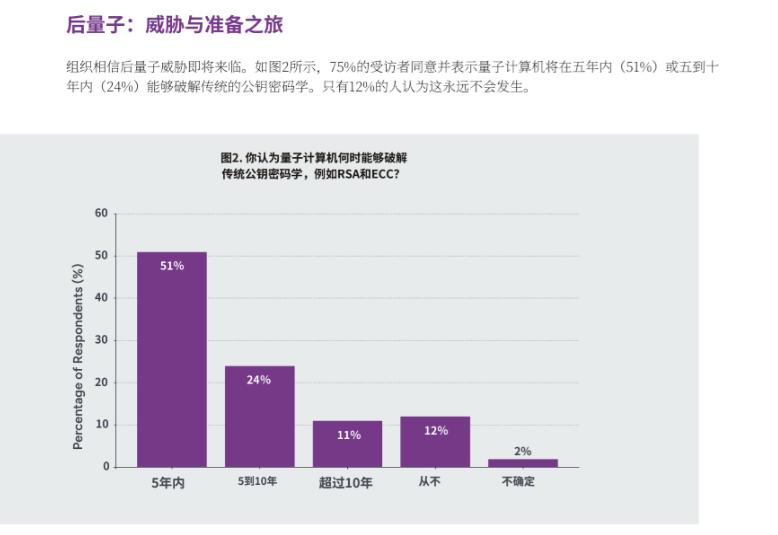
The "2026 Global Post-Quantum and Cryptography Security Trends Report" released by the Ponemon Institute shows that 75% of global IT and security executives believe that quantum computers are expected to crack RSA and ECC algorithms within the next ten years, and 51% of respondents judge that this risk will arrive within five years.
Source: Ponemon Institute
In this context, post-quantum cryptography came into being, aiming to develop new cryptographic algorithms and protocols that can resist attacks from quantum computers, and has now become one of the most concerned cutting-edge directions in the cryptography field. The design goal of post-quantum cryptographic algorithms is to resist attacks from both classical computers and quantum computers. Like traditional cryptographic algorithms, they can run on existing classical hardware and be embedded in existing communication protocols and business systems.
Global PQC Layout Race
At present, major global economies are accelerating the R&D of PQC technology and system migration.
The United States is relatively ahead in the promotion pace: the National Institute of Standards and Technology (NIST) of the United States released three PQC standards in August 2024, and issued the final version of "Transition to Post-Quantum Cryptography Standards" (NIST IR 8547) this October, clarifying the implementation path, transition plan and time nodes for switching from traditional public key algorithms to quantum-secure PQC algorithms. According to the plan, the overall migration work will be completed no later than 2035.
Based on the independent and controllable strategy, China launched the global solicitation of new generation commercial cryptographic algorithms by the Institute of Commercial Cryptography Standards (ICCS) last February, and announced the first round of candidate algorithm list this September. According to the plan, the first round of evaluation is expected to be completed in June 2027.
In order to accelerate PQC technology iteration through open source collaboration, China established the PQMagic post-quantum cryptography open source community this August. Yu Yu, distinguished professor of Shanghai Jiao Tong University, introduced that the PQMagic open source ecosystem gathers multiple stakeholders, and promotes the continuous iteration and trial deployment of post-quantum cryptography technology from the directions of algorithm implementation, verification tool development, technical specification compilation, and scenario incubation. The community simultaneously released its first open source project, the PQMagic post-quantum cryptography algorithm library, which supports a number of international post-quantum cryptography standards and domestic independent algorithms, providing open source basic components for researchers, developers and enterprises to carry out algorithm verification, performance testing and other work.
China's national unified overall migration plan for PQC has not been officially released to the public, but industry insiders suggest setting two time windows in 2030 and 2035: complete the migration of critical information infrastructure by 2030, and achieve full deployment by 2035, which is generally aligned with the mainstream international plans.
6G Security Pressure is Brought Forward
The security risks brought by quantum computing do not appear only after quantum computers are mature. "The attack mode of 'collect first, decrypt later' has already emerged: attackers first store the data collected now, and decrypt it after quantum computing matures, which also poses a huge threat." Zhang Yongtao, Deputy General Manager of the Technology Department of Ericsson China, said in an interview with IT Times.
Telecom systems have a long life cycle, cross-domain interconnection, and carry critical services, so preparations and deployments must be carried out in advance, which is particularly critical for 6G.
First of all, the attack exposure surface of 6G is much larger than that of 5G. The large-scale deployment of capabilities such as air-ground integrated communication and edge intelligent collaboration expands the service boundary of 6G, and also brings new security challenges. The "Research on 6G Network Endogenous and Boundary Security Technology and Standardization" released by the Secretariat of the National Cybersecurity Standardization Technical Committee a few months ago pointed out that 5G only realizes the service-oriented transformation of the core network, while 6G moves towards full-network ITization and microservice, with service capabilities sinking to the access network, edge nodes and terminals, forming a large number of cross-domain open interfaces. The attack mode has changed from single-point breakthrough to mesh diffusion, and attackers can complete lateral penetration and in-depth control relying on the service call chain.
Secondly, the short board of anti-quantum protection capability is prominent. 5G relies on traditional public key algorithms such as RSA and ECC, which is vulnerable to quantum cracking and has a typical "collect first, decrypt later" risk. 6G needs to deploy anti-quantum cryptography systems in advance, supporting a fast key update mechanism, but the overall protection foundation is still relatively weak at this stage.
The industry has listed PQC as one of the core technologies for 6G security, and reached a consensus that 6G must support PQC from its first version. The aforementioned report proposes that 6G should introduce PQC at the architecture design stage, complete the overall upgrade of authentication, key exchange, and digital signature systems, and simultaneously strengthen the symmetric encryption strength and key negotiation mechanism.
Ericsson has also clarified the most urgent work at present: prioritize the migration of key negotiation algorithms to hedge the "collect first, decrypt later" risk; replace the long-term trust anchor that is the foundation of digital trust.

Source: unsplash
Unresolved Implementation Challenges
The industry consensus is that large-scale communication security protection cannot be achieved without post-quantum cryptography, but the implementation chain is very long, covering multiple links such as algorithms, protocols, key management, code implementation, and operation and maintenance processes, and there are many implementation obstacles.
At the algorithm level, Feng Zebing, chief engineer of the China Academy of Information and Communications Technology, wrote that the performance of PQC algorithms such as calculation speed, key volume, and signature size are usually not as good as traditional cryptographic algorithms. The public key and private key lengths of the Kyber1024 algorithm reach 1568 bytes and 3168 bytes respectively, which is difficult to meet the lightweight authentication requirements of massive IoT terminals in 6G scenarios. Therefore, PQC algorithms still need continuous optimization to reduce computational complexity and storage occupancy, and adapt to resource-constrained 6G terminals and network environments. In addition to the performance of the algorithm itself, it is also necessary to evaluate its impact on device interconnection, end-to-end delay and other aspects.
The challenge also lies in the parallel operation of multiple standards and international mutual recognition. Compared with the new generation of commercial cryptographic algorithms under development in China, the standards released by the United States have differences in algorithm selection, security parameters, and evaluation specifications. The industry suggests deeply participating in the formulation of international quantum security standards, and outputting China's practical experience in the integrated deployment of Quantum Key Distribution (QKD) and PQC relying on multilateral platforms such as the International Telecommunication Union.
The post-quantum cryptography layout for 6G is not only a technical research task, but also a long-term race related to digital trust.
This article is from the WeChat official account "IT Times" (ID: vittimes), author: Qian Lifu, editors: Qian Lifu, Sun Yan, published with authorization from 36Kr.