Behind DeepSeek's rate limiting: The AI era is putting an end to the free logic of the Internet.
On November 16, DeepSeek adjusted the usage quotas for its app and web versions. Some users reported that they received a notification of exhausted quota after less than two hours of continuous use, with the single-input cap adjusted to around 40,000 words, and some long dialogs that had not been used for more than 7 days could not be continued.
DeepSeek stated that this adjustment is related to server load and computing power resources, mainly affecting the app and web versions, while the pay-as-you-go API services remain unaffected. According to a report by Yicai, as of the release of the report, DeepSeek has not announced specific quota management rules and subsequent adjustment arrangements.
At present, from overseas mainstream AI products such as ChatGPT, Claude, Gemini, Grok to domestic ones including Tencent Yuanbao, Doubao, Qianwen, Kimi, etc., mainstream AI products still provide free services to ordinary users to varying degrees, but all manufacturers have adopted different usage strategies in terms of model access permissions, usage frequency, context length and advanced functions.
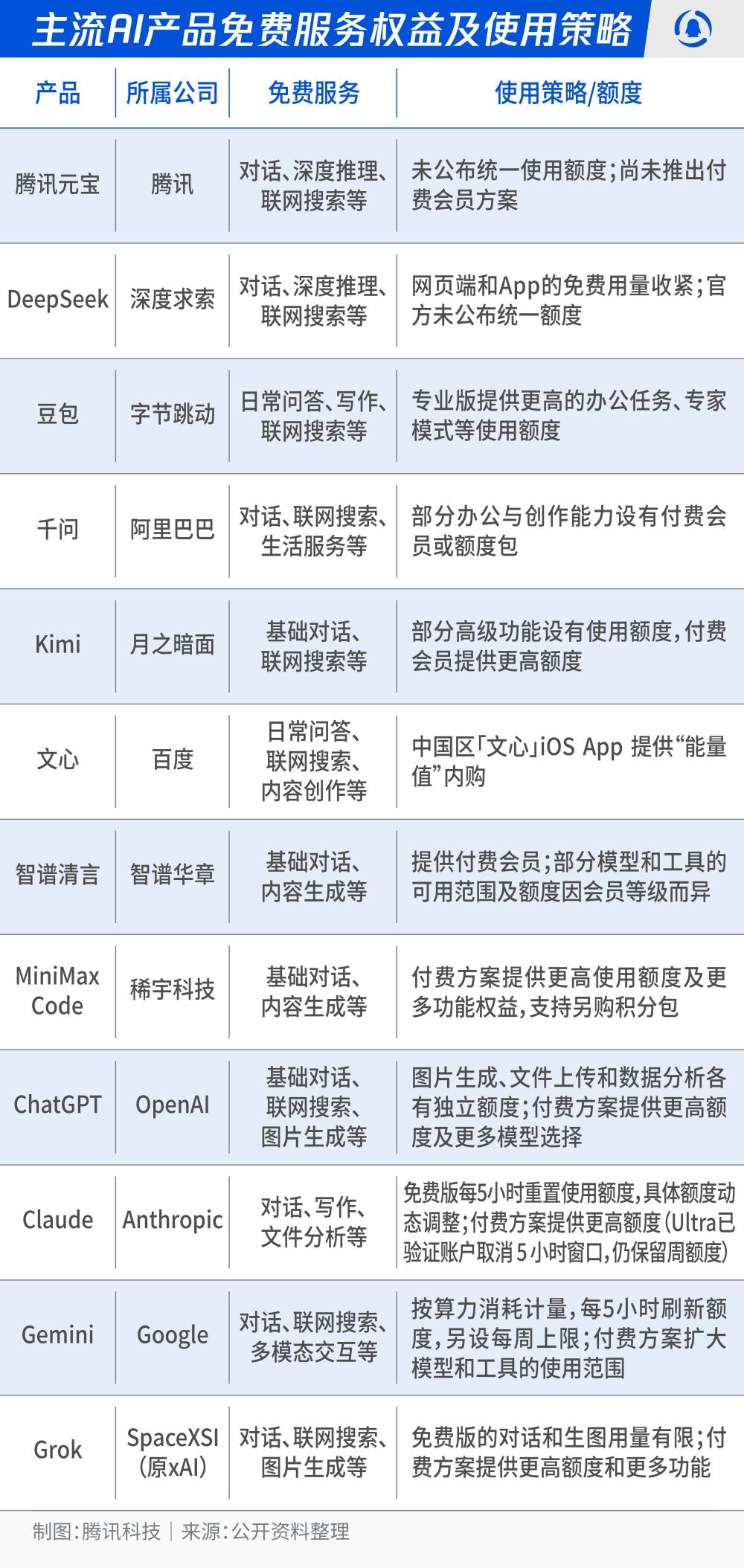
From the perspective of the commercial logic of the traditional Internet, AI seems to be experiencing the cost dilemma that early video websites once faced: free services cannot cover costs for a long time, and the introduction of paid memberships has become a natural commercial choice.
However, this explanation ignores a more fundamental difference between AI and the traditional Internet: In the Internet era, platforms pursue the maximization of user scale; in the AI era, platforms must also consider the use efficiency of limited computing power resources.
Over the past two decades, more and more Internet services have been opened to users for free, ranging from communications and search to office work and software development, and the scope and quota of free services have been continuously expanding. In 2004, Google launched Gmail, providing users with 1GB of free mailbox storage space; in 2016, WhatsApp canceled its annual subscription fee of about 1 US dollar; in 2019, GitHub opened an unlimited number of private code repositories to free users.
Underpinning this business model are the relatively low marginal cost of digital services and the growth of commercial value brought by scale effect and network effect. The larger the user scale, the more opportunities enterprises have to spread costs, expand revenue and build competitive barriers. The bandwidth dilemma of early video websites can provide a reference for us to understand the current AI traffic restriction, but this analogy has obvious limitations. If we only regard the shortage of computing power as a phased infrastructure bottleneck, it is easy to overestimate the role of expanding computing power supply and the "free traffic restriction + paid membership" model.
What AI is changing is precisely the economic foundation that supports the establishment of the traditional Internet business model.
When AI gradually becomes a general-purpose productivity tool, the problem is no longer just whether it is free or paid, but: when computing power cannot fully meet the needs of all people, who has the priority to use AI? Should market prices become the main basis for determining the allocation of computing power?
This may be the more noteworthy issue behind this round of AI traffic restriction.
01 Cheaper Tokens, More Expensive Computing Power Bills
Even serving 100 million users, letting 100 million people watch the same TV series and letting 100 million people ask different questions to AI are two completely different businesses.
The former only needs to produce the content once and then distribute it to different users; the latter needs to calculate and generate content in real time according to the needs of each user.
This difference determines that it is difficult for AI to simply copy the cost reduction path of the Internet era.
Large model reasoning is not the process of transporting ready-made files. There is also cache on the reasoning side, but at most it saves the repeated input part; once the context and task change, the answer still needs to be calculated word by word on the computing power cluster. Bandwidth can be spread through nearby replication, but reasoning has to consume computing power genuinely every time.
At present, the unit price of reasoning is falling every year. A report released by research institution Epoch AI in September this year estimates that since 2023, the price required to achieve the same capability has dropped to about one-thirteenth of that of the previous year. But agents have increased the token consumption of a single task by several orders of magnitude. A study introduced by Stanford Digital Economy Lab found that the tokens consumed by agents to complete programming tasks are on the order of 1000 times that of code Q&A.
The British economist Jevons pointed out in *The Coal Question* that the fact that steam engines consume less coal did not reduce coal consumption: after power became cheaper, there were more places to use coal, and total consumption rose instead. Computing power is repeating this story - the price is falling year by year, but the total consumption is skyrocketing. In April this year, GitHub suspended new user registrations for Copilot individual subscriptions; in November, DeepSeek began to limit traffic.
The usage of the Internet is limited by human attention, and the cost will converge. The usage of AI comes from automated tasks that can continue to expand. As long as each reasoning consumes computing power, computing power will always be in short supply.
02 The More Active Users Are, the Harder It Is for AI Companies to Make Money?
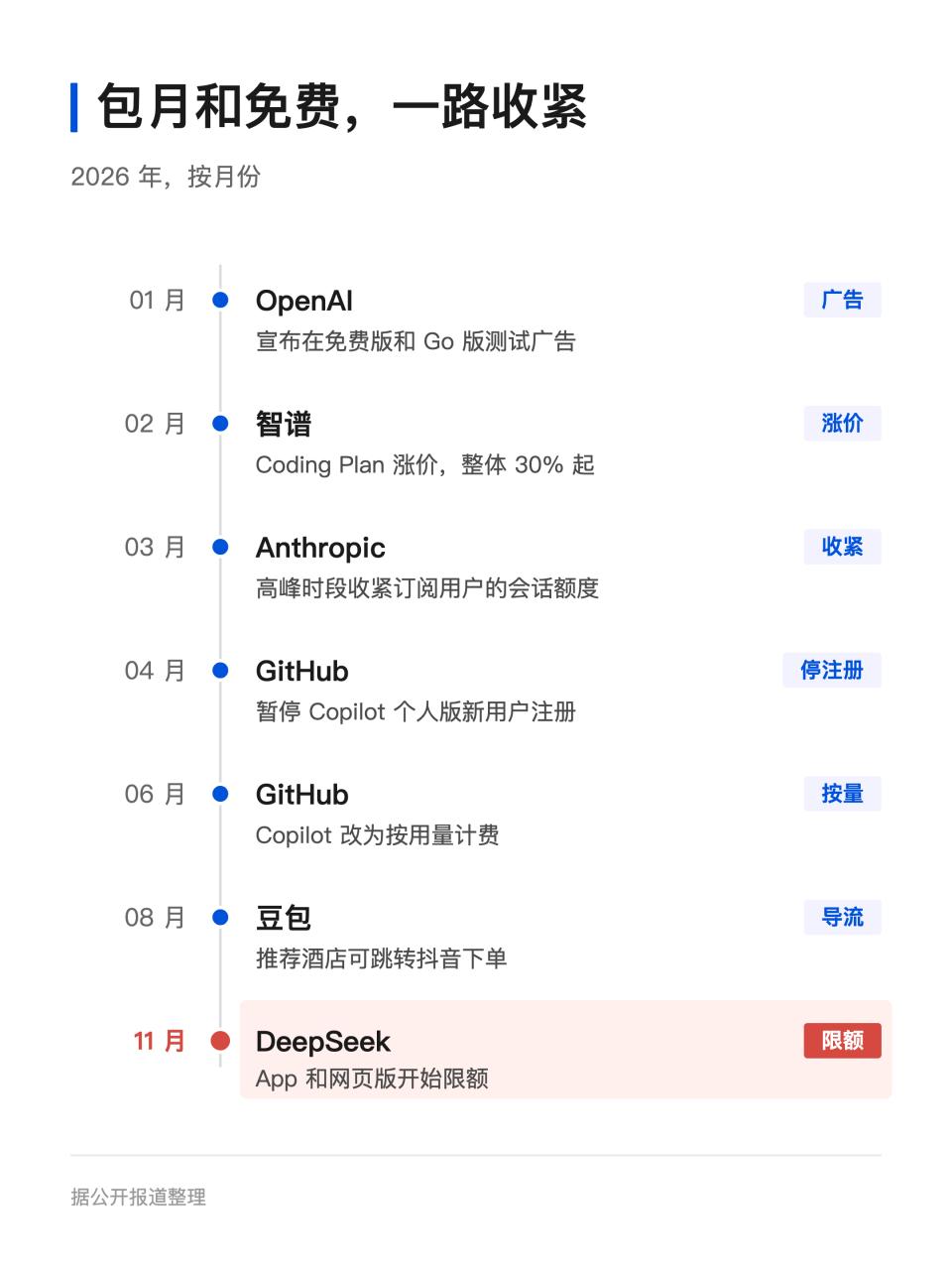
It's not just GitHub. According to a PCWorld report in March 2026, Anthropic quietly tightened the session quotas for subscription users during peak hours, and several leading manufacturers are repeatedly adjusting the monthly subscription cap. Domestic Zhipu sent a letter in February to adjust the price of the Coding Plan, with an overall increase starting from 30%.
Free services cannot support the cost, and copying the membership system of the Internet era is also not feasible.
An important reason why the traditional membership system can work is the difference in user usage: the subscription revenue contributed by a large number of light users can share the service cost brought by a small number of heavy users. However, with the popularization of agents, the token consumption of a single task is several orders of magnitude higher than that of ordinary Q&A. When more and more users start to use agents, the balance between fixed subscription revenue and actual reasoning cost may be broken.
In the traditional Internet business model, heavy users are often the most valuable assets of the platform; but under the fixed-price AI subscription model, heavy users may instead become the group that brings the greatest cost pressure.
Taking Wikipedia as an example, as the number of participants increases, the value of the product itself continues to improve, thus forming a competitive barrier. However, in current large model products dominated by independent interactions, a user using the model more frequently will not directly improve the service value obtained by other users.
The "data flywheel" often talked about in the venture capital circle in the early years has not been realized in AI applications so far. Without network effects to lock in users, there is almost no conversion threshold in the chat box, and users can switch to other services at any time if a model is stronger or cheaper. Simply paying users cannot bring a healthy development of the industry.
03 AI Payment Does Not Equal User Rights Protection
In 1998, Page and Brin, the two founders of Google, put forward a warning in the appendix of their foundational paper on search engines: search engines that rely on advertising for revenue tend to favor the interests of advertisers rather than the actual needs of consumers. Since search quality itself is difficult to evaluate, even professionals can hardly detect this bias.
Nearly 30 years later, as AI gradually becomes a new information entry, this problem has emerged again.
Under the background that the cost of AI services continues to grow and directly charging users faces many challenges, many manufacturers still choose to provide free services.
It is difficult to charge users directly, so many products choose to remain free. However, marginal costs do exist, and someone must pay for the free computing power. In the business world, the one who pays will get the product to serve their interests.
For AI products that do not charge ordinary users directly, there are currently two main commercialization paths.
One is to support free services for ordinary users through paid businesses such as APIs, and DeepSeek is a representative of this model. But this model has clear cost and resource constraints: when free services compete with paid businesses and model R&D for limited computing power resources, manufacturers need to readjust their computing power allocation strategies. This round of DeepSeek traffic restriction is targeted at the free app and web versions, while the pay-as-you-go API services are not affected.
The other is to continue the business model of the Internet era, by introducing advertisements, transaction commissions, or relying on revenue from other businesses to subsidize free AI services. Although users do not need to pay directly, their usage behavior can be converted into commercial revenue through other channels.
The difference between the two models lies not only in who bears the computing power cost, but also in whose commercial interests the AI products are bound to.
Traditional search engines mainly affect the distribution of users' attention, while AI is getting more and more deeply involved in users' judgments and decisions.
In traditional search, even if some search results are advertisements, users can still browse different information sources, make comparisons and make choices. AI integrates the processes of information retrieval, screening and analysis, and directly provides users with a seemingly objective conclusion. It is more difficult for users to judge which information is presented preferentially, which information is ignored, and whether there is commercial interest influence behind it.
In January 2026, OpenAI announced that it would test advertisements in the free version and the $8 Go version, and promised that advertisements would not affect the responses. At present, manufacturers have made clear statements on the boundary between commercialization and response independence, but the actual operation effect of relevant mechanisms still needs further observation.
If free AI is paid for by advertisements and traffic diversion, what will be affected are the decisions users entrust to it.
The paid model can partially change this relationship. According to OpenAI's plan, tiers above $20 are ad-free. Payment turns users from being sold traffic into customers. But customers' rights are also limited: the price, quota, and what the model prioritizes optimizing are still determined by the seller; the $8 Go version, even after payment, is still within the scope of advertisement testing; the monthly subscription quota can be quietly lowered. Even whether to provide paid service is determined by the seller — DeepSeek users said they were willing to pay, and some suggested launching a monthly card, but there was not even a payment entry in the app.
Payment answers the question of who bears the cost of AI, but does not answer who AI should be responsible for. When AI gradually becomes a basic tool for people to acquire knowledge, carry out work and even make decisions, it is necessary for users to ask: after I pay, what exactly are the obligations this AI has to me?
04 AI Payment Is Not Only a Commercial Act, But Also a Form of Resource Allocation
On November 22, a widely discussed help post appeared on the mathematics Q&A community MathOverflow.
A pure mathematics postdoctoral researcher working in a developing country said that he and his colleagues could not even afford the subscription fee of ChatGPT Plus, and still relied on pen and paper to carry out research. In the context that more and more peers are using AI for scientific research, how should they continue to publish papers in the future? In just a few days, this post received nearly a hundred likes.
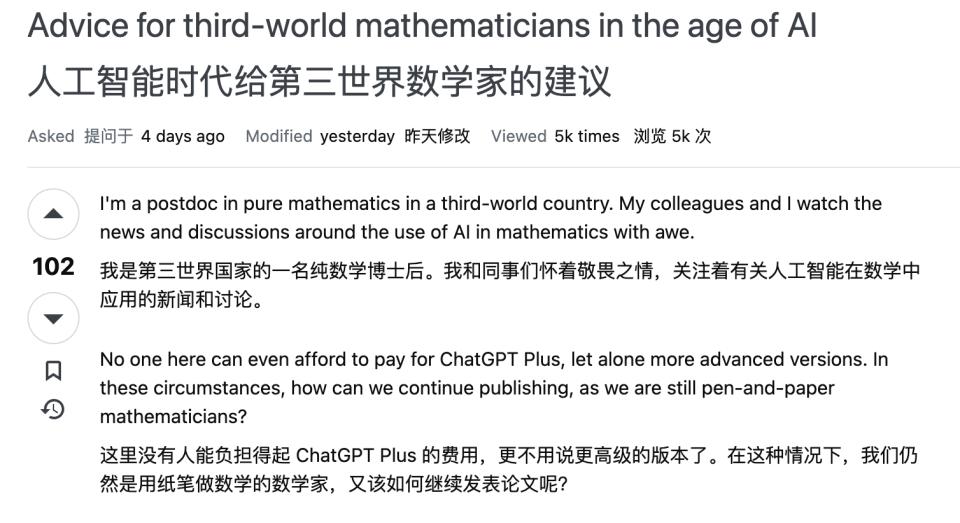
Daniel Teixeira in the comment section calculated the purchasing power account: the subscription fees of Plus and Pro are less than 1% and 5% of the doctoral student stipend in the United States respectively, and about 5% and 25% in Brazil. Some others added that even if they could afford it, the service provider did not open the service to his country due to sanctions.
The same AI product and the same subscription price mean completely different usage thresholds for researchers in different countries.
At the same time, AI is also changing the competitive environment of academic research.
Bogdan Grechuk, associate professor of mathematics at the University of Leicester in the UK, suggested applying for OpenAI's free program for scholars, and he also came up with an idea: go to the preprint website dedicated to publishing AI-generated proofs, find those papers marked with "partial" or "no" human understanding level, contact the authors, propose to fully understand the proofs and rewrite them into papers readable by peers, and then submit them together. He posted one of his own preprints, marked on the page as "mainly generated by AI" with a human understanding level of "partial".
Gordon Royle, a journal editor, said in the same post that the number of submissions to his journal has surged, but the number of editors and reviewers has not increased, and fewer people are willing to review papers, leading to a much higher rejection rate than before. The most affected are those who have not increased their submission volume fivefold. Even if a researcher's professional ability does not decline, he may face greater publication pressure because other researchers use AI to greatly improve their output efficiency.
When AI becomes a tool that can enhance individual cognitive and production capabilities, access to sufficient computing power resources is becoming a new variable affecting personal development opportunities.
This also gives the issue of AI traffic restriction and payment another layer of meaning.
When the computing power supply cannot meet the needs of all people, whether it is to control the usage through quota limits or adjust demand through prices, it is essentially the allocation of scarce resources.
Regarding AI payment, a viewpoint worthy of re-examination is that payment can guarantee the service quality of high-value users and promote the healthy development of the industry. But how exactly should this "high value" be defined?
If "high value" is measured by the user's revenue contribution to the manufacturer, then prioritizing the service quality of high-paying users is just a resource allocation choice made by the enterprise based on commercial interests. This conforms to the manufacturer's business logic, but is not sufficient to prove that this allocation method is conducive to the healthy development of the industry.
If it is measured by the actual value created by users with the help of AI, then price is not an effective measurement standard. The willingness to pay is constrained by the ability to pay. Users who can afford higher fees may not necessarily create greater economic, scientific research or social value. When AI becomes a tool to enhance individual cognitive and production capabilities, simply allocating computing power according to price may further convert the original income gap into a capability gap, thereby exacerbating inequality in development opportunities.
Looking back at the past two decades, zero-marginal-cost replication coupled with network effect has created a very special free era. It lasted so long that the market and users took the exception as a law, and forgot what the law originally looked like: when there are not enough costly things for everyone to use, someone has to decide who gets to use them.
AI has brought the resource allocation issue back to the forefront, and this time, what is being allocated is no longer just information resources, but intelligent resources that can enhance human reasoning, analysis, creation and decision-making. Who pays for computing power determines whose interests AI serves first; the rules by which computing power is allocated determine who can obtain the capability gains brought by AI.
Therefore, after DeepSeek's traffic restriction, what is really worth discussing is no longer just whether AI should be paid. The "free" exception ends with AI, and the next question to answer is: who is qualified to use machines to think, and who will allocate this qualification.
This article is from "Tencent Tech", written by Li Biao, edited by Li Hailun, and published with authorization by 36Kr.