The new graduate headcount slots at big tech companies are being prioritized for teams with AI budgets.
In the AI era, Microsoft, the tech giant that has been the boldest in overhauling its own organizational structure and the most creative in launching new initiatives, has become a new practitioner of AI-oriented organizational transformation. But this time, what Microsoft brings is not good news, but an open admission that "Microsoft has slowed down its recruitment progress for fresh graduates."
In a recent episode of The Pragmatic Engineer podcast, when the host asked Microsoft CEO Satya Nadella "whether Microsoft still recruits fresh graduates", Nadella publicly acknowledged on the show that Microsoft's recruitment of fresh graduates has indeed slowed down, and stated that "many companies are doing the same".
For this conclusion, he explained that the current "top priority is to ensure that everyone within our organization is adjusted to the right position", and first build the "software factory" model where humans and AI collaborate to write software.
But in his plan, the second step after post adjustment is still to fully spend the AI budget first. When talking about AI-native companies that are built around AI from the very beginning, Nadella said, "What is an AI-native company? They start with an AI budget and one person. This person spends the full AI budget, then says, add one more person." He also put forward his own judgment, "Every company will start to operate this way."
This statement is not only shocking, but also in sharp contrast to his own statement ten months ago. During the Davos Forum in January this year, Nadella said in a podcast interview that "I still firmly believe in campus recruitment, because AI is a mentor that helps new employees get up to speed faster."
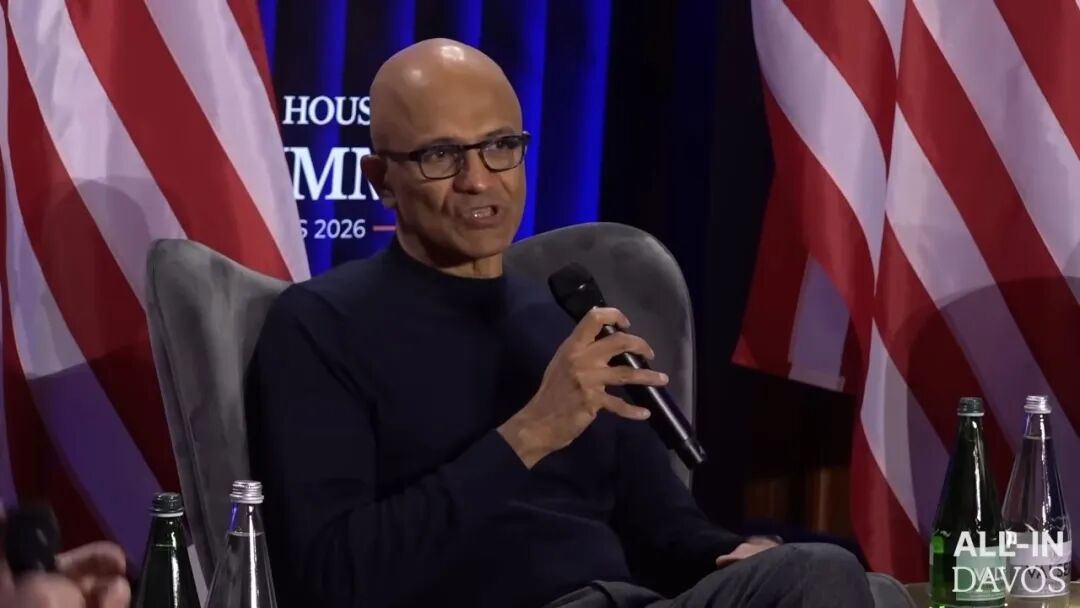
In Davos in January, he also said he believed in campus recruitment | Image source: All-In
What he might not have imagined at that time is that ten months later, AI has gone from being a mentor for new hires to a budget that must be fully spent before recruiting new people.
Microsoft's own calculations
As Nadella, the current CEO of Microsoft who has always presented himself as a shrewd professional manager, is willing to publicly contradict his own remarks from 10 months ago, it must be because Microsoft has internally realized new situations encountered in the AI organizational transformation. This is the first time in a decade that Microsoft has seen a reduction in its number of employees, while the company's business is still growing.
According to data from Microsoft's annual fiscal report, there are currently about 223,000 full-time employees, about 5,000 fewer than a year ago, while revenue increased by 18% over the same period. This is the first annual employee decline for Microsoft since it wrapped up its Nokia mobile phone business in 2016.

Microsoft's R&D headcount dropped from 80,000 to 77,000 | Image source: Microsoft
The product R&D team saw the largest reduction, indicating that business growth no longer adds engineers at the old proportional rate. Microsoft's annual report shows that product R&D headcount decreased by about 3,000 people, marking the second consecutive year of decline. Calculated, three out of every five people in Microsoft's net reduction are engaged in R&D, not including the new round of about 4,800 layoffs announced in July.
At present, Microsoft's energy is focused on rearranging the existing people in the company, that is, as Nadella said, first adjusting internal personnel to suitable positions, and recruiting new people will be arranged after this task. That's why Microsoft recently offered a voluntary separation package to most of its software engineers for the first time, and employees can choose whether to accept it before December.
While encouraging employees to switch to more suitable teams within Microsoft, Nadella also said, "If you feel professionally stuck in a team, you can vote with your feet."
Nadella also spoke sincerely, confessing the dilemma that large organizations like Microsoft face when undergoing AI organizational transformation: "I wish I could sit here and tell you that everything will remain the same. But I can't."
Nadella's remark that "every company will start to operate this way" is true, because the opportunities left for new entrants in the entire technology industry are shrinking sharply. A report released by venture capital firm SignalFire in June this year shows that compared with 2019, 12 large tech companies including Microsoft and Apple have seen a roughly 65% drop in recruitment of new graduates and entry-level positions.
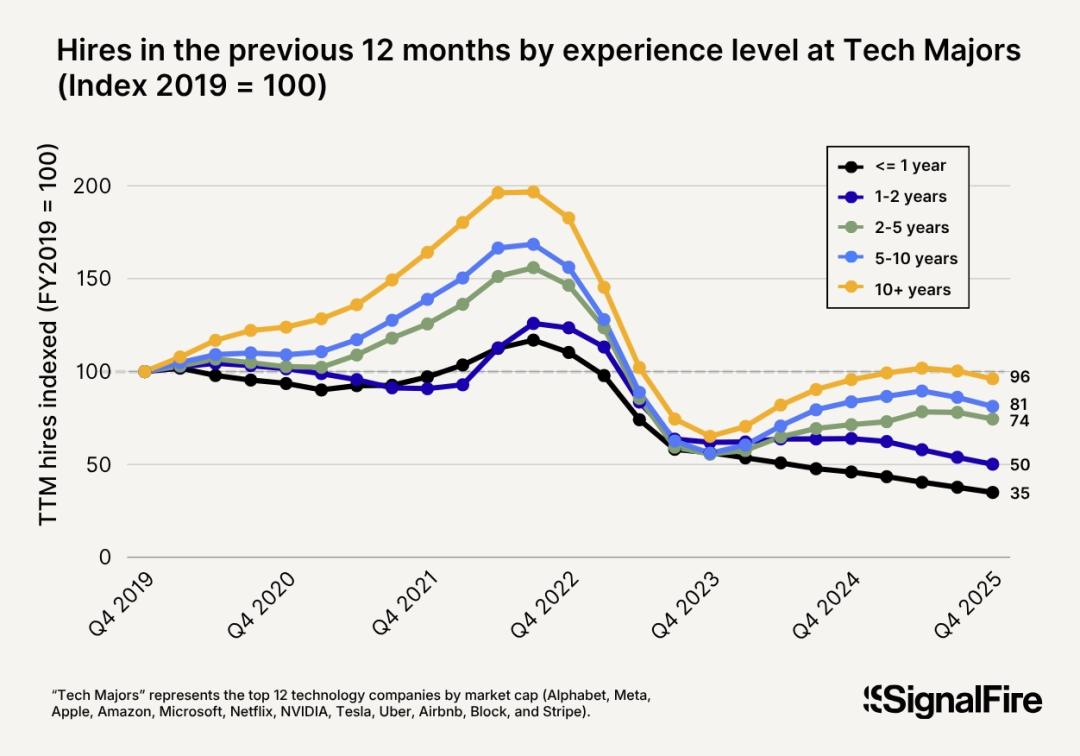
Recruitment of new graduates is only over 30% of the 2019 level | Image source: SignalFire
In the same report, the overall recruitment of these large companies is only 25% lower than that in 2019, and the most severe shrinkage falls on people who have just graduated from school. The drop in new graduate recruitment at early-stage startups is even larger. Last April, Shopify CEO Tobi Lütke wrote in an internal letter: "Before teams apply for more manpower and resources, they must first explain why the work cannot be done with AI."
Last May, Anthropic CEO Dario also said in a media interview that AI could eliminate half of entry-level white-collar jobs within five years. Not all warnings will come true, but they are enough to make young job seekers and their parents feel anxious.
As for Microsoft, it is already one of the 12 large companies that have reduced new graduate recruitment. Nadella's public statement on this issue just reveals the choice that the industry has been making for more than a year.
Non-layoff downsizing
Different from layoffs, the reduction in recruitment itself has never been a hot news topic, and its corresponding effects can only be traced from the financial reports and internal research of large enterprises. In November this year, Lindsey Raymond from the Massachusetts Institute of Technology and Eleanor Dillon from Microsoft Research published a non-peer-reviewed paper on the preprint website arXiv. The GitHub Copilot tested in the paper is an AI assistant sold by Microsoft to enterprises, which can automatically complete content when writing code.
By comparing the renewal time of existing enterprise contracts, companies that were forced to adopt Copilot earlier due to contract renewal schedules saw a 29% reduction in technical personnel recruitment per quarter one year later, but the number of departing employees and the total number of technical positions remained unchanged.
The reduction in recruitment mainly falls on junior positions. Among the same batch of companies that were forced to adopt Copilot earlier due to contract renewal schedules, the recruitment of junior software engineers decreased by about 40%, the more the work is code-focused, the greater the decline, while the recruitment of experienced engineers has no obvious change.
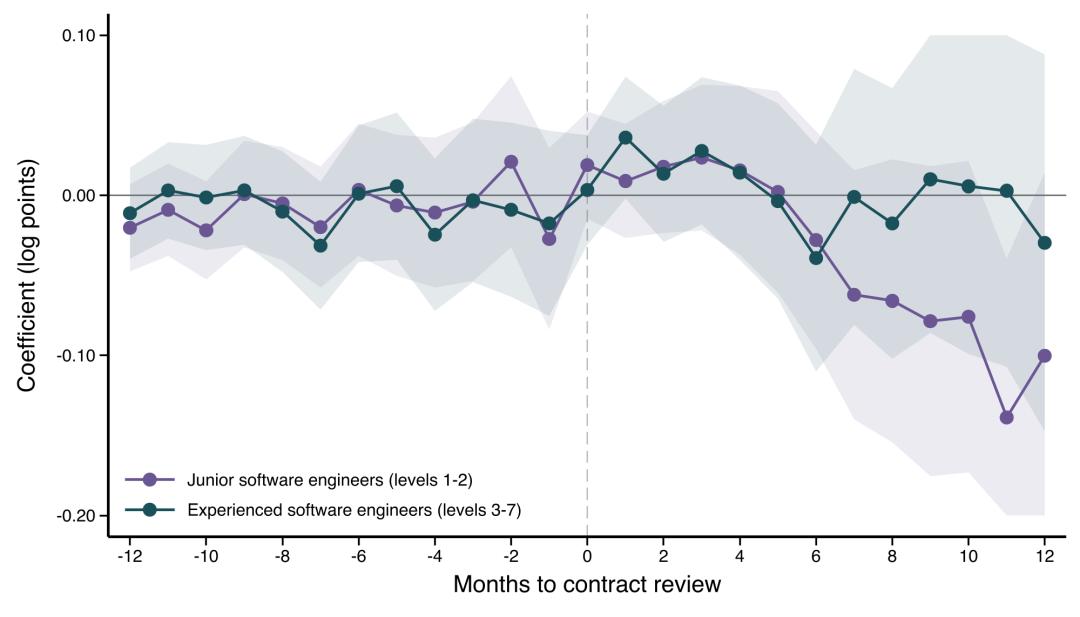
Six months after contract renewal, junior recruitment (purple line) begins to decline | Image source: Raymond, Dillon
However, the 29% figure given in the paper is a broadly estimated range, and the authors also pointed out that at least half of the reduction in technical positions after 2022 comes from industry contraction, and all samples are large multinational enterprises, with only the first-generation code completion tool tested.
Erik Brynjolfsson and other researchers from Stanford University's Digital Economy Laboratory saw the same pattern using data from U.S. payroll service provider ADP. The update in August this year shows that among occupations most vulnerable to AI impact, the employment of young people aged 22 to 25 is about 19% lower than the expected level as of June this year, and the gap is still widening.
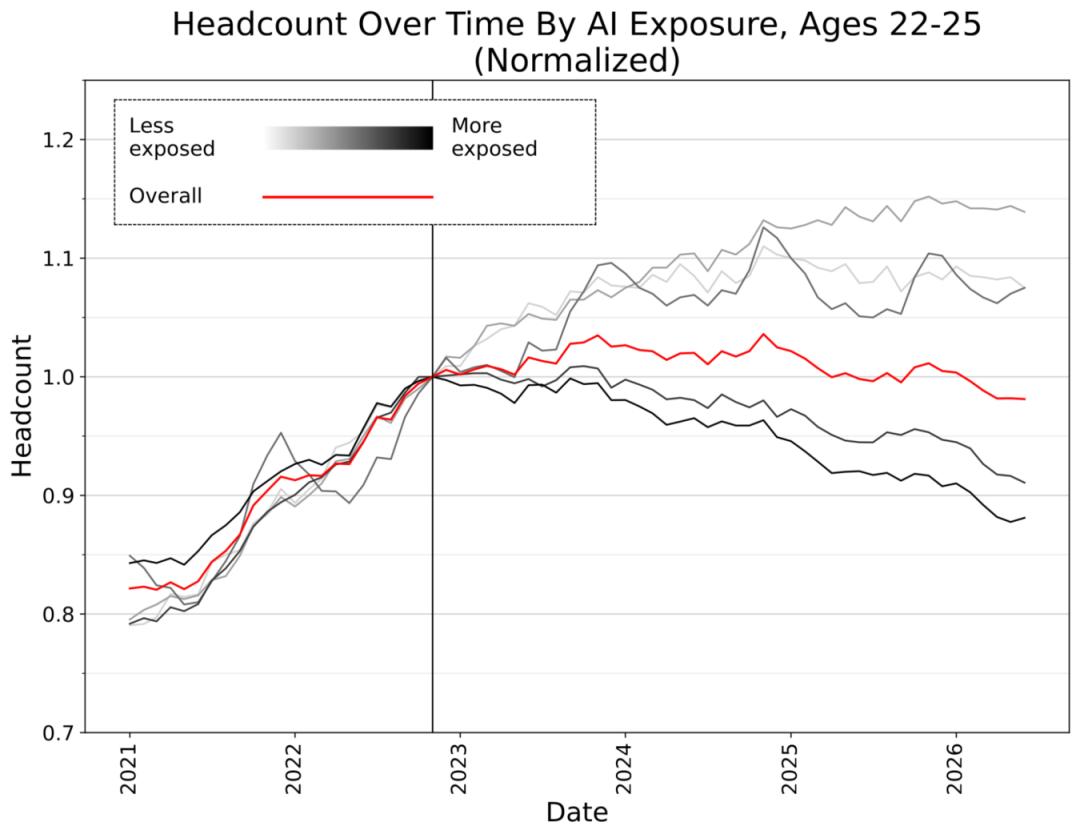
The more vulnerable to AI impact, the steeper the decline in youth employment | Image source: Stanford Digital Economy Laboratory
The gap mainly comes from the reduction in youth recruitment. Enterprises shift the funds originally used to recruit new hands to purchase AI call quotas, and then recruit existing experienced personnel. The junior work of writing basic code as required will most likely be taken over by AI first. After this part of the work is shared by humans and machines, the company's motivation to train new employees from scratch weakens. The paper also found that companies that adopted the tool earlier recruited senior employees with longer average work experience and a higher proportion of master's and doctoral degrees.
Diamond-shaped pyramid
Not only that, under the influence of AI, the employment structure of enterprises is also transforming.
Lucy Beaumont from talent assessment company SHL told CNBC, "If the past organizational structure was a pyramid, what we are seeing now is a diamond." That means fewer new entrants at the bottom and more experienced personnel in the middle.
But there is obviously a problem that everyone has been avoiding talking about. The group of experienced, judgment-driven people in the middle of the diamond were all trained by doing junior-level work at the bottom.
AI saves the time spent writing basic code, but it cannot help new employees develop the senior judgment that comes with practice. Cheney Hamilton from research firm Bloor told CNBC, "AI raises the lower limit of new employees' output, but it does not give them the ability to judge where the output is wrong."
New employees are not only getting fewer opportunities to practice, but it is also difficult for them to grow into experienced professionals if they only rely on AI to get work done.
Many people in the industry have also noticed the hidden danger behind this logic of drinking poison to quench thirst. Last August, AWS CEO Matt Garman mentioned in an interview that some executives claimed "AI can replace all junior employees in the company", and he refuted that "this is the stupidest thing I have ever heard". He believes that new employees "are probably your cheapest employees and the most willing to use AI tools".
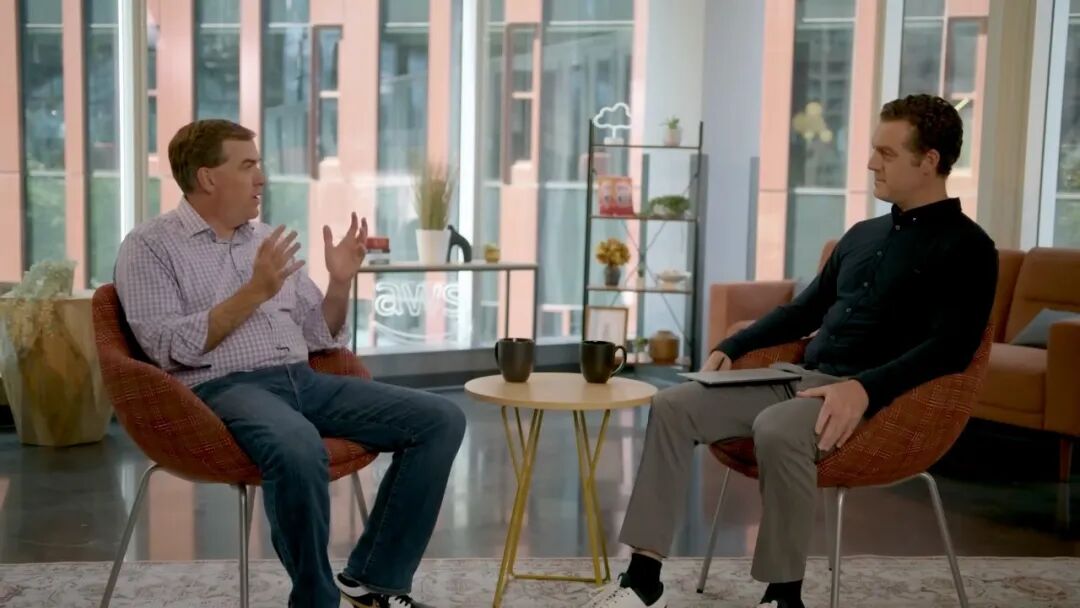
Garman said that replacing new employees with AI is the stupidest thing he has ever heard | Image source: Matthew Berman
Garman is worried about the longer-term talent gap. He asked rhetorically, "What if in ten years, no one has accumulated experience and learned anything?" So he said, "That's why we absolutely must continue to recruit fresh graduates."
The logic is clear, but it has become a collective dilemma for every company. Training fresh graduates takes up the energy of senior employees, and the trained talents may leave for other jobs; reducing new graduate recruitment and adding an extra AI budget can generate cost savings as early as this year.
In terms of corporate financial reports, reducing new graduate recruitment is a cost-effective deal, and companies can poach experienced talents trained by other companies in a few years. But if all companies in the industry follow Nadella's advice, adding new people only after the AI budget is fully spent, and no one trains new employees for the industry, there will be fewer and fewer senior engineers available to poach in ten years. This long-term account has not yet appeared in the financial reports of large companies, but the anxiety is first borne by young job seekers and their parents.
Microsoft's own actions also show hesitation. On the one hand, it sells Copilot to enterprises and slows down campus recruitment, on the other hand, Microsoft is still cooperating with Carnegie Mellon University on PRAISE, a mentorship program for early-career engineers. Nadella also said in the podcast, "I think it's too early to define too many things as long-term trends now." According to the host's interpretation, he believes that all kinds of abnormal phenomena in the current restructuring period are only temporary, and junior-level recruitment will pick up after the situation is sorted out.
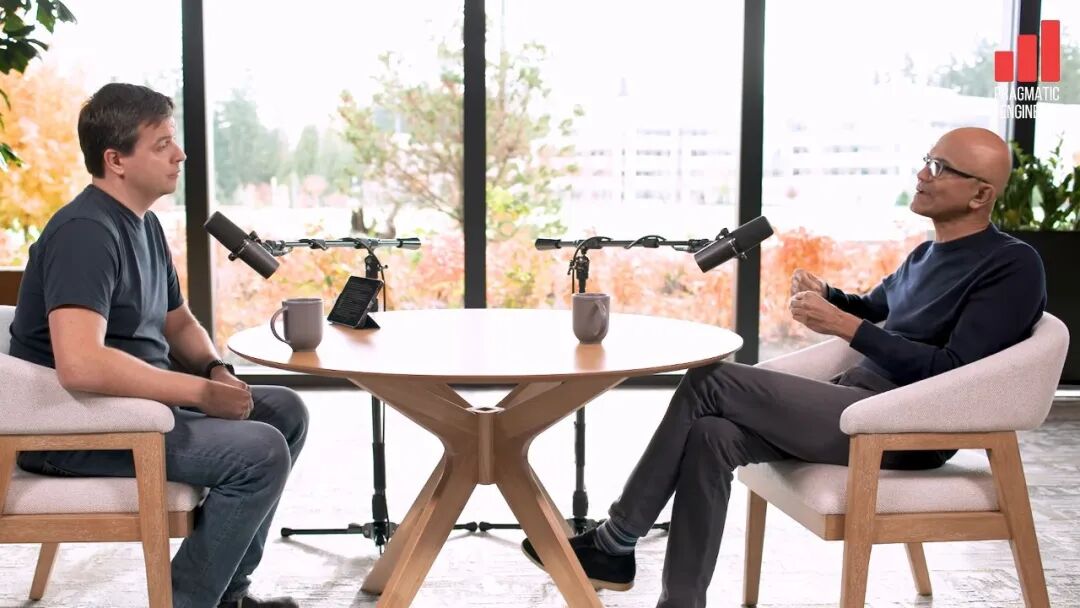
Talking about reducing new graduate recruitment, Nadella said it's too early to draw conclusions | Image source: The Pragmatic Engineer
But even if the current period is only a transition, Nadella's phrase "one AI budget and one person" has already rewritten the job-seeking path in the workplace.
Looking forward, what young people need to prove after graduation is probably no longer just that they can work faster than their peers, but also to show that besides the next AI budget, the company is still worth recruiting them as an extra person.
For Microsoft and the entire technology industry, what will be truly scarce in the future may no longer be people who can write code manually, but people who can spot where AI has made mistakes. Such talents cannot appear out of thin air, and can only be cultivated by giving new employees opportunities, through gradual practical training.
After calculating the immediate AI budget, the question that the industry will sooner or later have to answer may have changed from "should we still recruit new employees" to "where can new people grow into experienced professionals?"
This article is from the WeChat official account "GeekPark" (ID: geekpark), author: Zhang Yongyi, editor: Jing Yu, published with authorization from 36Kr.