This year, leading institutions such as IDG and HSG are all making bottom-fishing investments in consumer companies.
On November 17, Shiseido released an announcement of less than 200 words: it will transfer 100% equity of Shiseido Liyuan Cosmetics Co., Ltd. to an investment consortium led by IDG Capital. Shiseido Liyuan is the operating entity of Aupres in China. This transaction also includes the Aupres brand, the Beijing factory and all production equipment.
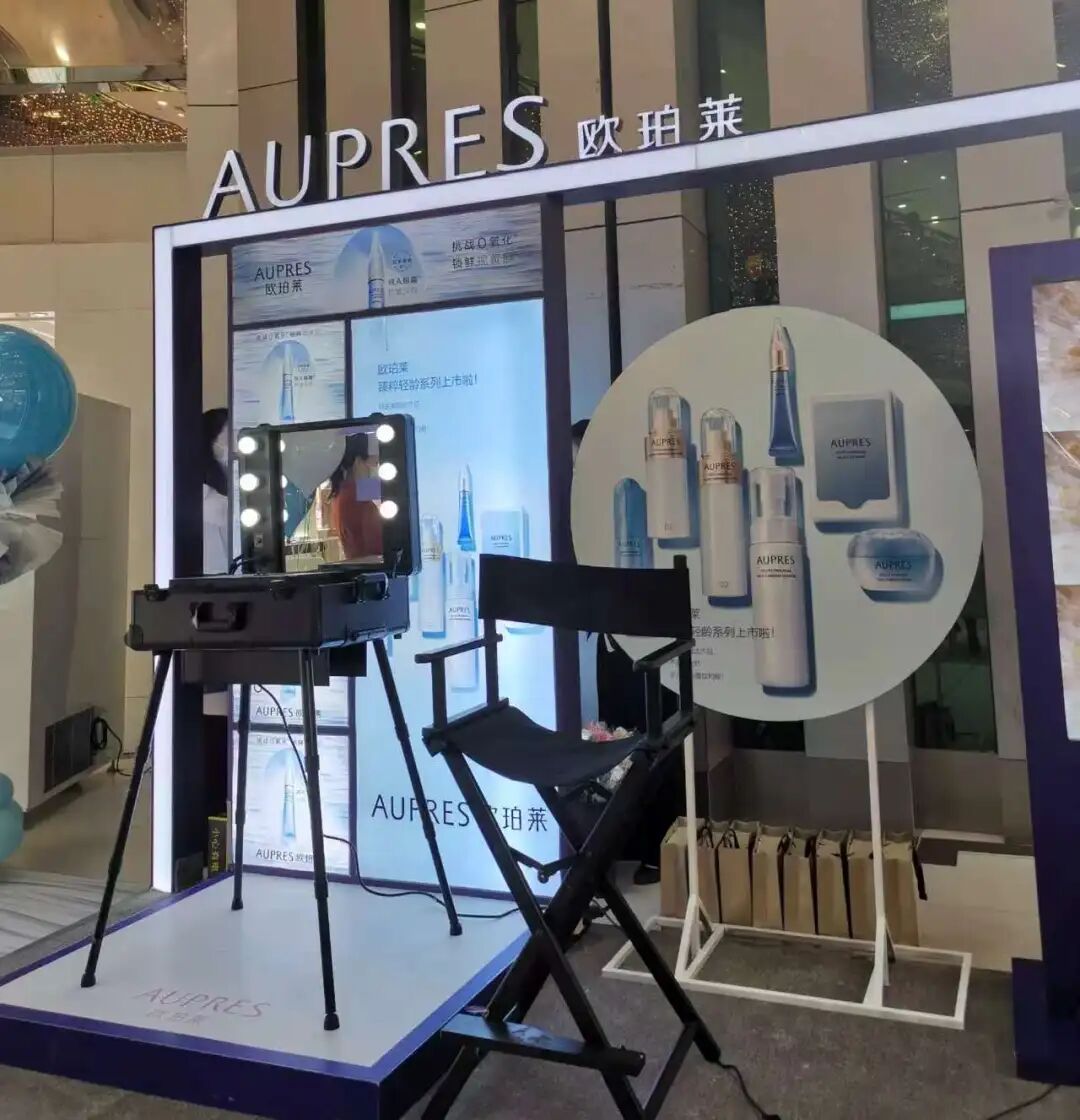
The closing is expected to be completed between the fourth quarter of 2026 and the first quarter of 2027, and the consideration has not been disclosed.
Aupres is a Sino-Japanese joint venture brand, co-founded by Shiseido and Beijing Liyuan, adopting local R&D and local production. It has a factory in Yizhuang, Beijing, and has long been active in domestic department store counters. It can be regarded as the most "down-to-earth" business of Shiseido's system in China.
Unexpectedly, after more than 30 years of operation, the fate of this brand was handed over to a Chinese VC institution.
However, it needs to be clarified that Aupres has no equity relationship with the listed company Proya. The two brands only differ by one character in their names, which makes them very easy to be confused.
IDG Capital Spent 570 Million Yuan to Acquire a Joint Venture Beauty Brand
The specific arrangement of the transaction is as follows: the funds managed by IDG Capital set up two special purpose vehicles, holding a total of 95% equity: Sunrise Winning Limited holds 80.66%, and Zhuhai Pulai Management Consulting Partnership Enterprise holds 14.34%. The remaining 5% is held by Shanghai Pozhiyuan Enterprise Management Partnership Enterprise, which is led and established by Aupres's new management team.
This shows that the control right is still in the hands of IDG Capital, but the new management team also has a direct interest alignment.
Shiseido also signed a separate transition service agreement to continue providing intellectual property licensing, new product R&D support, production technology assistance and part of raw material supply within the agreed period.
For this acquisition transaction, the price circulating in the market is about 570 million yuan.
This figure is derived from calculation: in August 2026, Shiseido China acquired 35% of the equity held by Beijing Liyuan for 199.5 million yuan. According to this transaction, 100% equity of Shiseido Liyuan corresponds to about 570 million yuan. However, the specific consideration of this transaction has not been officially disclosed so far.
From the equity transfer in August to the overall sale in November, the two capital actions took no more than three months, which is really unexpected. But after careful consideration, it is reasonable: first, take back the Chinese shares left over from the joint venture era to become a 100% shareholder, and then sell the whole to financial investors. This is the standard clearance action for multinational companies when they withdraw from China, but this time the rhythm is too fast for the market to react.
However, this matter has shown signs long ago. According to reports, the third-phase joint venture agreement of Shiseido Liyuan will expire in December 2026, and the two joint venture parties have negotiated not to renew it. This is the direct motivation for the state-owned second shareholder to list its shares and Shiseido China to take over and then sell them.
So what kind of assets did IDG Capital actually buy?
According to the data at the end of May 2026, Shiseido Liyuan has a net asset of 398 million yuan, an operating revenue of 869 million yuan in 2025, and a net profit loss of 41.337 million yuan. After conversion, the estimated price-to-book ratio is about 1.4 times, and the price-to-sales ratio is about 0.66 times.
However, according to the data disclosed by the Beijing Property Rights Exchange, Aupres's operating revenue in the first 5 months of 2026 was 234 million yuan, with a net loss of 53.4152 million yuan; that is, the money lost in the first five months of this year has exceeded the total loss of the previous year. The expected annual revenue is roughly 560 million yuan, which is one third less than that in 2025.
The particularly severe situation is that the department store counter channel where Aupres started is also shrinking.
From 2019 to 2023, the number of cosmetic counters in department stores in 51 key cities across China decreased from 15,415 to 9,502, a decrease of 38%. The reduction of counters means that the passenger flow that a single brand can reach is systematically taken away, which cannot be reversed by changing a general manager or holding several promotional activities.
Therefore, what IDG bought is neither a high-growth consumer brand nor a clean empty shell.
It has brand awareness, a still operating Beijing factory, product lines that need repositioning, and scattered channels. According to this portfolio pricing, a price-to-book ratio of 1.4 times roughly reflects that "the assets have a bottom line, but the operation has no bottom line".
The Collective Packaged Sale Wave of China Regional Consumer Assets in the Past Two Years
The sale of Aupres is not an isolated case. Since the second half of 2025, similar transactions have appeared intensively, and the forms are also changing: from the past of buying minority shares for financial investment, to taking controlling shares, dispatching teams, and personally participating in operation.
We can trace back a little earlier.
In May 2025, Boyu Capital indirectly acquired 42% to 45% of the equity of Beijing SKP, with the amount undisclosed. That was a relatively financial purchase under the background of falling valuation of retail assets.
The real turning point came in November 2025, when Boyu took over the retail business of Starbucks China, holding up to 60% of the shares in the joint venture, with an enterprise value of about 4 billion US dollars, and the closing was completed in the spring of 2026.
The pace has accelerated significantly after entering 2026: in February 2026, CPE Yuanfeng acquired about 83% of the equity of Burger King China, and injected another 350 million US dollars of operating capital to obtain the exclusive development right of the Chinese market for 20 years; in March, L Catterton took over the global offline store business of Blue Bottle Coffee from Nestle; in July, CPE Yuanfeng fully acquired the Swiss outdoor brand Mammut; in October, CPE took 81% controlling stake in A.O. Smith's China business; in November, IDG Capital led the acquisition of the beauty brand Aupres.
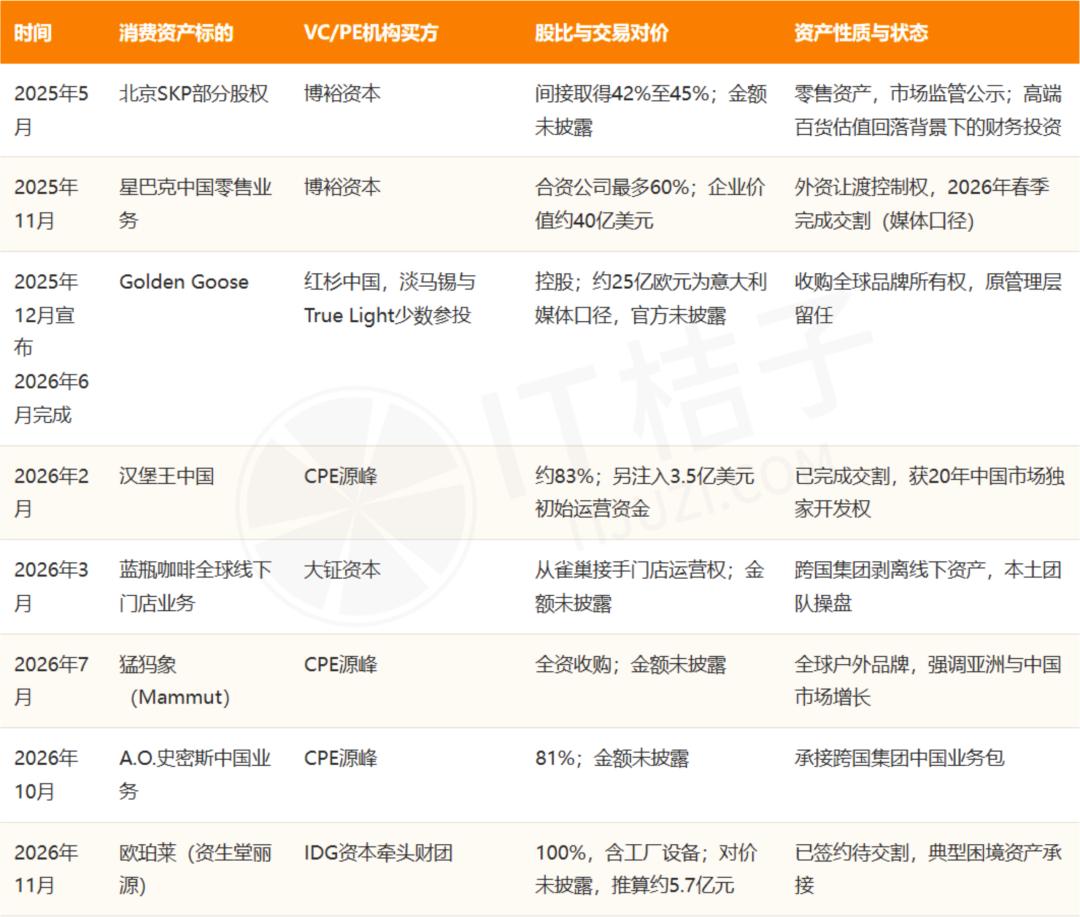
These transactions can actually be divided into two different lines.
One line is undertaking the China regional business packages divested by multinational groups, such as Starbucks China, Burger King China, A.O. Smith China and Aupres all fall into this line.
What the buyer gets is a whole package composed of brand use right, local team and channel network, and the pricing anchor is net assets, channel stock and localization improvement space.
The other line is directly buying the ownership of global brands.
Golden Goose was led and controlled by HSG, with a small number of institutions such as Temasek participating in the investment. The valuation according to media reports is about 2.5 billion euros. The transaction was announced in December 2025 and completed in June 2026, with the original management remaining in office. Blue Bottle Coffee's global store business and Mammut also belong to this category.
The pricing anchor of this type is the global growth of the brand, as well as the amplification effect brought by China's supply chain and channels.
Now, Are Chinese Consumer Brand Assets Really Systematically Undervalued?
To say that consumer assets are cheap, we must first separate the calibers: what the secondary market says and what the primary market says are not the same thing.
In the secondary market, the valuation of consumer stocks is indeed at a low level.
As of November 26, the price-to-book ratio of the CSI Consumer 50 Index is at the 11th percentile of the past 5 years; the price-to-sales ratio is 2.29 times, at the 7.23rd percentile of the past 10 years. The pricing of both the asset side and the revenue side is at the historical bottom, the price-earnings ratio of 20.8 times is only at the median level, and the dividend yield of 3.8% is at the 87th percentile of the past 10 years.
In other words: The market is not willing to pay much for the assets and revenue of these companies, and a large part of the reason for continuing to hold them comes from dividends.
But low price does not mean that demand has bottomed out.
According to the data released by the Ministry of Commerce on November 19, the total retail sales of social consumer goods from January to October increased by 1.0% year-on-year, excluding automobiles, it increased by 2.8%, and the retail sales of services increased by 4.9. Commodity consumption is still in the low single-digit range, and the demand side has not given a reversal signal.
There is obvious stratification in the primary market.
Using the announced consideration and the revenue of the latest full fiscal year for rough calculation as a reference, Aupres's price-to-sales ratio is about 0.66 times, Starbucks China's is about 1.3 times, and Golden Goose's is about 3.4 times. The first two are more like priced according to distressed assets and slowing growth, and the last one is still priced as a high-quality global brand.
Finally, back to this question, are consumer assets "low in price" or "undervalued"?
The judgment criteria usually look at four conditions: whether the price is lower than the replacement cost or net asset; whether the operation has stopped falling; whether there is a clear operation improvement starting point; whether the seller's exit is due to strategic restructuring, or the asset itself is irreversibly going downhill.
This still needs to be analyzed on a case-by-case basis. For Aupres: the first condition is satisfied, with net assets of 398 million yuan and a price-to-book ratio of 1.4 times, the buyer did not pay extra for the brand reputation; the third condition is also satisfied, with the factory in hand, the supply chain cost can be internalized, and the management team has invested 5% in the deal, so the transformation is not an empty slogan; the second condition is not satisfied, and the loss in the first five months of 2026 is still expanding; the fourth condition is partially satisfied, Shiseido has indeed been shrinking non-core brands in recent years, and has sold ZA and Pure & Mild before; but the channel damage of Aupres is real, and it will not be automatically repaired just by changing shareholders.
Two of the four conditions are missing, so the conclusion should not be "getting a bargain", but closer to "taking over a transformation project with a bottom line". The bottom line comes from net assets and the factory, and this part will basically not lose money; whether the project can be done well depends on when the operation stops falling.
This transaction has been finalized, and what is worth watching later is whether several groups of indicators can be fulfilled.
At the macro level, it is the demand side: whether the growth rate of total retail sales of social consumer goods and service retail can pick up for two consecutive quarters. If demand cannot rise, any story of consumer assets lacks a foundation.
At the meso market level, whether the price-to-book ratio percentile of CSI Consumer 50 can return to above 30%, and at the same time the profit expectation stops falling. This means that the index returns from "only supported by dividends" to "profits are trusted by investors", which is a sign of secondary market pricing repair.
At the micro level, it mainly depends on Aupres itself: first, in terms of operation, whether the single-quarter revenue and online transaction volume after closing can turn positive. Second, people and goods: whether the 5% management follow-up investment and the retention of the core team are truly implemented; after the transition service agreement expires, whether new products and channels can operate independently without relying on Shiseido's support.
Before these are fulfilled, "consumer assets have reached the bottom" is only a price judgment, not yet a value judgment.
Note: The valuation data of the CSI Consumer 50 Index is as of November 26, 2026, and each indicator has a different backtracking window, so it cannot be directly compared horizontally. This article is a collation and analysis of public information and does not constitute investment advice.
This article is from the WeChat official account "IT Juzi" (ID: itjuzi521), author: Wu Meimei, published with authorization from 36Kr.