When Agents replace humans as database users, a revolution has begun.
Computing power, models and data are the three core elements for AI implementation. Over the past two years, the industry has mostly focused on the first two elements: larger computing power clusters and more powerful models. However, when AI is truly deployed in enterprises, what determines success or failure is often not the strength of model capabilities, but whether enterprises can provide high-quality data that can be understood by AI.
According to the relevant research released by Gartner in 2026, insufficient data preparation remains the main obstacle to AI implementation, and more than 75% of organizations are prioritizing investment in "AI-ready data" (that is, data that can be directly understood and used by AI). Models are getting smarter, but data has not kept pace yet.
As a result, new voices are emerging at the data layer: The database itself needs to be redefined. In the past, databases solved the problems of how to store, manage and use data; but today, when enterprises start to deploy large models and build AI Agents, data also needs to be understood, organized, invoked, and even become the memory for AI to operate continuously.
The AIDB (Active-Intent Databases) concept, which was first systematically proposed by Academician Wenfei Fan internationally, provides an answer: Databases should not only stay at the stage of managing data, but also further move towards managing intelligence.
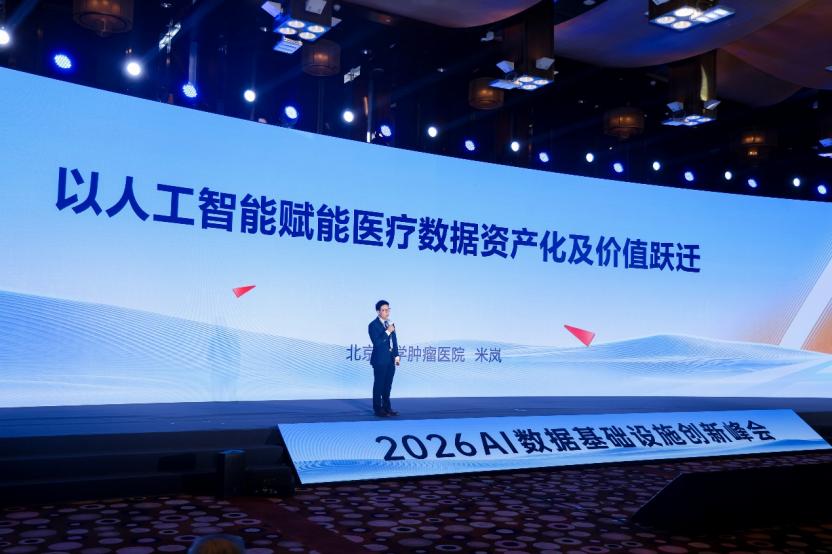
On November 25th, at the 2026 AI Data Infrastructure Innovation Summit hosted by the Shenzhen Institute of Computing Sciences and undertaken by Yashan Technology, Yashan Technology released YashanDB V27, the Yashan Data Intelligence Base, and the full-stack AI data infrastructure, pushing this concept into engineering and productization.
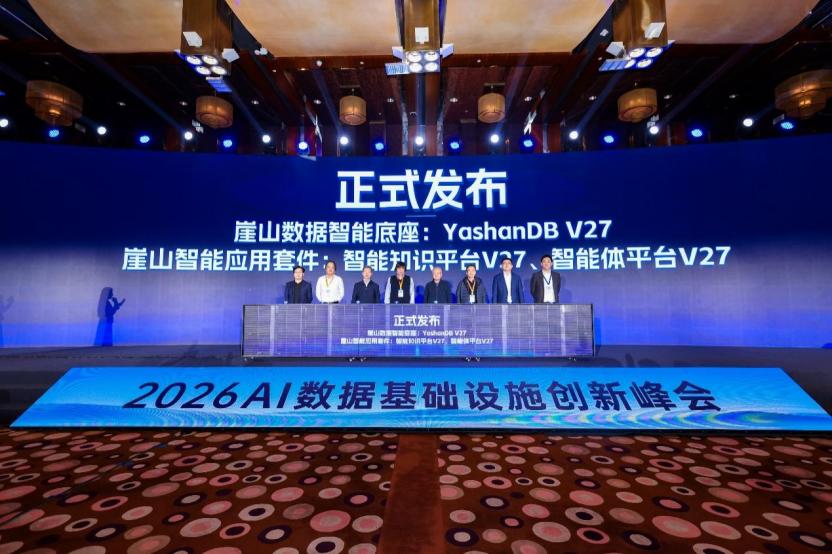
For many people, Yashan is no stranger. Founded in 2019, this company relies on the scientific research team led by Academician Wenfei Fan, adheres to full-stack independent R&D from underlying theories, core technologies to database kernels, and has penetrated into the core systems of finance, government, energy and other industries in the past few years.
This time, what it delivers is no longer just a database. Apart from the data intelligence base, Yashan is also equipped with a set of kits for AI applications: on the one hand, it converts the enterprise's data that has been dormant for many years into knowledge that AI can understand, and on the other hand, it allows business personnel to build their own agents.
Behind this is not just a simple upgrade, but a paradigm leap. Yashan itself has thus transformed from a database vendor to an AI data infrastructure company.
"Making data usage simpler and smarter" is the mission Yashan set at the time of its establishment. In the AI era, this sentence has a new interpretation. From the perspective of Zhibiao Chen, CEO of Yashan Technology, many enterprises are falling into a kind of AI anxiety: they are worried that they will fall behind if they do not use AI, but they do not know how to use AI and how to truly implement it. Enabling enterprises to apply AI to their business without understanding the underlying technology is the meaning of this mission today.
1. Whoever helps enterprises make good use of data first will hold the right to define the next round
If computing power determines how fast AI can run, and algorithms determine how smart AI can be, then data determines what AI can understand, what it can learn, and what problems it can ultimately solve.
Yashan has been exploring ways to make better use of data. In 2024, Yashan targeted independent controllability and focused on domestic substitution for critical systems. By 2025, with the development of large models such as ChatGPT, AI needs to process multi-modal data including text, images, audio and video. Yashan correspondingly launched the AI Ready data platform to supplement multi-modal data management capabilities.
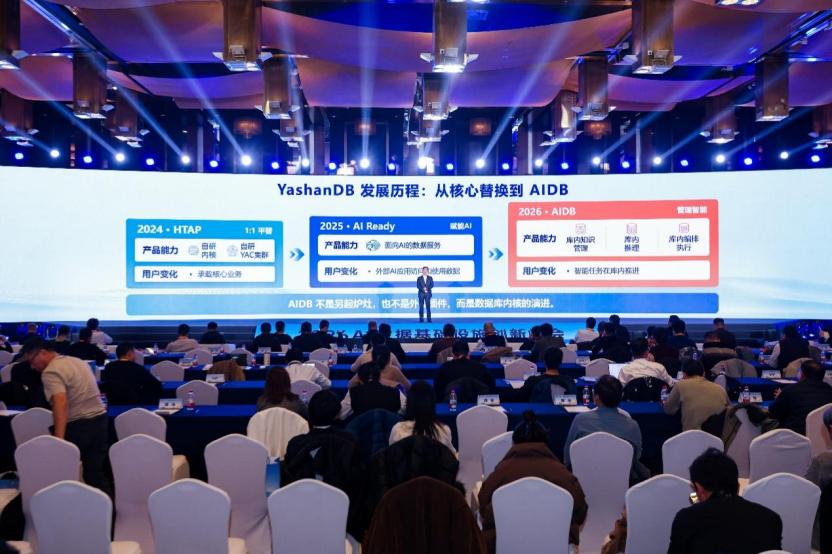
By this year, the problem has gone a step further. "Agents are beginning to develop on a large scale, but there are still high thresholds for enterprises to truly deploy agents into production systems," said Zhibiao Chen. Behind the threshold is an easily overlooked change: the "user" of the database has changed from human to Agent.
Over the past 60 years, everything in enterprise IT has been designed around humans. Humans log in to the system, fill out forms, and run reports. The problems that databases need to respond to are whether they can store enough data, query quickly, and operate without errors. But it does not need to "understand" the data, and the human sitting in front of the screen operates everything as the center.
After agents go into operation, this order is reversed. Humans set goals, Agents break down tasks, call data, and execute operations, making Agents the main "users" of data. IDC predicts that by 2029, the number of active global agents will exceed 1 billion. At this time, the core requirement for Agents becomes "understanding": understanding the meaning of data, the caliber of business, and the boundaries of operations.
In this context, higher requirements are put forward for the database itself, which needs to explore more extended functions and values, and every change behind it means a series of technical challenges. In other words, enterprises do not lack data, but lack data that can be understood, used and managed well by AI.
This means that databases are undergoing a real paradigm leap. In the past, the core value of databases was to manage data efficiently and stably. Now, it needs to become the foundation for intelligently understanding data, calling data and executing tasks. The ensuing changes are not only the evolution of the technical architecture, but also the reshaping of the entire development direction of data infrastructure.
In the new round of reshuffling, whoever can help enterprises make use of data first will have huge market space and the right to define the industry.
This has also become the common choice of global technology giants. Players from different camps are accelerating their expansion from their familiar fields to AI infrastructure: some data platform vendors supplement capabilities such as model training, intelligent retrieval and AI application development through acquisition and independent R&D; some traditional database vendors embed AI capabilities into databases; cloud vendors integrate data and AI into the cloud stack. Although each participant has different entry points and paths, their strategic directions are converging.
However, the capability distribution of these solutions is still dominated by modular supply: vector retrieval, model services, intelligent retrieval, etc. often belong to different product lines, and the collaboration between them requires enterprises to complete integration and tuning on their own. For enterprises, what they get is a number of professional capabilities, but connecting these capabilities into a functioning whole is still an engineering problem they have to face on their own.
Facing this practical challenge, Academician Wenfei Fan, Chief Scientist of Shenzhen Institute of Computing Sciences, believes that the real solution should be to move from "managing data" to "managing intelligence". In this context, he officially proposed the AIDB (Active-Intent Databases) concept at this press conference.
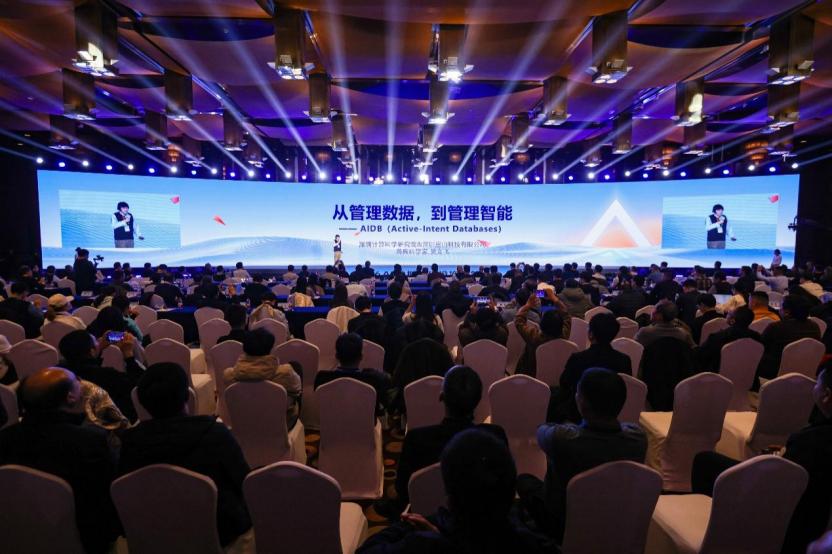
Different from the traditional "plug-in AI" transformation path, AIDB, based on breakthroughs in original theories, can uniformly manage data, models, ontologies, tools, memories and agents within the database. It advocates sinking intelligent elements directly into the database kernel, and evolving from passive execution to an "intelligent system" that can understand intentions, plan automatically and provide active services according to data changes.
From "managing data" to "managing intelligence", this is not only a direction for the future evolution of databases, but also a paradigm reconstruction of data infrastructure in the AI era.
Whether the concept is valid ultimately depends on whether technology and products can deliver on their promises. The YashanDB V27 data intelligence base and full-stack AI data infrastructure released by Yashan at this summit is precisely an attempt to further promote the AIDB concept to engineering and product implementation.
2. From database kernel to agent applications, building enterprise AI data infrastructure
Whether a set of AI data infrastructure is easy to use first depends on whether it can solve the real problems encountered by enterprises during implementation. According to Zhibiao Chen, at present, if enterprises want to make good use of agents, they have to cross at least four hurdles: the data layer must withstand the elastic load of thousands of agents running 7×24 hours; knowledge must be able to be precipitated, reused and continuously evolved; the operating environment of agents must be safe and controllable; and large models must find a balance between effect and cost.
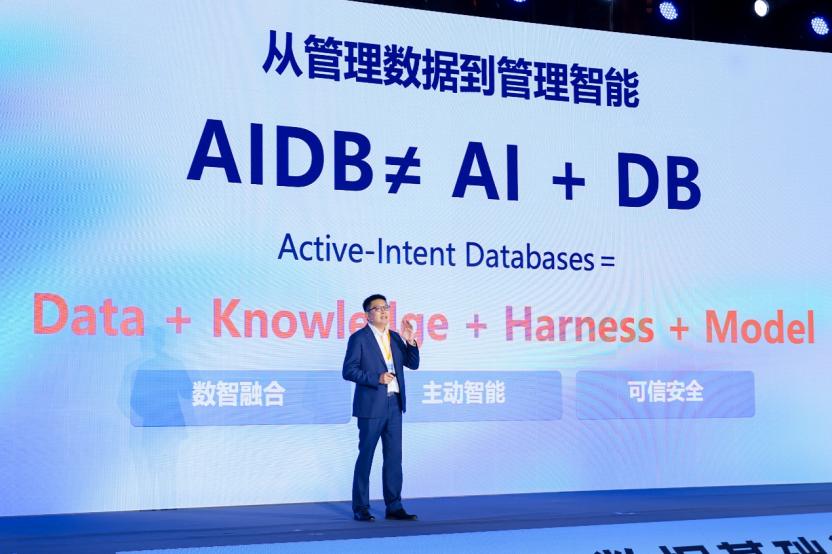
The YashanDB V27 data intelligence base and full-stack AI data infrastructure proposed by Yashan at this press conference are precisely designed to solve the above problems. To break it down, the full-stack AI data infrastructure can be understood as "1+1+N": 1 base, 1 set of kits and multi-industry ecological cooperation.
The foundation of the entire system, that is, the base of the AI data infrastructure, is the YashanDB V27 data intelligence base. It has been greatly enhanced based on Yashan's original kernel, and natively supports eight types of data models including relational, vector, graph, and document.
From the perspective of storage, V27 uniformly manages multi-modal data in one kernel. Relying on the integrated cluster architecture, V27 can allocate an isolated data sandbox for each agent. "The size of the sandbox can start from a few MB, and smoothly expand to GB, TB, or even PB level as the agent runs, to adapt to the business load of different agents."
From the perspective of computing, it has a built-in agent operating environment on top of general-purpose computing, and performs unified orchestration under the constraints of resources, quality, cost and permissions, so that deterministic computing and uncertain reasoning can work together.
Knowledge is where V27 stands out from traditional databases. For example, "high-value customers" is only a field in a table in a traditional database, but in V27, it can correspond to a complete set of business semantics that AI can understand; the knowledge precipitated by one agent can also be reused by other agents to reduce repeated reasoning and continue to evolve with use. As a result, the database becomes smarter the more it is used.
However, no matter how good the base is, it still needs to be actually used by enterprises. The "last mile" of AI implementation is often stuck with business personnel: people who understand business cannot write code, and people who can write code do not understand business.
Yashan's kits are precisely aimed at this breakpoint. The intelligent knowledge platform first helps enterprises complete "cold start", convert historical materials and documents into knowledge that AI can use, and then continuously evolve with use; the agent platform allows business personnel to directly define rules and processes in natural language, such as which steps an order needs to go through after it arrives. In the past, every process adjustment required a software service provider to customize it again, but now business personnel can modify it by themselves.
The combination of the two types of platforms means that enterprises not only allow AI to learn to understand existing knowledge, but also further participate in actual work according to business logic. The processes that previously required the technical team to convert business requirements into codes and develop applications can now directly involve business personnel in the definition and construction of agents. From knowledge to processes, and then to specific business tasks, the connection between AI and the actual work of enterprises is becoming more direct. This is also the key for Yashan to get through the "last mile" of AI implementation: enabling business-savvy people to use and adjust AI, and finally transform AI from a technical capability into truly usable business productivity.
As for "N", it is Yashan's tentacles extending deep into the industry. Industry Agent companies know their industries better, but underlying data processing is not their forte, and the two sides are perfectly complementary. "Partners can convert industry rules, processes and experiences into rules and skills, and run them on our base," said Zhibiao Chen.
The superposition of the three layers of capabilities brings true "out-of-the-box" "enterprise intelligence": what Yashan delivers is not a database, but a complete set of AI data infrastructure with a base and kits. By encapsulating complex data, models, tools and knowledge uniformly inside the database, data truly moves from "being recorded" to "active service", and customers can use it without understanding the complex underlying architecture. Old customers can upgrade to V27 online without migrating data, without affecting the stable operation of core businesses.
Therefore, the special feature of Yashan's release this time is not that it adds a new database, but that in the new track of AI data infrastructure, it tries to get through a complete chain from original theory to technological breakthroughs, and then to engineering implementation. Three questions need to be answered together: whether the theory is valid, whether the technology has achieved breakthroughs, and whether the product is usable.
Zhibiao Chen revealed that with the help of this combination, enterprises only need a few days to complete the implementation of digital employees. Yashan itself is the first batch of users of this system. The team is trying to let digital employees independently go through the complete process from formulating test plans to feeding back bugs. Zhibiao Chen revealed that since this year, the R&D efficiency of kernel codes has increased by about 20% to 30%, and the improvement of peripheral tool-related work is even more obvious.
Behind this, we can also get a glimpse of Yashan's ambition and the direction they want to focus on: transforming from a database company to an AI data infrastructure company. The business boundary has been greatly broadened, and new problems have followed. How big is this new market after all?
3. From domestic substitution to paradigm leap, Yashan opens up new room for imagination
The capital market is often the first to perceive changes in direction.
In August 2026, Databricks completed a $5 billion financing with a valuation of $190 billion; by mid-November, Snowflake's market capitalization had also approached $100 billion. In the AI era, a pure model is not necessarily the most profitable business, and platforms that can make data generate intelligence are being re-priced by capital.
The domestic market is also expanding. According to the "Database Development Research Report (2026)" released by the China Academy of Information and Communications Technology, the scale of China's database market reached US$9.49 billion in 2025, and it is expected to reach 97.974 billion yuan in 2028; the report also points out that databases will rapidly evolve into the core workbench and long-term memory hub for AI applications.
For Yashan, this means two markets: the stock domestic substitution is the basic market and the main source of current revenue; the incremental AI applications open up a new ceiling. The two are not separated. Customers who have completed information technology application innovation substitution can directly extend the base to the AI era without changing the kernel or repeating construction.
In the past, the market was more concerned about whether Yashan "can replace Oracle". Now the question becomes "can it support AI".
At present, Yash