What large models cannot break through is the real moat of embodied intelligence.
Against the backdrop of reshuffling in the embodied intelligence track, investors keep voting with their feet.
PE Daily has learned that Zero-Order Robotics has closed a new round of financing worth hundreds of millions of yuan. Investors in this round include Zero2IPO Industrial Investment, Xizhou International, Zhuoyuan Asia, Yuemin Sufeng, Wuxi Binhu State-owned Capital, Hefei Construction Investment, Hefei Industrial Investment Guozheng, Jack Group, and multiple industrial strategic investors. Existing shareholders Cowin Capital, Lihe Fund and Relay Angel have continued to make over-allocated additional investments.
The Zero-Order team takes Picking as the entry point to continuously improve the generalization ability of grasping skills, and its robots have been gradually deployed in convenience stores and warehouses.
Entering the second half of the embodied intelligence competition, real-scenario performance has always been the core test for embodied intelligence. As demonstrated by the team's newly released and open-sourced new-generation embodied model Zerith-V2.5, embodied self-evolution framework ESI, and approximately 1000 hours of real robot interaction dataset, they have opened up the link from model capability to physical execution in real scenario performance covering retail, warehousing and other fields, and deployed the nation's first embodied front warehouse in Hefei.
Imperceptibly, the industry is increasingly converging on a consensus: only those that can enter scenarios earlier to create value can move towards the general artificial intelligence future.
Behind the counter-cyclical financing, the nation's first embodied front warehouse has arrived
As is widely perceived in the venture capital circle, since the second half of the year, the number of embodied intelligence investment cases closed by investors has decreased significantly.
After all, obvious concerns remain: the underlying technology has not yet stabilized, products are waiting for mass production and delivery, and the urgency of finding real self-sustaining scenarios is growing increasingly strong. The current competition among startups is not about raising funds, but about whether they can turn funds into deployable and practical products.
A report from IDC points out that robots are moving from the technical demonstration stage of "being able to walk and jump" to the commercial verification stage of "being able to work and generate revenue". In this transition, the party that first establishes reusable operation capabilities in real scenarios will seize the first-mover advantage.
This is exactly the core advantage of Zero-Order Robotics.
The General Office of the Ministry of Industry and Information Technology and the General Office of the State-owned Assets Supervision and Administration Commission of the State Council jointly issued the Special Action for 2026 Real-scenario Practical Training of Humanoid Robots and Embodied Intelligence, which clearly puts forward the closed-loop path of "real-scenario practical training - data precipitation - product iteration - large-scale deployment", and sets the target of achieving a deployment capacity of 10,000 units by the end of 2026. Among the 9 key practical training scenarios, performance and exhibition are not included, all of which are actual production lines for real business operations, including warehousing logistics and distribution retail.
Zero-Order chooses to enter the high-value scenarios such as retail and warehousing with the Picking capability as the breakthrough point — as the basic operation capability repeatedly called for in sorting, restocking, handling and storage tasks, Picking has clear business requirements and performance standards. It is a capability unit with clear objectives, verifiable results and a complete physical interaction process.
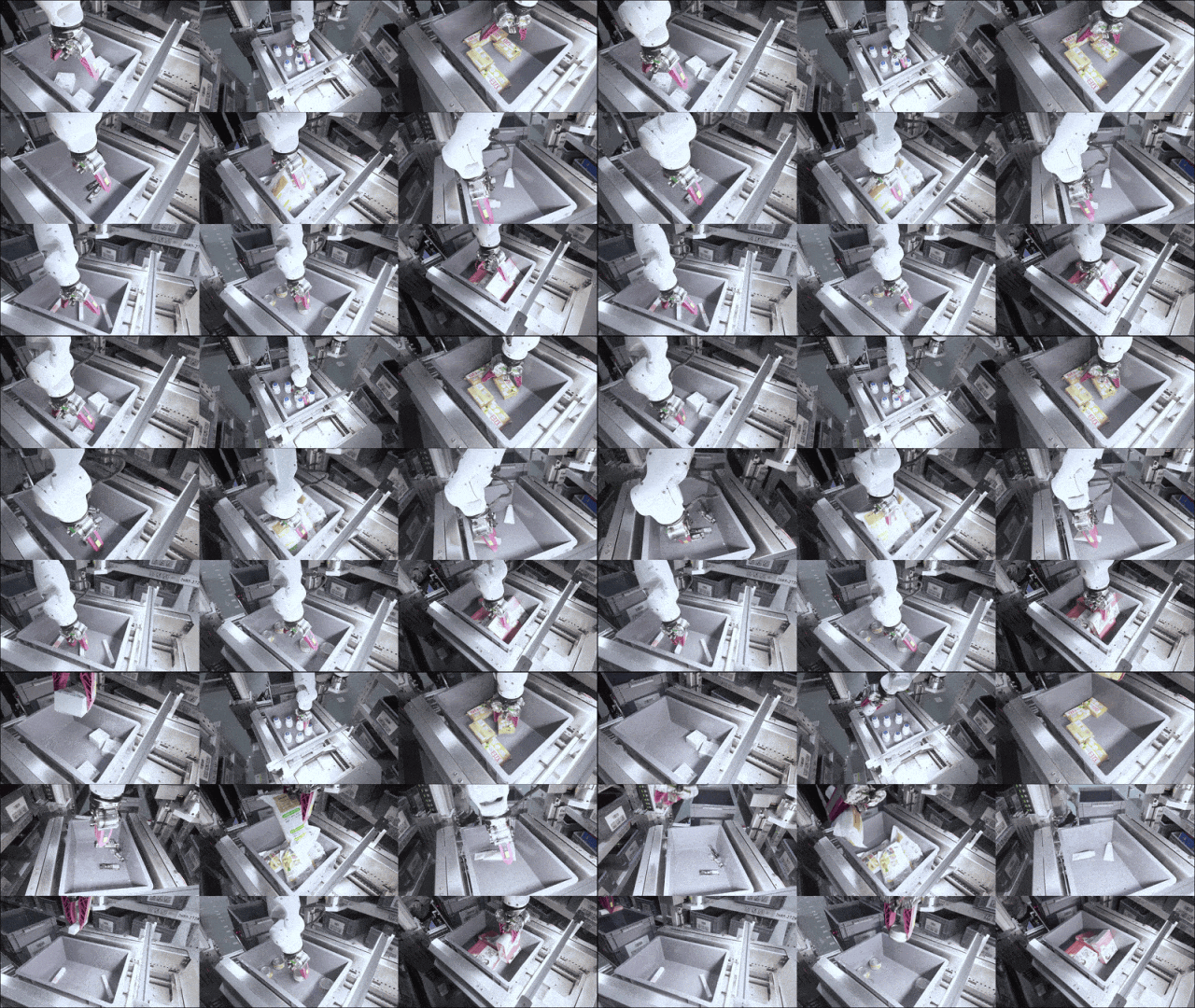
Picking features generalization: it is not a preset action for fixed objects and positions, but an operation strategy generated and dynamically adjusted by the model based on visual observation, spatial information and the robot's own state. Focusing on this goal, Zero-Order has explored and promoted the "Pick Anything" initiative, enabling the same set of grasping skills to adapt to different object categories, materials, postures and stacking states.
The latest progress is that Zero-Order has launched the Zerith R1 series robots for warehousing scenarios and the universal embodied sorting warehouse solution, which integrates storage, movement and embodied operation, supports large-scale replication in multiple warehouse types such as central warehouses, regional warehouses, front warehouses and lightning warehouses, and has taken the lead in deploying the nation's first practically implemented embodied front warehouse.
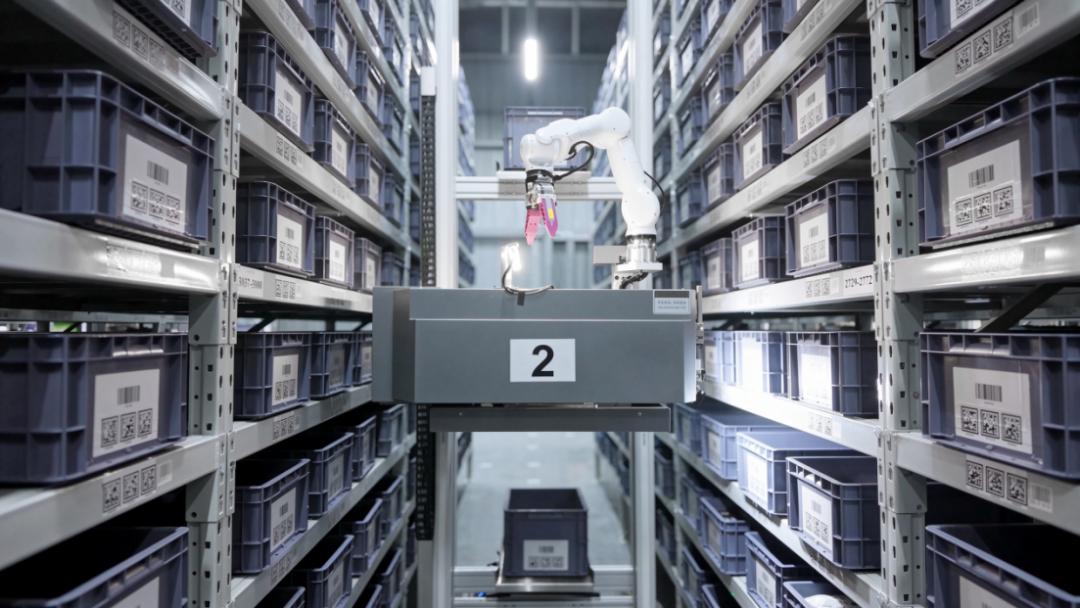
Taking Picking, the core operation capability, as the starting point, Zero-Order gradually expands to operations such as placing, inserting and tool operation by supplementing data and training for new contact modes, and continuously expands the generalization boundary. As skills are verified under more variable conditions, their value will extend from a single commodity or fixed scenario to cross-task and cross-scenario capability reuse.
The youngest embodied intelligence team that continues to receive heavy bets
Quite unexpectedly, this is a new-generation team in the embodied intelligence track.
Born in 2000, Min Yuheng has a strong geek temperament. In 2020, he was admitted to the Mingyue Science and Innovation Experimental Class of Chongqing University, studied under Professor Li Zexiang, and participated in two startups during his undergraduate years; after graduation, he was recommended for admission to Tsinghua University, and joined the AI&Robot Lab.
At that time, Min Yuheng judged that embodied intelligence represents a historic wave that can surpass the scale of the Internet. So he founded Zero-Order Robotics in 2025, focusing on humanoid robot R&D.
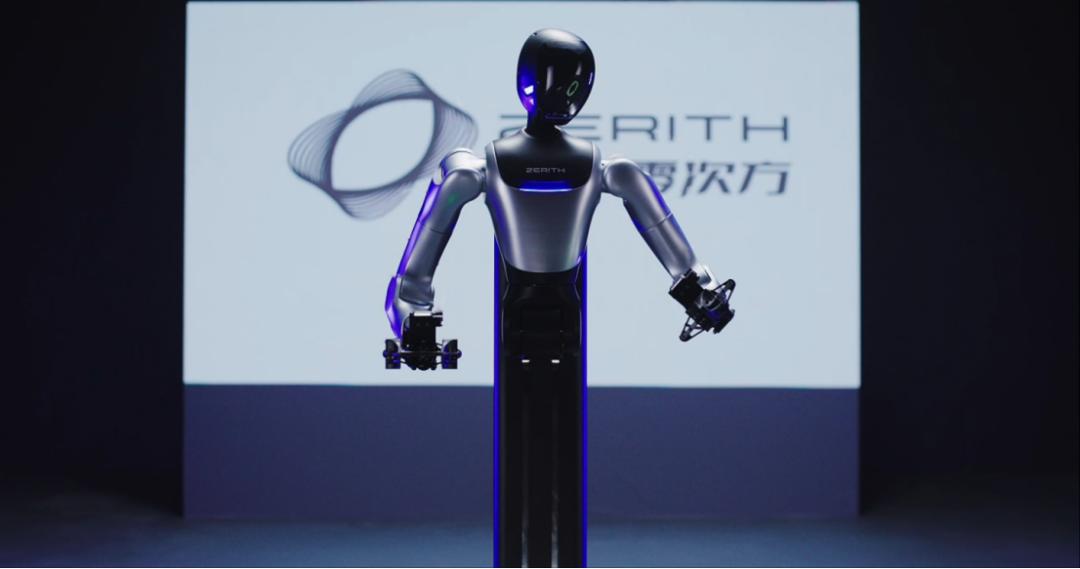
"Zero to the power of zero is mathematically undefined, and we hope to convey the concept of no upper limit, continuous boundary breaking and infinite possibilities through this name," Min Yuheng once explained the naming of the company. Many of the core members of the team are post-2000 generation, who are master and doctor graduates from Tsinghua University, Harbin Institute of Technology and other top universities, and have published many papers on top robotics conferences and journals such as T-RO, CoRL, ICRA and IROS.
The team realizes that embodied intelligence must be supported by real cognitive science. Long before sensory feedback arrives, the human motor system has already generated predictions about "what consequences the action will bring", which is the premise for actions to become smooth and accurate.
Inspired by this, Zero-Order released and open-sourced the new-generation embodied model Zerith-V2.5, which adopts an architecture that decouples the video generation model and the action policy. The video model is responsible for learning changes in future states, while the action policy reads the attention Key and Value features exported by the video model, applies the predictive representations to action decision-making, and supplements scene geometric information with the frozen VGGT features. In simple terms, it first establishes predictions for task dynamics, and then learns the actions needed to achieve the goals.
On this basis, Zero-Order launched the embodied self-evolution framework ESI, which integrates the large language model good at task understanding and planning and the embodied model responsible for action execution into a unified system-level collaborative architecture, and forms a closed loop of "planning - execution - feedback - correction" between the two in task execution, converting interactive experience into subsequent capability improvement.
The effect is obvious. In the final model evaluation, Zerith-V2.5 achieved SOTA on the LIBERO, LIBERO-Plus and Meta-World MT50 tasks; on the ten challenging robot operation tasks of the RoboDojo simulation evaluation suite, ESI achieved an average task score of 62.0 and an average task success rate of 49.41%, surpassing GPT6-Astra by nearly 24 percentage points.
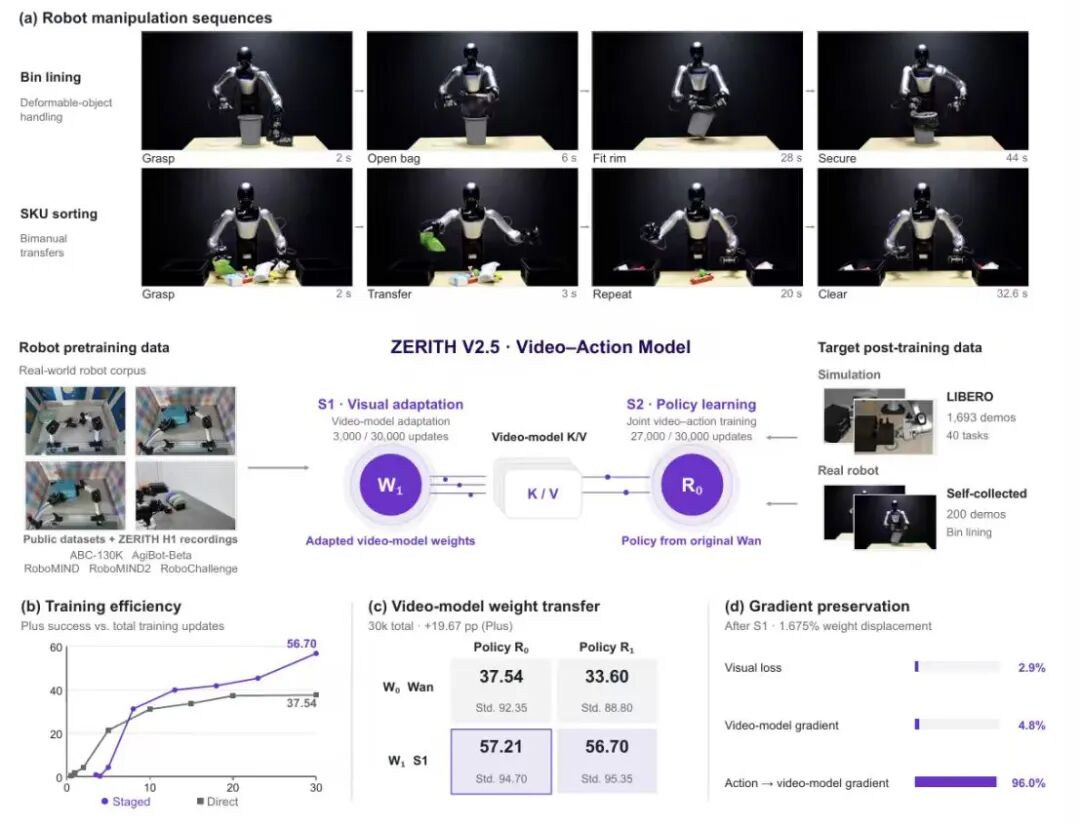
In addition, the team open-sourced approximately 1000 hours of real robot interaction dataset, covering full-body collaborative behaviors such as dual-arm operation, chassis movement and waist movement, and completely retains time-series observations, robot states and action sequences. This dataset puts more emphasis on the continuous interaction process itself, enabling the model to learn the cross-time-domain correspondence between actions and state changes, and provides a real data foundation for research on long-time-domain operations, complex contact relationships and cross-scenario migration.
Investors soon followed. Only half a year after its establishment, Zero-Order successively completed the angel round, angel+ round and angel++ round of financing. In April this year, the company announced the completion of a financing of over 100 million yuan, led by listed company Runze Group.
Even in the entire embodied intelligence circle, such a financing pace is quite rare. Especially when the financing heat of the current industry is slowing down, a large number of local state-owned capital, well-known financial institutions and industrial parties still make large-scale additional investments, which is of landmark significance for the industry trend.
The underlying investment logic is easy to understand: Zero-Order's commercial performance has been converted into deployable physical productivity — the team has built the nation's first embodied instant retail front warehouse in Hefei, and has run through the verification closed loop of "scene delivery - commercial monetization". Centered on the embodied model and guided by real commercial performance, Zero-Order makes the operation experience of robots in the physical world reusable and sustainably evolvable.
The life-and-death test for embodied intelligence
No one could have expected that the listing of Unitree Robotics would mark the beginning of a watershed for the entire industry.
After the stock price correction, a subtle sentiment began to spread across the industry. The overly distant future is no longer applicable. After stripping off the grand narrative of AGI, every company must start to explain clearly what kind of business it is actually running.
In a sense, this is also the beginning of the industry moving towards maturity: valuations supported only by narrative are no longer applicable, and data, model capabilities and commercial applications will become new hard indicators.
Different from large language models, the real breakthrough of embodied intelligence is not just about stacking parameters or data, but about deploying a closed loop: after the scale of robot deployment expands, the adaptation cost for new scenarios can continue to decline, and data backflow can stably improve model capabilities. This is the "Scaling Law moment" in the physical world.
However, the production of physical interaction data cannot simply follow the previous data acquisition methods, which indirectly leads to the large-scale production of physical interaction data being limited by model capabilities, while model evolution is in turn limited by data scale. Lack of data, lack of model improvement paths, and lack of industrial closed loops have always been the bottlenecks that the embodied intelligence industry cannot easily cross.
To break this dilemma, it is necessary for the model to correctly establish a continuous improvement mechanism between reasoning, execution and feedback. Zero-Order has established a systematic data AI Infra solution in real scenarios such as retail, warehousing and industry. The system supports the full-link closed loop of "collection - training - deployment - supervision - backflow - evolution", supporting the deployment of tens of thousands of scenarios, continuous evolution of models with tens of billions of parameters, and management of millions of hours of data.
It is reported that while Zero-Order Robotics completes real tasks, it will imperceptibly precipitate massive amounts of interaction data, and continuously convert new states, new disturbances and new failures that constantly appear in reality into model capabilities. Each commercial reuse helps to dilute the production cost of real data, and enables the next generation of physical capabilities to be built on richer interactive experience.
In this way, from model training to skill generalization, from real scenario deployment to data iteration, and then to skill reuse and complex task execution, Zero-Order has gradually opened up the key links of Physical AI from capability formation to physical execution.
Up to now, the deployment of many robots is still a highly customized project-based business. Data, training, debugging and manual labor accumulate with the increase of scenarios, and the high marginal cost has become an insurmountable threshold. Without a clear calculation of deployment cost, it is difficult to talk about enabling robots to continuously create actual value.
Zero-Order targets the Scaling of Physical AI, and builds the infrastructure required for data production, model iteration and capability deployment. As model capabilities improve, robots can adapt to more items and operation conditions, reducing the adaptation cost for new scenarios; the expansion of deployment in different scenarios brings richer physical interaction data, providing new experience for model iteration.
Especially to reduce the invocation cost of grasping capabilities across tasks and scenarios, Zero-Order is simultaneously promoting the physical grasping API, which encapsulates verified grasping skills as standardized interfaces for invocation in different tasks and scenarios. By adapting Picking skills to corresponding robot bodies and execution systems, it forms products and solutions of different forms, and promotes the cross-scenario reuse of operation capabilities in retail supermarkets, robot convenience stores and other places.
This is a microcosm of the entire industry.
Several years later, robots have moved from demonstration to the moment of value closed-loop realization. The ability to work stably, calculate costs clearly, and reuse across scenarios has become the real watershed.
The law of history is that the prosperity of the industry often starts with universal optimism, but finally ends with differentiation. At the forefront of the trend, the narrative of the second half of embodied intelligence has just begun.
This article is from the WeChat official account "PE Daily" (ID: pedaily2012), written by Yu Mengying, and published by 36Kr with authorization.