Deutsche Bank: The sell-off of technology stocks is likely to bottom out, it is expected that the S&P 500 will rise by another 25% to 9000 points next year, and the Federal Reserve may raise interest rates three more times.
Deutsche Bank states in its newly released 2027 Global Outlook that the S&P 500 is expected to rise to 9000 points by the end of 2027.
In the report led by Binky Chadha, the bank's Chief US Equity and Global Strategist, the team further judges that this round of tech stock sell-off should bottom out soon, followed by an expected rise of more than 25% in the S&P 500 — calculated at Wednesday's closing price of 7182.78 points, the 9000-point target implies an upside of more than 25%, which is also the highest target among major investment banks, while the market consensus target is 8700 points.
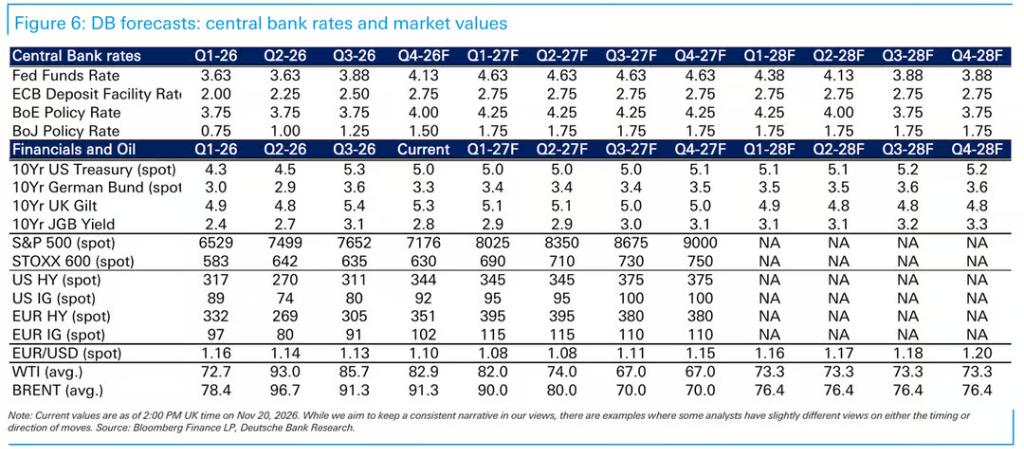
However, the bank expects the Federal Reserve to implement three more interest rate hikes, and the federal funds rate may rise to 4.625%. These two seemingly divergent forecasts point to the same core variable: AI capital expenditure.
Deutsche Bank believes that AI investment will continue to drive U.S. growth, corporate earnings and stock market performance; but at the same time, related investment may also exacerbate inflationary pressures, push up financing costs, and amplify the fragility of the credit market.
The bank's equity strategy team is bullish on tech stocks, as well as the U.S. and Asian markets; but its credit strategy team recommends allocating S&P 500 put options to hedge against market risks brought by the slowdown in AI capital expenditure.
Tech Stock Sell-off: Turbulence Will Take 6 to 8 Weeks to Subside and the Market to Complete Bottoming Out
Deutsche Bank points out that since mid-October, the Nasdaq 100 index has fallen by about 12% cumulatively, and investors' sentiment towards AI and the huge investment it requires has cooled; over the same period, semiconductor stocks as a whole plunged by about 29%, Jensen Huang's departure from NVIDIA and subsequent return dragged down the popularity of the entire industry. Anthropic's debut listing also failed to effectively boost traders' confidence in the sector.
Binky Chadha, the bank's Chief US Equity and Global Strategist, points out that there have been five significant rotation rounds in and out of the tech sector over the past two and a half years. This round started as a regular rotation, but under the catalysis of Alphabet's Q3 earnings report, the U.S. midterm elections, and a series of tech and infrastructure failures, it evolved into a volatility shock and market sell-off.
According to the bank's statistics, in previous similar shocks, market turbulence took an average of 6 to 8 weeks to subside and the stock market to complete bottoming out.
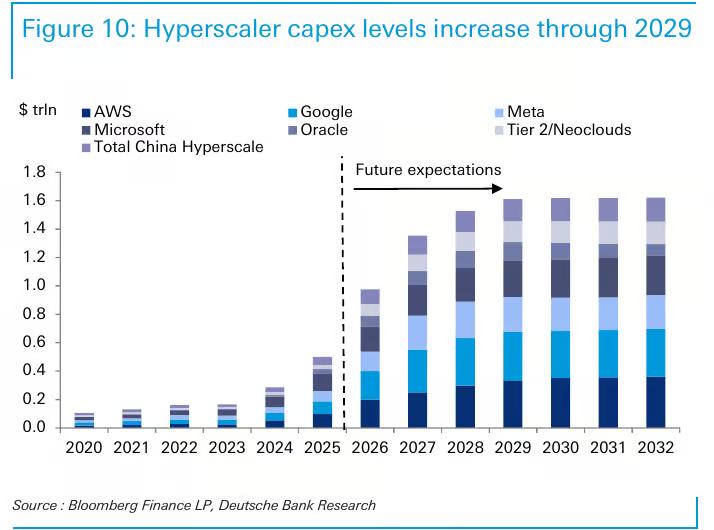
The bank expects the growth rate of capital expenditure of hyperscale cloud service providers to peak next year, but as investors shift their focus from "burning money" to AI application and monetization, their earnings growth will accelerate.
At the same time, the recovery of manufacturing activity drives the rise of cyclical recruitment, which strategists believe will help improve productivity. Combining the two factors, Deutsche Bank expects S&P 500 earnings per share to grow by 19% in 2027, and sets a target of 9000 points.
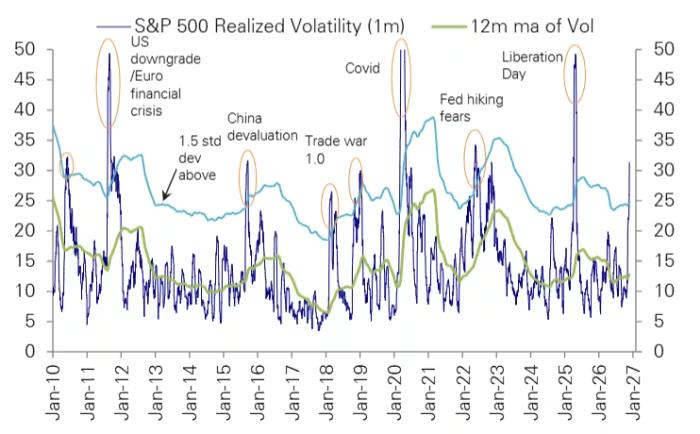
On the demand side, Deutsche Bank believes that "with the continuation of robust earnings growth, the heavily washed-down stock positions have sufficient upside potential". Although capital inflows have slowed down, the post-pandemic boom of cross-asset capital inflows "still has room for further development".
"On the supply side, we see buybacks rising with earnings, and the stock issuance boom will continue. This supply is endogenously driven by strong demand, which can be said to slow down the bull market but will not derail it."
AI Capital Expenditure Supports Growth, But Productivity Dividend May Appear Later
David Folkerts-Landau, the bank's Chief Economist, and strategist Jim Reid said in the same outlook report titled *High Expectations, But High Risks* that the recent stock market decline is more like a volatility event and does not mean that fundamentals are damaged.
"Our equity strategists believe that the recent trend is a volatility event that may further develop before bottoming out, but it will not undermine fundamentals. They expect that driven by highly supportive earnings, the S&P 500 will reach 9000 points by the end of 2027."
In terms of macro forecasts, strategists expect the global economic growth rate to rise from 3.3% in 2026 to 3.5% in 2027, while the U.S. economic growth rate will slow slightly from 2.4% to 2.3%.
Strategists estimate that AI-related capital expenditure has recently contributed about 0.9 percentage points to the annualized U.S. economic growth, but the import leakage effect of about one-third to one-half needs to be deducted. The bank expects the growth rate of U.S. real equipment investment to slow from about 16% at the end of 2026 to about 10% in 2027, which still remains at a relatively high level.
In terms of the scale of capital expenditure, Deutsche Bank expects the capital expenditure of hyperscale cloud service providers, including Oracle, new cloud computing enterprises and relevant Chinese enterprises, to increase from about US$1 trillion in 2026 to about US$1.35 trillion in 2027, reach about US$1.6 trillion in 2029, and then stay around this level.
Strategists expect that AI can eventually bring a 0.5 to 0.75 percentage point increase in productivity every year, but this effect "will be more obvious in 2028 than in 2027". The report also reminds that the capital expenditure cycle driven by technological revolution is often not smooth sailing.
The report states: "History still warns us that technology revolutions driven by capital expenditure rarely move smoothly to the expected end point. Overinvestment, recession, as well as unexpected winners and losers, are all part of this process."
Inflationary Pressures Remain, The Federal Reserve May Raise Interest Rates By Another 75 Basis Points
Deutsche Bank expects that the average growth rate of the overall U.S. CPI in 2027 will drop from 3.4% in 2026 to 2.7%. But the decline in core PCE inflation will be relatively slow: it is expected to stay above 3% at the end of 2026, and fall to 2.5% in the fourth quarter of 2027.
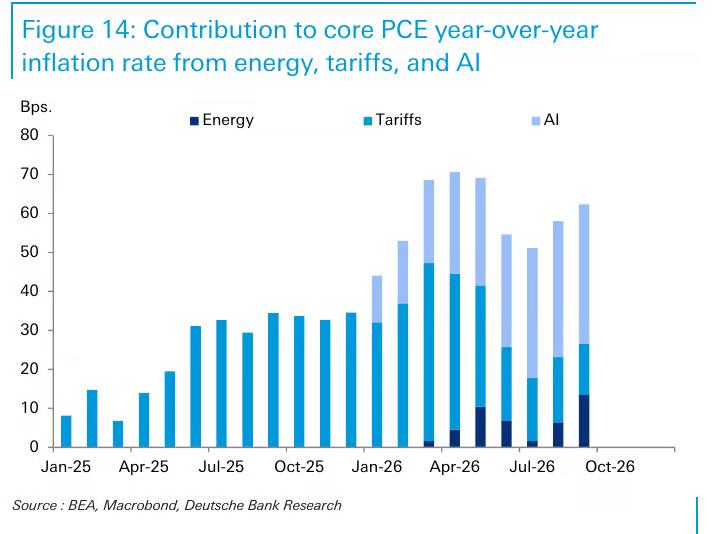
The bank believes that demand-driven inflation has rebounded somewhat, housing inflation remains sticky, and AI investment is also creating price pressures in some sectors. The report mentions that of the roughly 60 basis point increment in core PCE inflation contributed by energy, tariffs and AI combined, AI has accounted for more than half, although the relevant figures are estimated from chart readings.
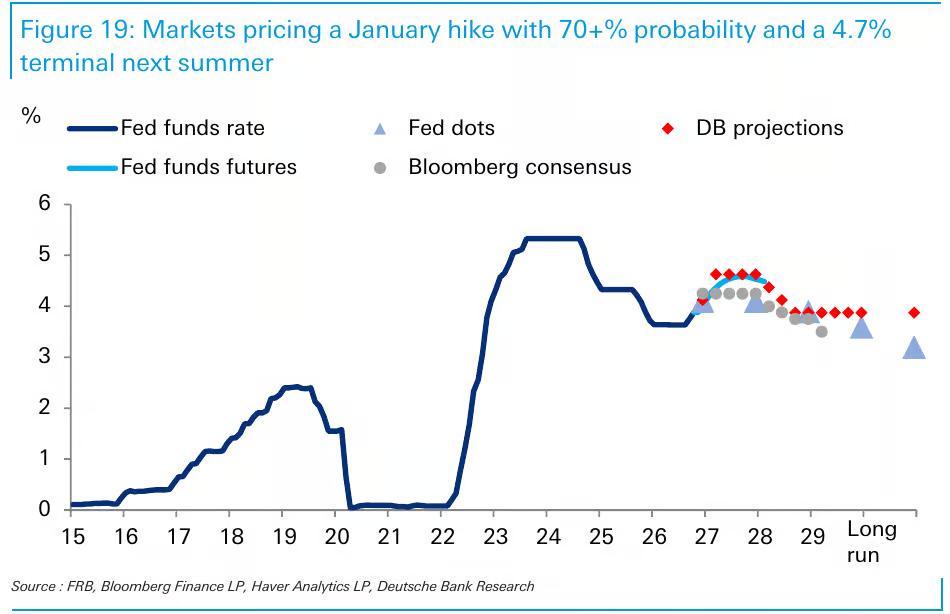
Based on judgments such as inflation above target, resilient economic growth and a stabilizing labor market, Deutsche Bank expects the Federal Reserve to raise interest rates by 25 basis points respectively in December 2026, January 2027 and March 2027.
"Against the backdrop of above-target inflation, resilient growth and a stabilizing labor market, our economists expect the Federal Reserve to tighten by an additional 75 basis points from the current level, raising the federal funds rate from the current 3.875% to 4.625%."
Deutsche Bank estimates the nominal neutral interest rate in the range of 3.75% to 4%, which is more than 100 basis points higher than the level in the period after the global financial crisis. The bank also expects the 10-year U.S. Treasury yield to reach 5.05% by the end of 2027.
Bullish Judgment On Stock Market Is Based On Strong Earnings
The bullish judgment of Binky Chadha's equity strategy team of the bank is mainly built on earnings expectations. The team expects that the earnings per share of S&P 500 constituent stocks will reach US$430 in 2027, a year-on-year increase of 19%.
The report points out that the S&P 500 earnings growth was about 11%, 25%, 34% and 34% respectively in the first three quarters of 2026, and the earnings level is about 20% higher than the long-term trend channel. The equity strategy team believes that current market positions are still low and have not fully reflected the strong earnings performance.
"At present, large-cap stock positions are moderately underweight, which implies an earnings growth expectation of 1%, significantly lower than the current overall actual growth rate of more than 30%, and also lower than the growth rate of about 15% for median companies."
The equity strategy team believes that stock prices are still about 20% lower than the reasonable level corresponding to year-end earnings. After tech stocks underperformed by about 20 percentage points in the recent industry rotation, the team tactically overweights tech stocks, the U.S. market and the Asian market.
However, the bank's credit strategy team has adopted different risk response suggestions. The team said: "Short-term hedging tools are needed to guard against the slowdown of AI capital expenditure. Both the S&P 500 and the Euro Stoxx 600 are overvalued. Equity put options should serve as effective hedging tools. In the credit market, we will underweight chip manufacturers, new cloud computing enterprises and data centers."
The credit strategy team believes that high financing costs are putting pressure on non-cyclical enterprises with high leverage ratios, and may also affect new cloud computing enterprises and data centers with lower ratings in the U.S. AI industrial chain. "Simply put, the credit market needs interest rate relief."
AI Brings Upside Potential And Also Serves As A Source Of Risk
The bank repeatedly emphasizes in the report that the forces driving the market upward may also become the source of risks.
"The S&P 500 rising to 9000 points is fully consistent with our strategists' earnings and capital flow framework, but this judgment is highly exposed to earnings and AI-related risks. If our high expectations are fulfilled, 2027 could end up being a very good year. But don't expect to feel that way every day in what could be another high-volatility year."
Judging from the allocation suggestions of different teams within Deutsche Bank, the sustainability of AI capital expenditure will be the key variable to determine whether its 2027 forecasts can be fulfilled: if investment continues to support earnings and growth, the stock market may get upward momentum; if financing costs and credit pressures curb capital expenditure, the stock market, credit spreads and the U.S. dollar may all face repricing.
Forecasts For The U.S. Dollar, Bond Market And Oil Prices Are All Related To The AI Cycle
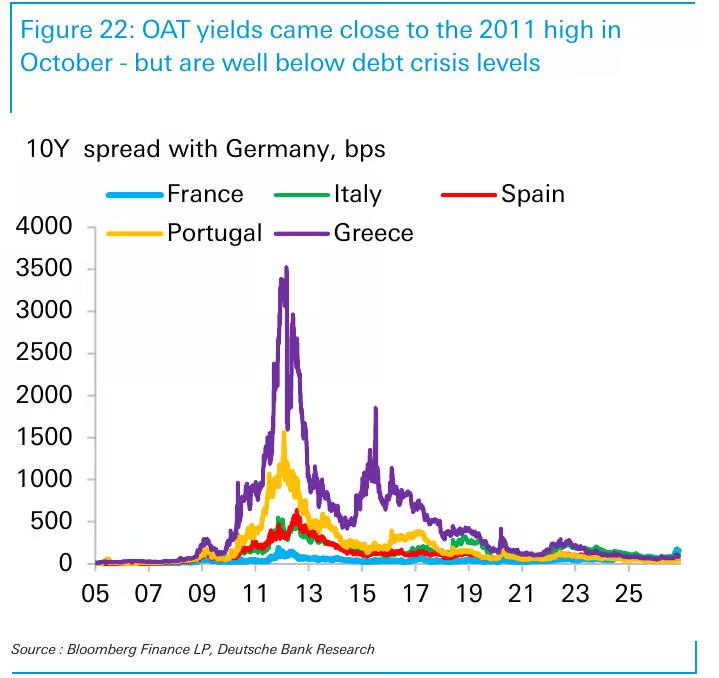
In the interest rate market, Deutsche Bank has shifted to a neutral duration position, and expects the yield curve to steepen further. The bank believes that Japanese long-term government bonds are relatively low compared with the U.S. dollar and euro yield curves, while French government bonds have priced in a fairly significant risk premium.
Deutsche Bank expects France's economic growth rate to be 0.5% in 2027, and the fiscal deficit will account for 5.2% of GDP. The bank believes that France may become one of the important European market topics in 2027, but its baseline judgment is still that the risk premium will fall after the election, rather than a systemic crisis.
In terms of foreign exchange, the bank's foreign exchange team adjusted its previous weak U.S. dollar judgment, and instead expects the U.S. dollar to remain relatively strong for a long time. The bank expects the EUR/USD to fall to 1.08 in the first half of 2027 and then rebound to 1.15; the USD/JPY may enter the 140 range.
But the bank points out that the U.S. dollar's dependence on the AI capital expenditure cycle is increasing. The report states: "The most important risk first is that the U.S. dollar's rising dependence on the AI capital expenditure boom. If capital expenditure expectations are adjusted down more significantly, it will push down U.S. real interest rates and weaken equity capital inflows, thereby weakening the two key pillars supporting the U.S. dollar."
In terms of the energy market, the bank expects the average Brent crude oil price to be around US$90 per barrel in the first quarter of 2027, fall to US$80 in the second quarter, and drop to around US$70 in the second half of the year. The bank expects the WTI crude oil price to be around US$67 per barrel in 2027.
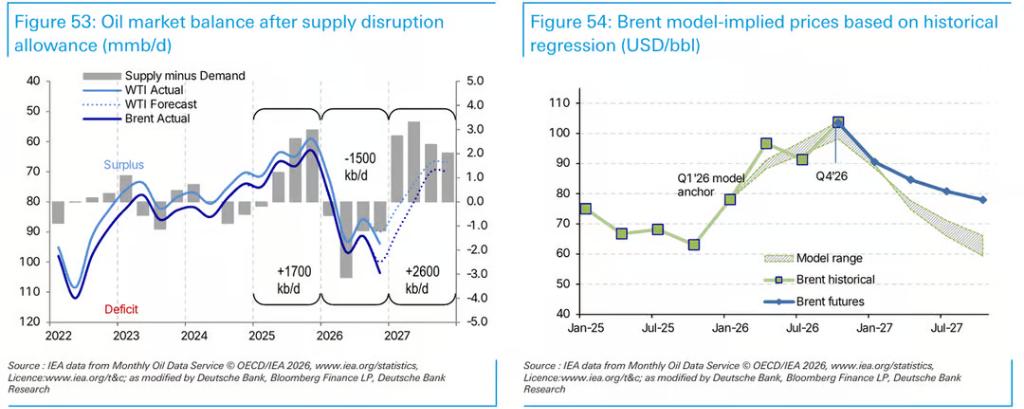
The bank also points out that the oil price forecast is highly dependent on the evolution of geopolitics, including the passage of the Strait of Hormuz, and whether Iran will shift the focus of conflict to energy infrastructure.