Elon Musk gives away 120 billion.
On the eve of the Black Friday shopping festival, the world's richest man once again dominated headlines across all social platforms.
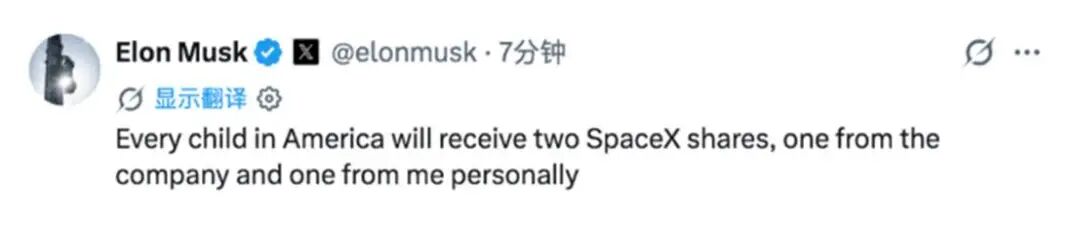
On local time November 25, SpaceX announced that it would donate one newly issued Class A common share to every active "Trump Account". Elon Musk immediately added a comment on X: Every child in the United States will receive two shares of SpaceX stock, one from the company and one from himself personally.
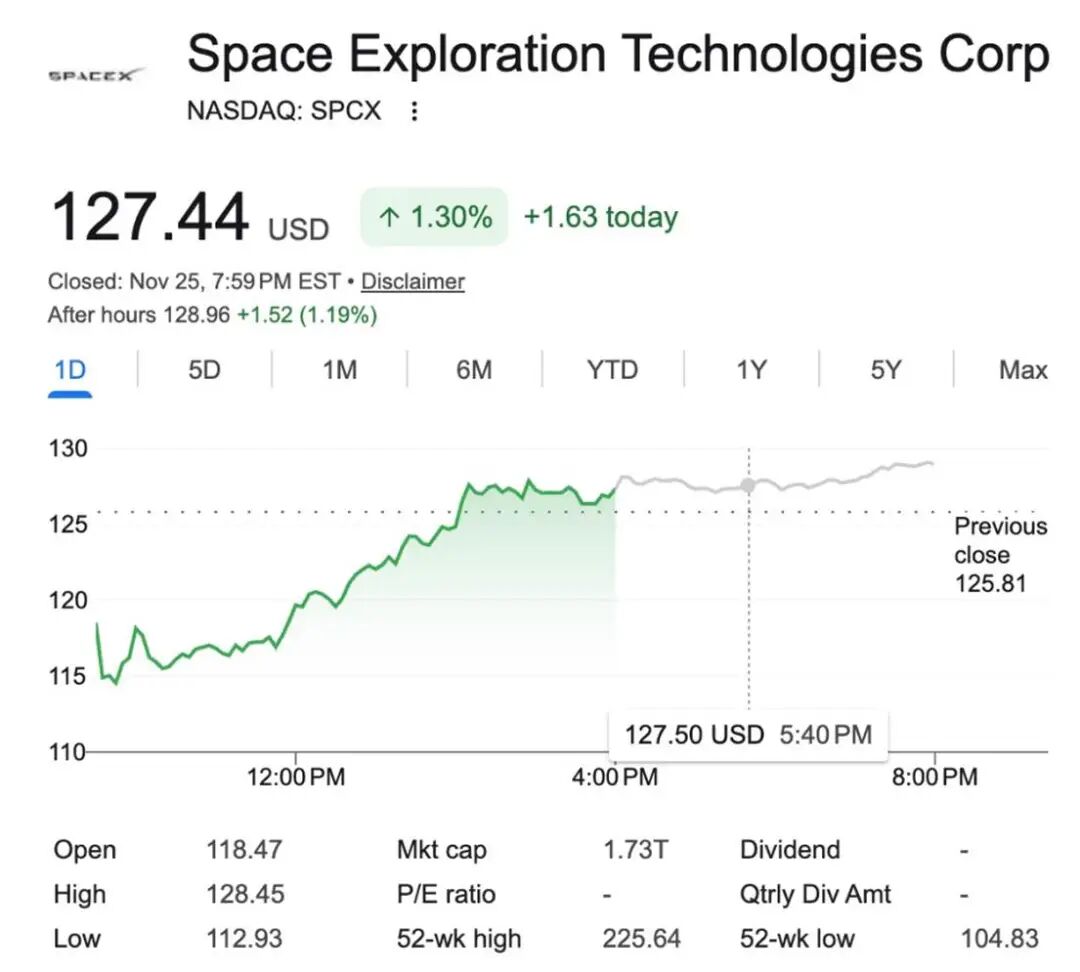
How large is this "gift"? There are roughly 72 million children under the age of 18 in the United States, and SpaceX closed at $127.44 per share that day. 72 million × 2 × $127.44 equals approximately 18.351 billion US dollars (around 121.8 billion yuan).
This is a figure significant enough to be recorded in business history. If you only treat it as a lavish act of "splashing cash", you are underestimating Elon Musk.
In the very same week, his brain-computer interface obtained the FDA's approval for pivotal clinical trials, his humanoid robot got a new updated timeline, and his rocket company won the world's first "space data center license". What was given out are stocks, but what is truly demonstrated may be his absolute certainty about the future.
An "option" written for the next generation
Unpack this "gift". It is more like a long-term option written for the future, rather than a sum of cash: what children get is not money that can be spent today, but a bet on the future of a company.
The "Trump Account" is a tax-advantaged investment account set up by the United States for children under 18. According to data released by the White House in October, nearly 70 million such accounts have been created. SpaceX stated that the ownership of the companies that built these systems should also extend to the next generation of Americans. Musk put it more bluntly: The right approach is to put stocks, which are part of the future economy, directly into the hands of the people.
This is not a random whim. Last month, he already announced that he would give one share of SpaceX stock to every American child next year, and this move effectively doubled that promise. Gwynne Shotwell, President of SpaceX, also announced that she would personally donate more than 2 million shares.
The 18.351 billion US dollars is the estimated upper limit based on the scenario where all 72 million children receive two shares; if calculated based on the nearly 70 million existing accounts, the figure will drop to about 17.8 billion US dollars. SpaceX has not yet responded to questions about how children with unactivated accounts will be covered, and whether there is a lock-up period for the gifted shares.
For Musk personally, the matching donation part is about 8.9 billion US dollars, while Bloomberg estimates his net worth at around 813 billion US dollars — his generosity is real, but it will never hurt his financial foundation.
What is more subtle is that when tens of millions of families become small shareholders of SpaceX, the public recognition of this company in American society has also been quietly written into every child's account.
From mind control to warm embrace
If giving out stocks is to share the "future" with children, then the news brought by Neuralink on the same day is intended to return the "future" to those who are trapped inside their own bodies.
On November 25, Neuralink announced that it had obtained approval from the U.S. Food and Drug Administration (FDA) to launch a pivotal clinical trial called LINK, targeting adult patients with severe paralysis caused by Amyotrophic Lateral Sclerosis (ALS). The company stated that this is the first pivotal clinical trial for an implantable brain-computer interface in the United States.
A "pivotal trial" is usually the last large-scale clinical checkpoint before a medical device applies for marketing. The question it needs to answer is no longer "whether it can be used", but "whether it is safe, effective, and reliable for long-term operation".
Previously, Neuralink has accumulated experience on more than 30 test subjects; the core device in this trial is the N1 implant. The recruitment page indicates that participants need to invest about 24 months, and the number of enrolled subjects has not been announced yet. The product is still an investigational device at present and has not been put on the market for sale.
The resonance triggered by this news in China may be deeper than that in the United States, because of one name: Cai Lei.
The former Vice President of JD Group was diagnosed with ALS in 2019, and since then he has devoted the rest of his life to racing against the disease. His team has built a scientific research platform for ALS, promoted nearly 300 drug pipelines, and cooperated with multiple hospitals to advance clinical research on brain-computer interfaces. Now he has entered the end stage of the disease and communicates with the outside world relying on an eye tracker.
On October 31, at the "2026 Super Science Night", he expressed a wish through video: If one day he completely loses his language and motor functions, he hopes to use a brain-computer interface to control a robot avatar and hug his son again.
This sentence sounds like science fiction, but it is not an empty fantasy.
In the same panel discussion, the Jieti Medical team introduced that there are already domestic patients with high paraplegia who can use their minds to control a robotic dog to pick up takeout orders and run an online store independently. But "hugging" is completely different: it requires accurate position judgment, control of the trajectory and strength of both arms, and real-time adjustment when the other person moves slightly. Cai Lei himself is very clear: 2027 may be the year of breakthrough, but not the year of explosive development.
It is worth mentioning that China is not a follower in this track. On March 13 this year, the National Medical Products Administration approved BrainCo's "Implantable Brain-Computer Interface Hand Motor Function Compensation System" to go on the market. This is the world's first approved invasive brain-computer interface medical device, which only took 1 year and 7 months to go through the entire special review process for innovative medical devices. Shanghai subsequently completed the online procurement listing in 11 days, and included it in the city's medical insurance medical consumables catalog. Also this year, the "brain-computer interface" was written into the Government Work Report for the first time.
Neuralink got the first "pivotal trial" ticket in the United States, while China has already issued the world's first "marketing registration certificate" for invasive products. The two different paces point to the same end point.
Multi-point breakthroughs in robots and space computing power
The other half of Cai Lei's wish, the "robot avatar" that can hug his son for him, is exactly another track that Musk has bet heavily on. The brain-computer interface gives an exit to the mind, while the humanoid robot prepares a physical body for the mind.
Just one week before the share donation news, on local time November 18 in the United States, Musk said in a video interview that the Optimus humanoid robot is expected to complete multi-step complex operations within 12 to 18 months, with the path of being used in heavy industry first, and then entering households. The example he gave is very daily: taking out the trash, washing dishes, and putting the dishes into the cabinet.
He also announced that a new round of demonstrations will be held in one to two months, and specifically emphasized that the demonstration must be "real enough" — it will not rely on pre-programmed procedures for a single task, will not depend on remote control, and will not select ideal environments. This is almost a direct response to the long-standing external doubts that "robot demonstrations are all choreographed".
Whether it is a robot that can wash dishes, a car that can drive itself, or a decoding model that can read brain electrical signals, all of them point to the same scarce resource: computing power.
With ground power and land resources getting increasingly tight, Musk's answer is to move computing power into space.
On local time November 25, the U.S. Federal Communications Commission (FCC) conditionally approved SpaceX to build a space data center constellation named "Starmind", which can deploy up to 1 million satellites. This is the first time that a U.S. regulatory agency has issued such a license for a space data center constellation.
According to the authorization document, the satellites will operate in orbits between 500 and 1002 kilometers. SpaceX must start deployment before November 2033, complete 100,000 satellites and 500,000 satellites by 2035 and 2038 respectively, and finish the deployment of the entire constellation before November 2040.
What does 1 million satellites mean? According to statistics from the European Space Agency, there are currently about 16,900 satellites orbiting the earth, and the scale approved for SpaceX is nearly 60 times that number. According to public introductions, the supporting AI1 satellite has a regular output of 120 kilowatts per unit, with a peak of 150 kilowatts, and its comprehensive computing power is roughly equivalent to a modern AI server rack on the ground; the first batch of units is planned to be launched at the end of 2027.
"Elon Musk is leading China's scientific and technological innovation"?
Pulling the sight back from the orbit to the ground, the echoes of this series of actions in China's technology circle may be more thought-provoking than in the United States.
"Elon Musk is leading China's scientific and technological innovation." A domestic entrepreneur in the technology field sighed like this.
From robots to autonomous driving, then to brain-computer interfaces and space computing power, Musk's business empire is growing larger and larger. From the "catfish effect" brought by Tesla's entry into China, to reusable rockets and humanoid robots, he has repeatedly acted as the person who first wrote science fiction into business plans.
He defines new tracks, raises the ceiling of imagination, and also gives global capital a comparable benchmark.
However, if you only read the word "leading", it is not complete enough. A more accurate statement may be: Musk raises the questions, and China is answering them in its own way, and the answers are getting faster and faster.
In the field of humanoid robots, IDC data shows that the global shipment volume in the first half of 2026 was nearly 25,000 units, a year-on-year increase of 432.1%, of which the Chinese market shipped more than 19,000 units, accounting for about 77.9%. The data from another institution SAG is even more staggering: Chinese manufacturers have contributed more than 97% of the global shipment volume.
In the field of brain-computer interfaces, the world's first registration certificate for invasive products was issued in Shanghai, and capital is also pouring in at an accelerated pace. Jieti Medical has raised more than 1.1 billion yuan in cumulative financing within one year. In the field of space computing power, the first 12 computing satellites of the "Three-Body Computing Constellation" led by the Zhejiang Lab entered orbit in May 2025, and 10 artificial intelligence models and applications have been deployed in orbit, including a space-based remote sensing model with 8 billion parameters.
The differences between the two paths are also very clear. Musk is good at vision-driven development: he first draws a grand blueprint of millions of satellites and universal shareholding, and then reversely deduces the engineering plan. China's industry is more scenario-driven, relying on a complete supply chain and a huge application market, and verifying step by step in hospitals, factories and orbits.
The former provides direction, and the latter provides speed. Global technological competition is moving from unipolar leading to multipolar competition. No matter who takes the lead, this competition ultimately needs to answer the same question: How far can technology take human beings?
Movies have long given a romantic answer to this question. There is such a scene in the 2009 movie Avatar: Jake Sully, a disabled retired soldier, connects his consciousness to the Avatar's body for the first time. He tentatively moves his toes, then rushes out of the laboratory recklessly, steps on the soil barefoot, and starts running. At that time, it was just Cameron's imagination.
More than ten years later, some people use their minds to control pneumatic gloves to hold a water cup, some people use their minds to drive a robotic dog to pick up takeout; a father who can only talk to the world through his eyes is looking forward to using a mechanical body to hug his child again. The distance between science fiction and reality is shortening by the year.
Technology is not the answer itself, but the feet that help humans get out of difficulties again and again.
The 18.351 billion US dollars will eventually be turned into two shares of stock in tens of millions of children's accounts. And in the world where these children grow up, that scene in Avatar may eventually be realized.
This article is from the WeChat official account "Rongzhong Finance" (ID: thecapital), written by Abu, edited by Wuren, and published with authorization from 36Kr.