Who on earth is making money from the robot business in shopping malls?
Robot brands and distributors have been opening physical stores in shopping malls one after another, but it is not easy to replicate the offline retail business model of new energy vehicles at the moment.
Reporters from Jiemian News recently visited several offline robot stores in Shanghai and found that even on weekends, foot traffic in some stores remains low. In one multi-brand collection store, more than a dozen humanoid robots and robotic dogs are placed in a corner of the store, some in standby mode, others lying on the floor.
Meanwhile, isolation belts are set up around the exhibition area, preventing customers from getting close to the robots. When the reporter, posing as a consumer, asked for interactive experience, the staff said that the personnel in charge of explanation and experience arrangement were not present, so such arrangement could not be made for the time being. Another staff member stated that the equipment is only demonstrated at fixed time periods, and experience is not available at other times.
A customer who came with a child told the reporter that he had visited the store several times before but never caught the robot dance performance. Since the performance time is fixed, he could only wait on site this time as well.
Another customer said that the store has a wide range of products, including companion robots for children and mobility assist devices for the elderly, but the staff's introduction to different products is not professional enough, making it difficult for customers to fully understand their specific functions and differences.
At present, although some stores display a large number of robot products, the actual experience and sales services still need to be improved.
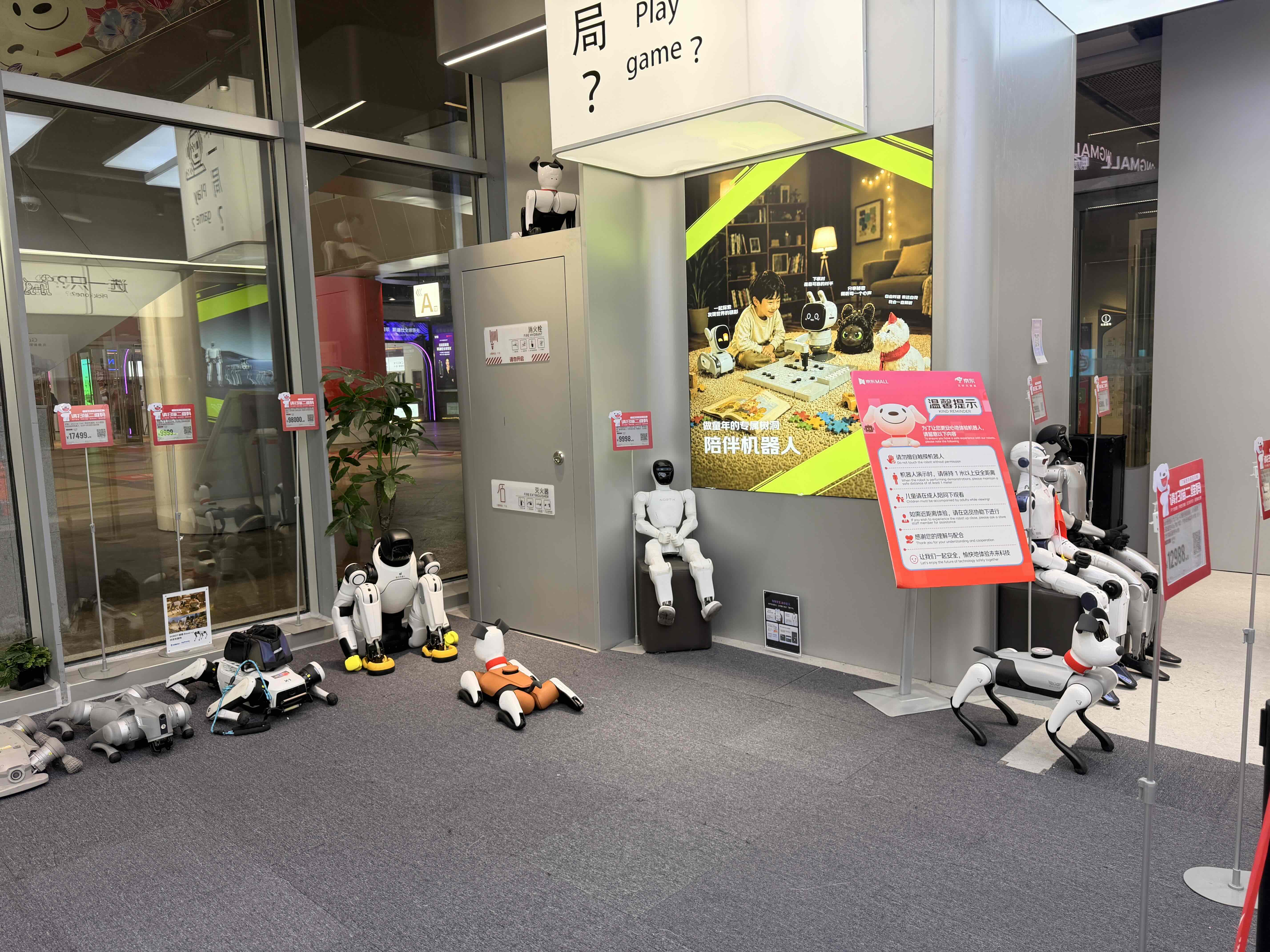
Image source: Jiemian News
From 3C products such as smartphones to new energy vehicles, shopping malls have become an important place for brands to expand offline sales channels, and robot enterprises are also trying similar paths at present. Shopping malls can enable more people to get in touch with robots and bring foot traffic to shopping centers through demonstrations, but whether this public attention can be converted into actual purchasing demand remains to be verified.
Yu Yiran, Managing Director of CIC, analyzed in an interview with Jiemian News that at present, robot enterprises continue to deploy offline stores. On the one hand, they hope to let customers understand the actual capabilities of products through close-range display, and increase their trust in high-priced robot products. On the other hand, they are also trying to reach individual consumers to collect real usage feedback. Compared with participating in exhibitions, permanent physical stores can maintain continuous contact with customers, but if sufficient experience cannot be provided, their role will also be limited.
In fact, even leading robot manufacturers such as Unitree are still exploring offline retail business. In June this year, Unitree opened its first Asian "Embodied Intelligence Experience Store" at Jiuguang Department Store in Jing'an, Shanghai. The on-site staff introduced to Jiemian News that the store mainly displays G1 and R1 humanoid robots and Go2 robotic dogs, while industrial-grade products are more targeted at enterprise customers.
The staff said that the store has limited space, and there are safety risks when humanoid robots perform large-range movements, so only simple dances or short-distance walking can be arranged on site. He also mentioned that many of the personnel involved in opening the store previously engaged in R&D and technical work, lack mature retail operation experience, and are still exploring at present.
From the perspective of operating entities, current offline robot stores can be roughly divided into three categories: the first category is brand directly-operated or authorized stores opened by manufacturers such as Unitree and Qiyuan Robot under Shangwei New Materials; the second category is multi-brand collection experience stores such as JD MALL and Taozhu Xinzaoju; the third category is stores operated by third-party distributors, which not only provide agency sales, but also provide robot leasing, maintenance and enterprise customization services. The business scopes of different models also overlap to some extent.
This wave of store openings has reached a certain scale. According to incomplete statistics from Jiemian News, as of November 26, 2026, there are more than 40 offline robot stores of various types in China, covering different models including brand directly-operated and authorized experience stores, multi-brand collection stores and robot 6S stores. Among them, the operation system of Shenzhen Longgang Robot 6S Store previously disclosed that more than 20 stores have been opened across the country; Taozhu Xinzaoju under Shoucheng Holdings has laid out 9 offline retail stores in Beijing as of October; brands including Qiyuan Robot, Unitree and Vitar Power have also successively opened experience stores in multiple cities.
Although they are all deploying offline channels, different types of stores have different profit requirements.
Yu Yiran analyzed to Jiemian News that brand directly-operated stores focus on brand and strategic accounting, emphasizing brand building, product display and user feedback collection, and have a high tolerance for single-store profitability; platform collection stores pay more attention to traffic, display commission, popular science drainage and enterprise customer resource docking.
In contrast, third-party distributors and franchise stores usually need to be responsible for their own profits and losses. They not only have to bear store rent and personnel costs, but also face the pressure of equipment procurement, overstocked inventory and capital turnover, and calculate the pure single-store ROI and cash flow account.
She also mentioned that some robot stores relying on industrial parks and state-owned capital platforms undertake functions such as industrial investment attraction, and their profitability cannot be measured completely according to the standards of ordinary retail stores.
From the perspective of market demand, robot shipments are indeed growing. According to IDC data, global shipments of humanoid robots in the first half of 2026 were close to 25,000 units, a year-on-year increase of 432.1%, of which China accounted for more than 19,000 units. However, scenarios such as scientific research and education, performance exhibition and government data collection centers still account for 69% of total shipments in total, and ordinary families are far from becoming the main purchasing group.
There is still a long way to go before humanoid robots enter ordinary families on a large scale. At this stage, the business of third-party distributors relies more on enterprise customers.
When Jiemian News reporters visited an offline robot store operated by a third-party institution in Shanghai, they learned that in addition to selling robots, the store also undertakes leasing, welcome performances, tour guide and customized deployment. The on-site staff said that as a brand agent, its business covers the whole country. Customers can choose multiple robots for joint performance according to event requirements, and can also customize dance movements, costumes and voice content. The institution is responsible for transportation, on-site technical support and maintenance.
The staff said that at present, the business of its offline stores is still dominated by enterprise customers. In addition to purchasing complete machines, customers also rent robots for activities such as opening ceremonies, exhibition hall explanations and product introductions, and the specific service content needs to be determined according to the usage scenario.
When the reporter consulted the price of renting an Agibot Lingxi X2 Youth Edition robot in Shanghai, the other party initially quoted about 3,000 yuan, and the specific cost needs to be further negotiated according to the service content. This quotation has no obvious price advantage. At present, price competition has emerged between different leasing platforms, and the daily rental quotations of multiple platforms are generally around 2,000 yuan.
In addition to leasing, third-party distributors also need to find other sources of income. Yu Yiran analyzed that third-party distributors usually also operate commercial performance leasing, popular science research, after-sales maintenance and enterprise customization projects, but at this stage, what is more likely to contribute profits are large-value procurement and customized solutions for enterprise and government customers.
Distributors are not necessarily responsible for underlying technology development, but connect with robot original manufacturers or integrators to earn the price difference from bulk procurement, channel rebates and service fees. Therefore, whether they have stable government and enterprise customer resources often has a greater impact on their profitability than the natural foot traffic of the store.
However, even with enterprise orders, it does not mean that the store can achieve profitability. Yu Yiran believes that third-party distributors that lack stable government and enterprise customers and only rely on the natural foot traffic of shopping malls to sell high-priced robots can hardly have healthy single-store profitability conditions at this stage.
She mentioned that a small number of collection stores that sell low-cost education kits and small companion robots may achieve slight profits in business districts with large parent-child foot traffic, but it is difficult to replicate this model on a large scale. Some large robot 4S and 6S stores have disclosed high turnover or intended orders, but intended orders are not equal to actual profits. Moreover, these stores usually have local industrial resources or policy support, which cannot directly represent the profitability level of ordinary private stores.
According to a report by China Securities Journal in May this year, a robot 6S store operated by a third-party institution in Guiyang has invested nearly 10 million yuan in total from preliminary planning to official operation. It needs to pay the full amount to the supplier for equipment procurement, and the monthly labor cost of a team of more than ten people exceeds 100,000 yuan.
More than four months after opening, the store received 500 to 600 person-times of foot traffic per day at peak hours, but the monthly operating turnover still cannot cover all operating costs, with a capital gap of about 40%. Its person in charge said that the company has reserved a three-year trial and error period for this, hoping to achieve profit turnaround within one to two years.
For some distributors, even if it is difficult to make profits in the short term, they are unwilling to give up the shopping mall as a sales channel. According to a report by Changjiang Daily, the operator of a robot store in Wuhan Xintiandi is Hubei Lingke Technology, the Hubei agent of Unitree. When asked about profitability, Feng Long, deputy general manager of the company, said, "We are opening stores at a loss now, but we have to do it."
Compared with selling complete machines directly, leasing can reduce customers' one-time expenditure, but distributors still need to consider how long it will take for the equipment to recover costs.
Taking the Agibot Lingxi X2 Youth Edition as an example, the current official selling price of this robot is 98,000 yuan, the daily rent in November this year ranges from 2,000 to 3,000 yuan, and the highest rent previously reached 5,000 yuan.
Roughly calculated based on the procurement price of 98,000 yuan and the rent of 2,000 to 3,000 yuan per day, a robot needs about 33 to 49 paid rental days to make the cumulative rental income reach 98,000 yuan, which does not include labor, transportation, maintenance and depreciation expenses.
The leasing platform side has given a relatively optimistic calculation. Wang Mingfeng, CSO of Qingtianzu, previously introduced in an interview with media including Jiemian News that a city partner in Hubei can receive 7 to 8 orders per robot per month, with each order ranging from 3,000 yuan to 5,000 yuan. The median break-even period for partners calculated by the platform is about 6 months.
Yu Yiran told Jiemian News that short-term commercial performance leasing is already facing homogeneous competition and downward pressure on prices. Each rental involves transportation, on-site debugging and technical personnel accompanying, and frequent handling will also increase joint wear and battery attenuation. In addition, there are peak and off seasons in the event market, and equipment idling will further extend the cost recovery cycle.
Li Yiyan, co-founder and then CEO of Qingtianzu, previously mentioned in an interview with media including Jiemian News that holidays are the peak period for robot leasing demand, but what really determines whether this business can last is not the concentrated orders during festivals, but whether normalized leasing demand can be formed.
Yu Yiran believes that in the future, the leasing business needs to shift from short-term commercial performances to long-term usage scenarios such as industrial sorting, property inspection and commercial cleaning, and charge by month or by operation volume, so that it is more possible to form stable income.
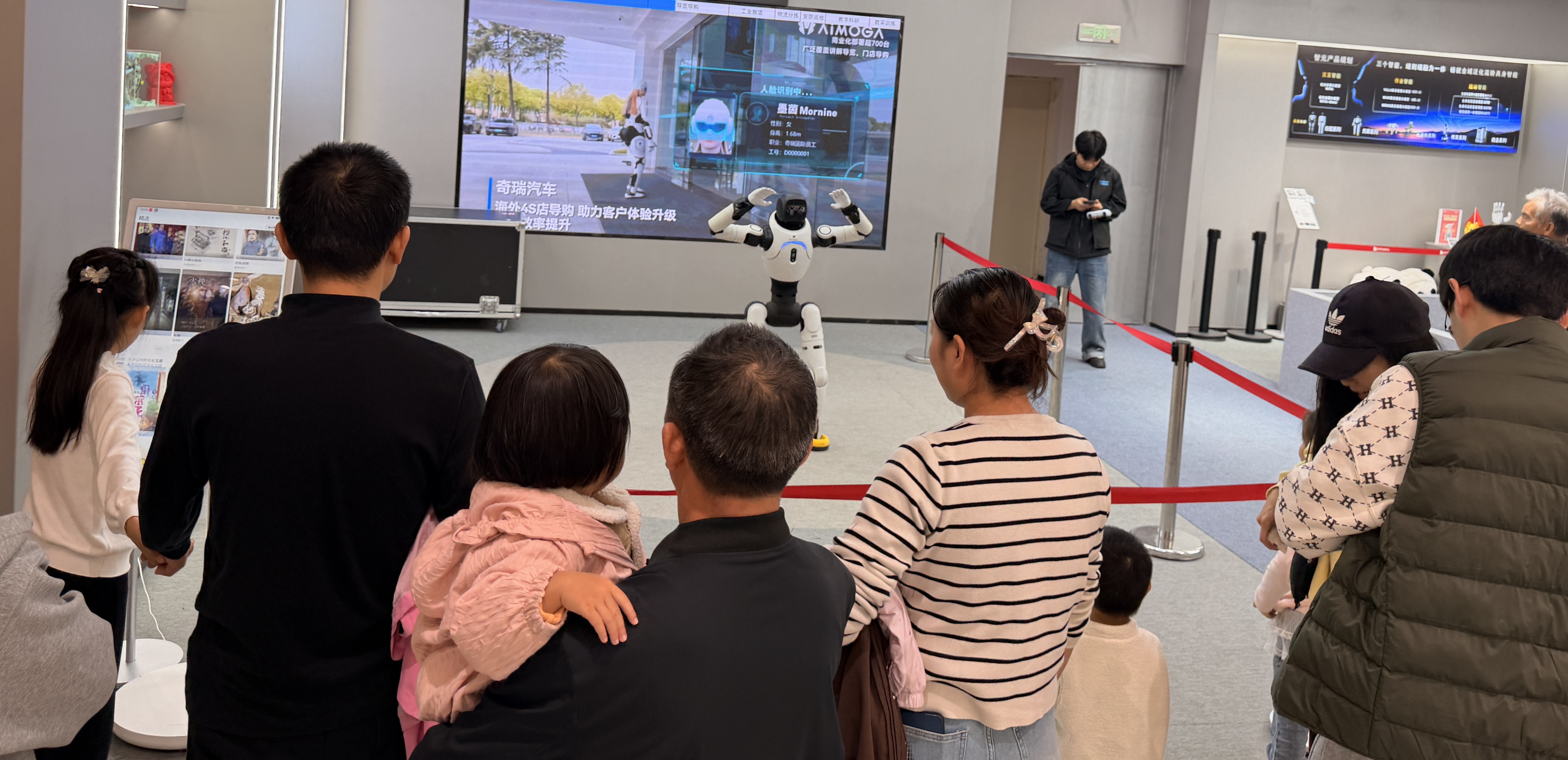
Image source: Jiemian News
For ordinary consumers, whether robots can provide practical value is still the first consideration before purchase.
A customer bluntly stated when talking about his purchase intention to Jiemian News, "I don't need this thing." The customer also said that robots such as companion and care robots are targeted at different groups of people, and different products should correspond to different target customers. It is not appropriate to regard all onlookers in shopping malls as potential buyers.
Yu Yiran also believes that at present, high-priced general-purpose humanoid robots are still difficult to stably complete complex housework such as folding clothes, cooking and care, and the price and after-sales maintenance also restrict individual purchases. In contrast, consumer-grade robotic dogs, desktop companion robots and educational programming products have relatively low purchase thresholds, and are more likely to form a personal consumer market first.
This is also the reason why it is difficult for robots to directly replicate the retail model of mobile phones and new energy vehicles in shopping malls.
Yu Yiran judged to Jiemian News that in the next three to five years, general-purpose robots will still find it difficult to directly replicate the offline retail path of 3C products and new energy vehicles. Mobile phones are high-frequency consumer electronic products, new energy vehicles can meet the daily travel needs of families, while for ordinary families, general-purpose humanoid robots still lack clear purchase necessity at present.
In addition, mobile phones and automobiles have a high degree of product standardization, and a mature sales and after-sales service system has been formed. 3C stores can rely on product turnover and accessory sales, while automobile stores are supported by high customer unit price, finance, maintenance and other income. In contrast, robot products iterate rapidly, and professional personnel are required for adaptation and maintenance. It is difficult for independent stores to cover the rent of shopping malls only by selling complete machines.
Yu Yiran believes that in the future, in addition to improving the actual working ability of robots in family scenarios and reducing product prices, it is also necessary to improve safety certification, after-sales maintenance and insurance services, and establish a clear channel price protection and prototype depreciation sharing mechanism to reduce the operational risks of third-party distributors.
At present, robot stores have gradually entered shopping malls, but under the circumstance that personal consumption demand is not yet mature, it is difficult for third-party distributors to directly replicate the retail model of mobile phones and new energy vehicles. At this stage, the income brought by enterprise procurement, leasing and follow-up services is still an important source to support the operation of stores.
This article is from "Jiemian News", reporter: Xu Meihui, editor: Wen Shuqi, 36Kr is published with authorization.