The smart home industry is eyeing home AI, the super entry portal.
Smart home manufacturers are competing for the daily scheduling authority of home appliances. Air conditioners can cool rooms, lights can illuminate spaces, and there is already a range of machines in households that are used every day. In the past, family members had to tell each of these devices one by one when to turn on and when to turn off. Manufacturers want AI to take over this work, breaking a casual daily remark into actionable tasks that multiple home appliances can execute. Once residents get used to a set of schedules, how many pre-adjusted settings can be retained when they add a new air conditioner or replace a thermostat will directly influence their purchasing choice.
According to 2025 data released by the National Bureau of Statistics of China, the average number of air conditioners per 100 households nationwide reaches 161.8. Both connected smart air conditioners and ordinary units that have been in use for years are included in this stock. Centralizing several air conditioners on a mobile phone can save the trouble of looking for remote controls. The devices, rooms and functions registered in the system can help users quickly locate the target air conditioner. To judge whether to turn on the unit, the system also needs to refer to the current temperature of the room, whether there are people staying inside, and how the family members adjusted the device just now.
Confirm room temperature after adjusting the air conditioner
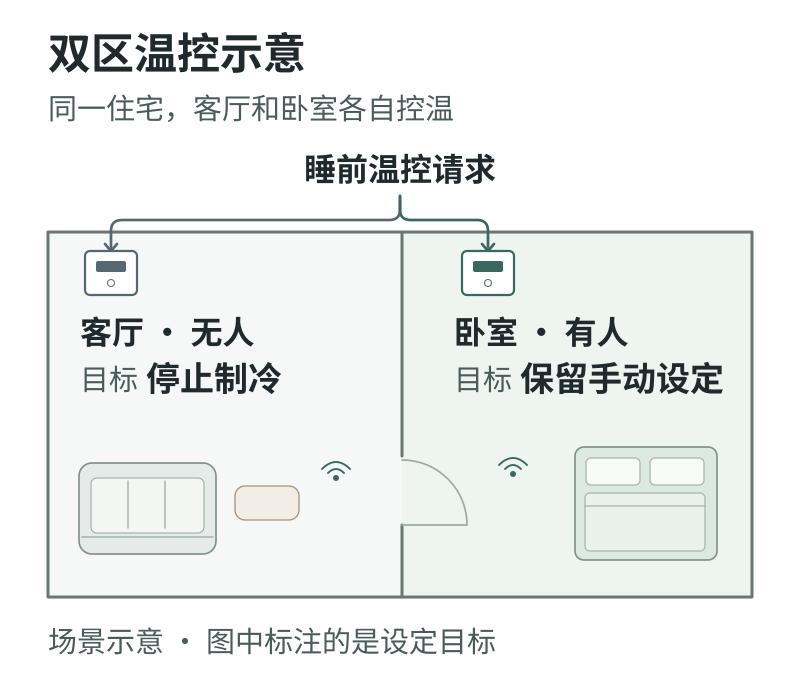
Imagine a house that can independently adjust the temperature of the living room and bedroom, where both rooms can report the temperature and detect human activity. At night, when the living room is empty and there are still people in the bedroom, the family has just adjusted the bedroom to a comfortable temperature. If someone asks AI to set up the temperature arrangement before going to bed, the cooling in the living room can be turned off, while the bedroom continues to operate at the manually set temperature. The resident only gives a verbal instruction, and the assistant needs to judge which settings to modify and which to retain, then find the corresponding devices to execute the commands.
Google opened the early access of the English version of Google Home MCP in the US this September, with eligibility requirements including premium subscriptions, approved cloud projects and compatible assistants. After authorization, the assistant can access the connected rooms, devices and their open capabilities. Google classifies temperature measurement and thermostat control as separate features. Sensors can report the bedroom temperature, but whether the room temperature can be adjusted depends on the functions provided by the thermostat side. If the air conditioner in the living room only exposes the on/off switch, the assistant can send a shutdown command. After that, the system needs to check both the status reported by the air conditioner itself and where the temperature reading comes from.
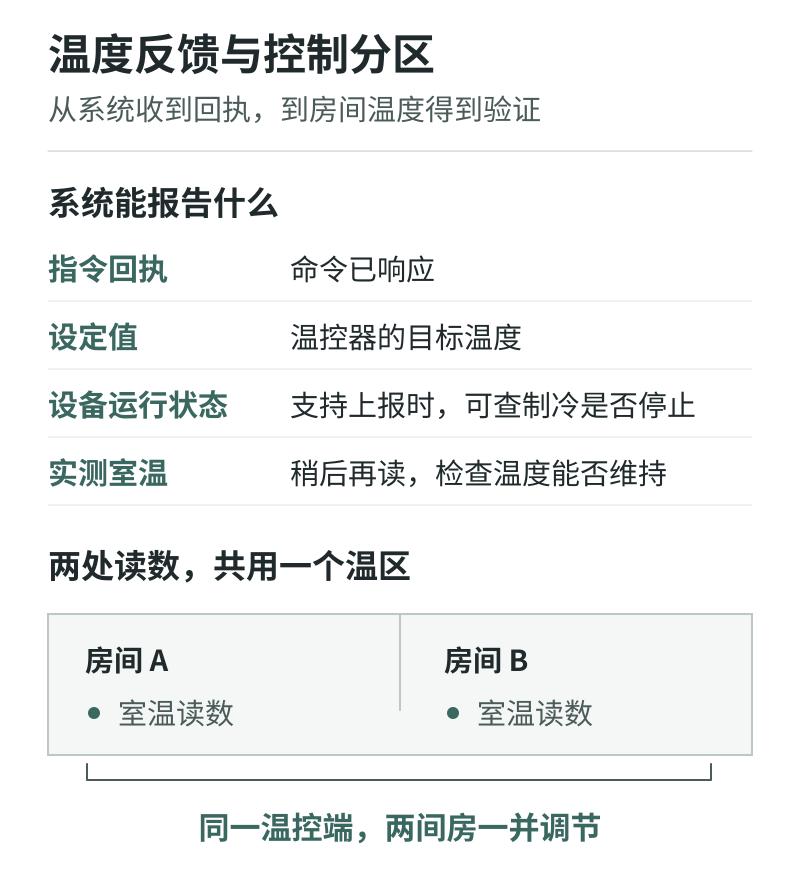
When the shutdown command gets a response, the assistant first confirms that its request has been received. Whether the cooling in the living room has actually stopped still depends on whether the device reports the actual operating status. The situation in the bedroom adds an extra layer of complexity. The set value on the thermostat is the target temperature it needs to maintain, while the sensor reads the current actual temperature of the room. In a short period of time, these two values may differ significantly. To confirm whether the temperature that the family wants to keep has been maintained, the system needs to wait for a while and then check the valid temperature reading. When the bedroom sensor goes offline, the original manual setting can be retained, and the assistant needs to inform the resident that it cannot confirm the room temperature temporarily.
Some residences have two temperature reading points, and both heating and cooling are managed by the same temperature zone. Installing one sensor in the living room and one in the bedroom allows the system to obtain data of one more room than using a single sensor. If the two rooms share a set of start-stop commands, the issued command will affect both rooms at the same time. The coverage of independent control for this set of equipment must be clarified during installation, so that the control terminal can know which requirements can be fulfilled later. To stop cooling in the living room while keeping the bedroom cooling as usual, additional arrangements are required for houses that only have one unified temperature regulation zone.
When the residential conditions are fully met, some actions can be executed before the family members speak. In the home accessory series announced by Apple in October, thermostats from LG and Schneider support the adaptive temperature function of the Home app. Apple introduces that this function leverages on-device intelligence on iPhone to judge usage states such as being at home, before going to bed and leaving home, then adjust the settings of supported thermostats. These two thermostat models are targeted at the US and Canadian markets. Once the machine acts automatically according to the work and rest schedule in advance, it will encounter situations where someone changes their mind temporarily at night.
The temperature just adjusted by family members must take priority
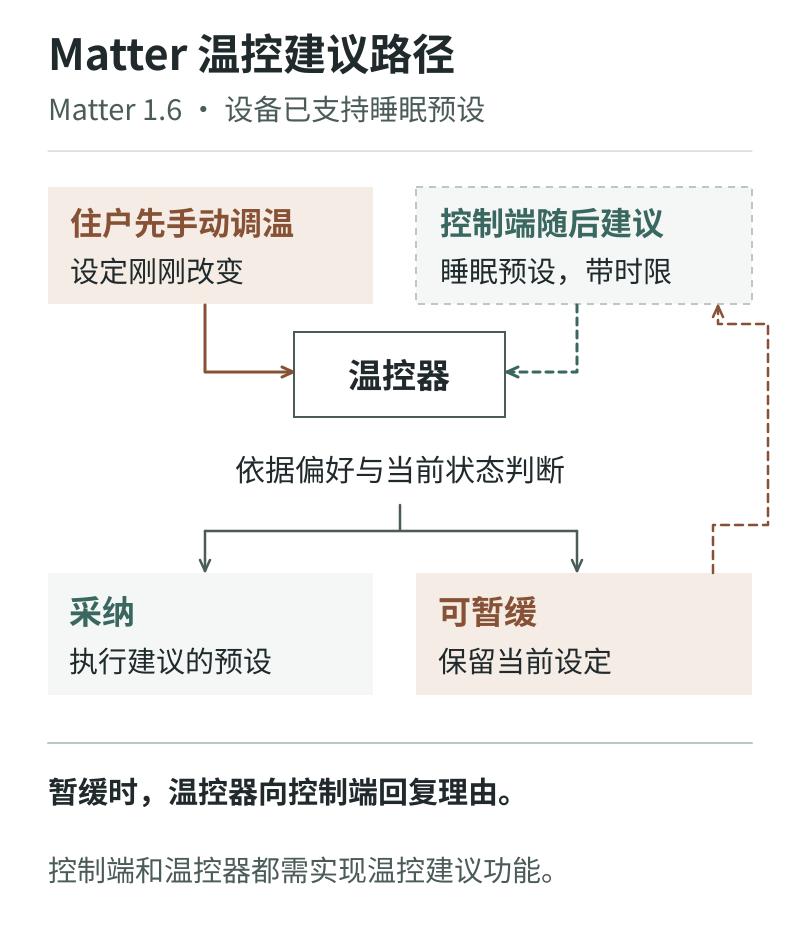
Right after the family finishes adjusting the bedroom temperature, the sleep schedule of another platform may also reach its trigger time, and both platforms end up targeting the same thermostat. The Matter 1.6 standard released in June adds a new type of unified network. After the thermostat joins the shared network, all control terminals authorized by the resident can find and manage it, so residents can reduce unnecessary pairing operations. As for which temperature setting to follow, different platforms still manage their own schedules separately. If two settings are sent one after another, the later one may overwrite the temperature value that the family just modified.
The same version of the standard also defines thermostat suggestions. The controller can send a time-limited suggestion to ask the device to enable the existing sleep preset. The thermostat decides whether to accept the suggestion based on the current status and user preferences. If the family member has just adjusted the setting on the wall, the thermostat can postpone the execution and tell the controller the reason. After receiving this response, the control terminal can end this attempt. Only when both ends implement this function and the transmitted instruction is a thermostat suggestion, can the thermostat judge the operation according to this mechanism.
Platforms will also determine which operations can be delegated to the assistant during device access. For example, Google Home MCP opens the locking permission for compatible door locks, while the unlocking function is not included in this authorization scope. For devices shared by all family members, Google advises integrators to inform co-residents in advance that the assistant will access home data and operate the devices. If a resident decides to stay in the living room for one extra night temporarily, they usually only need to modify the schedule once. To terminate the assistant's long-term access permission to home devices, the user who activated the service can revoke the authorization through the app or Google account. These two types of operations affect different time ranges and scopes, and the settings on the platform need to be clearly visible to all family members.
Short-term scheduling of a large number of household air conditioners has already become a practical business for some power companies. The grid demand response program of Southern California Edison allows eligible residents to sign up with their own connected thermostats. When the grid initiates a power consumption regulation event, the service provider can temporarily raise the cooling setpoint to make the air conditioner run for a shorter period of time. The program encourages residents to participate through electricity bill credits. In the evaluation commissioned by the power company, a three-hour test held on August 21, 2025 actually scheduled about 9,000 households. Taking non-scheduled participants as the control group, the report estimates that the average power consumption per household in the scheduling group decreased by 0.92 kilowatts. The power company cares about how much load can be reduced during the event period, while family members can still manually adjust the temperature back.
When switching to a new App, old home devices need to be compatible
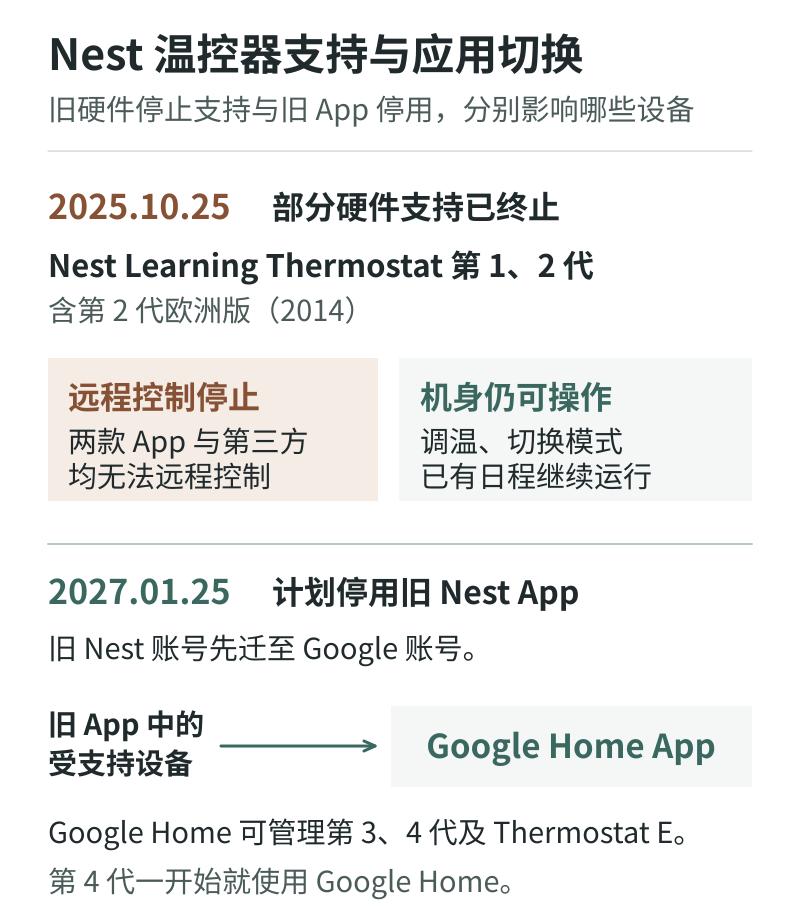
A thermostat installed on the wall may have a longer service life than the cloud service that controls it. Starting from October 25, 2025, the 1st-generation and 2nd-generation Nest Learning Thermostat ended support, including the 2nd-generation European version released in 2014. These models are no longer supported by the Nest and Google Home App, and remote temperature adjustment, status checking and third-party control functions on mobile phones are disabled accordingly. The manual operation on the device itself and existing schedules can still work. At that time, Google provided eligible users in the US and Canada with a limited-time discount to purchase the 4th-generation thermostat. If residents want to continue remote temperature adjustment in the original way, they have to reconsider which device to install on the wall.
Google plans to discontinue the old Nest App on January 25, 2027. This time, the 3rd-generation Nest Learning Thermostat and Nest Thermostat E that were originally managed through the old App are still within the support scope. Residents who still use old Nest accounts need to associate their accounts with Google accounts first, so that the thermostats can appear in Google Home, and the schedules and main settings can continue to be used. The 4th-generation thermostat has been set up in Google Home from the very beginning. For residents who have completed account migration, the supported thermostat originally placed in the room remains the same, only the access entrance changes, and the device can continue to be used.
When the thermostat on the wall breaks down and is replaced with a new unit, there are still follow-up operations after wiring. Google's instructions for professional installation users of the 4th-generation thermostat divide the process into two steps. The installer first configures the connection relationship between the thermostat and the heating and cooling equipment, then the resident adds the new device to their home system, connects it to the wireless network, and sets the desired temperature and schedules for at-home and away-from-home states. From the perspective of the home automation platform Home Assistant, the same room can retain its original name, but the device ID recorded under the platform has changed. If the rule is directly triggered by the old device, it will still try to access the old device after the old unit is removed, so the trigger object needs to be reselected.
Home Assistant also allows users to set the target of temperature adjustment actions to a specific room, and the action will be sent to all supported thermostat devices in that room. If the original rule was set to lower the bedroom temperature before going to bed, and the newly replaced device supports this original action, after installation, assign the new device to the original bedroom, and this action can continue to work. If the rule is still triggered by a specific status of the old thermostat, the person in charge of delivery still needs to confirm whether the trigger condition can be recreated with the new device. Run the original pre-sleep rule on site, so that residents can confirm which settings have been restored on the new device.
Even when the device is working normally, the home network may be temporarily disconnected. In the version released on October 16, Xiaomi's Miloco for developers allows supported devices to be controlled preferentially through the local hub, and rules can also be triggered by status changes actively reported by devices. The project document specifies that main perception tasks and agent judgment are handled by cloud models. When the external network is disconnected but the local area network at home is still connected, and devices and rules can be executed locally, some pre-set tasks can continue to run. The temperature adjustment actions that originally required judgment by the cloud model will be suspended. If the device retains local control functions, residents can adjust the temperature manually first. If someone modified the temperature before the network recovers, the system that takes over the control again needs to read the current setting first, so as to decide whether to continue the original arrangement.
Home appliance ecosystems will drive business in installation and after-sales services
Installing a thermostat in a house for the first time also incurs costs beyond software. The Atmospheric Fund of Canada included four old apartment buildings in the Greater Toronto and Hamilton Area into the heating renovation pilot project. Residents could not individually adjust the indoor heating before, and the project installed more than 700 thermostats in total for the four buildings, and added control valves to the radiators at the same time, so that the thermostats can adjust the heating output. According to the fund's review report, the valve renovation cost accounts for 70% to 75% of the total cost of indoor temperature control equipment and installation in this pilot project. The buildings also upgraded other heating equipment in the same period.
After the devices are installed, some users still do not understand how to modify the temperature or schedules. The post-renovation questionnaire covered about 16% of residents in the four buildings, and property staff, the project team and device manufacturers arranged information sessions and one-on-one Q&A support. The actual temperature in some apartments was once higher than the upper limit set on the thermostat. The radiators continued to dissipate heat after the valves were closed, and the project team also found thermostats with incorrectly configured parameters. By matching the readings with the machine status, staff can figure out whether the room cools down slowly or the device was not set correctly from the beginning. After testing during delivery, staff may still need to return to adjust the settings after residents start using the devices.
Midea includes this period of adjustment into its whole-house smart delivery service. The company launched the home intelligent agent MevoX this March, and later launched the M-Smart platform. According to a November report by Cover News, Wang Hui, Minister of User Service Business Support Department of Midea China Region, said that the company provides one free optimization service within three months after the delivery of whole-house smart systems. Midea's interim report also includes design, construction and acceptance into the service process of offline stores. After home appliances are connected to the app, residents still need to be clearly informed of which specific sensor is responsible for the bedroom, and whether the bedtime should be delayed. Only after the resident has stayed in that bedroom for several nights can the settings be adjusted to fit the actual daily routine. The platform can save these modifications, and when there are incorrectly configured devices or misconnected temperature zones on site, there must be personnel who can correct these errors.
When the bedroom air conditioner really needs to be replaced, family members will check how many of the pre-set schedules can still be used. If these settings can be migrated to the new device, residents will save the trouble of re-debugging. If different brands can all support the original settings, residents will have more device models to choose from. For home appliance manufacturers, only when users get used to the whole set of devices in the house, can they have the opportunity to generate follow-up business based on these existing settings.
This article is from the WeChat official account "Feng Wei Feng Dabai", author: Feng Dabai, published by 36Kr with authorization.