Wherever Alibaba has demands, Jack Ma will be there, and this time it's T-Head's turn.
By | Sun Rui
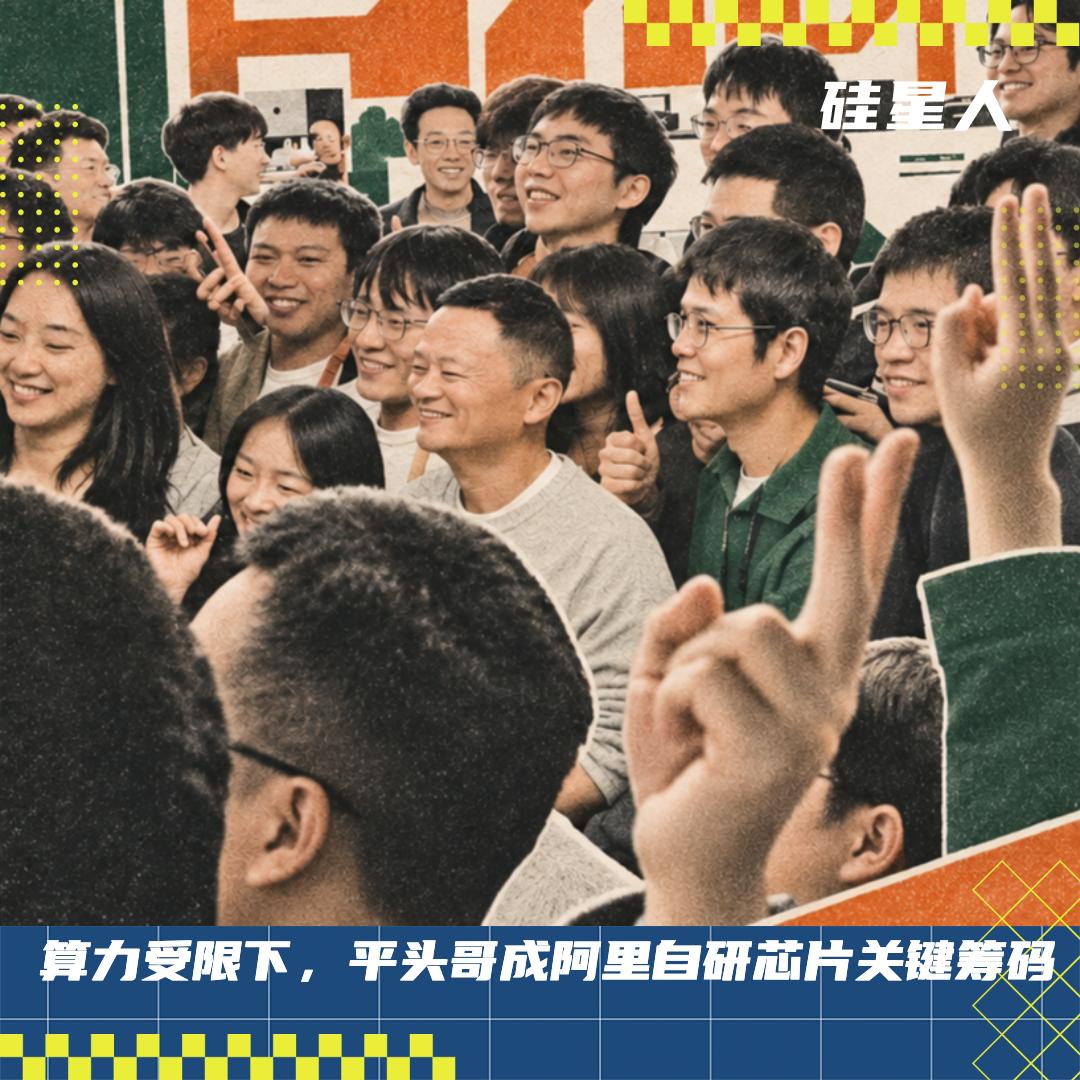
On November 26, Jack Ma showed up at the office area of T-Head. Wearing a gray sweater and giving a thumbs-up, he stood among a group of young chip engineers and smiled for a group photo. Some employees posted on social platforms and sighed: "I have been at T-Head for 7 years, and today I finally get to see the real Mr. Ma in person."
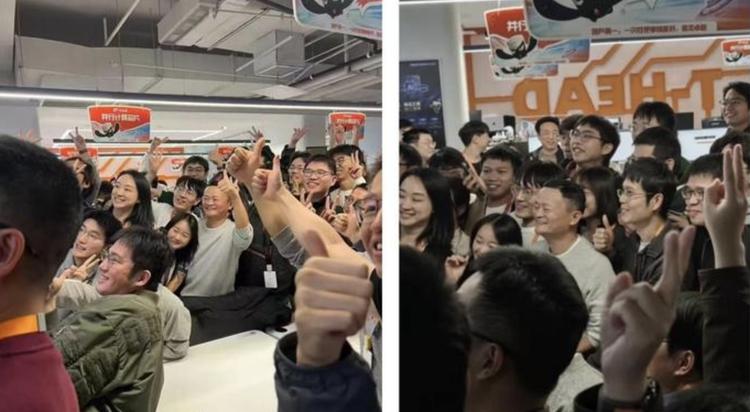
After stepping down from his positions for many years, Jack Ma rarely appears in Alibaba's specific business teams, but every one of his public appearances in the past two years has almost coincided with the node of Alibaba's strategic focus shift. Last April, he showed up at the Alibaba Cloud Yungu Park to deliver a speech, right after Alibaba announced that it would invest over 380 billion yuan in three years to build cloud and AI hardware infrastructure, making AI and cloud the main growth engine of the group; this Spring Festival, he appeared at the Tongyi Qianwen project team, which corresponded to the 3 billion yuan investment of Tongyi Qianwen in launching the "Spring Festival Treat Plan", covering the title sponsorship of four major TV station Spring Festival Galas, and expanding its business to C-end traffic entrances.
This time, it's T-Head's turn.
It has just been two weeks since Alibaba officially announced the spin-off of T-Head for independent listing in Hong Kong, and one week since Alibaba CEO Wu Yongming introduced its self-developed chip business at an unusual length at the earnings call. At this point in time, the founder showed up. For T-Head and Alibaba, at a time when external computing power access is almost completely locked, internal large model iteration is in urgent need of support, and the capital market is eager to reprice Alibaba, this "honey badger" that has been nurtured for eight years has been pushed to the forefront of the entire group.
1
Chip Shortage and Valuation
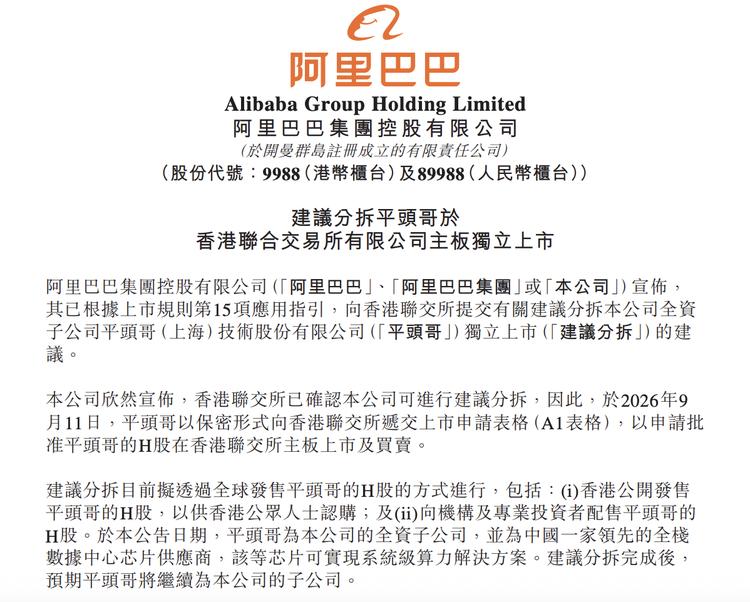
On November 10, Alibaba issued an announcement to promote the spin-off of T-Head for listing on the Main Board of the Hong Kong Stock Exchange, and disclosed that T-Head had confidentially submitted its listing application to the Hong Kong Stock Exchange as early as September 11. Market rumors say that the IPO fundraising scale this time is between 2 billion and 3 billion US dollars, with the target of landing on the Hong Kong stock market next year, and T-Head will remain an Alibaba-controlled subsidiary after the spin-off.
What is more interesting is the valuation calculation given by Wall Street investment banks: JPMorgan Chase gives T-Head an independent valuation range of 25 billion to 62 billion US dollars, while BofA Securities widens the range to 30 billion to 75 billion US dollars. The difference between the highest and lowest values is nearly three times, which is equivalent to 12% to 30% of Alibaba's current total market capitalization.
When a mature tech giant spins off its assets, such a drastic valuation divergence rarely occurs. The core of the disagreement lies in how the outside world views T-Head, and how to price Alibaba next.
If we examine it from the logic of "the internal hardware department of Alibaba Cloud", it is just a cost center that highly relies on related transactions with its parent company, and only deserves a discounted valuation for hardware; but if it can prove that it is the real "second pole of domestic AI computing power", referring to the premium the secondary market gives to domestic computing power targets, it can not only support a market value of hundreds of billions of Hong Kong dollars on its own, but also directly rewrite the market's assessment of Alibaba Cloud's profit margin and Alibaba's AI autonomy.
What really further pushes T-Head to become a "must-have option" for Alibaba at this moment is the suddenly tightened external chip containment.
Over the past four years, major Chinese manufacturers have more or less retained some buffer paths when responding to US chip export controls, either purchasing NVIDIA's compliant reduced-spec chips, or remotely renting advanced computing power through overseas data centers. But recently, with the rapid unfolding of Jensen Huang's farce, these two doors have almost been closed at the same time.
The US Department of Commerce has issued new regulations that directly block Chinese enterprises from remotely calling overseas advanced AI chips — as long as overseas data centers provide Chinese customers with services exceeding the equivalent computing power of about 750 H100 chips, they must apply for a license. At NVIDIA's earnings call on November 17, the then acting CEO Colette Kress also confirmed that NVIDIA has completely stopped shipping Hopper architecture data center chips including H200 to the Chinese mainland, and completely cleared the relevant expected revenue in the Chinese region.
According to the latest disclosure by The Information on November 25, many major Chinese model manufacturers clearly stated at recent internal all-hands meetings that they will accelerate the adoption of domestic chips, and some model manufacturers specifically mentioned that they will use more AI chips from Huawei and Alibaba.
This is exactly the background that Wu Yongming repeatedly mentioned T-Head at Alibaba's earnings conference on November 19. Wu Yongming said bluntly at the earnings conference that 2027 and 2028 are expected to be the two years with the most severe shortage of domestic computing power; at present, Tongyi Qianwen has trained the next generation of models based on T-Head chips, and Alibaba Cloud Bailian has also provided inference services based on domestic chips. Alibaba plans to prioritize its self-developed flagship chips to guarantee the supply for large model training.
T-Head is very important to Alibaba today. Internally, the subsequent model training largely depends on whether T-Head's chips can meet the demand; externally, Alibaba's market value narrative in the next few years also depends on whether this chip asset can gain a firm foothold in the Hong Kong stock market.
2
T-Head: A Typical Alibaba-style "Tech Obsession" Story
Looking at it over a longer period, the birth and evolution of T-Head is a very typical Alibaba-style story. Just like Wang Jian insisted on developing Alibaba Cloud in 2009 despite internal doubts that he was a "liar", and Jack Ma approved the investment of hundreds of billions to establish Damo Academy in 2017, Alibaba has long had an obsession in its prosperous period: it does not want to be just an e-commerce company, but to become a real hard technology company. This obsession made it make many heavy investment decisions in the early stage that seemed financially unclear and faced great internal disputes at that time, but eight years later, these decisions have become life-saving strategic moves.
At the Yunqi Conference in September 2018, Alibaba integrated C-Sky, a domestic CPU IP company it acquired wholly, and the chip team of Damo Academy, to officially establish T-Head. Jack Ma personally approved the name, taking the meaning of the African honey badger: "never admit defeat, dare to gnaw at hard bones".
The external environment at that time was not as extreme as it is today. Alibaba's original intention of developing self-owned chips was more to digest the massive search and recommendation traffic of Taobao and Tmall, the peak traffic of Double 11, and the computing power cost brought by the expansion of Alibaba Cloud. But the doubts from the outside world have never stopped since the first day: an Internet company that makes money from traffic and transaction commissions, stepping into the semiconductor industry where the cycle often lasts five or six years and a single tape-out costs tens of millions of dollars, is it really doing technology or just creating a capital concept?
T-Head got off to a pretty good start in its first four years. It launched the Xuan Tie 910 processor IP and the Hanguang 800 AI inference chip in 2019. The former became a benchmark for China's RISC-V open source ecosystem, while the latter was deployed in Taobao Search and Pailitao, setting a record for inference performance at that time; in 2021, it released the Yitian 710 server CPU based on the Arm architecture with 5nm process, which was massively deployed in Alibaba Cloud data centers and actually undertook the cloud-native and video codec workload; in 2023, it launched the enterprise-level SSD master control chip Zhenyue 510, and began to transform the underlying storage.
But then the challenges came, between 2022 and 2023, it ushered in the most difficult low ebb period since its establishment.
First, there is the generational challenge of the technical route. Although the Hanguang 800 has extremely high theoretical inference scores on paper, it is essentially a dedicated inference ASIC chip designed for the CNN (Convolutional Neural Network) vision era. After 2020, when the Transformer architecture dominated the whole industry and large models shifted the computing power demand from "dedicated small model inference" to "general training of ten-thousand-card clusters", the architecture of Hanguang 800 was completely insufficient. At the same time, with the escalation of US export controls at the end of 2022 and the restricted authorization of Arm's high-end Neoverse architecture, advanced process server CPUs like Yitian 710 suddenly faced the problem of overseas foundry supply interruption.
At the same time, Alibaba's internal cost reduction and efficiency improvement and organizational turbulence also directly affected T-Head. When the high growth of the Internet peaked, departments like chips that only spend money without making profits all year round inevitably stood under the spotlight of review. In 2023, Alibaba launched the largest organizational reform in its history, the "1+6+N" reform, emphasizing that each business should independently face the market and be responsible for its own profits and losses. T-Head then underwent drastic adjustments. The Xuan Tie and RISC-V ecosystem teams were transferred to Damo Academy, Meng Jianyi, the founding vice president of T-Head who came from C-Sky, once left the company; the outside world has been spreading rumors of shrinking chip business and layoffs, and people generally suspected that T-Head would eventually degenerate into an internal hardware group that only customized network cards and master control chips for Alibaba Cloud.
It was also during this period that T-Head internally approved the Zhenwu series PPU (Parallel Processing Unit) for general parallel computing, and began to grit its teeth to redevelop the large chips required for large models.
By 2025, the changes in the entire external environment made this general-purpose computing chip extremely valuable. When Zhenwu 810E was officially unveiled on the official website in early 2026, IDC data showed that in China's AI accelerator card market in 2025, Huawei Ascend ranked first with 812,000 units shipped, and T-Head took the second place among domestic manufacturers with 265,000 units. According to Alibaba's data, as of the first half of this year, the cumulative shipment of the Zhenwu series has reached 560,000 units, with annualized revenue exceeding 10 billion yuan, serving more than 650 enterprise customers.
It, together with Tongyi Lab and Alibaba Cloud, began to be called the "Tong-Yun-Ge" iron triangle.
3
Under Process Constraints, the Bet is Placed on System Engineering
So, what is the actual technical level of T-Head?
At present, the global AI large computing power chips are mainly divided into two schools. One is the GPGPU (General Purpose Parallel Computing Architecture) represented by NVIDIA, which has extremely strong versatility and deep software ecological barriers, but the hardware overhead of the chip is large; the other is the DSA/ASIC (Domain Specific Architecture) represented by Google TPU, which is extremely cost-effective for running its own specific models through extreme optimization for matrix multiplication, but has weak flexibility and high migration threshold for external customers.
After suffering from the disadvantage of "inflexible dedicated architecture" on Hanguang 800, T-Head has taken a very pragmatic self-developed parallel architecture route similar to GPGPU on the Zhenwu PPU.
It tries to fully self-develop the underlying computing core and inter-chip interconnection, but on the upper software stack (PPU SDK and PCCL communication library), it is fully compatible with the mainstream AI ecosystem, provides unified API, and focuses on "zero code modification for business migration". That means it hopes that the PyTorch training code originally written by car companies and large model companies in NVIDIA's CUDA environment can be directly migrated to the Zhenwu cluster for operation almost without major modifications.
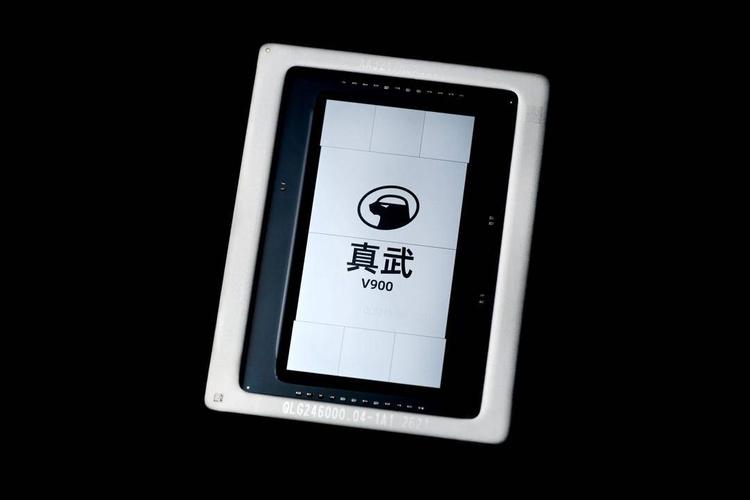
In terms of single-card performance, according to previous reports, the overall performance of Zhenwu 810E is equivalent to the special version of H20. The overall level of Zhenwu M890 has roughly reached the threshold of NVIDIA H100; Zhenwu V900, released at the Yunqi Conference in September this year, is expected to be mass-produced in the first quarter of 2027, equipped with 216GB of super large video memory, with inter-chip interconnection bandwidth up to 1200GB/s, the nominal single-card performance is 3 times higher than that of M890, and the development of the next-generation J900 has also been launched to promote the supply chain.
But the gap is still obvious. NVIDIA has now entered the stage of large-scale delivery of the Blackwell architecture, and the next-generation Vera Rubin is ready to go. There is still an objective generational gap of one to two generations between domestic chips and the world's top level. Especially under the premise that external advanced lithography processes are almost frozen, no domestic chip can work magic by relying on the transistor density of a single wafer.
In this regard, T-Head's idea is essentially to use system engineering and full-stack collaboration to make up for the disadvantage of single-card process. It uses super large video memory to break through the "memory wall", and by painstakingly developing inter-chip interconnection and "computing-storage-network" super nodes, to connect into a "super large chip". T-Head has self-developed the ICN inter-chip interconnection bus protocol and ICN Switch switching chip similar to NVIDIA NVLink, which supports unified memory addressing, and realizes full-bandwidth symmetric interconnection within the 1000-card Scale-Up domain. It is said that this work has also received close attention from NVIDIA. In addition, it also has self-developed Zhenyue SSD storage master control, Panmai smart network card, and plans to launch the Yitian 730 server CPU with fully self-developed micro-architecture next year.
In today's competitive landscape, T-Head is theoretically one of the few players in China that has truly achieved the closed loop of "open source models + first-tier public cloud + self-developed full-stack chips", which will become extremely valuable in the large domestic computing power gap from 2027 to 2028. Next, for Alibaba, T-Head will be a very critical business. It seems that Jack Ma may appear in T-Head's office area more than once, and T-Head's employees will see Jack Ma more often.
Click the "heart" icon before you leave~