As the dust settles on the Double 11 shopping spree, why has it become even harder for AI hardware to make its way into the shopping carts of the general public?
AI workstations priced at tens of thousands of yuan, smart glasses costing thousands of yuan, as well as smart water cups, portable recording cards, and companion toys.
These products, which differ greatly in price, form and application scenario, all appeared on the same major promotion performance sheet during the just-concluded Double 11 Shopping Festival. Each of them responds to different daily life demands, but they are all included in this consumption boom as they share the same technical prefix.
As of November 11, JD sold more than 50 million AI products throughout the full-cycle promotion, and the transaction volume of multiple trending categories including AIPC, AI glasses and AI recording devices doubled year on year. According to Syntun Data, the cross-platform e-commerce sales across the whole network increased by 4.8% year on year. Against the backdrop of slight overall market growth, the doubling growth of AI hardware is particularly noticeable. Even with different statistical calibers, the 50 million units are far from all AI hardware, but this increasingly rich product portfolio is enough to prove that changes are taking place.
A year ago, the most eye-catching story in this industry still took place in the capital market. In the first half of 2025, 114 investment and financing events were recorded in the domestic embodied intelligence and AI hardware sector, with the total amount exceeding 14.5 billion yuan. Investors were betting on the possibility of the next-generation terminals. Today, those technical visions that once relied on PPT and roadshow documents have already turned into heavy parcels in logistics vehicles.
However, it is obviously overly optimistic to regard Double 11 as the watershed for the full maturity of AI hardware.
After the parcels are unpacked, the fates of these products begin to diverge: some consumers repurchase a familiar product because of its AI features, some put it on the shelf after impulsive consumption, and some silently click the return button after the novelty fades away.
New technologies are always born in imagination, but are destined to be tested in specific reality. The shopping cart is honest and cruel, where people place orders and also change their minds. Through these parcels, what we really need to explore is: when AI hardware evolves from products created by technology to commodities that the market is truly willing to buy, use and continuously operate, what changes are taking place in real demand, product supply and business reality?
Hello, this is "AI Trend Watch".
No matter how surging the tide of technology is, it will eventually carve specific gullies on the riverbed of daily life.
The expansion of consumption boundaries and the buyer's market with fading filter
The growth of AI hardware is spreading from a small number of high-profile emerging technology terminals to a wider range of life scenarios. During the 2025 Double 11, the main growth drivers of the market were still traditional form smart devices such as AI tablets and large-screen AI mobile phones. But this year, JD's performance report saw the explosion of more segmented devices: AI recording devices increased by more than 200%, AI smart water cups increased by more than 5 times, and the transaction volume of AI toys increased by 150% year on year. From work to life, from sports to entertainment, a continuously extending consumption spectrum is taking shape.
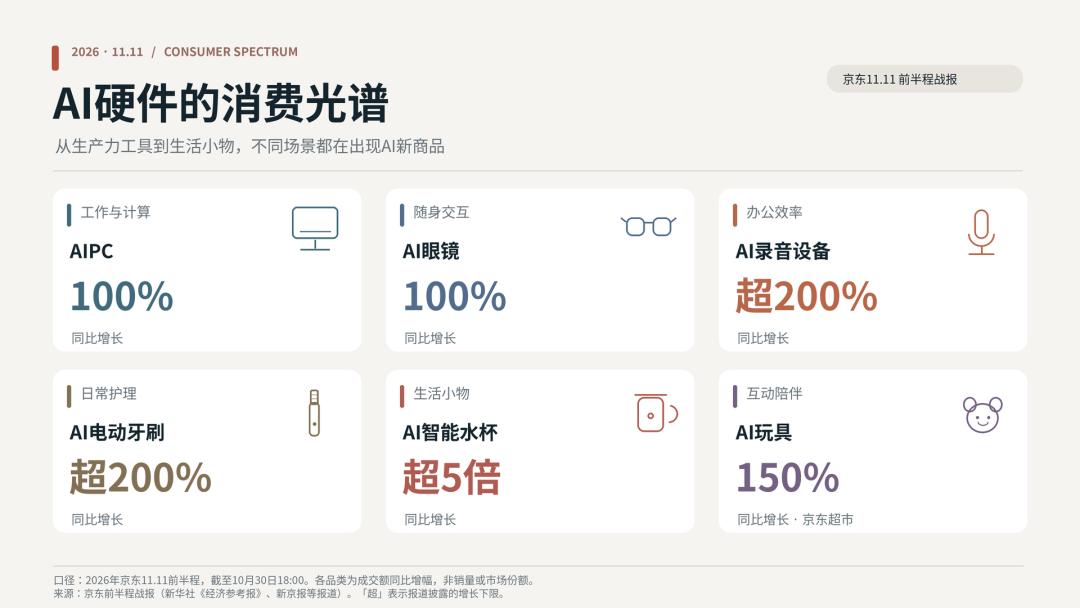
Behind this expansion is the sharp drop in the cost of trying new products and the expansion of user groups. Take the most concerned smart glasses as an example. During this year's Double 11, this category was included in the national home appliance trade-in subsidy scope for the first time. At the same time, the maturity of no-brand supply chain has pushed the price of some products down to the hundred-yuan range. Data from Runto Technology shows that smart glasses priced below 300 yuan have captured about 17% of the online market share. The performance of leading brands also confirms the generalization of audiences. According to the disclosure from RayNeo to AI Trend Watch, its total platform transaction volume exceeded 100 million yuan in this Double 11, with a market share of 37.2%, and it has ranked first in the category sales for 5 consecutive years. This year, its consumer group is obviously no longer limited to digital geeks, but extends to a broader mass group.
RayNeo's performance report provides the public with an observation sample: when the purchase cost of a piece of AI hardware drops from an expense that requires careful consideration to a one-click order, the resistance for it to enter the public shopping cart disappears completely.
But this does not mean that consumers are blindly paying for technology. Data released by CNNIC in September this year shows that the number of generative AI users in China has exceeded 700 million, with a penetration rate of over 50%. The public is no longer unfamiliar with AI, and the filter that products labeled with AI tags can trigger a buying spree as it did two years ago has failed. Consumers may be attracted by the novel features of AI, but this is no longer a sufficient reason for them to pay.
Wu Jianjun, head of Qwen AI Hardware, pointed out that "the market no longer pays for vague AI functions, but pays for specific scenario value."
In fact, this batch of AI hardware is a rare consumer product in the history of technology whose capabilities are born before demand. When personal computers and smartphones were first launched, their purposes for communication and office work were clear. But this generation of AI hardware usually comes with strong underlying computing power to find landing scenarios.
Therefore, there is no inevitable positive proportional relationship between the technical complexity of products and the price consumers are willing to pay.
The stratification of consumers' purchase motivation is extremely obvious. Some people buy efficiency tools, such as choosing AI recording cards to solve the pain of sorting out long meeting minutes; some people buy new interactive experiences, such as buying smart audio glasses so that they can listen to songs and navigate without taking out their mobile phones when cycling; others buy emotional feedback, such as choosing AI toys or sleep assistance devices that support voice interaction.
The complexity of consumer demand is sometimes reflected in the fact that the purchaser and the user are not the same person. Li Chongxuan, operation manager of Cansumer Technology, mentioned in an interview with AI Trend Watch that an important group of purchasers of consumer-grade assisted exoskeletons are children who buy the equipment for their parents. Compared with assistance parameters, they pay more attention to safety and whether there are professionals to provide follow-up professional services.
"To sum up in two words, it is peace of mind."
A low-end device that only solves small trivial troubles in daily life can also get a clear purchase reason as long as it accurately grasps the pain point; on the contrary, an expensive device stacked with multimodal recognition and complex large models will still be neglected by the market if it cannot correspond to specific daily demands.
Technical advancement is only one of the many evaluation criteria. What really drives the transaction is the deterministic compensation provided by the product in terms of efficiency, experience or emotion.
In addition, we need to objectively separate the real increment behind the data. A considerable part of the huge sales volume belongs to the passive upgrade of traditional products. For example, the rise in sales of AI PCs or AI mobile phones is largely because consumers can hardly buy flagship models without AI functions in the regular phone replacement cycle. This part of growth reflects the technical iteration of the supply chain, rather than the new demand entirely stimulated by AI.
The real market increment is concentrated on those independent hardware that replaces the old lifestyle or creates a brand new interactive entry.
The door of the consumer market has indeed been pushed open, but what greets AI hardware is a set of secular standards that are far more complex than laboratory tests.
From technical capability to product definition, the supply side is re-seeking answers
Facing increasingly diverse and pragmatic consumer demands, the innovation paths of hardware manufacturers are clearly diverging.
In the mature 3C and home appliance tracks, AI acts as a lever for old products to seek new growth. Products such as mobile phones, computers and steam ovens have long been trapped in excess performance and stagnant innovation. The intervention of large models allows manufacturers to bypass the involution of underlying hardware parameters, and redefine products through capability allocation instead.
The same device, embedded with different AI exclusive functions, can carry out differentiated marketing for content creators, student groups or business travelers.
However, this improved innovation is facing strict scrutiny. If the AI function only adds a voice assistant menu without bringing substantial experience improvement that conventional software updates cannot provide, it is difficult to support the product premium for a long time.
In contrast, the challenges faced by the emerging AI hardware track are much harsher. New forms such as smart glasses, motion sensors and portable interactive devices must prove their absolute reason for independent existence in the existing smart hardware ecosystem.
Explaining the capability of the multimodal large model as helping users organize messy information or translate foreign languages in real time is only the first step of market education. The more difficult second step is to prove to users that since the applications on smartphones can already complete these tasks perfectly, why do they need to spend extra money to wear a pair of glasses on the bridge of their nose or clip a recording card on their collar?
Even if everyone has a mobile phone with excess performance, in the view of Xu Gao, founder of Plaud, 99.999% of people in reality are not recording. The demand is hidden in places that mobile phones cannot reach, which is the reason for the birth of independent hardware.
The living space of emerging hardware does not lie in how strong its computing power is, but in whether it can occupy the physical position that mobile phones cannot obtain. Glasses occupy the visual input of human's first perspective, wearable devices occupy all-day physical sign perception, and recording peripherals reduce the operation steps in meeting scenarios. This unique perception position, lower interaction resistance and more natural sense of companionship are the moat that prevents new hardware from being swallowed by mobile applications.
For this reason, a rational retreat has begun to appear in the industry in terms of product definition. Li Hongwei, CEO of RayNeo, once gave a striking number: more than 200 new features of smart glasses emerged in the past year, but the long-term user utilization rate is less than 6%. With more and more functions, the daily experience has not really improved.
Software can stack functions infinitely, but physical devices must abide by the strict laws of weight, heat generation, battery life and cost. During this Double 11, this restraint of subtraction is particularly obvious in leading products. Take RayNeo iO with impressive sales as an example. The team retained the core display capability when defining the product, but took the initiative to give up the camera and speaker.
Li Hongwei told AI Trend Watch the trade-off logic behind this decision: giving up the camera, on the one hand, is because there is no multimodal model in the industry that can support killer applications at present, on the other hand, it is to achieve all-day wearing, reduce privacy pressure and power consumption challenges; while giving up the speaker is because in the slender temple of daily myopia glasses, the current technology can hardly balance the contradiction between sound quality (the smallest high-standard speaker needs a diameter of 7mm) and form. RayNeo will further weigh "being able to listen" and "pleasant to hear" in the future.

When AI hardware truly moves into the public's daily use, stacking technologies will instead become a burden on experience. Abandoning unnecessary functions and finding a balance between physical constraints and core scenarios is replacing blind technical stacking, becoming the most advanced product wisdom of hardware manufacturers.
At the same time, the innovation chain of AI hardware is becoming more open. General large models, mature hardware supply chain in the Pearl River Delta, and the draft-style incubation of e-commerce platforms intervening from the front end have enabled more entrepreneurial teams to turn ideas into commodities. JD's Aidol Creation Camp has more than 200 teams participating in innovation and incubation, and the transaction volume of more than 50 new AI hardware products increased by more than 130% month on month in the first half of Double 11. The platform also began to connect technology, supply chain, channels and consumer feedback at an earlier stage.
However, the reduction of some manufacturing thresholds does not mean that business success is easy. When more and more entrepreneurial teams can easily call similar underlying AI capabilities, technology itself is no longer a scarce resource. The factors that determine product competitiveness are further extended to industrial design, cost control, mass production delivery quality and the understanding of real users.
The ancient law of hardware manufacturing has not been subverted by AI. On the contrary, it has become increasingly important in this era.
Strict scrutiny and re-accounting, the rules of the second half of AI hardware
When tens of millions of pieces of AI hardware truly enter the real life of ordinary people, the industry has ushered in the most real and cruel test.
The coexistence of hot sales and returns is the most authentic portrayal of the current AI hardware market. Monitoring data from institutions such as Runto Technology shows that the return rate of some smart glasses on online channels is in a high range of 30% to 70%. In addition, the overall sales of screen-free lightweight AI glasses even declined year on year in the third quarter. The growth and acceptance of different products are diverging, and the first wave of novelty-seeking enthusiasm has begun to be tested by actual experience.
Behind the high return rate is the friction between high expectations and low tolerance in the mass market.
At the moment of purchase, driven by marketing, consumers pay a premium for the imagination of cutting-edge technology, and even have a compensatory psychology of not wanting to be abandoned by the AI era. But when the product is unpacked and worn, they immediately return to the most demanding realists, and subconsciously measure the new device in their hands with the experience of mature mobile phones, earphones and other electronic products.
Manufacturers emphasize the upper limit of AI capabilities at press conferences, while users test the lower limit of hardware experience in daily life.
This expectation gap is extremely specific among multiple returning users contacted by AI Trend Watch. One user originally hoped to use the glasses to record work to-dos and complete translation for going abroad, but actually encountered problems such as uncomfortable wearing and flickering translation subtitles. The AI even mistakenly summarized daily communication as "having a meeting while eating at 4 p.m.". Another user placed an order for the "all-day memory" function, but found that after the device recorded the voiceprint, it still confused his speech with that of his friends.
The functions they really need have precisely become the reason for the final return. As Ye Qingqing, market analyst at IDC China, pointed out, users are willing to pay for freshness, but will not continuously pay for experience shortcomings. Without forming continuous value in experience, user retention will become a bottleneck.
The upper limit of software can never save the lower limit of hardware. Whether it is the ill-fitting frame, poor voiceprint recognition, or a leading AR glasses brand was forced to recall thousands of devices in early November due to hidden dangers of overheated temples, it intuitively proves that the passing line of traditional consumer electronics is completely applied to AI hardware.
But the return data should not be regarded as the death knell of the industry. It is more like the first batch of research reports submitted by the mass market for the current product form. In fact, the above user who returned the product due to immature memory function also mentioned that this trial increased her interest in AI glasses, the experience of open-listening music and cycling navigation was unexpectedly good, and she was still willing to buy again in the future as long as the memory accuracy is improved. Sales prove that the demand is real, and returns honestly point out that the current hardware container cannot perfectly carry these demands.
It is worth noting that the mismatch between online retail and emerging hardware is also amplifying this friction. One returning user said bluntly that due to the lack of offline experience, she would never dare to place an order for such close-fitting equipment that affects the efficiency of life and work without the "7-day no-reason return" as a guarantee.
Leading manufacturers have keenly realized this point and begun to make up for the shortcomings of offline experience and services. Whether it is the trial wearing, optometry and glasses matching of smart glasses, or the professional adaptation and subsequent adjustment of consumer-grade exoskeletons, the industry is using heavier offline contacts to try to smooth the experience gap brought by online retail.