Large Models Flood into Drug R&D: Closed Loops, Physical Bottlenecks and Betting on Validation
Paradigm shifts, tech giants' strategic layout, and rising hot capital: what makes this year's AI narrative different, and what will the newly emerged model giants bring to drug R&D?
The combination of AI and biopharmaceuticals is not a new thing.
Efforts in the industry are mainly centered around a well-known cost rule: a new drug typically takes 10 to 15 years from project initiation to market launch, costing over 2 billion US dollars, while only about one in ten candidate drugs that enter clinical trials can finally reach the market.
With such massive investment, a group of companies established more than a decade ago have applied AI to the front end of the R&D chain and the data, documentation and process management links of the clinical chain.
The former identifies targets from massive data and designs molecules in computers. From locking a target to obtaining a candidate molecule, the traditional approach usually takes 4 to 6 years, while fast AI companies can complete this process in 1 to 2 years. Using AI to sort and match in clinical links, such as medical record data processing, patient screening for enrollment, and trial process management, also aims to shorten the clinical cycle that accounts for most of the investment in drug R&D.
However, the efficiency improvement in a single link has not significantly changed the drug R&D process. The process from post-candidate-molecule animal experiments and human trials to market launch remains long and tortuous. After AI-designed drugs enter Phase II clinical trials, their pass rate has not shown a significant difference compared with traditional drugs. To this day, there is still no drug on the market that is approved for launch with both its target and molecule discovered by AI.
This year, some new trends are emerging in the AI pharmaceutical sector. The moves of tech giants are the most easily observed change. In the past, they mostly provided tools in this field, but now they are one step closer to actual drugs.
Overseas large model companies have begun to directly enter the drug R&D link. Anthropic has acquired computational biology companies and built its own molecular biology laboratories to directly promote self-developed pipelines. At the same time, it has launched a number of vertical life science products and carried out in-depth cooperation with biotech companies. OpenAI has also acquired Orchestra Bio, and cooperated with pharmaceutical companies and cloud laboratories to get more deeply involved in the drug R&D process. External analysis shows that large model companies are reconstructing the drug R&D process with the AI-Native paradigm.
Chinese company ByteDance is also building a more complete link from scientific models to drug pipelines. In June this year, ByteDance split its internal team that had operated for many years into an independent company named Anew Labs, which completed a 290 million US dollar Series A financing in September, and already has preclinical small molecule pipelines in hand.
In addition, the industry's acceptance of AI is also changing this year. Jiang Zhicheng, Vice President of Deep Intelligent Pharma, told Shuzhi Qianxian that last year, whether AI can do clinical trial work was repeatedly questioned in the pharmaceutical industry, but this year, "investors will all say that you are using too little AI in pipeline operation now".
Capital is also pouring into this field at an accelerated pace. A few days ago, Isomorphic, an AI pharmaceutical company spun off from Google Deepmind, completed a 5 billion US dollar Series C financing, just half a year after it completed a 2.1 billion US dollar financing. Overseas, in January, NVIDIA and Eli Lilly announced a joint laboratory with a maximum investment of 1 billion US dollars over 5 years. In China, in the first three quarters of this year, the financing amount in the AI pharmaceutical sector exceeded 150 billion yuan, more than 3 times that of the whole of last year.
In the past few months, discussions about large models swallowing the Robotics sector have been endless. Now the same question arises in the AI pharmaceutical field: what is the boundary of large models in the AI pharmaceutical industry? Can the new generation of AI break through the biggest bottleneck in the current pharmaceutical sector?
Anxiety
"We are the 'old-timers' in the AI pharmaceutical industry, classified as the first generation of AI pharmaceutical companies, and now the second generation has emerged." At the Medical Innovation and Investment Conference in late October, the speech of Ren Feng, Co-CEO of Insilico Medicine, attracted widespread attention.
The second generation he mentioned is often called AI-native biotech in Silicon Valley. Industry research institution PitchBook describes them as drug R&D companies that "use breakthrough models and computing tools to drive discovery and development", and Xaira, Isomorphic, and Generate have all become unicorns after two rounds of financing.
In Ren Feng's view, the situation of the two generations of companies is different. The second generation "is still in the sunrise period when everyone only talks about technology, and no one requires them to achieve practical implementation". He also summarized the top keyword of the industry this year as anxiety, and enterprises inside and outside the field are all anxious. "We are also very anxious. In the era of AI explosion, we need to think about our future competitive advantages and what kind of company we will become."
In fact, anxiety is not only shared by the first generation of AI pharmaceutical companies, the new generation also has their own concerns.
Jindu Biotech, which trains models with raw DNA and RNA sequences, can be regarded as a second-generation company. Its co-founder Zhou Tianyao mentioned the impact of general large models at a forum during the Baidu World Congress a few days ago.
Two days before the forum, Anthropic just released its new model Fable 5.2. Officials and the industry revealed that it can design proteins from scratch, and proxy scientific research and automated experiment workflows.
Zhou Tianyao said he was quite shocked personally. Previously, the industry was very confident in scientific models, believing that the boundary between scientific models and language models "is in a sense unbreakable", but the super-large-scale models made by large model companies "are very powerful, which makes me feel worried to some extent".
The mindset of the heads of the two companies is the epitome of the most prominent change in the AI pharmaceutical sector this year.
On the one hand, the valuation of emerging leading AI pharmaceutical companies has been rising all the way, and they are warmly sought after by capital. Isomorphic is a typical example. In the past six months, it has completed two rounds of financing of 2.1 billion US dollars and 5 billion US dollars respectively, totaling more than 7 billion US dollars; according to foreign media reports, its valuation in this round has reached about 500 billion US dollars. This figure exceeds that of most mature medium and large listed biopharmaceutical companies, but Isomorphic does not currently have any drug that has entered human clinical trials.
Jeffrey Low, an investor in the healthcare sector, commented that the market is willing to give a valuation expectation of tens of billions or even hundreds of billions of US dollars when it does not have sufficient drug pipeline support, because investors are paying for a capability, "this is a kind of technology option".
In a sense, leading companies like Isomorphic are carrying the narrative aura of "large models and AI Agents reshaping the pharmaceutical R&D infrastructure".
On the other hand, the way tech giants enter the biopharmaceutical sector has changed. In the past, large companies made dedicated models (such as AlphaFold) or incubated a company; this year, companies that make language models like OpenAI and Anthropic come directly with general models and agents, and building their own laboratories is no longer new.
"Tech giants did not make drugs before, they only provided underlying infrastructure, but now they are directly entering the pharmaceutical sector." An executive of a veteran AI pharmaceutical company said that this was something they had not expected before.
The reason why large model companies enter this field is not hard to infer. They need to find scenarios that can be implemented and profitable, and new drug R&D is one of the few industries with sufficiently large single transaction value. The annual global investment in new drug R&D is calculated in hundreds of billions of US dollars. Although the overall success rate is less than 10%, once a blockbuster new drug for a major indication is successfully developed, a single product can usually leverage a global market of tens of billions or even hundreds of billions of US dollars per year. Some people summarize the attractiveness of this track into three points: data-intensive, objective verification results, and a "payer who is very rich and has very strong demand".
At the same time, the technical paradigm of the industry is also changing. Ren Feng from Insilico Medicine mentioned that previously, the AI pharmaceutical field was based on vertical models to solve segmented problems, and each problem built a model with a type of data; this year, the industry began to transition from single-modal vertical models to multi-modal large models, which schedule vertical models and agents to solve problems.
The second-generation companies have similar judgments. Zhou Tianyao said at the same forum that taking model parameter count as a barrier now is actually a false proposition. In the future, we need to think about "how to use the language model as a commander to cooperate with these scientific models": the language model coordinates at the top, and each scientific model is refined and specialized.
This change is catalyzed by the maturity of technology. An investment industry person focusing on biopharmaceuticals introduced that from the end of last year to the beginning of this year, agent technology has matured, and vertical models that used to be responsible for separate segments and relied on experts to convert data in the middle can be connected into a workflow for the first time.
Some analysis believes that the industry's expectation for this year is to break the previous situation where the AI and pharmaceutical sectors are separated from each other and only provide single-point empowerment, so that AI can run through the whole chain of drug R&D, covering the whole process of preclinical dry and wet experiments, clinical protocol design, patient enrollment, commercial calculation and other links.
How far has the closed loop gone?
From single-point empowerment to covering more links, agents have naturally become an important battlefield for the deep integration of AI and pharmaceuticals and the layout of various players this year.
At present, different companies have different statements, but the things they want to do are similar: no longer just let AI help in a certain link, but connect the previous and next steps, so that the result of the previous step directly becomes the input of the next step, and finally form a self-running loop, which the industry calls "closed loop".
At present, the most widely covered are various agents that do information work: reading literature, writing plans, sorting data, and reviewing reports.
For example, IQVIA, one of the world's largest clinical CROs, launched an agent platform together with NVIDIA in March this year. There were more than 150 agents at launch, used to parse trial protocols, screen research centers, and review clinical data; according to the company's disclosure, 19 of the world's top 20 pharmaceutical companies are using it.
In China, Deep Intelligent Pharma uses a multi-agent system to reconstruct clinical operations, uses AI to write trial protocols and promote full clinical delivery, and also runs a "virtual clinical trial" before patients are officially enrolled to predict enrollment rate and dropout risk; public reports show that in the first two months of this year, its order amount exceeded that of the whole year of 2025.
Among domestic AI pharmaceutical companies, agents have already started to take over part of the work.
Niu Zhangming, CEO of MindRank AI, told Shuzhi Qianxian that they are gradually applying agents to literature and patent analysis, target research, pharmaceutical intelligence retrieval, experimental data sorting and molecular property comparison, assigning repetitive and information-intensive work to multi-agent collaboration. According to their internal evaluation, the data mining task that used to take 8 to 10 people about 3 months to complete can be done by 1 to 2 people in about a week after switching to the multi-agent system.
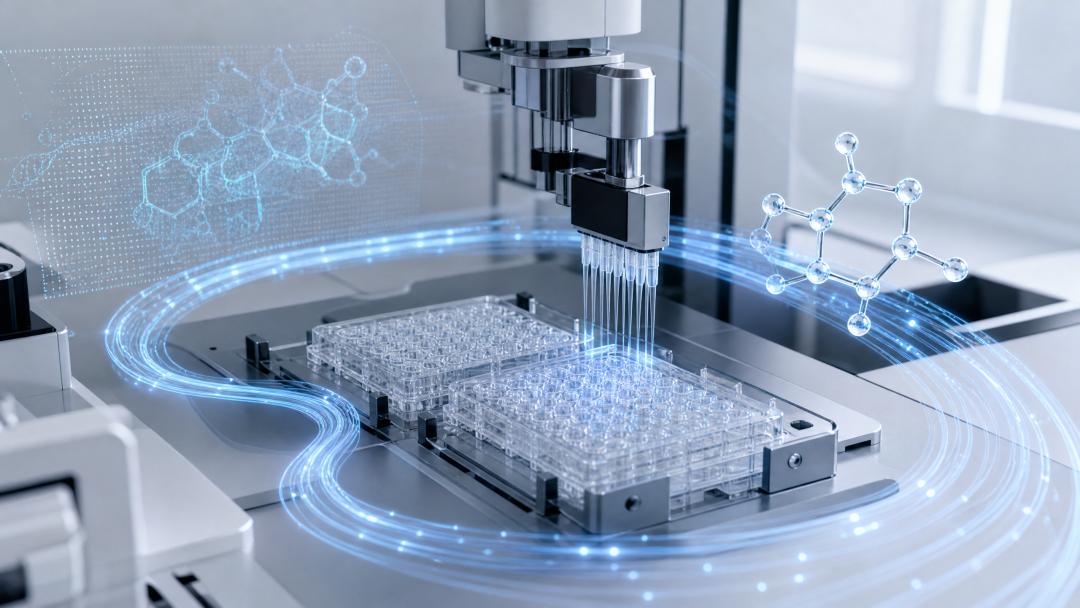
Another type of agent does not only process information, but also commands equipment in the laboratory.
Insilico Medicine launched its intelligent laboratory system LabClaw in the first half of this year, connecting target discovery, compound screening and automated experiments, running on Insilico's self-built second-generation laboratory LifeStar2. XtalPi upgraded its scientific agent platform XtalPi Science in September this year, extending capabilities from the digital end to experimental execution, connecting scientific research data systems and autonomous laboratories, and directly scheduling laboratory robots and experimental equipment to carry out experiments.
What they want to achieve is also the hotly discussed dry-wet closed loop in the industry at present: the prediction in the computer is "dry", the verification in the laboratory is "wet", and the experimental results are fed back to the model to enter the next round.
New drug R&D has always followed the process of "Design, Synthesis, Testing, Analysis". The previous generation of AI pharmaceutical companies have automated several of these steps, such as the model scoring molecules or generating molecules, chemists picking out the molecules to be made, robots synthesizing and testing them, and data going back to train the model. Some companies began to build automated laboratories as early as 2018, but at that time, it was mainly scientists who pushed the cycle to run, for example, what to do in the next round had to be decided by scientists after reviewing the results.
The change this year is that the role driving the cycle has been replaced by the model. The cooperation between OpenAI and synthetic biology company Ginkgo in February this year is a typical example. The model designs the reaction formula by itself, hands it over to Ginkgo's cloud laboratory for execution, designs the next round after reviewing the results, tests more than 36,000 formulas after six rounds, and reduces the production cost of a protein by 40%.
However, this automatic iteration system is still in its early stage.
When OpenAI released the public experimental results, it disclosed that the improvement of experimental protocols and reagent processing still require human supervision and operation. Wang Sheng, assistant professor at the University of Washington in Seattle, also evaluated in a podcast that the current completion degree of large models in designing experimental protocols "may only be 30%". AI can give molecular formulas, but details such as how to synthesize, store, and administer drugs to mice are poorly handled, and it is difficult to arrange work combining the existing equipment in the laboratory.
Even in information processing work, the industry believes that key judgments are still made by humans. Niu Zhangming told Shuzhi Qianxian that AI is good at processing a large amount of information and comparing multiple candidate designs at the same time; setting R&D goals, selecting molecules worthy of verification, and interpreting experimental results are the responsibilities of medicinal chemistry experts. The results of information sorting need to be checked for sources, suggestions related to molecular selection need to be judged by pharmaceutical experts, and the actual activity and safety need to be verified by experiments and clinics. "The final decision is made by personnel with corresponding professional qualifications and responsibilities."
To make AI cover more links of drug R&D, models and agents alone are not enough. Various players are also exploring the infrastructure to connect all parties.
General AI office agents are entering the market. Tencent has built a life science platform on WorkBuddy to connect several types of companies. Participants include AI pharmaceutical companies MindRank AI and Insilico Medicine, CXO player GenScript that can provide high-throughput wet experiment verification, and innovative biopharmaceutical company Immuneune Biotech with heavyweight self-developed pipelines. From an external perspective, the participation of multiple complementary roles essentially aims to open up the chain from AI molecular design to wet experiment verification, and then to the implementation of new drug pipelines.
Some players also directly deliver models and computing power to pharmaceutical companies. Deep Intelligent Pharma recently launched the integrated organizational AI software and hardware product EvoOrg x DIP Xiaofang for life science users, which aims to deploy AI-native organizational platforms, including DIP proprietary agent clusters and proprietary models, to pharmaceutical companies.
Stuck in the physical world
To keep data, models and experiments running continuously, the constraints of the physical world cannot be avoided.
The currently popular wet experiment closed loop is still at the front end of the drug R&D chain. Extending further to the back end, after the experimental subjects become living animals and then move to patients, it is difficult to accelerate the process with computing power, and it is also difficult to hand it over to machines.
MindRank AI's MDR-001 can reflect this gap. This is an AI-assisted designed oral small molecule weight-loss drug targeting the known GLP-1 receptor, which has now entered Phase III clinical trials in China. From project initiation to confirming the preclinical candidate compound, it only took about 8 months, with about 80 small molecules actually synthesized during the period; but from project initiation to obtaining the clinical trial approval of the