Why These 10 Cities Are Selected for the New Round of "National Team"
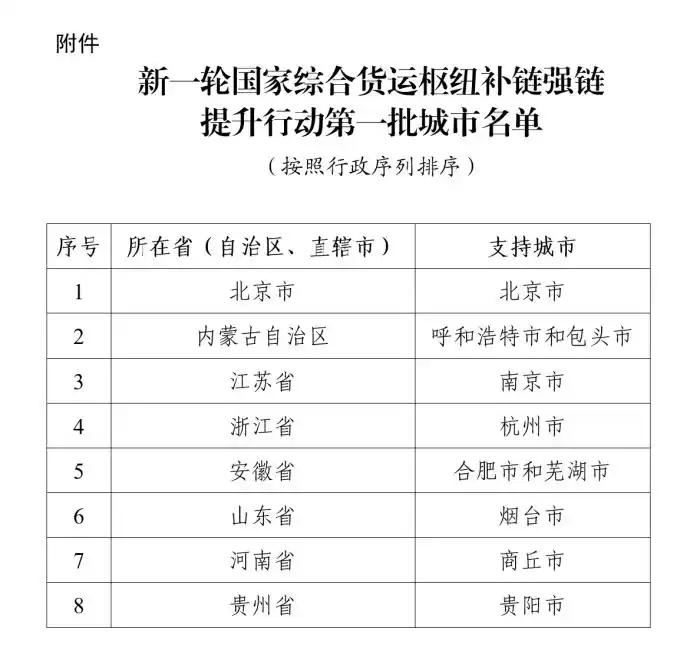
On November 25, the General Office of the Ministry of Transport, the Comprehensive Department of the National Railway Administration, the Comprehensive Department of the Civil Aviation Administration of China, and the General Office of the State Post Bureau jointly issued a notice, confirming the first batch of cities for the new round of national comprehensive freight hub chain supplementation and strengthening improvement action, with 10 cities including Beijing, Hohhot, Baotou, Nanjing, Hangzhou, Hefei, Wuhu, Yantai, Shangqiu and Guiyang successfully selected.
In early April this year, the Ministry of Finance and the Ministry of Transport jointly issued a notice to support the new round of national comprehensive freight hub chain supplementation and strengthening improvement action. It plans to concentrate efforts on supporting about 30 cities (city clusters) in about 3 years, focus on the "6 axes, 7 corridors and 8 channels" scope of the national comprehensive three-dimensional transportation network, take railways as the backbone and highways as the foundation, give full play to the comparative advantages of water transportation and civil aviation, enhance the transportation capacity of important strategic materials and key industrial products, and accelerate the formation of an interconnected, safe and efficient logistics network that connects domestic and overseas markets.
The national comprehensive freight hub is a key node and important support of the national comprehensive three-dimensional transportation network, and plays a vital role in building a modern comprehensive transportation system.
In 2022, the Ministry of Transport and the Ministry of Finance jointly launched the work of supplementing and strengthening the chain of national comprehensive freight hubs. Industry experts previously analyzed that looking back at the construction history of China's transportation infrastructure, there has long been a tendency of "valuing lines while neglecting nodes" and "valuing passenger transport while neglecting freight transport"; after years of construction, lines and passenger transport hubs have taken the lead, while freight hubs are relatively lagging behind.
Under the actual demand of improving economic operation efficiency and reducing the logistics cost of the whole society, the core of "supplementing and strengthening the chain" is to solve the problem of "connected but unobstructed, adjacent but not linked" between different transportation modes, so as to better "serve the industries".
According to data from the Ministry of Transport, 37 hub cities have implemented the chain supplementation and strengthening work for national comprehensive freight hubs, leading to the formation of 63 rail-water intermodal hubs, 76 highway-rail intermodal hubs, and 43 land-air intermodal hubs, directly serving more than 240 national-level industrial parks and industrial clusters.
Compared with the first round, some experts pointed out that the implementation logic of this round of improvement action is shifting from "strengthening weak points and laying a solid foundation" to "enhancing the network and improving efficiency".
In April this year, the Ministry of Transport pointed out at a regular press conference that this round of policies focuses on enhancing the support and guarantee for national strategies, focuses on the trade and transportation demands of key cargo types such as grain, energy, mineral resources and advanced manufacturing, improves the layout and functions of comprehensive freight hubs, and targets to make up for the weak links in the comprehensive transportation chain.
At the same time, in accordance with the principle of "what is missing shall be supplemented", we will clear up blockages and stuck points around major freight nodes such as major ports, key inland ports, large logistics parks, large-scale industrial parks, and China-Europe and China-Central Asia Railway Express assembly centers.
For the selected cities, the priorities are different: for example, Beijing, Nanjing and Hangzhou are all among the about 20 international comprehensive transport hub cities specified in the Outline of the National Comprehensive Three-dimensional Transportation Network Plan; Yantai is the world's largest port for bauxite import and an important energy import and export base in northern China; Guiyang undertakes the functions of inland opening channels such as the New International Land-Sea Trade Corridor in the western region; Shangqiu is located at the junction of Henan, Shandong, Jiangsu and Anhui provinces, and is an important circulation node in the Central Plains region...
In accordance with the goals of the improvement action, we will promote the "four further improvements" of the hub's multimodal transport function, cross-mode conversion efficiency, organizational model innovation effectiveness, and the overall benefit of the comprehensive transport network.
Taking Nanjing as an example, the local government has made it clear that it will focus on four major cargo categories: grain, energy, minerals and advanced manufacturing, improve the "two main and four auxiliary" comprehensive freight hub system featuring Longtan River-Sea, Highway-Rail-Water Intermodal Transport Main Hub and Lukou Land-Air Intermodal Transport Characteristic Hub, and strive to enhance the capacity of the international comprehensive transport hub city, global international postal express hub, and regional shipping logistics center.
This article is from the WeChat Official Account "Urban Evolution Theory", written by Liu Yanmei, and published with authorization from 36Kr.