36Kr Exclusive | This haptic glove company benchmarking against Manus has generated tens of millions in revenue and secured investments from SAGE Capital, Puhua and other investors.
Source / Enterprise
This article contains approximately 2600 words, with an estimated reading time of 6 minutes
Author | Ou Xue
Editor | Yuan Silai
36Kr has learned that Dayan Technology, a tactile data and embodied intelligence infrastructure provider, has recently completed a Pre-A round of financing of tens of millions of yuan, led by Saizhibole, with participation from Puhua, Zheshang Venture Capital, Zheli Xin and other institutions, and additional investment from existing shareholder Zhejiang Provincial Science and Technology Innovation Mother Fund. The proceeds from this round will be mainly used for the construction of data centers and the production line of tactile gloves.
Founded in May 2025, Dayan Technology positions itself as a Physical AI infrastructure service provider. Centered on tactile sensing technology, the company has built a complete technology stack, and currently has three major product lines in place: the tactile 5D-Ego data acquisition software and hardware platform, the foundational tactile model, and the domestic embodied simulation engine for contact mechanics.
36Kr understands that Yang Lin, founder and CEO of the company, holds a doctorate in computer science from the National University of Singapore. The core team also includes academicians of the two academies and senior technical executives from Huawei, with doctors accounting for more than 70% of the total team members.
At present, focusing on the main line of tactile sensing, the company has built three major business segments: the tactile Ego dataset, the large foundational tactile model, and the contact mechanics simulation platform:
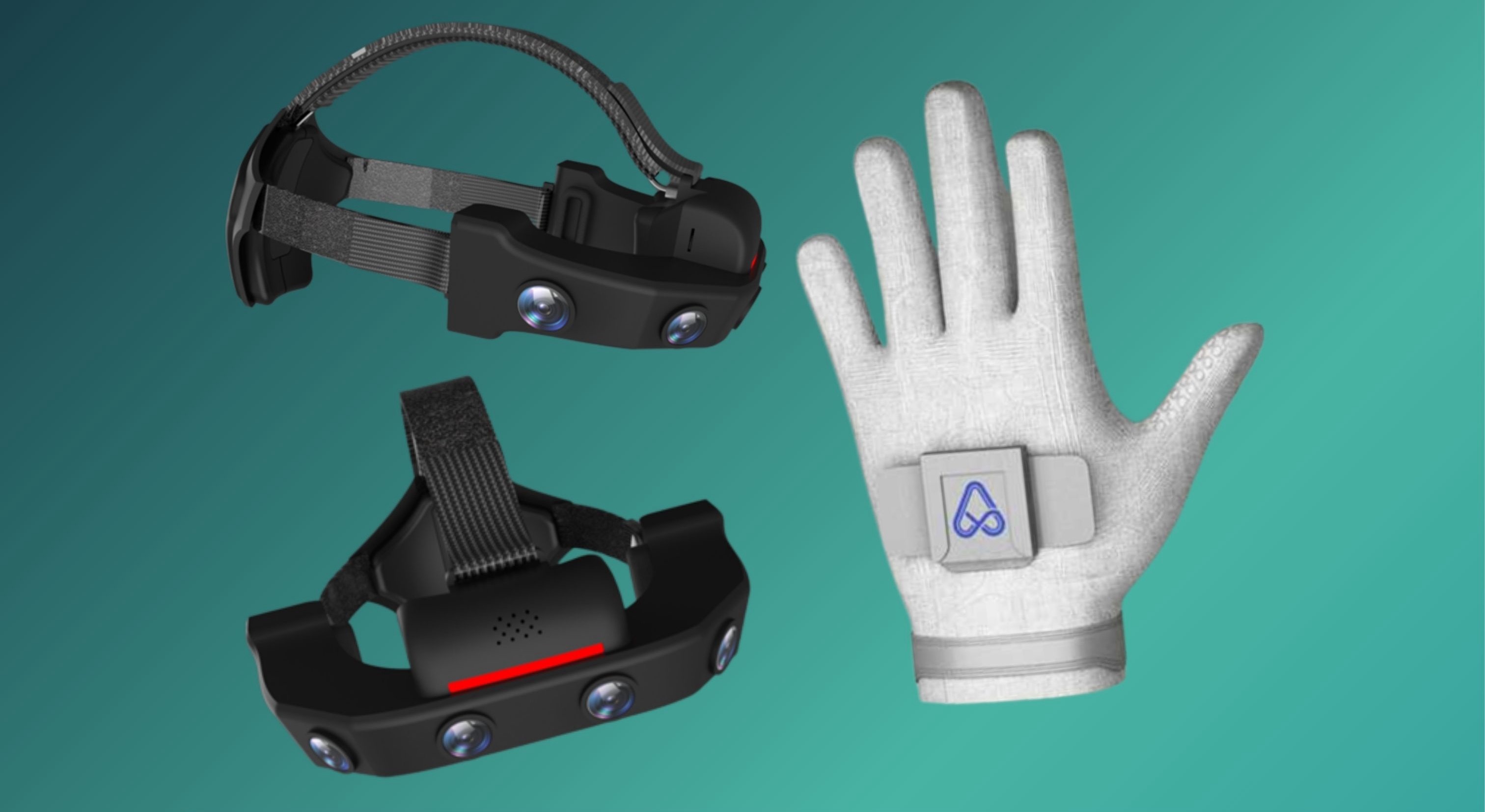
First, the tactile 5D-Ego data acquisition software and hardware platform. Its core hardware is the self-developed tactile data glove. After engineering iterations, the product has a stable working life of up to about 1000 hours, with excellent reliability indicators among similar flexible tactile gloves.
Previously, mainstream industry solutions mostly used inertial navigation/electromagnetic motion capture paired with distributed fabric pressure sensors, while Dayan Technology adopts a differentiated flexible electronics technology route. Specifically, the back-of-hand motion capture module is equipped with a self-developed liquid metal strain sensor, which can reproduce fine hand movements with high precision, and supports stable capture of high-degree-of-freedom and high-difficulty hand postures such as finger-to-finger contact and finger interpenetration.
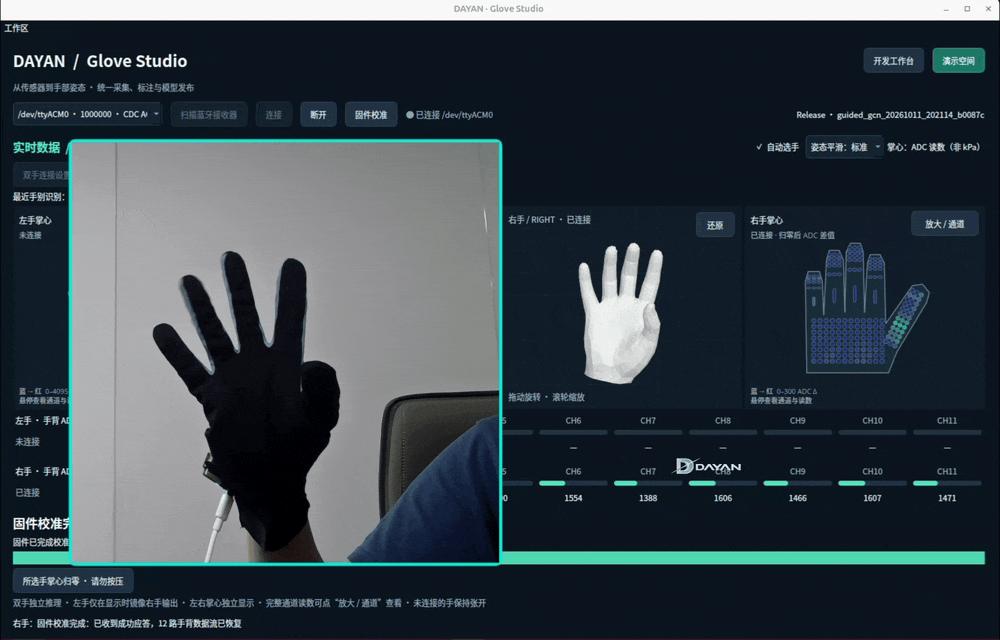
Finger-to-finger / finger interpenetration motion capture (Source / Enterprise)
In terms of tactile sensing, Dayan Technology adopts a dual-track parallel strategy: the mass-produced version for large-scale delivery is equipped with fabric pressure sensors, balancing cost, yield and stability; the next-generation version under development uses a full-curved capacitive tactile array, which can perceive continuous deformation of the contact surface, output vertical normal force, tangential friction force and slip information synchronously, and realize continuous 3D force perception.
The data acquisition adopts a synchronous acquisition architecture of "head-mounted Ego acquisition terminal + tactile glove", which collects tactile force signals, hand and whole-body kinematics data, first-person perspective videos, and scene semantic annotations in an aligned manner, forming a 5D-Ego dataset with five-dimensional alignment.
Liu Yanxin, co-founder of the company, told 36Kr that traditional visual Ego data can meet the basic training of short-term VLA and WAM models, but the capability breakthrough of robots in fine manipulation tasks must make up for the key dimension of tactile sensing, which is also a rigid demand of industrial automation customers.
Second, the foundational tactile model. The base of Dayan Technology's self-developed foundational tactile model has an original parameter count of 50B, supports lightweight compression of the model, and the edge-side deployment version can be compressed to a scale of 3B. Relevant research papers have been accepted by NeurIPS, the world's top academic conference.
In addition, based on the architecture of the visual world model, this model integrates autoregressive modeling and reinforcement learning paradigms, aligns tactile, force, first-person perspective video, and multimodal semantic information to build a tactile-augmented world model, which is mainly oriented to tasks such as contact force prediction, robot fine manipulation control, and tactile closed-loop feedback manipulation.
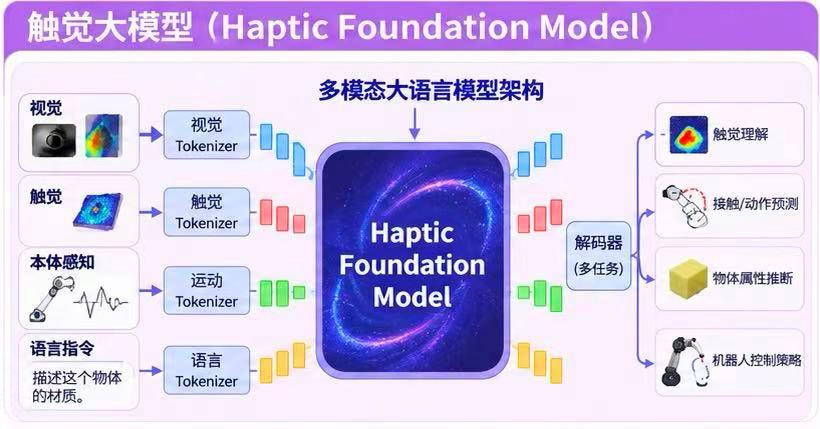
Framework of the foundational tactile model (Source / Enterprise)
Third, the domestic embodied contact mechanics simulation engine. Liu Yanxin revealed that the simulation engine is currently in internal testing, and about 5,000 sets of simulation scene assets have been open-sourced this year.
Liu Yanxin further analyzed that compared with traditional physics engines based on analytical solutions, this engine has two core differentiated ideas: first, the simulation kernel is deeply optimized for contact mechanics tasks, and is deeply coupled with the self-developed foundational tactile model; second, it adopts a neuro-physical hybrid simulation paradigm: no longer relying solely on numerical solutions of classical mechanics formulas, but combining physical priors with implicit inference of neural networks.
Liu Yanxin explained that the advantage of this hybrid simulation framework is that it can incorporate complex boundary conditions that are difficult to model accurately with explicit physical equations, such as humidity, surface roughness, communication delay, and temperature. At the same time, relying on GPU parallel acceleration, the simulation throughput efficiency is significantly improved, which is suitable for batch reproduction of scenarios on the cloud and accelerates the iteration of robot control strategies. The simulation engine is planned to be officially launched to the public as early as the first half of next year.
In terms of performance, the company's revenue this year has reached tens of millions of yuan, and the main revenue comes from the embodied intelligence track business: about one third of the revenue comes from the hardware sales of tactile sensing gloves, and the remaining two thirds comes from tactile Ego data delivery and model customization services.
Liu Yanxin believes that structural changes are taking place in the demand of this track. At this stage, customers who purchase Ego data in large quantities are still mainly leading overseas enterprises; the domestic market was dominated by teleoperation solutions in the early stage. Since the second half of this year, domestic customers have gradually started the verification and pre-research of tactile Ego data and tactile sensing models, and the industry's attention to tactile closed-loop solutions has risen significantly at the end of the year.
When talking about the data flywheel, Liu Yanxin emphasized the core difference between Dayan Technology and most pure data service providers: the company does not only focus on data annotation and collection, but connects the full chain of "self-developed sensors - acquisition pipeline development - dataset delivery - model training - simulation evaluation", forming a closed-loop flywheel driven by the mutual promotion of data, model and simulation.
In terms of overseas layout, Liu Yanxin revealed that Dayan Technology has formed four major directions: relying on the compliant channel of the National Cross-Border Data Pilot Center, in cooperation with City University of Macau, it has set up a joint laboratory for overseas customers in Hengqin; it carries out industrial scenario implementation cooperation with European industrial intelligent enterprises; relying on the academic resources of academician Sadiq in the team, it expands robot project opportunities in the Middle East and Saudi Arabia; it co-builds joint simulation laboratories with North American universities such as the University of Pennsylvania and the University of Ottawa, as well as robot ontology laboratories, to carry out joint R&D; at the same time, it promotes the implementation of tactile data collection projects for labor-intensive industries in Southeast Asia.
The following is an edited excerpt of the conversation between 36Kr and Liu Yanxin, co-founder of the company:
36Kr: By using neural network-assisted simulation and weakening the traditional solution of physical formulas, how to ensure that the simulation results are credible and can be used for robot implementation?
Liu Yanxin: The value of neuro-physical hybrid simulation is reflected in two points. First, it can accommodate a large number of coupled variables that are difficult to quantify in traditional analytical physics, such as complex factors like contact surface humidity, surface friction changing with deformation, and communication link delay, which is closer to the real physical world; second, the GPU parallel architecture can run simulation samples in batches, and the iteration speed is much higher than that of traditional physics engines with CPU serial solution.
We do not completely abandon physical priors, but inject classical mechanics into the model as a strong constraint, and then use the neural network to fit the nonlinear part of complex contact, so as to balance fidelity and simulation efficiency. In the long run, in the next 3–5 years, tactile-based neural simulation will form an independent track, which is also the underlying logic for us to lay out the third product line.
36Kr: What level is the current performance of tactile gloves in the industry? What is the subsequent iteration route?
Liu Yanxin: We benchmark against overseas industry benchmark products such as Manus. Current version indicators: fingertip positioning accuracy ≤1mm, joint angle resolution 0.1°; tactile single-point range 0–40N, force resolution 0.01N, natively supports 3D force output, maximum tactile sampling rate 600Hz; the maximum number of configurable tactile sensing contacts for the whole hand is 1012, and the whole set of indicators is in the first echelon of the industry.
The focus of the next phase of iteration is to upgrade from the current fabric pressure sensing solution to the full-curved capacitive tactile array solution. The capacitive array can capture the continuous deformation field of the contact surface. Compared with discrete pressure points, the density of perceived information and spatial continuity will be greatly improved, which is suitable for more fine contact sensing tasks.
36Kr: What do you think is the biggest risk in the current embodied intelligence industry?
Liu Yanxin: The core risk is the pace of commercial implementation. Whether it is the general embodied or industrial robot track, the mature scenarios that have achieved real large-scale implementation and mass delivery are still very limited at present. Some scenarios overseas have achieved closed-loop operation, but the inflection point of large-scale commercialization in China has not yet arrived.
Only when the commercial delivery of robots reaches a certain scale, the demand for tactile data and sensing models will be stable and clear, and the business model can continue to operate smoothly. Therefore, on the one hand, we adhere to the full-link closed loop and keep the data flywheel running continuously; on the other hand, we actively expand pilot implementation cooperation in high-risk and high-value scenarios, while maintaining the self-sustaining profitability of the business, and promoting the two lines of business operation and capital financing in a coordinated manner.