36Kr Exclusive | An embodied intelligence company has secured hundreds of millions of yuan in investment from Zero2IPO Industrial Investment and other investors, and its robots have been put into actual commercial operations.
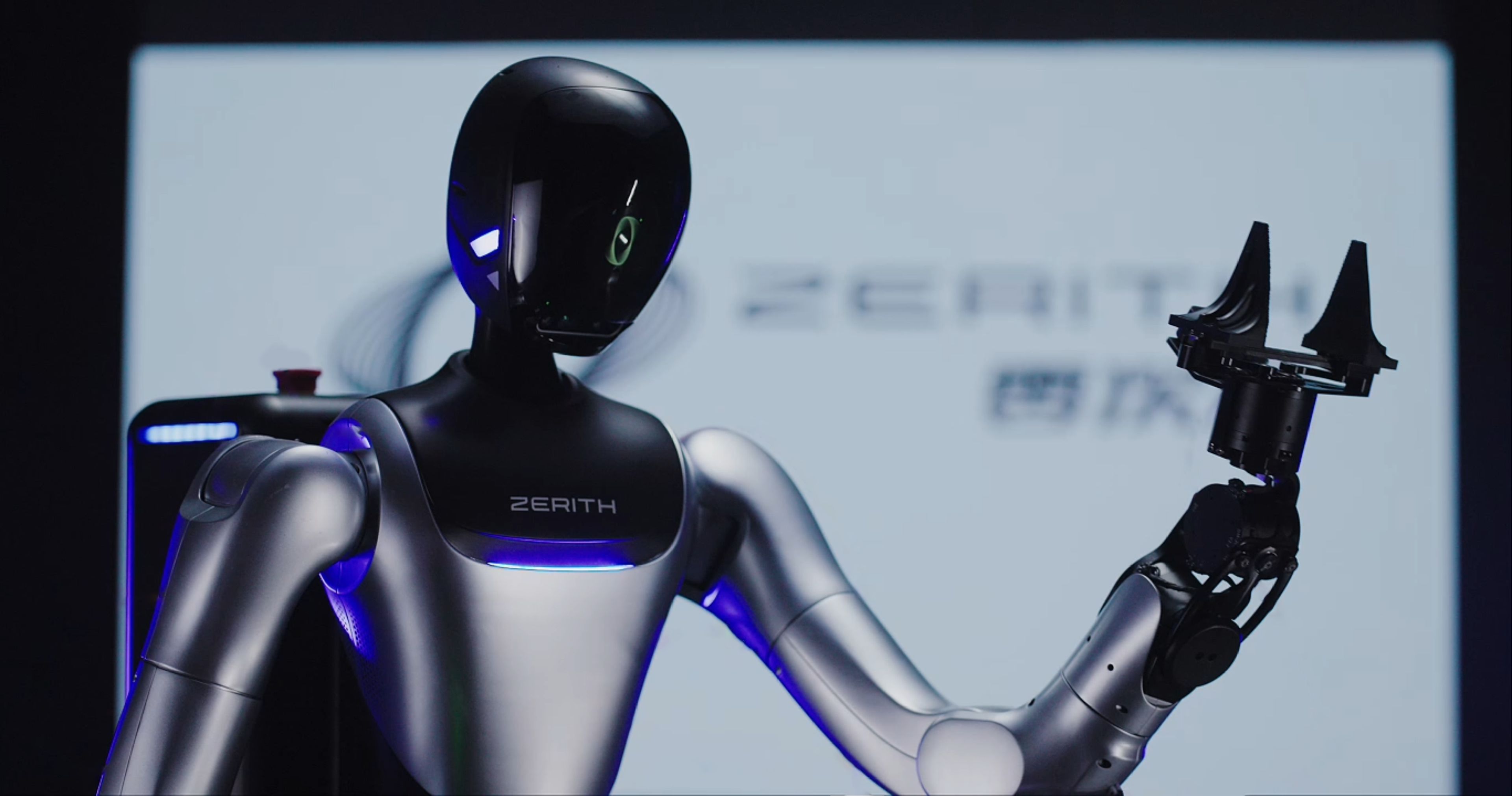
Source / Enterprise
This article contains approximately 2100 words, with an estimated reading time of 5 minutes
Author | Ou Xue
Editor | Yuan Silai
36Kr has learned that Zerith, an embodied intelligence robotics company, has recently completed a new round of financing of several hundred million yuan. Investors in this round include Zero2IPO Capital, Xizhou International, Zhuoyuan Asia, Yuemin Sufeng, Wuxi Binhu, Hefei Construction Investment, Hefei Industrial Investment Guozheng, Jack Group, and a number of industrial strategic investors. Existing shareholders Tongchuang Weiye, Lihe Fund, and Relay Angel continued to make additional over-allocated investments. The funds will be mainly used in two directions: first, to expand the implementation scale of the scenarios that have been verified to be feasible, and second, to reserve computing power scheduling capabilities for the Picking API to be opened at the end of the year.
Founded in January 2025, Zerith is spun off from the AI Robotics Lab of Tsinghua University, which has been deeply engaged in the robotics field for more than 15 years. It is a full-stack hardware and software collaborative Physical AI model company, committed to continuously improving robots' operational capabilities through real physical interaction and promoting the large-scale commercial application of embodied intelligence technology.
Min Yuheng, founder and CEO of Zerith, received his bachelor's degree from Chongqing University and his postgraduate degree from Tsinghua University, majoring in multimodal operation and algorithms. He started his own business when he was an undergraduate, and has obtained investment from US dollar funds as CTO and co-founder.
According to Min Yuheng, Zerith hopes to take the embodied model as the core to complete the evolution of next-generation embodied intelligence in real scenarios — gradually build a complete system from model training, physical execution to capability iteration, and promote the standardization of robot products and further develop Physical AI infrastructure.
In terms of technical route, Zerith has chosen a deliberately narrowed niche: Picking. Min Yuheng divides operational capabilities into perception, planning, robot operation and contact and other links, and judges that models in other fields have performed well enough in the perception and planning layers, while the truly unvalidated part is the "action modality" in the field of embodied operation. The company thus trains a native action model from scratch, focuses on the execution end, and uses it as an interface to connect with external models, converting the operational experience on a single robot into a transferable Physical API.
The above technical route is also reflected in Zerith's recent research progress: Zerith has open-sourced the embodied action model ZERITH-V2.5, the Agentic self-evolution framework ESI, and the real robot interaction dataset ZERITH-H1-1K with more than 1000 hours of data. The three cover action learning, task execution collaboration and real physical interaction data accumulation respectively, forming a complete technical closed loop from training to execution feedback.
This also means that Zerith's product development is no longer limited to a single robot form, but gradually extends from robot products to the underlying operational capability platform.
He uses Newton's first law to analogize the logic of his company's model: the state of an object remains unchanged if no external force is applied, while Zerith's model works the other way around — it first defines how the task state needs to be transferred, then calculates how to apply a combined force to the object to make it change according to the defined state.
In terms of core products, the product line is developed around the lettering of "ZERITH": the H series is wheeled arms, the R series is direct picking for storage locations, and the T series is grippers. The T series is the key product of this year — it paves the way for the subsequent API to generalize robots of different configurations with the gripper as the core carrier, connecting software on one end and adapting to different robot bodies on the other end.
In terms of scenario strategy, the core scenario criteria for Zerith are sufficiently large volume, considerable revenue, and the highest data value. At present, it has been deployed in supermarkets, shopping malls and warehousing, and will lay out home sorting tasks in the future.
36Kr has learned that the embodied picking robot R1 developed by Zerith has been put into real commercial operation in an instant retail front warehouse in Hefei, becoming the first embodied intelligence robot "picker" in China that achieves normalized performance in the instant retail front warehouse scenario.
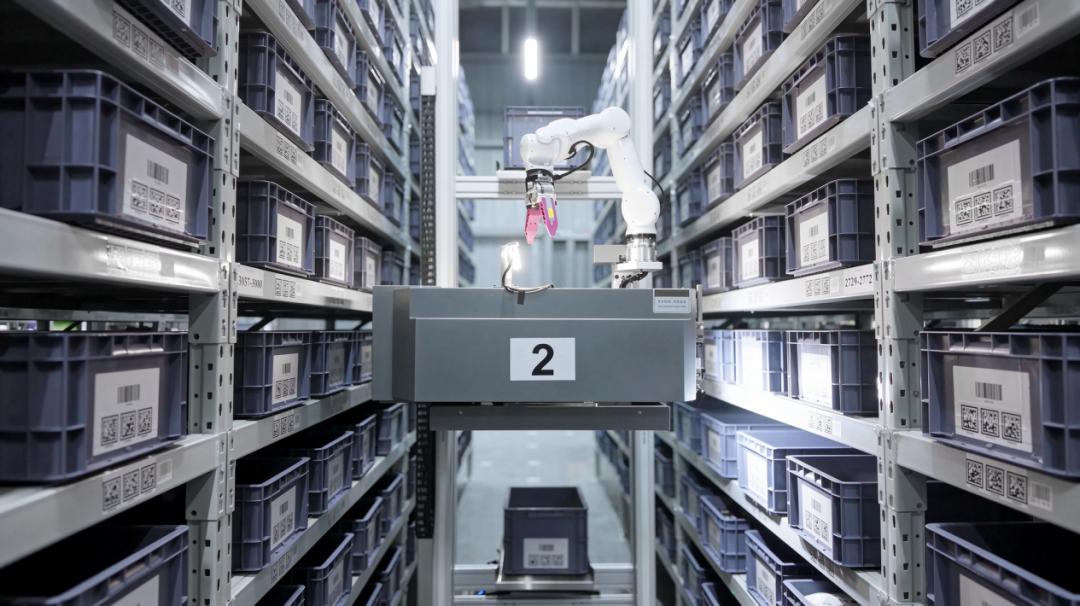
Zerith robot working in the warehousing scenario (Source / Enterprise)
Min Yuheng revealed that the improvement of embodied model capabilities is inseparable from real physical interaction data. Therefore, Zerith takes commercial scenarios as an important carrier for model evolution, and prioritizes scenarios with high-frequency operation requirements and clear commercial value such as retail and warehousing.
Because there are about 150 million new products launched on the market globally every year, and the overlap rate of SKUs in ordinary households and SKUs in large retail scenarios is less than 1%, moving upstream first — entering supermarkets, e-commerce, and instant retail is a relatively good physical data training site.
It is worth noting that small store business is currently the main revenue source of Zerith, and it is also the most mature implementation form. Its model is a semi-open, convenient service station with glass barrier: no need to rent a storefront, no need for decoration, it is placed at the site in the form of a car window, not a traditional unmanned retail store. Min Yuheng positions it as a "non-standard product robot supermarket" — cutting into the non-standard product scenarios that traditional retail cabinets are difficult to cover.
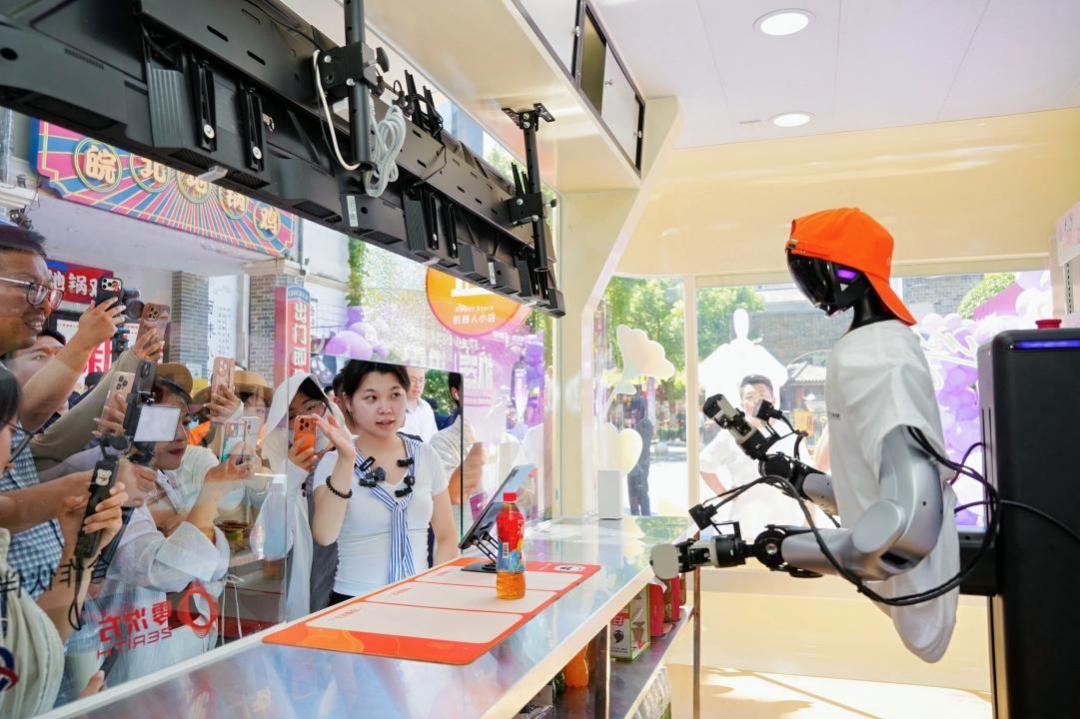
Zerith robot working scenario (Source / Enterprise)
The following is an edited excerpt of the interview between 36Kr and Min Yuheng, founder of Zerith:
36Kr: Could you share what outstanding accumulation you have made in the data dimension?
Min Yuheng: On the one hand, in real unmanned warehouses, including common e-commerce retail warehouses, we can already cover about 95% of SKUs; on the other hand, we have recently won an excellent first place in relevant rankings. But I think what is more important is the number of real deployed applications: there are nearly 200 sets of small stores, the warehouses operate 24 hours a day, and each robot performs at least 1500 tasks per day. These real scenarios continuously feed back data every day, which is the most valuable accumulation.
36Kr: You emphasize 4D physical understanding, could you elaborate on the advantages of your model?
Min Yuheng: The model pays more attention to the decoupling of predictive control, it is a two-branch architecture optimized in stages, which combines the spatial geometric information of VGGT to generate actions. We have predictive planning for the next few actions, but we will not restore the entire action details in the simulation at a full 1:1 ratio. Instead, it is more like human beings' fuzzy prediction of future actions.
We found in data and experiments that the control value of prediction prior is related to the module and supervision coverage. Through prediction adaptation, we further change the visual fitting of the target domain, providing a good optimization starting point for action learning. Recently we have completed a task combining rigid and flexible objects, the demo is mainly about putting garbage bags on trash cans — the garbage bag is a flexible object, which can reflect the operational capability of the end effector combining with continuously changing objects; at the same time, it needs to be put on a relatively hard trash can, which involves the opening of the bag mouth, the deformation of the bag body and the hard change representation of the bucket edge, which can further demonstrate the model's capability in predictive representation. During execution, the current observation and predicted observation will be combined for specific operations to improve the success rate.
36Kr: The industry is divided into three stages: pseudo-generalization, approaching generalization, and true generalization. Which stage are you in now?
Min Yuheng: We are definitely aiming at true generalization for the API-based direction. At present, the several deployed scenarios, whether small stores or warehouses, are in the approaching generalization stage — first, we can ensure that the deployed business is commercially reasonable, and second, it is our largest data production factory. Each robot performs 1000 to 2000 tasks every day, feeding back 1000 to 2000 pieces of the most valuable normal data. Overall, we have robots in the semi-generalization stage, and we are transitioning to true generalization, which is basically the stage we are at now.