Gemini 4 Carbon illuminates 8 suns, the 70-year-long unsolved geometry mystery that has puzzled the mathematics community for decades is finally cracked, with a stunning master-level proof that takes only 6 pages.
Do you still remember the terminator line mentioned in your high school geography class?
This common physical phenomenon is regarded as an extremely challenging geometric puzzle in the eyes of mathematicians.
If this planet is not a perfect sphere, but an arbitrarily distorted, angular "convex polyhedron", or even its surface is covered with terrain interlaced with smooth and sharp features, what is the minimum number of "suns" we need to hang up to illuminate it completely?
In 1957, Swiss mathematician Hugo Hadwiger formally put forward this conjecture later known as "Problem No. 20" in the journal *Elementa Mathematica*.
Hadwiger's Covering Conjecture:
Any d-dimensional convex body can be fully covered by at most 2d strictly reduced homothetic copies of itself.
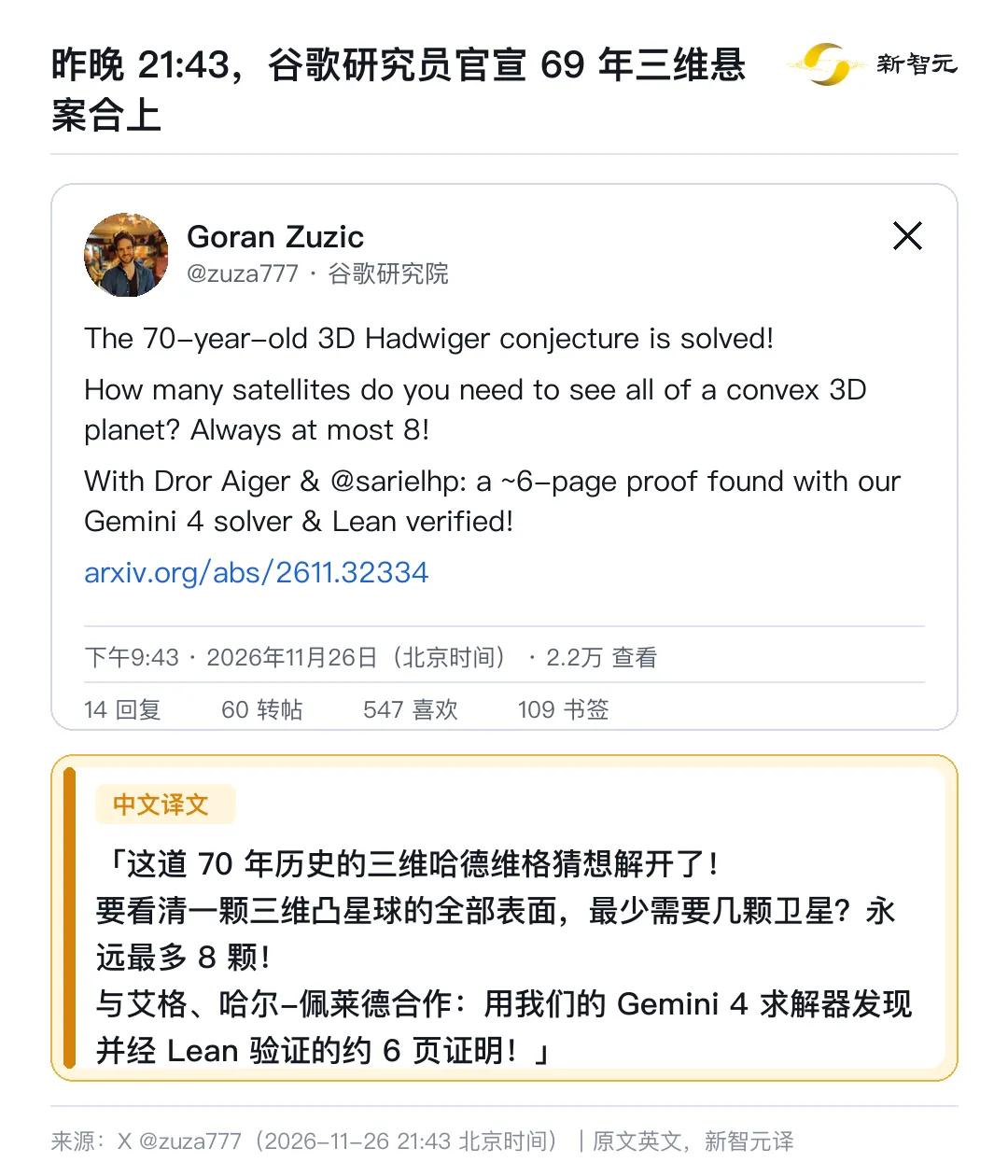
Just now, researcher Goran Žužić from Google Research announced in a post that the 70-year unsolved geometric case — the 3-dimensional Hadwiger's conjecture — has been solved!
Paper link: https://arxiv.org/abs/2611.32334
To see the entire surface of a 3D convex planet clearly, what is the minimum number of satellites we need? The maximum number will never exceed 8!
What is even more shocking is that Gemini 4 Carbon figured out the proof framework and intuition on its own; the two human researchers only "steered the wheel a few times" midway.
The strict formal verification code as long as 13,700 lines was also automatically generated by the agent.
Puzzling Mankind for 70 Years: Why Does Approximation with Smooth Substitutes Fail?
Why has the problem of shining several beams of light on a convex stone, which does not even require calculus, trapped brilliant mathematicians for 70 years?
First, we need to understand why the upper bound of the conjecture is "8".
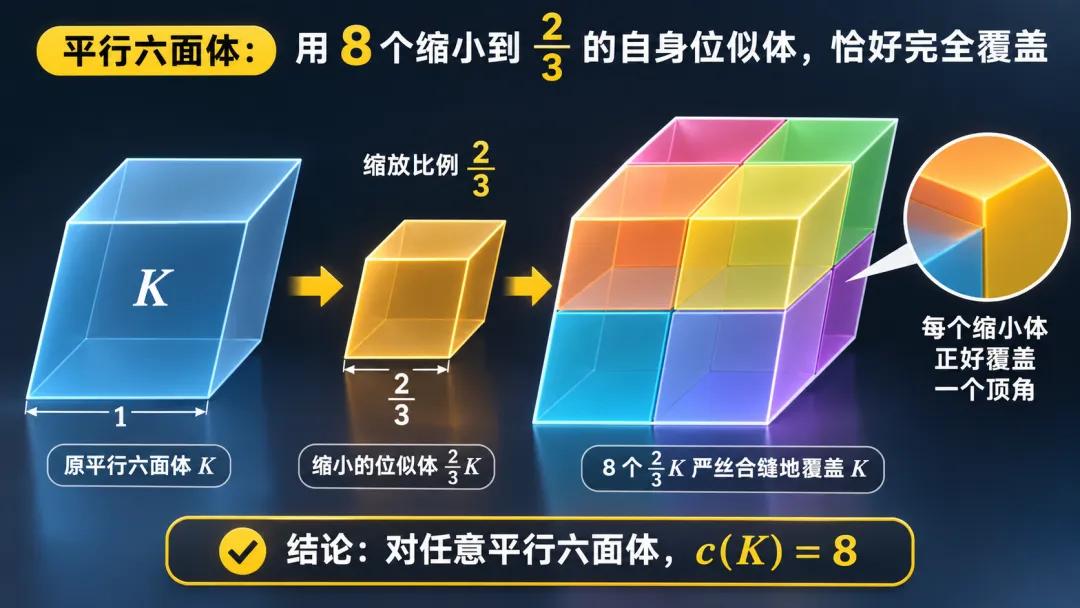
Place a cube on the table, with its eight sharp corners pointing to all directions. A beam of parallel light can illuminate at most seven corners, and there is always one corner hidden in the dark. Therefore, a cube (or parallelepiped) requires exactly eight suns, no less than that.
For perfectly centrally symmetric shapes (such as standard ellipsoids), mathematician Lassak proved as early as 1984 that 8 suns are sufficient.
However, once the "ground" is skewed and asymmetric, the light path will be completely disordered.
For general 3-dimensional convex bodies, Papadoperakis reduced the upper bound to 16 in 1999; it was not until 2023 that Prymak improved it to 14 using complex geometric constructions.

The further mathematicians went, the more desperate they became, because there was a fatal trap hidden in this problem.
In mathematics, we usually like to approximate rough objects with smooth ones.
For a 3D convex sphere with a smooth and rounded surface everywhere, you only need 4 suns (pointing in the directions that form a tetrahedron) to illuminate the entire sphere.
Then, can we regard a cube as the limit of a "smooth sphere" that is infinitely flattened?
Theoretically yes. You can take a series of smooth convex spheres, gradually squeeze them into a more cubic shape step by step, to approximate the target cube. At every step in the approximation process, these rounded substitutes only need 4 suns to be fully illuminated (c(K)≤4).
But at the very last 0.01 second when they perfectly fit the cube, the number of required suns will jump sharply from 4 to 8 instantly!
In mathematical terms, this is called "upper semi-continuous but not lower semi-continuous under the Hausdorff metric".
This means that you cannot simply prove the conclusion on a polyhedron or smooth substitute and then "take the limit". The moment you reach the end of the approximation, the law of light and shadow will break, and your proof will fail directly.
This is why traditional analytical methods have repeatedly hit a wall when facing Hadwiger's conjecture.
Two Suns Guarding the Two Ends, the Terminator Line Is Precisely Cut into 6 Segments
Since the path of using "substitutes" is impossible, how did Gemini 4 Carbon do it?
The secret lies in the terminator line.
The illumination scheme conceived by AI is extremely consistent with human intuition, and has amazing geometric accuracy.
It is summarized in the paper as "2 + 6 = 8 Terminator Line Illumination Method".
Step 1: Solve the most troublesome parallelepiped first.
First, the proof separates the parallelepiped for independent processing.
For a parallelepiped, there is no need for complex lighting settings. You can directly take 8 copies of itself scaled down to 2/3 of the original size, translate them, and they can perfectly cover the eight corners of the original object exactly (c(K)=8).
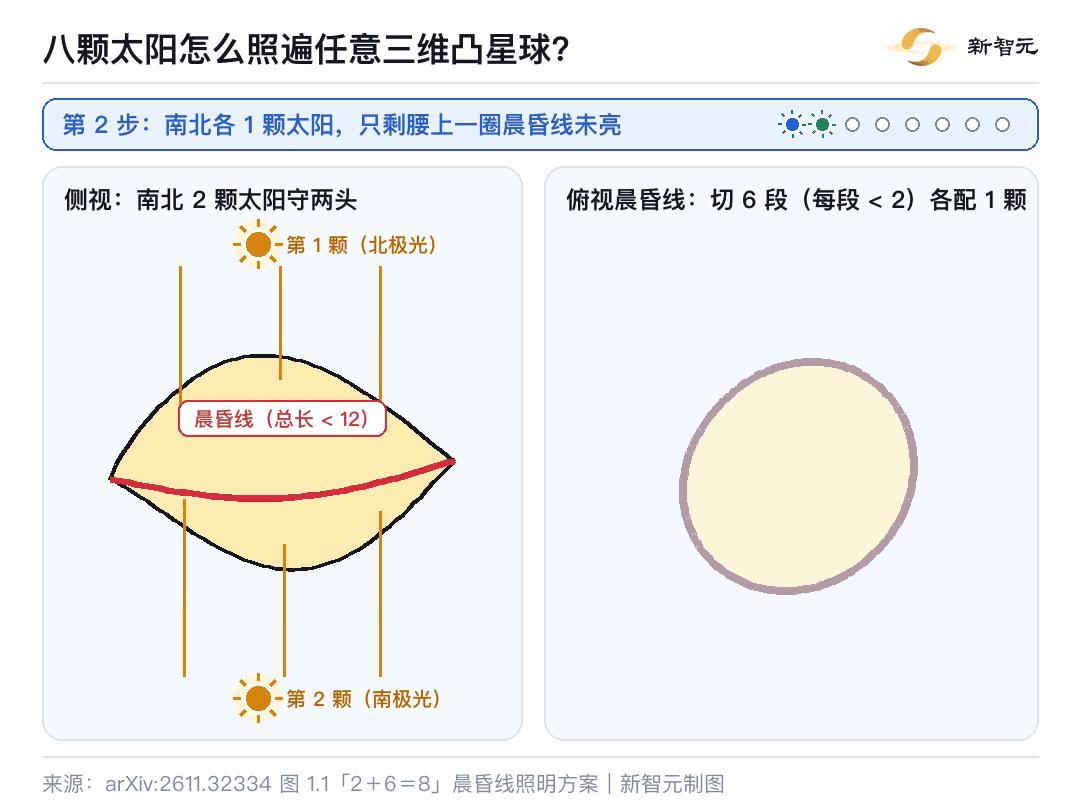
Step 2: Two suns guard the two ends.
For all the remaining irregular convex planets, the AI says: pick a specific direction, and light up one sun (+w) and one sun (-w) from the north and south ends respectively.
Since the planet is convex, when these two beams of light are projected, except for the "terminator line (shadow boundary Σ(K,w))" on the waist that skims past the light, the entire northern and southern halves of the ground are fully illuminated no matter how rugged they are.
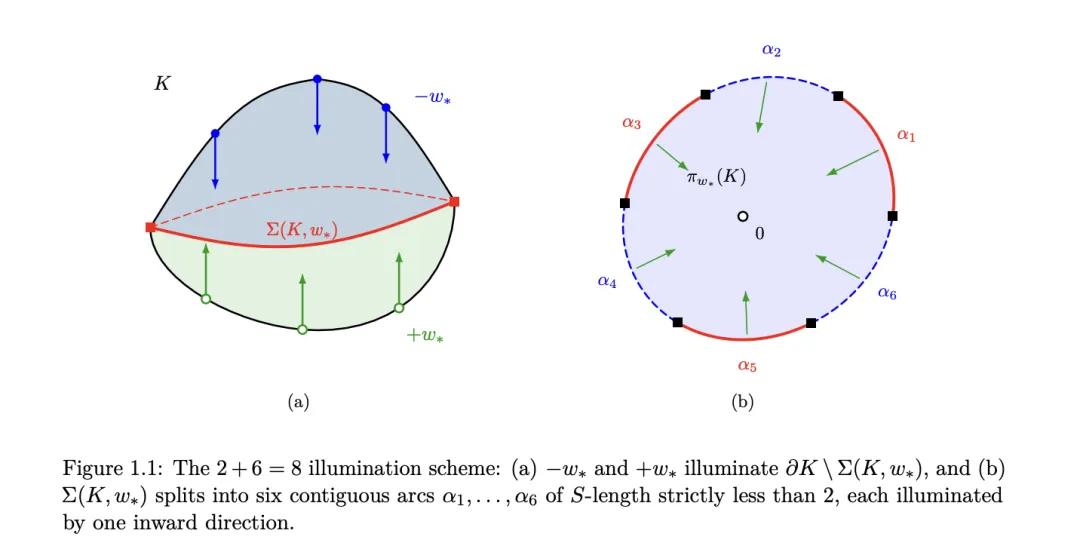
Step 3: Cut the terminator line into segments.
The budget for the remaining six suns is entirely reserved for the closed terminator line around the waist.
But what if the planet has a very tricky shape, for example, it looks like a starfish, and the terminator line twists and turns to be extremely long?
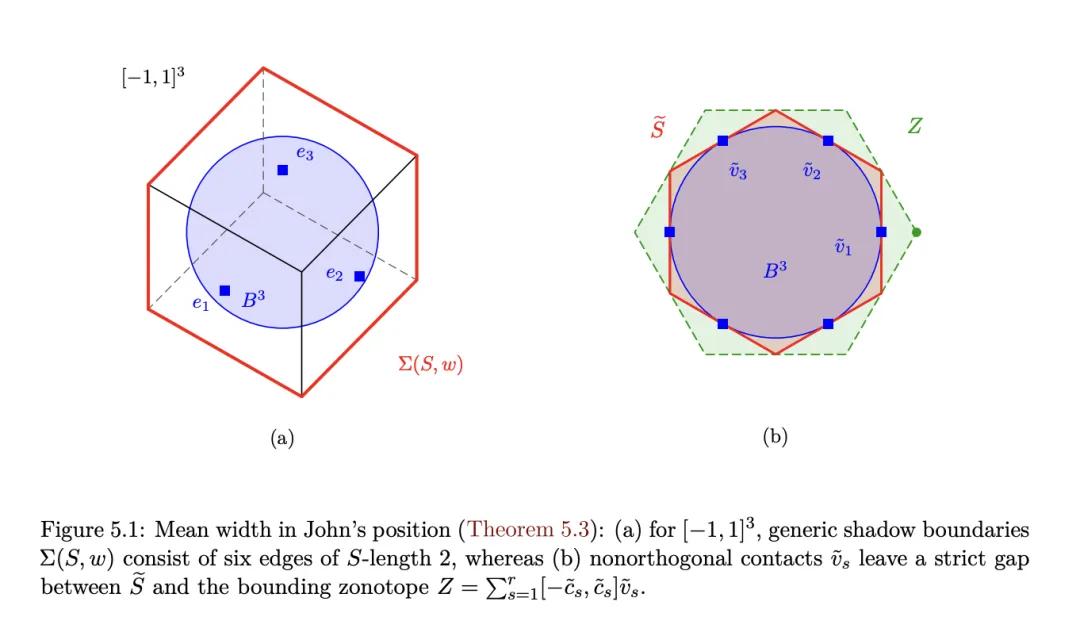
At this time, the AI uses a beautiful modern convex geometry tool. Instead of directly measuring the Euclidean length of this line, it introduces the concept of "difference body"
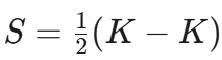
, which forcibly symmetrizes the originally asymmetric planet, and measures the curve under this new metric.
It places this symmetric body S in the so-called John position — that is, it inscribes an ellipsoid of maximum volume inside it (
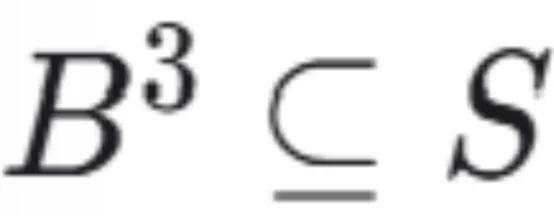
).
Here, the machine keenly captures the "rigidity" feature of the parallelepiped: as long as the planet is not a parallelepiped, the spherical average of its support function in all directions is strictly less than 3/2.
This means that as long as you pick directions at random, you can always find a "good direction" that allows this terminator line to avoid the straight edges, and form a closed curve with a total length strictly less than 12!
The average length is less than 12, which is a very critical number. This means we can divide this terminator line evenly into 6 segments, and the length of each segment is strictly less than 2.
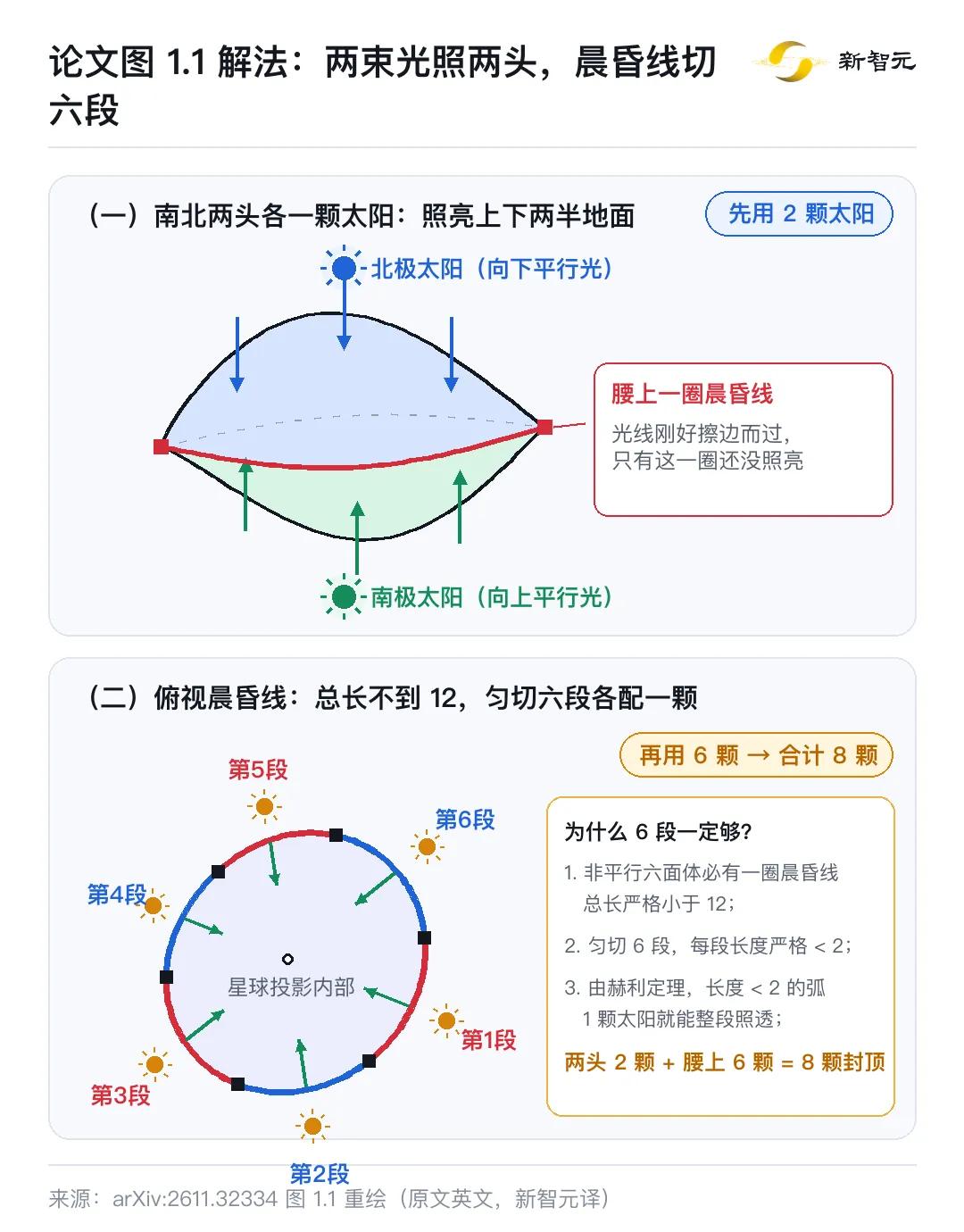
Step 4: Perfect Ending with Helly's Theorem
Why is it so important that the length is less than 2? The Helly's Theorem put forward a hundred years ago is used here.
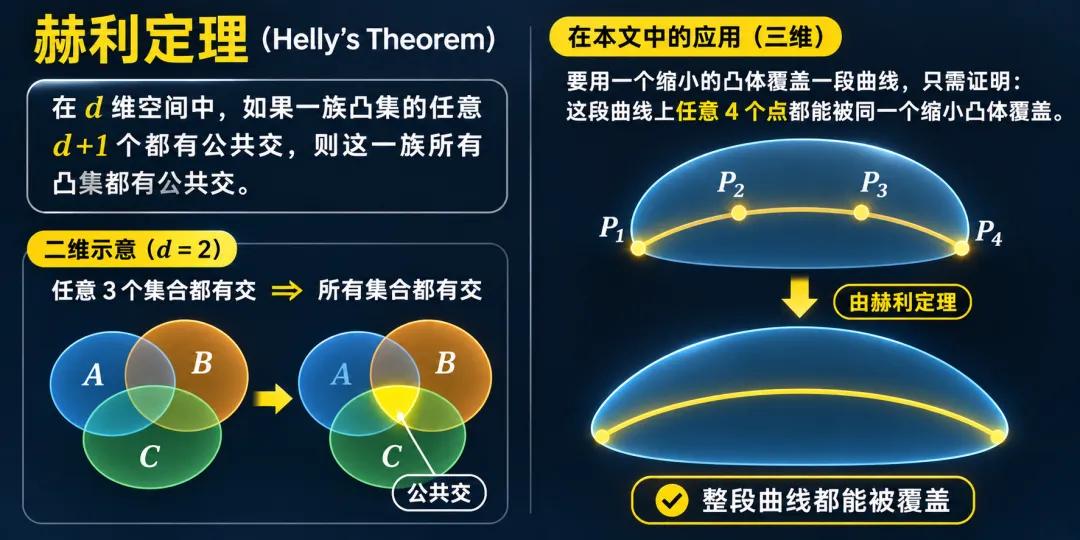
In 3-dimensional space, if any four points on a continuous curve can be covered by the same scaled-down version of the planet, then the entire curve can be covered.
For an arc with a length strictly less than 2, through clever scaling of chord length, the AI proves that there must be a scaling ratio λ0<1 that can cover this arc.
Each arc with a length less than 2 is enough to be illuminated by one sun shining from the inside.
Two suns at the two ends, six suns for the six segments on the waist, adding up to exactly 8!
Moreover, in order to perfectly avoid the "approximation trap", the AI uses a clever tactic: it uses the circumscribed polyhedron and Cauchy's planar perimeter formula only to "measure the length", and combines Fatou's lemma to take the infimum.
All operations are performed on the original planet, perfectly avoiding the approximation trap.
Human Steering, Machine Self-Verification
So, for such an exquisite solution, how much did humans participate?
In the paper, Dror Aiger from Google, Professor Sariel Har-Peled from the University of Illinois, and Žužić candidly stated:
The experimental framework built internally at Google based on Gemini 4 Carbon discovered this proof with very little human guidance from Dror Aiger and Goran Žužić.
Subsequently, the agent architecture on Gemini 4 Carbon completed the formal verification in Lean 4.
The three authors verified the mathematical details and prepared the presentation of this paper.

This time, Gemini 4 Carbon demonstrated highly creative mathematical intuition, such as constructing the difference body, finding the John position, and skillfully dividing the terminator line.
What is even more amazing is its implementation capability.
After finding the idea, the agent directly turned to the Lean 4 formal verification system.
In Appendix A of the paper, without any extra custom assumptions, the agent directly called the most basic definitions of "compactness", "convex set" and "interior" in the standard mathematical library Mathlib.
/-- **Hadwiger's covering conjecture in three dimensions (Theorem 1.1)**:Every compact convex subset `K ⊂ R3` with nonempty interior can be covered byeight smaller positive homothetic copies of itself... -/
In order to prevent the AI from being lazy by using existing conclusions, the machine even proved basic propositions such as Carathéodory's theorem and Helly's theorem from scratch.
The final delivered complete project contains 34 files, with a total of 13,725 lines of Lean 4 code.
4-dimensional Space Problem, Mankind Can Only Leave It to AI
In the masterpiece *Nightfall*, Isaac Asimov once described a planet named "Lagash".
This planet is located in a multi-star system with six suns, the sky is always bright, and an eclipse and night come only once every two thousand years.
What Hadwiger left to mankind 69 years ago is also such a planet that needs to be lit by suns. Today, Gemini has