Karpathy sparks the LLM Wiki, Chinese companies have taken the lead in developing and launching enterprise-grade products.
When processing complex materials with AI, "failing to find relevant content" is no longer a problem. The real pain points are that "the retrieved content is untrustworthy" and "the retrieved content cannot be used by Agents".
In current professional scenarios, the materials include PDFs that are often hundreds or thousands of pages long, as well as various formats such as videos, Excel spreadsheets, and mixed text-image files. Statements from different materials even contradict each other.
While AI liberates productivity, cross-document verification, conflict identification, and conclusion tracing in turn take up a huge amount of people's time.
Last April, Andrej Karpathy, the former co-founder of OpenAI, published a technical concept on GitHub, outlining a knowledge system called LLM wiki in more than 2,000 words, which points directly to the fundamental defect of current knowledge bases: every time a large model receives a new question, it has to retrieve and deduce from the original documents from scratch, which is equivalent to "rediscovering knowledge from scratch every time". There should be a compiled knowledge product that enables the model to avoid repeating reasoning in new tasks.
After its release, the Gist gained more than 10,000 stars, and the top concern of the community is: who will turn this concept into a product?
Eight months later, lumimax launched by Haima Cloud gives this concept a concrete product form.
Founded in 2014, Haima Cloud has been continuously exploring the transformation of AI technology into actual productivity. From RunningHub, an all-round content creation platform driven by native AI agents, to lumimax, the enterprise-level trusted knowledge base infrastructure for Agentic AI, Haima Cloud is expanding the application of AI to more vertical productivity scenarios.
lumimax organizes massive, ultra-long and multimodal professional materials into interconnected knowledge, supporting cross-document reasoning, conflict identification and evidence tracing, so that Agents have available knowledge and traceable basis when performing tasks.
Upon its release, lumimax achieved the highest score in 8 public global evaluations. The gold content of this set of results depends on the difficulty of the test questions and the weight of the reference line:
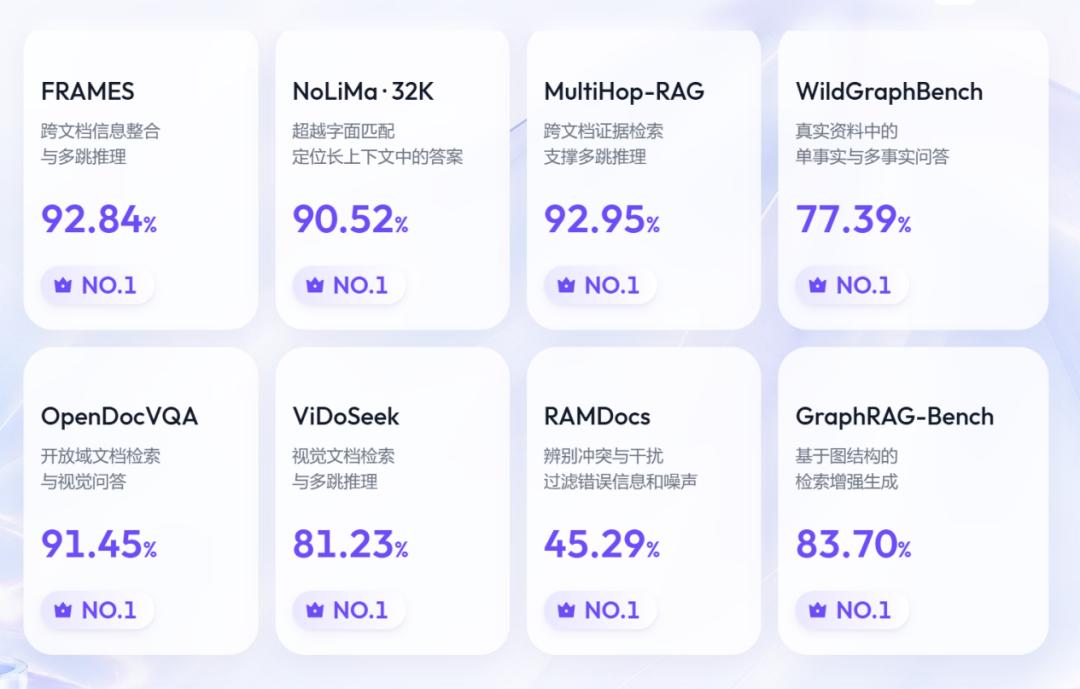
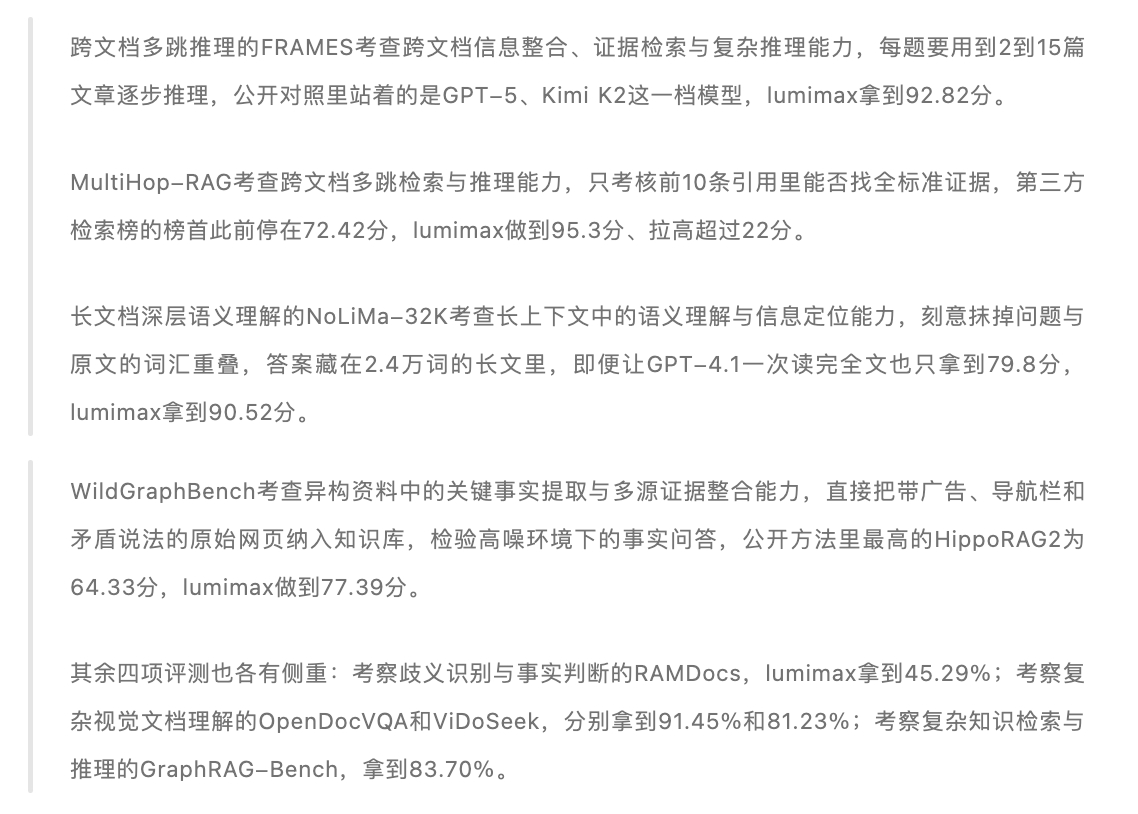
Finding all evidence, clarifying sources, and extracting facts from noise, these test questions directly target the practical difficulties in enterprise implementation, and also determine whether enterprises dare to apply AI-generated conclusions to business operations.
These mainstream benchmarks aim at the core problems that the knowledge layer must solve in enterprise scenarios: cross-document clue connection, deep semantic retrieval of long documents, analysis of complex multimodal documents, conflict detection, and fact extraction in high-noise environments.
After solving these problems, the value of the knowledge layer in the Agent era goes far beyond that.
01. What does China's LLM wiki look like?
From the perspective of structural changes in the knowledge layer, lumimax implements the knowledge compilation idea proposed by Karpathy in LLM wiki into the product. It skips traditional keyword matching and text slicing, and reorganizes all types of documents imported by enterprises into a reasoning-enabled, traceable, and Agent-accessible knowledge network.
Behind the productization of the LLM wiki concept, a bigger signal is that industrial consensus around the knowledge layer is converging.
The current AI landscape is: the model layer and the application layer are more prosperous than ever, but the enterprise's own knowledge layer is the only short board. The implementation of general Agents is stuck due to the lack of sufficient, available and trustworthy context, so the knowledge layer needs to be constructed and invested independently.
KMWorld predicts that the global knowledge management market size will grow from 23.2 billion US dollars in 2024 to 74.2 billion US dollars in 2031. In the report released by Sullivan last October, the positioning of AI knowledge base was upgraded from an information management tool to an enterprise business infrastructure.
The capital side has already given its answer. An overseas enterprise knowledge management startup completed its Series F financing in June 2025, with a post-investment valuation of 7.2 billion US dollars and an ARR of about 200 million US dollars.
"Whether a company can grow out of the AI knowledge layer" has been marked with a clear market value, and this is exactly where lumimax cuts in. A highly productized LLM wiki is more suitable for current enterprise-level AI than the traditional RAG solution that shreds documents, vectorizes them, and recalls paragraphs by similarity.
In fact, in the past, the technical link of RAG was not considered outdated for enterprise knowledge bases. But this year, after the truly capable Agents are implemented in enterprises, the volume of documents that can be called by Agents is huge with many versions, and conclusions need to be supported by a more complete evidence chain. The problems of RAG such as retrieval drift, context breakage and untraceable facts have been sharply amplified.
Haima Cloud launched lumimax at this node, which is equivalent to seizing the time window when the market starts to "reprice" around the Agent ecosystem. The evaluation score is only a representation. More importantly, a brand new technical route has been verified.
The product logic of lumimax is actually very simple. Enterprises upload content assets such as documents, images, audio and video through the entrance at www.lumimax.ai, supporting the one-time warehousing of materials at the level of tens of millions of words; the system performs full-volume multimodal analysis, extracts entities, events, relationships and evidence, builds a cross-document knowledge graph, and then is called by humans and Agents through dialogue or MCP interface.
02. Verifiability: Turning Knowledge from Raw Materials into Conclusions
From concept to product, the form and access method of LLM wiki are easy to figure out, and the real bottleneck lies in the choice of technical route.
The past task of the knowledge base was to "find relevant paragraphs", but now the requirement has become to "deduce traceable conclusions", and the underlying architecture will move to a completely different link.
Let's look at a specific scenario. A law firm faced a typical knowledge management dilemma in a battery pack quality dispute: a large amount of evidence, layers of replacement of clauses, and different wordings for the same meaning. The case involves more than 1,000 documents including the main supply contract, old and new versions of attachments, supplementary agreements, exchanged emails and meeting minutes, totaling more than 10,000 pages, and the most critical clause is likely to be hidden in one of the scanned attachments that has not been made into a formal text.
What is more tricky is the version relationship: the main contract stipulates the upper limit of the total amount, the supplementary agreement makes an alternative expression, and the new version of the attachment separately limits the compensation conditions for specific claim types. Which clause is actually applicable depends on the signing time, replacement relationship and priority. If relying on traditional keyword search, due to different expressions, according to industry practice, four lawyers need to spend several days reading through all documents to sort out the clues.
The law firm imported all the materials into lumimax. The system associated different expressions such as "compensation cap" and "liability is limited to...", tracked from the liability clauses in the main contract to the replacement agreements in the supplementary agreement, and then found the compensation restrictions and priority clauses in the new version of the attachment. The system lists the relevant clauses into a comparison table, marking the source of the original text item by item for lawyers to review.
In the end, the lawyers quickly deduced the real priority and determined which clause took effect. The knowledge layer did not replace the lawyers to make professional judgments, but concentrated the clauses, replacement relationships and original sources scattered in thousands of pages of documents, helping lawyers complete the verification before submitting evidence in the fastest and most efficient way.
The fields that have strict requirements for the credibility of knowledge verification are not limited to the legal industry, and professional scenarios such as scientific research, medical care, and finance are the same.
In the scientific research environment, most of the literature and experimental data involve sensitive information and cannot leave the boundary of the laboratory. At the same time, the versions of guidelines and literature will continue to be updated, and conclusions and prerequisites are easily mismatched. The private deployment of lumimax enables knowledge processing to run locally, and the incremental update mechanism helps researchers continuously incorporate newly published literature and new data, so that every conclusion can be traced back to the original source.
From these two scenario cases, it is obvious that without accessible and reliable knowledge assets, professionals cannot obtain professional productivity only through Agents, which is also the most important presentation form of sovereign AI in enterprise scenarios.
To achieve these capabilities, lumimax has independently developed a full-link knowledge engine. The basic unit of the underlying core architecture DEN (Deep Evidence Network) is not a text slice, but takes "entity-event-relationship-evidence" as the basic unit, connecting the complete path from materials to conclusions.
03. Four Links from Materials to Conclusions
How does the link of DEN (Deep Evidence Network) operate specifically? Let's start with what a piece of material will go through after entering lumimax.
The first link is how material analysis forms knowledge. The traditional practice ends after extracting text from multimodal documents, while lumimax first performs full-volume multimodal analysis, uniformly extracts PDFs, scanned documents, tables, images, audio and video, and retains the original sources. Then it enters the knowledge compilation stage, extracts entities, events and relationships from a large amount of materials, and builds cross-document searchable knowledge pages and graphs.
In this process, there is a classic difficult problem in the field of information extraction: entity disambiguation. The knowledge compilation of lumimax is to accurately locate entities, sort out relationships, and connect events. Parties A and B in different contracts of the enterprise, the same person or the same piece of equipment in different emails are thus accurately connected by the system.
For example, after uploading the full movie *Odyssey* to the knowledge base of lumimax, the system will divide the whole film into sections and paragraphs with specific time intervals, and synchronously extract shot descriptions and line transcriptions. When the user asks "Introduce the role played by Anne Hathaway, and what plots her acting skills are mainly reflected in", the answer first clarifies that she plays Penelope, Queen of Ithaca, and then disassembles it paragraph by paragraph according to specific scenes. Every performance analysis is accompanied by a reference number and the corresponding time interval, which is convenient for direct backtracking to the film for verification.
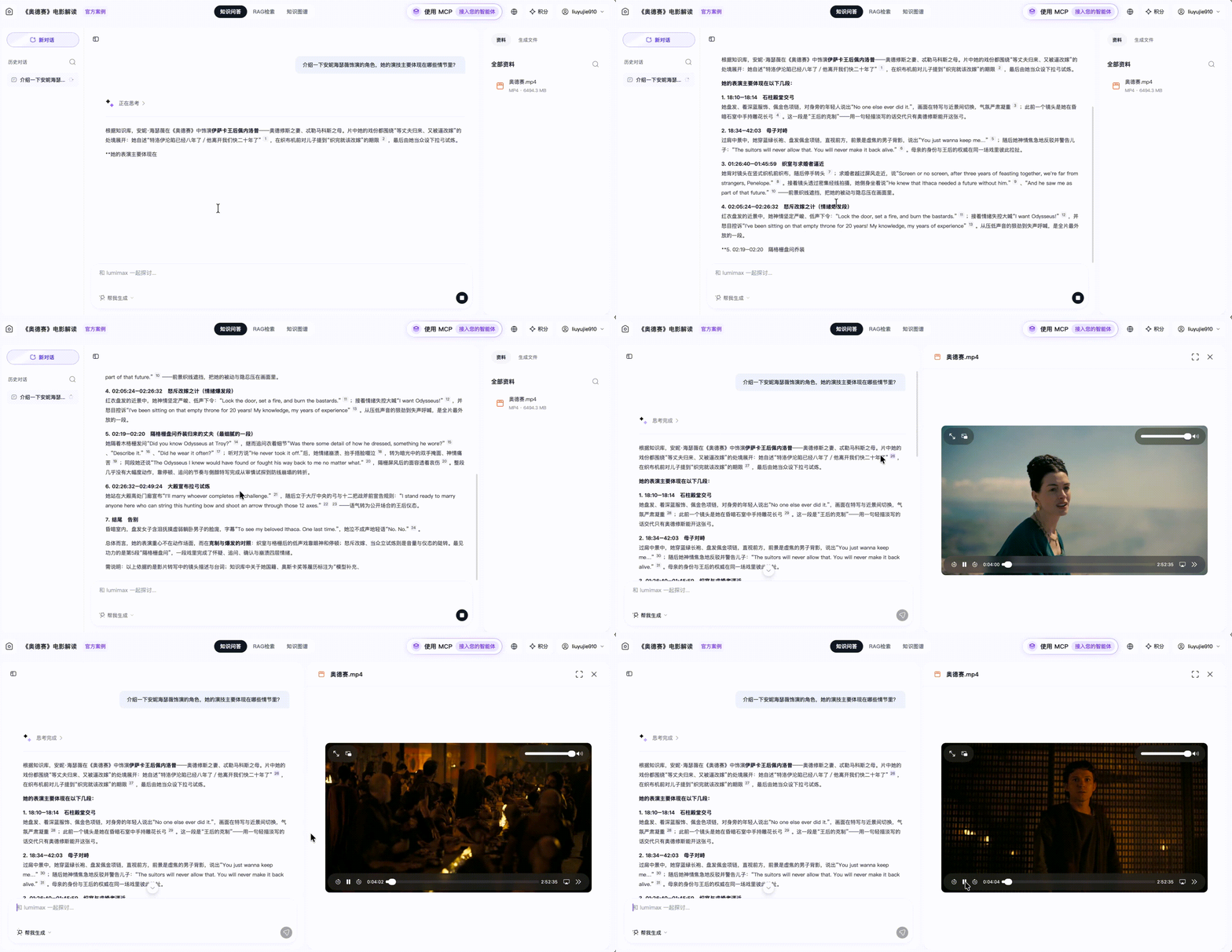
At the end of the answer, the system will actively draw the evidence boundary, noting that the above content is based on the shot descriptions and lines in the film transcription, and the resume information in the knowledge base involving the actor's nationality, Oscar awards and other information is marked as "model supplemented, not externally verified" and will not be used as the basis for the plot. Based on the same set of parsed knowledge, the user continues to ask to organize it into a classroom speech, and the system immediately generates a 15-page PPT, and brings the basis description into the finished product together.
The second link is how retrieval evolves into reasoning. The traditional RAG method uses semantic similarity to grab several paragraphs and throw them to the model, so the model sees isolated fragments. lumimax's hybrid retrieval is not satisfied with this step: it automatically combines paths among knowledge directories, keywords, semantics and relationship queries, starting from one fact, tracking to the next intermediate object, then to related materials, and deduces layer by layer. There is no skipped step in the middle, and each step is anchored by the source.
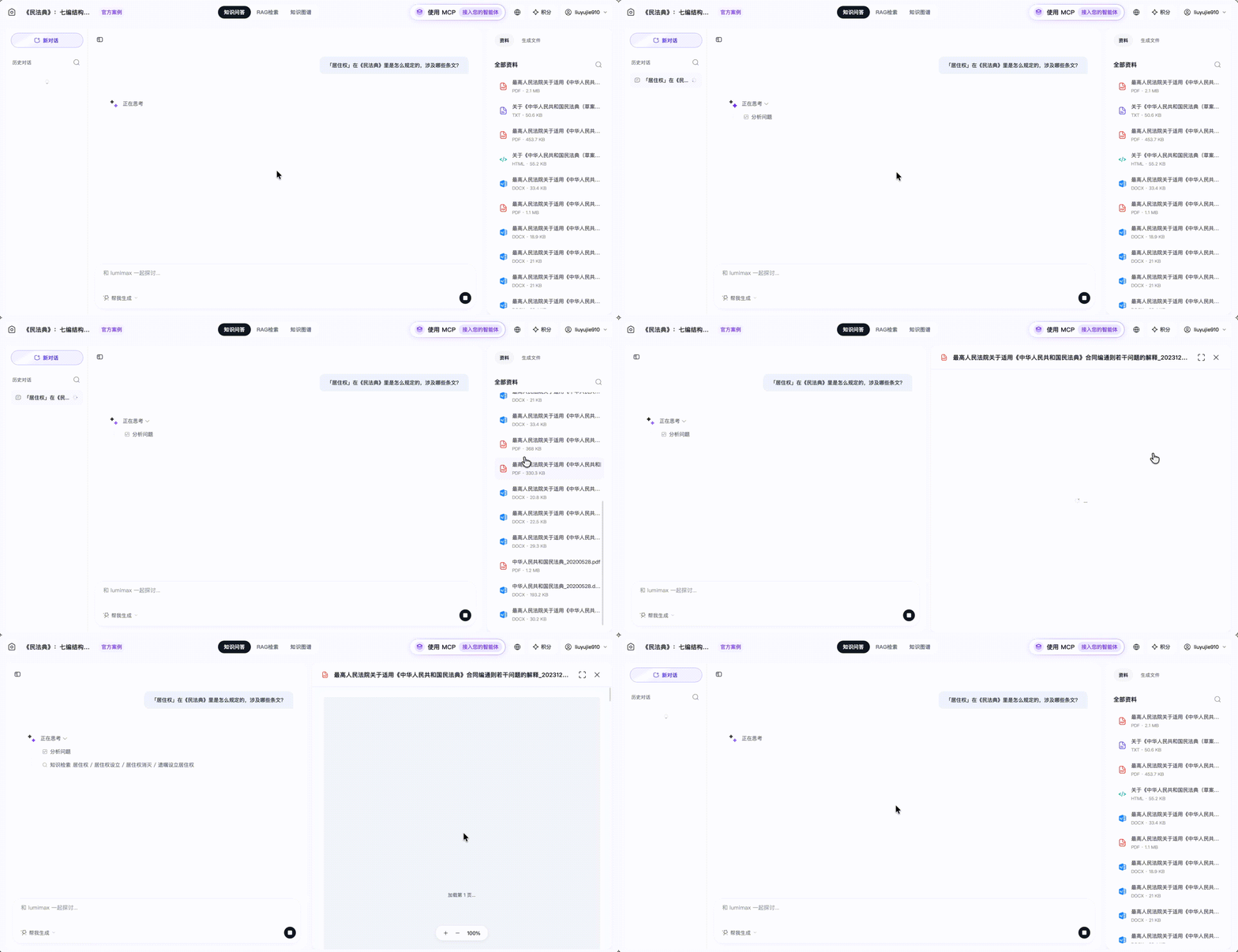
In an official case, more than ten mixed-format documents including the full text of the Civil Code and multiple separate interpretations of the Supreme People's Court were uploaded to lumimax. The system will first compile it into a knowledge graph containing thousands of nodes and tens of thousands of relationships.
Asking "How are the provisions on the right of habitation stipulated in the Civil Code, and which articles are involved", the system first locks the core provisions in the Real Rights Part, then continues to track between the main text and the General Provisions Part, the Marriage and Family Part, and the Succession Part judicial interpretations along the connection of legal provisions, pulls out the connecting clause of Article 945 of the Contract Part that the owner who establishes the right of habitation must notify the property service person in time, and simultaneously calls out the corresponding page number.
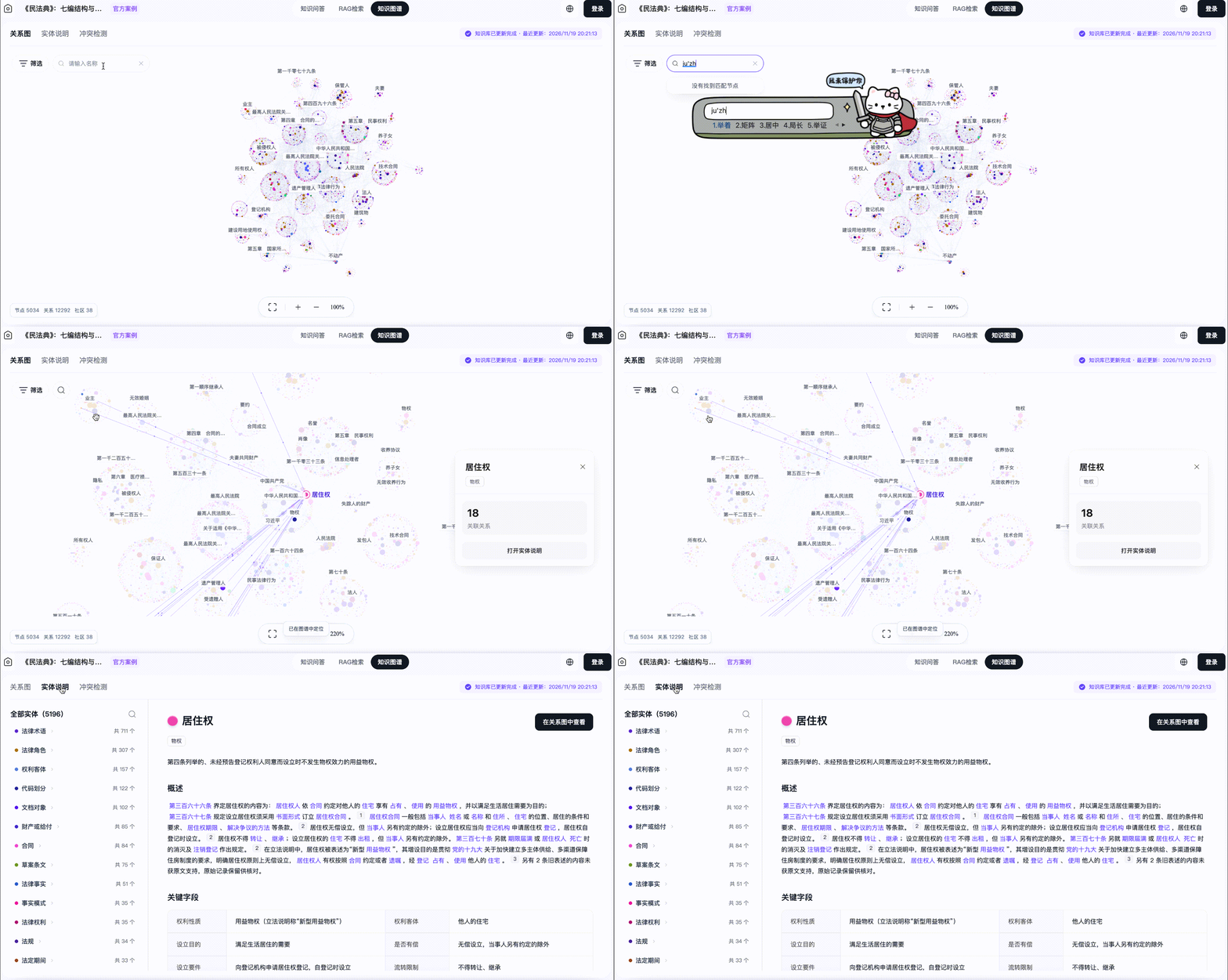
The answer is expanded item by item according to the definition, establishment, elimination and cross-part connection of the right. Click the attached reference number, the right side directly locates the corresponding page of the Civil Code PDF and highlights the original paragraph, and every conclusion can be traced back to the source.
The third link is incremental update. The knowledge base built by lumimax can be continuously updated as materials change. When new materials come in, or the original file is modified, the system only updates the affected knowledge entries and associations. For example, if a supplementary agreement modifies a certain agreement in the original contract, the system will update the corresponding clauses and sources, and other sorted content can continue to be used.
The fourth link is more convenient document presentation. lumimax supports enterprises to directly generate reports, tables and presentations on the web page. In the previous *Odyssey* example, after the user finishes asking about the role and performance, he can then ask the system to organize the analysis into a PPT for classroom speech, and the relevant basis will also be brought into the finished product.
The logic of lumimax's knowledge link is that after the previous step is completed, the next step must be able to take over. After the multimodal analysis is completed, knowledge compilation can pick up cross-references, and then hybrid retrieval can pick up cross-document jumps; after retrieval and reasoning are completed, verification can pick up the original text comparison.
If the knowledge breaks at any link, the output conclusion will lose credibility.
So far, in the AI knowledge layer represented by lumimax, the generational differences of technical routes are also becoming clear. From keyword retrieval that can find the specified paragraph, to vector semantic retrieval that understands similar meanings, to basic RAG that can generate answers based on recalled paragraphs, lumimax supports cross-document connection, multi-hop reasoning and conflict detection, realizing computable knowledge, verifiable reasoning and traceable conclusions.
04. Knowledge Base Comes First before Agent Driving
In 2026, the AI industry is forming a consensus: AI is moving from answering questions to performing tasks, and Agents will play an increasingly important role in it. Dang Jinfeng, founder and CEO of Haima Cloud, has a judgment: the future will be an era of "Agents driving everything".
As the capabilities of general models gradually mature, the focus of AI Agent competition shifts to professional scenarios - the implementation solutions that can really help people make judgments and perform tasks in specific fields.
Gartner's prediction draws a new