New romantic outlook among young Americans: they would rather stay single than date people engaged in AI-related work.
If you go on a blind date and the other person introduces themselves, saying, "I work as an AI engineer at a big tech company."
What would your reaction be?
Most likely, you would think that this person not only has a stable income but is also very motivated, having at least seized the opportunity and ridden the wave of the times.
However, at a blind date event in the United States, when an AI practitioner proudly introduced their profession, they were met with boos. They have no idea about the market, and many people's signatures on dating apps explicitly state that they do not want to date people working in the AI industry.
Can we talk about something else besides AI?
Last month, a blind date event themed "Love Isn't Blind" was held in San Francisco. The process was quite dramatic: four single men sat on the stage, and the host checked their AI chat histories, Reddit browsing records and other content on their phones in front of the audience, then showed the content to the people in the audience.
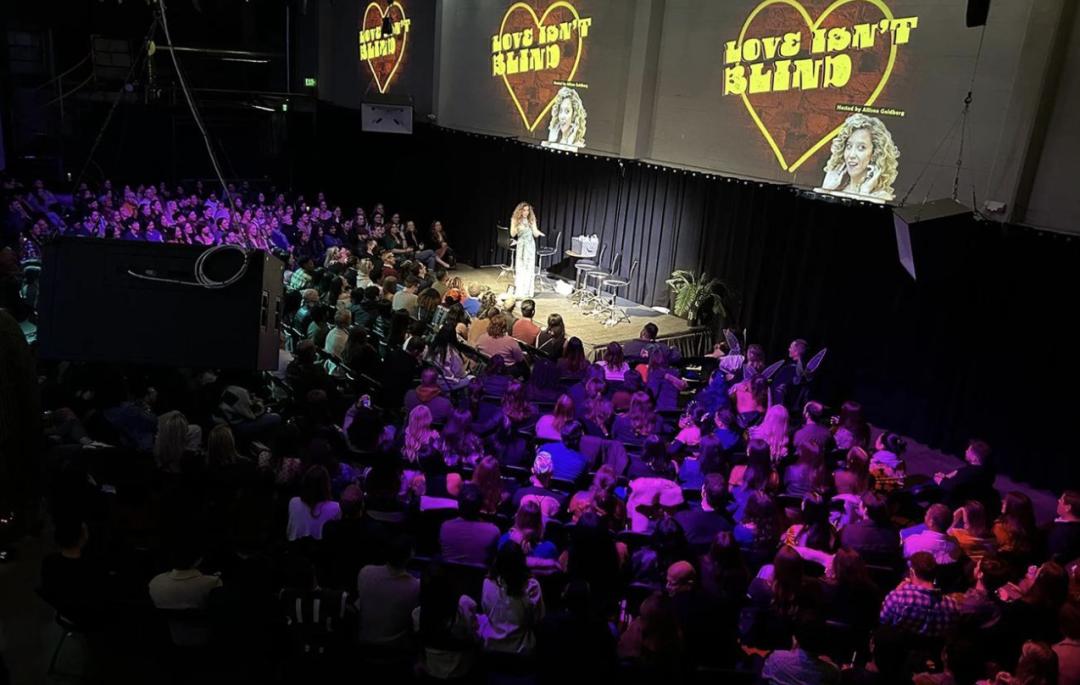
Image source: The Foundry
Two of the four men work in the AI industry. When the host introduced their professions, boos broke out from the audience. The host was shocked, as she had held the same event in seven cities across the United States, and only the guests in San Francisco had such a strong reaction.
What kind of place is San Francisco? It is the headquarters of AI companies including OpenAI and Anthropic, gathering a group of the richest and smartest minds in the world. According to common sense, the professional backgrounds of these people should be a clear advantage in the blind date market. But it turns out that they were the first to get "rejected"?
24-year-old elementary school teacher Jessica Traver said that if a blind date says he works at OpenAI, she will immediately deduct points from her first impression of him. The reason is that she resents these companies' attempts to replace human jobs with AI. The values demonstrated by enterprises are very important. For example, Anthropic has won more of her trust because it often publicly calls for "attaching importance to AI safety issues".
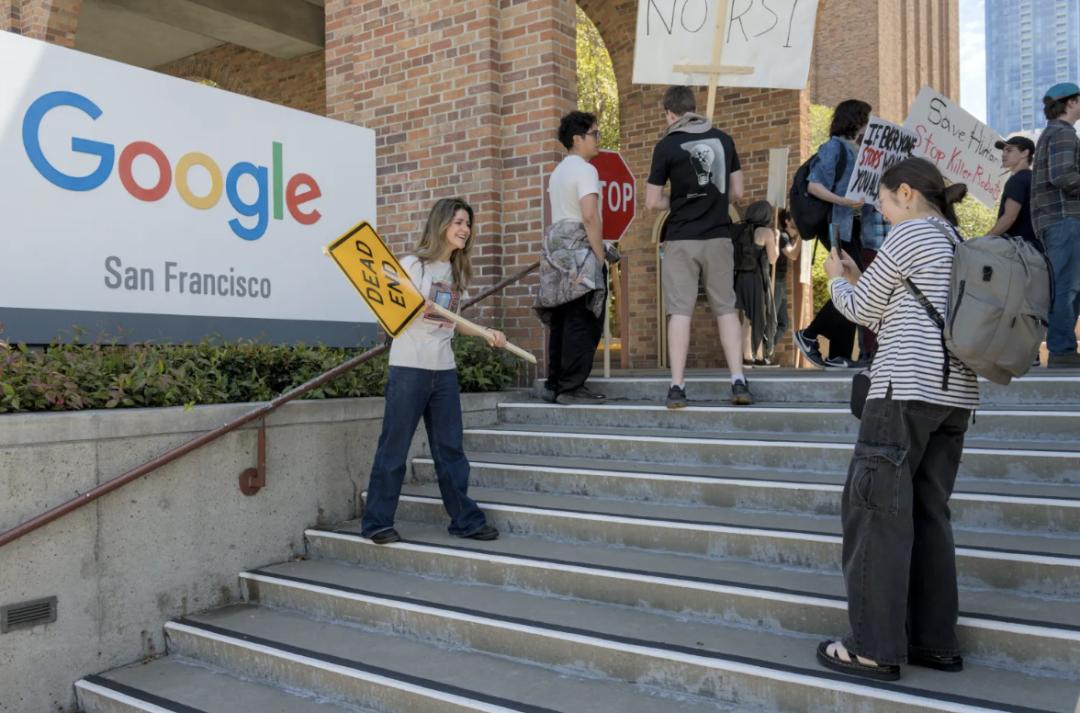
Anti-AI protest in San Francisco on November 14 | Mission Local
A lawyer shared that he once met a woman in a bar, and they got along very well at first. But when he learned that the woman worked in sales at OpenAI, he immediately lost interest, thinking that she was just chasing the trend to make quick money. "I'm fed up with everyone talking about AI all the time. Can't people talk about other things, like politics or religion?"
Interestingly, people inside the industry also do not want to date someone working in the same field. Because they are well aware that many people are only attracted by the high salary, or the seemingly glamorous and cutting-edge technical prospects, and rarely think deeply about the impact of their work on society.
On dating apps, AI has become a "personal preference" alongside skiing, yoga and surfing. Where there are people who love it, there are people who hate it. Some people write "Fuck AI" blatantly in their personal profiles; others explicitly list their dating rules, stating "I just don't want to date people who love using AI".
However, "views on love and marriage" vary greatly across different cultural backgrounds. The New York Times interviewed Zhao Qinghua, founder of the North American Chinese dating platform "2RedBeans". According to her observation, in recent years, the mate selection requirements of some Chinese clients have become more and more specific. In the past, they only wanted to find engineers working on the east and west coasts of the United States, then they wanted Silicon Valley engineers, and now they specifically name AI engineers, preferably working at OpenAI or Anthropic.
This is a narrative that we find easier to understand. Blind dates value income and social status, and a well-paid job that is expected to remain on the rise is decent enough to demonstrate social status. Can't even this win the hearts of young Americans?
Why do people get so reactive when they hear the word AI?
In May this year, at graduation ceremonies of several universities in the United States, students began to get "reactive" whenever AI was mentioned.
The University of Arizona invited former Google CEO Eric Schmidt to deliver a speech to more than 10,000 graduates. Schmidt originally wanted to encourage young people to embrace AI, but as he was imagining how this technology would transform every profession, every classroom, and even every interpersonal relationship, the boos from the audience grew louder and louder.
The Associated Press interviewed a recent college graduate about this phenomenon. She submitted about 30 resumes and never got any response. She said that teachers did not allow students to use AI to do their homework when they were in school, but when it came to job hunting after graduation, enterprises required candidates to have the ability to "collaborate with AI".
A survey by Pew Research Center in August this year showed that 71% of American adults believe that AI will reduce the number of jobs in the United States in the next 20 years. Among young people aged 18 to 29, this proportion reaches 73%.
It is inevitable for students to roll their eyes at the self-absorbed industry tycoons: you use AI to improve work efficiency, but where are the jobs?
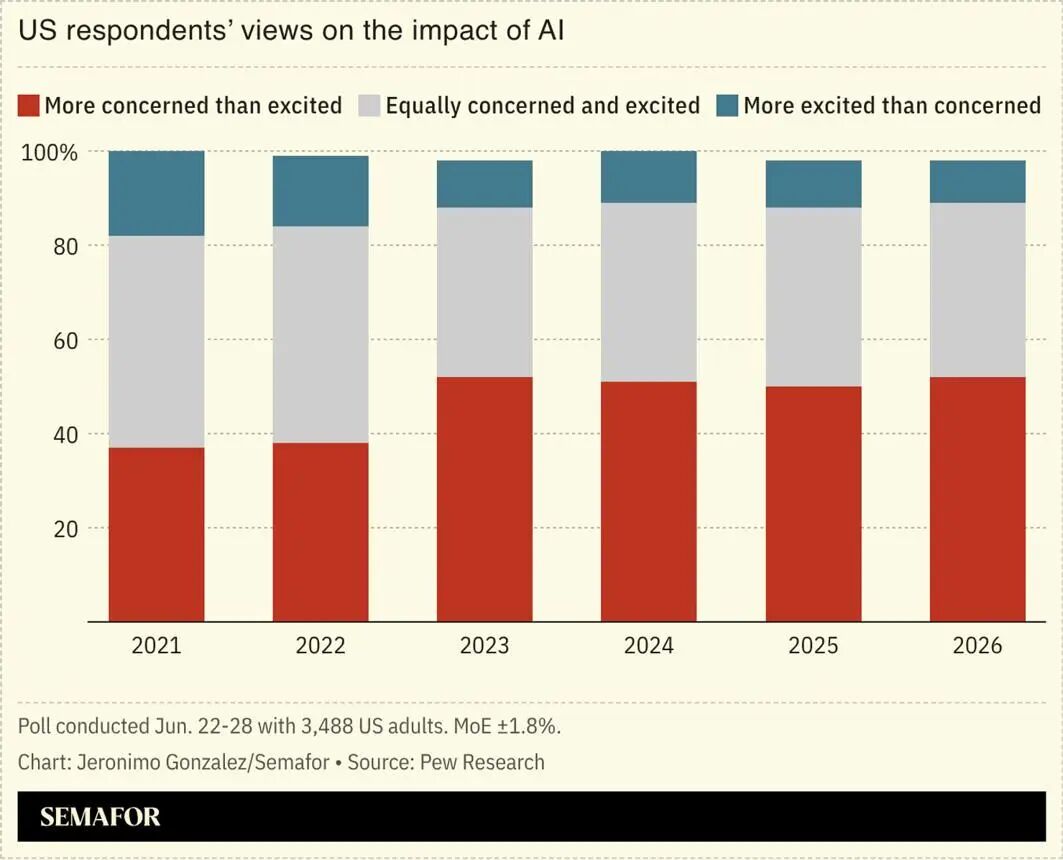
Ordinary American people's concerns about AI are growing day by day | Pew Research Center
Even if you successfully find a job, is a young person's career stable?
Even industries that once prided themselves on "creativity first", such as writers, illustrators, musicians and actors, have been infiltrated by AI. The director of *The Shape of Water* yelled "Fuck AI" on the stage at this year's Cannes Film Festival, winning widespread applause from the audience. Creators are afraid that their achievements will be used to train AI models, and then they have to compete with AI-generated content for the remaining "attention" of human beings.
AI is original sin, stay away from it
Gartner's survey this year shows that 49% of American users believe that generative AI has already worsened the quality of online content. We surf the Internet which is full of all kinds of low-quality AI-generated content. From the perspective of users, people's resentment towards AI has shifted to relevant practitioners.
Creators in the gaming industry dare not admit that they use AI at all. The hit indie game *Big Walk* fell into controversy a few days ago. The development team admitted that they once used AI to debug code, but the involved code accounted for less than 0.1% of the entire game. 19 judges at the Independent Games Festival (IGF) publicly stated that they would not vote for any game that uses generative AI this year. Using AI is original sin, even if it only accounts for 0.1%.
In Europe and the United States, AI has become a sensitive point that undermines community trust. Leaving aside the quality of content, ordinary users will first ask, "Is this thing made by AI?" Europe and the United States have a strong awareness of copyright. Since AI became "prevalent", rights disputes in various fields have followed one after another.
Ipsos surveyed 32 countries this year, asking people if they are excited about AI products and services. 83% of respondents in China said yes, but only 33% in the United States, and as low as 29% in the United Kingdom. One reasonable explanation may be regulation. Some AI tools overseas can generate content with excessive inappropriate content. It is very convenient to use Grok to generate explicit content, and technologies such as Deepfake and voice cloning are also misused, while AI in China has relatively strict restrictions on pornography and portrait rights.
"AI is developing too fast. If it continues like this, humanity may be doomed" is a very mainstream argument on American social media.
In 2023, Geoffrey Hinton, the "Godfather of AI", left Google and publicly warned that AI may bring disasters to humanity;
In 2024, Jan Leike, a researcher responsible for AI safety at OpenAI, resigned, accusing the company of prioritizing the launch of new products over safety research;
Another former OpenAI researcher Daniel Kokotajlo later participated in releasing the *AI 2027* report, which deduced a future where AI loses control and eventually destroys humanity, triggering heated discussions;
In September this year, Jacob Coxon, a former researcher of OpenAI and Anthropic, publicly resigned, accusing the two companies of risking the future of humanity. Many people even involved in AI R&D believe that AI may bring a catastrophe to humanity by the end of the 2020s.
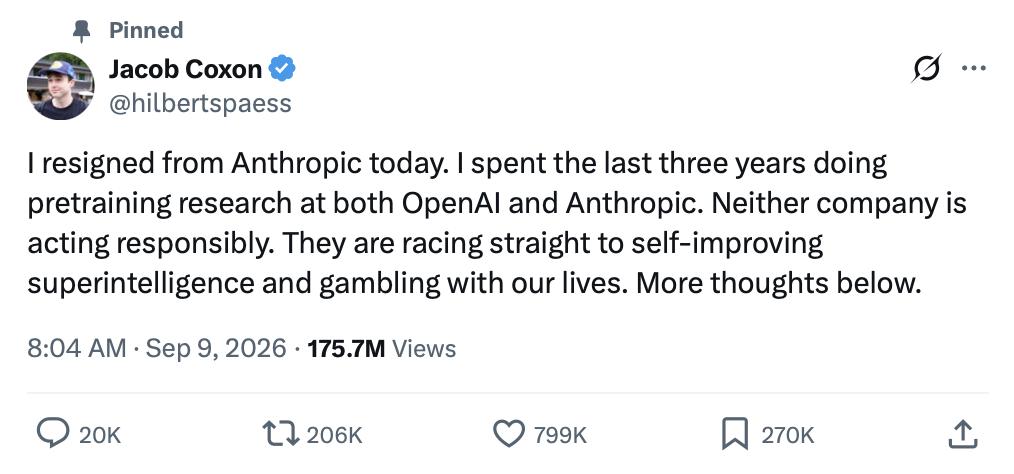
This post has received 175 million views | X
These remarks from industry leaders, who are more vigilant than ordinary people about low-quality AI content and AI's impact on employment, have actually affected the views of ordinary people.
Quinnipiac University conducted a survey showing that 73% of people are worried that AI may threaten human survival in the future. 74% of Americans have little or no trust in the leaders of major AI companies.
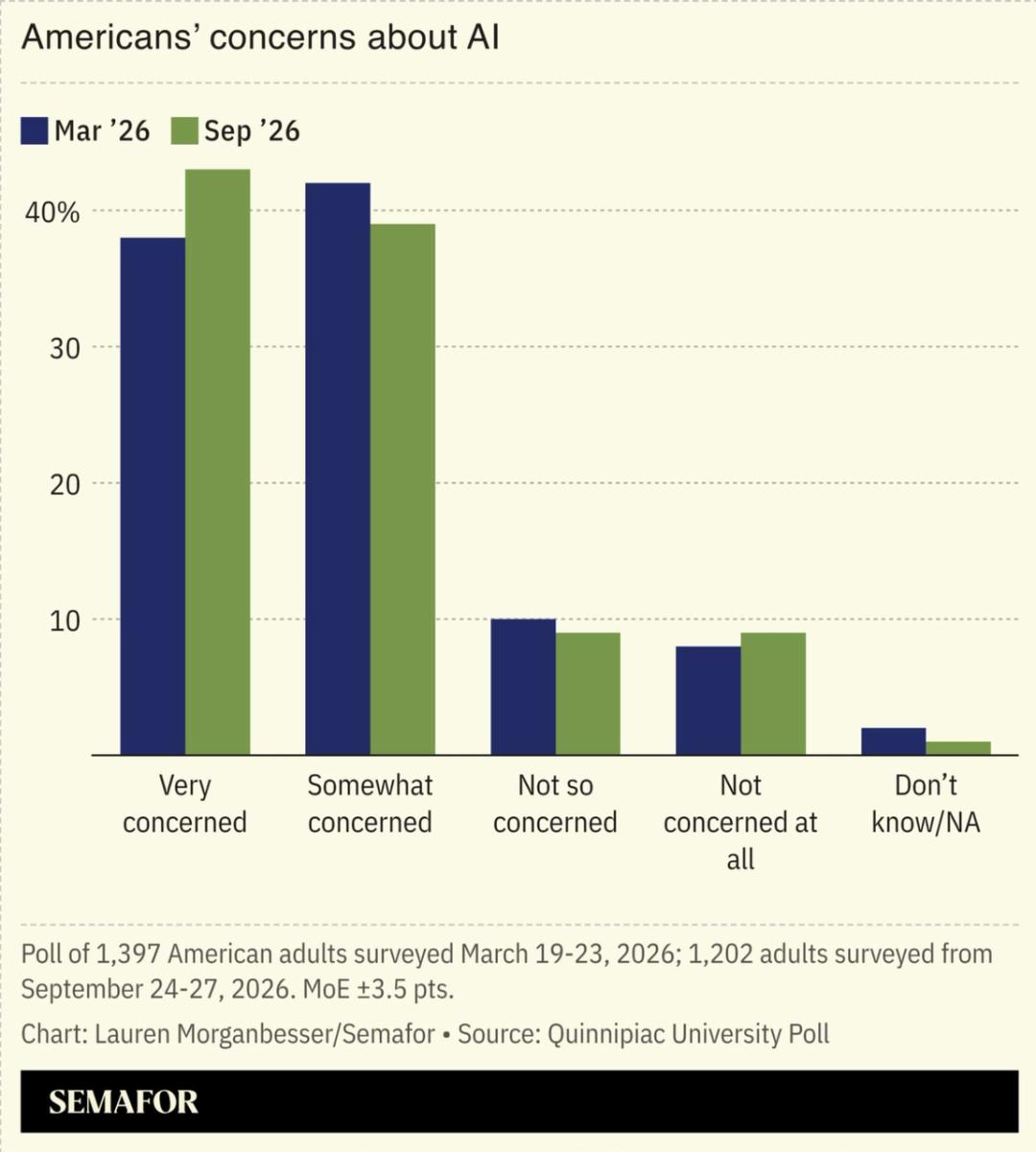
Image source: Quinnipiac University
Our homes are gone, what else is there to talk about?
In fact, even if ordinary people do not use AI, they cannot escape this technological invasion.
The huge data centers being built across the United States mean, in the eyes of nearby local residents, that they occupy a large amount of land for their lives, consume massive amounts of water and electricity, drive up electricity bills, and the related supporting facilities cause pollution.
A super data center project in Utah triggered strong resistance because of its excessive scale. The local area is already arid and short of water, and the nearby Great Salt Lake is shrinking continuously. When residents heard that a large area of power-consuming industrial facilities was to be built, they organized protests one after another, and even filed lawsuits against the government over project approval issues.
In Memphis, Tennessee, in order to provide computing power for Grok, xAI deployed a number of gas turbines for power generation near the data center. Local residents, who have long suffered from industrial pollution, joined environmental organizations and took xAI to court.
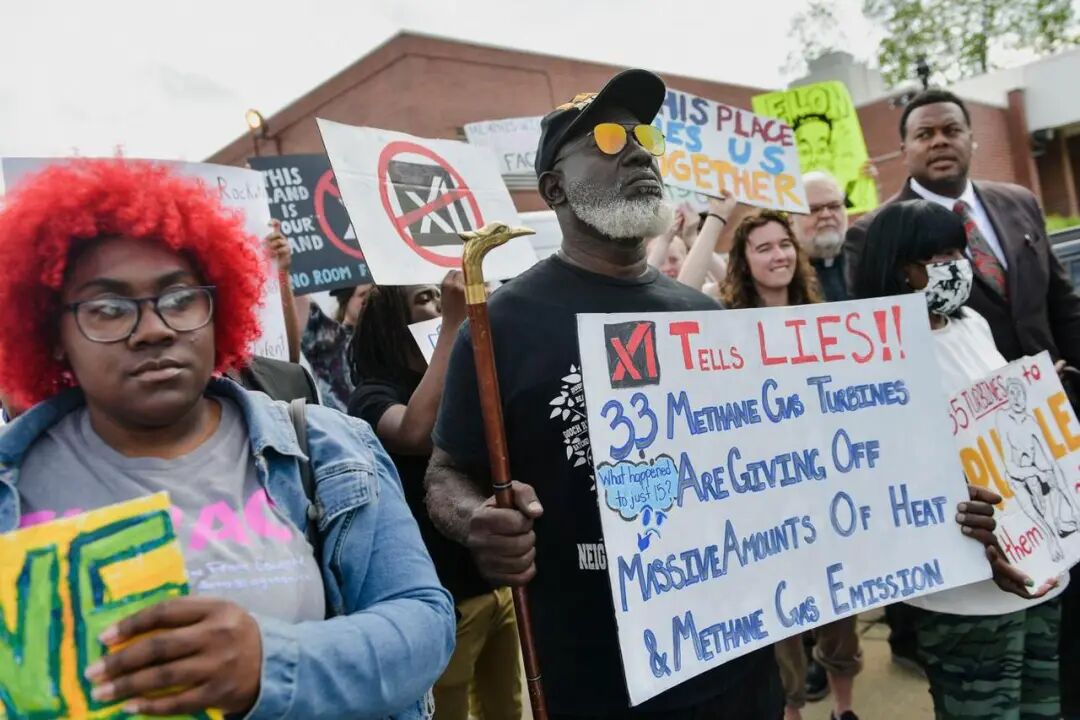
Memphis residents protest against Elon Musk's xAI data center | The Washington Post
A survey released by Pew Research Center in September shows that 60% of American adults are unwilling to build new data centers in the areas where they live. They took their opposition to data centers from community protests to the US midterm elections.
During the midterm elections on November 3, there were 41 issues directly related to data center construction on local ballots in ten US states. In the end, the voting results of 40 of these issues tended to restrict development or reject support for new projects. Some places directly passed construction bans, some suspended approval, and others required that when data centers occupy a large amount of land, water and electricity, they must first obtain the consent of voters.
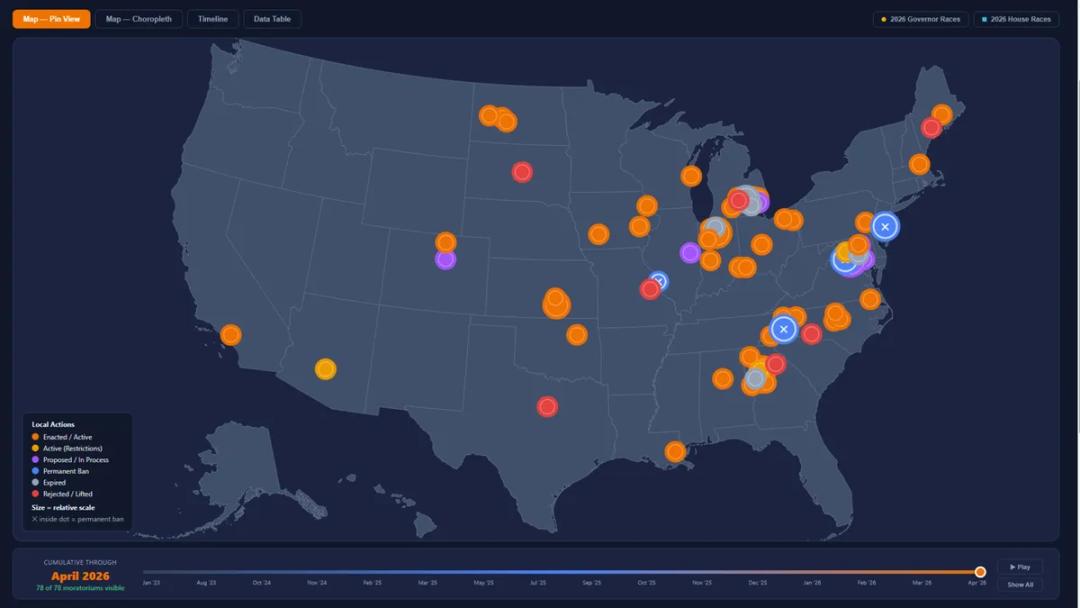
Bans and approval suspensions for data center construction are increasing across the United States. The picture shows the construction progress | Tom's Hardware
Ordinary people have nowhere to escape. Their biggest fear is that one day they plan to lie low, go back to farming and live a secluded life in the mountains, only to find that a data center is going to be built next door. Ordinary people hate AI, but cannot stop it from developing. They can only resist AI within their capacity, refuse to let data centers encroach on their living radius, reject AI products, and refuse to date an AI practitioner with conflicting values.
References
[1]https://www.theverge.com/ai-artificial-intelligence/1028609/ai-dating-feelings-doomers-singularity?utm_source=chatgpt.com
[2]https://sfstandard.com/2026/10/24/ai-dating-preferences/?utm_source=chatgpt.com
This article is from the WeChat official account "Guokr" (ID: Guokr42), written by Gaoji Dongwu, edited by Ma Wen, and published with authorization from 36Kr.