Is there hope for the unification of relativity and quantum mechanics? With the participation of GPT-6 Astra, an 83-page paper has caused a huge stir in the physics community.
"If this conclusion is finally confirmed, physics will truly usher in a grand unification."
After dealing a heavy blow to mathematics, AI now turns its "blade" to physics.
Stanford physicist Venkatesa Chandrasekaran has published a new 83-page paper, which, with the assistance of GPT-6 Astra, proposes a method to unify general relativity and quantum mechanics in four-dimensional spacetime.
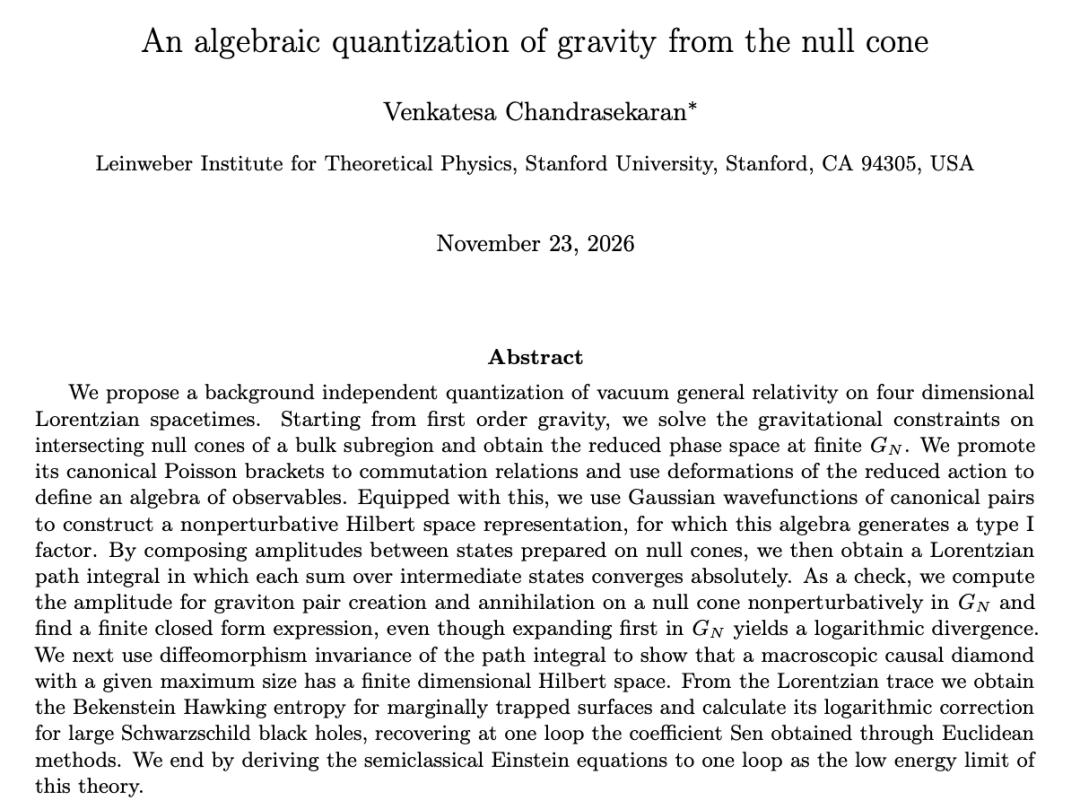
This method attempts to use a unified set of mathematical rules to describe both the gravitational curvature in the macroscopic world and the uncertainty of particles in the microscopic world at the same time.
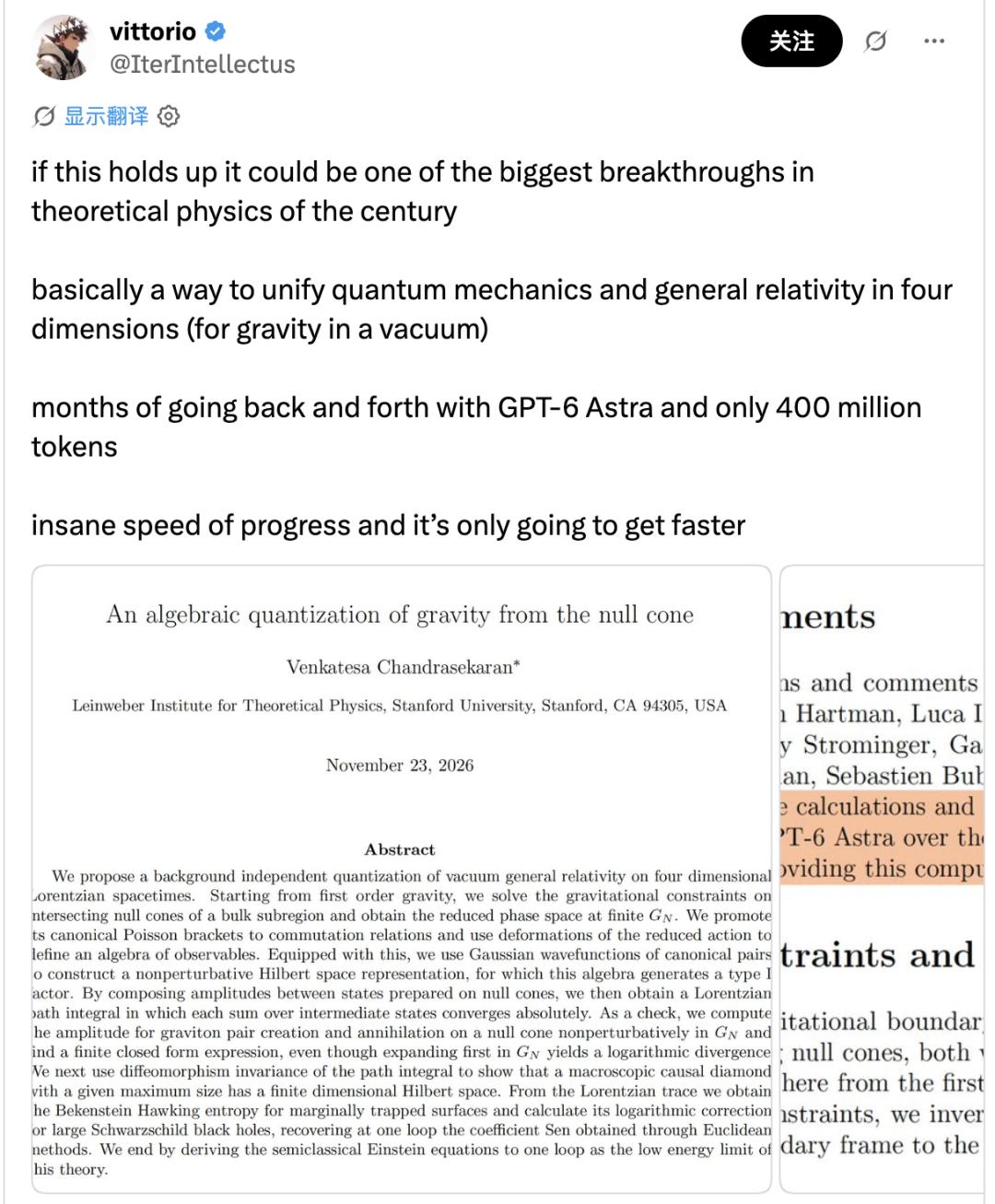
To derive the key calculations and proofs in the framework, he worked iteratively with the model for several months, consuming approximately 400 million tokens in total.
The paper was posted on arXiv for less than a day and immediately caused a huge stir on the Physics sections of X and Reddit.
Some bloggers on X commented that if this theory holds up, it will very likely be one of the most significant breakthroughs in theoretical physics of this century.
The problem behind this paper is a hard nut that physicists have been trying to crack for a hundred years, and it also plagued Einstein for the rest of his life.
Two conflicting sets of rules, physicists have been stuck for over a century
What this paper attempts to unify is "General Relativity", which governs gravity in the macroscopic universe, and "Quantum Mechanics", which describes the laws of microscopic particles.
General relativity, proposed by Einstein in 1915, uses Riemannian geometry to describe gravity, pointing out that matter and energy bend four-dimensional spacetime, and gravity is the external manifestation of spacetime curvature.
If you cannot understand these physical terms, at least you should know that general relativity governs "massive objects" such as the universe, galaxies, planets and black holes.
In its description, four-dimensional spacetime is like a stretched elastic bedsheet. The Sun presses a pit in the bedsheet, and the Earth circles along the edge of the pit.
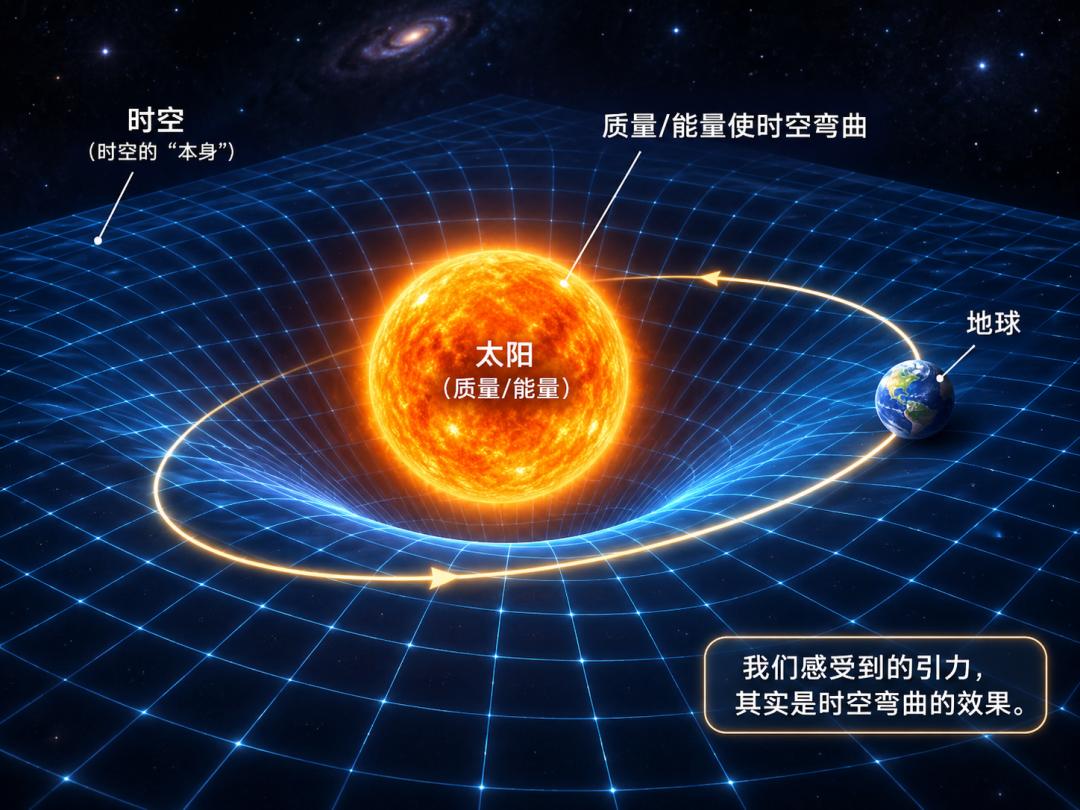
Generated by AI
Quantum mechanics, born in the early 20th century, as well as quantum field theory and the Standard Model of particle physics developed on its basis, use wave functions, probability amplitudes and quantum fluctuations to describe the motion and interactions of microscopic particles.
Simply put, quantum mechanics governs "tiny entities" such as atoms, electrons and photons.
At this scale, particles do not have definite orbits, and are more like a cloud of energy distributed according to probability. The three fundamental forces in nature, namely the electromagnetic force, the strong nuclear force and the weak nuclear force, have all been successfully incorporated into this set of quantum rules.
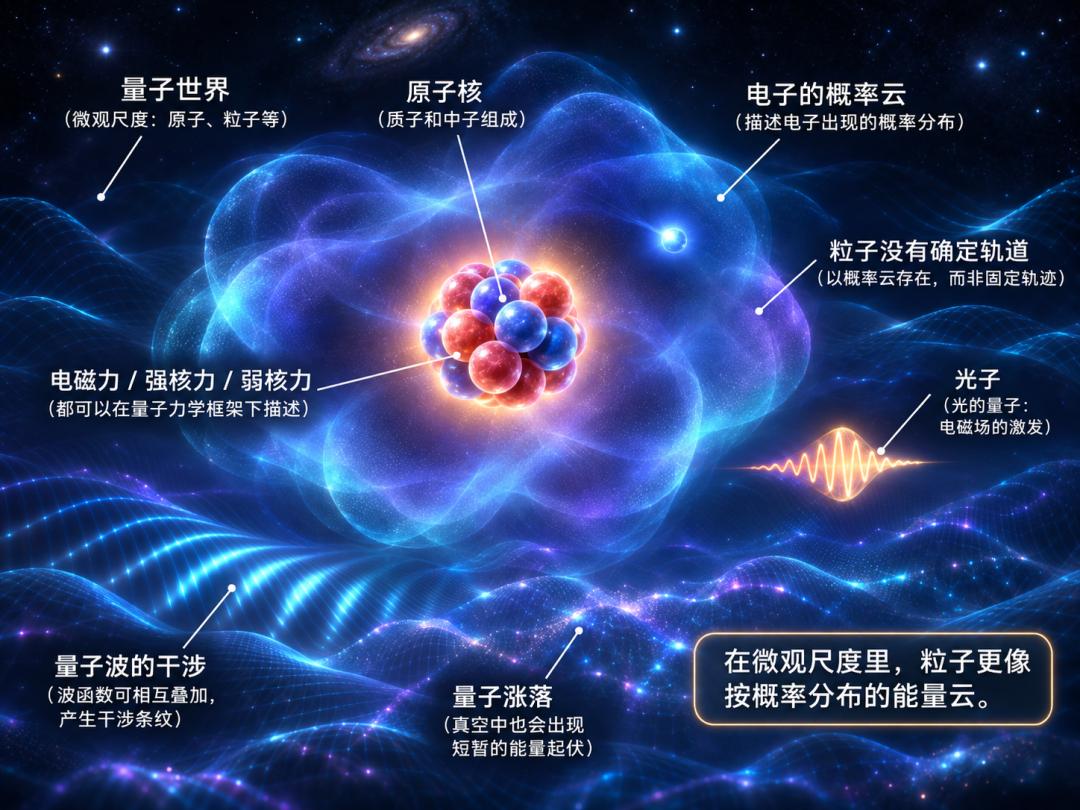
Generated by AI
Both theories are sufficiently accurate in their respective scales, but physicists are obsessed with unifying them.
Why is that?
The first reason comes from the inherent logical contradiction of the equations.
The left side of Einstein's field equation is the geometric tensor describing the classically smooth spacetime, while the right side is the energy-momentum tensor representing the distribution of matter. But matter in the microscopic world follows the superposition principle of quantum mechanics.
For example, when a microscopic electron is in a quantum superposition state of "being on the left" and "being on the right" at the same time, should its generated gravitational field bend spacetime to the left or to the right? Classical general relativity can only make do with the average value of the quantum state.
Once the quantum fluctuation of gravity itself becomes significant, this approximation will completely fail.
It is like a program that only accepts integers suddenly being fed a string of garbled code.
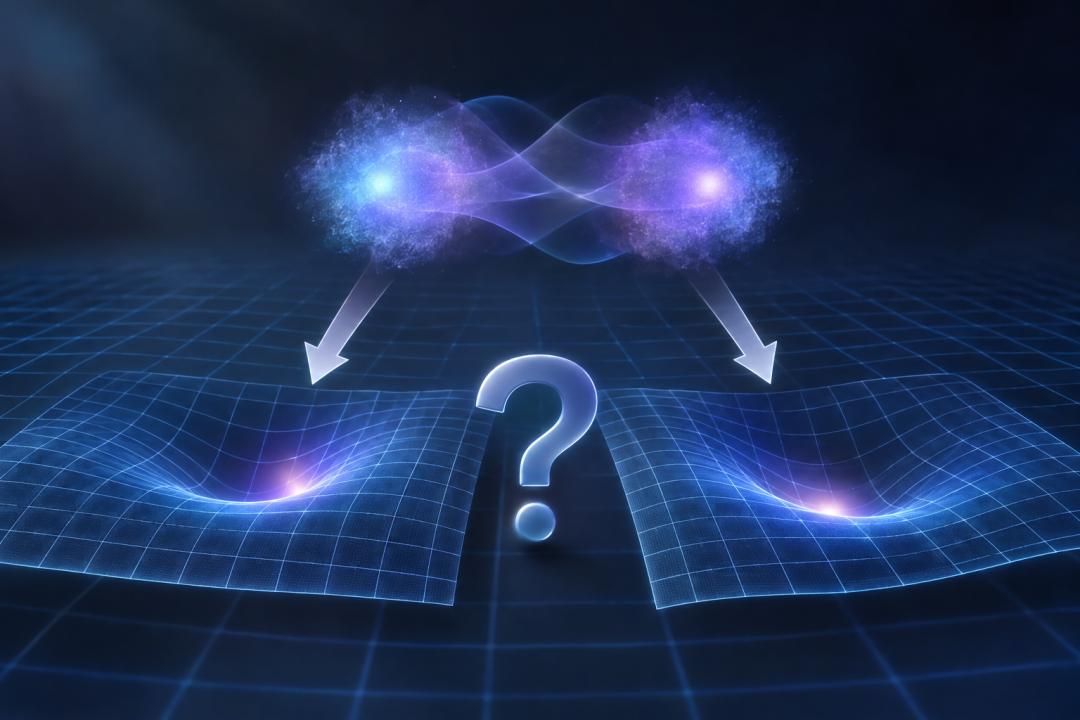
Generated by AI
The second reason comes from extreme scenarios in the universe.
Among the four known fundamental forces in nature, the electromagnetic force, strong nuclear force and weak nuclear force have all been quantized, and only gravity remains outside the quantum framework.
On Earth, gravity is extremely weak and the mass of microscopic particles is extremely small, so the two theories can coexist without interfering with each other.
But at the singularity at the center of a black hole or in the very first instant of the Big Bang, the mass of the Sun and even the entire universe is compressed into the Planck scale, which is countless times smaller than an atom.
In this case, the extremely strong macroscopic gravity and the violent microscopic quantum effects will squeeze into this tiny space at the same time, leading to the failure of existing equations.
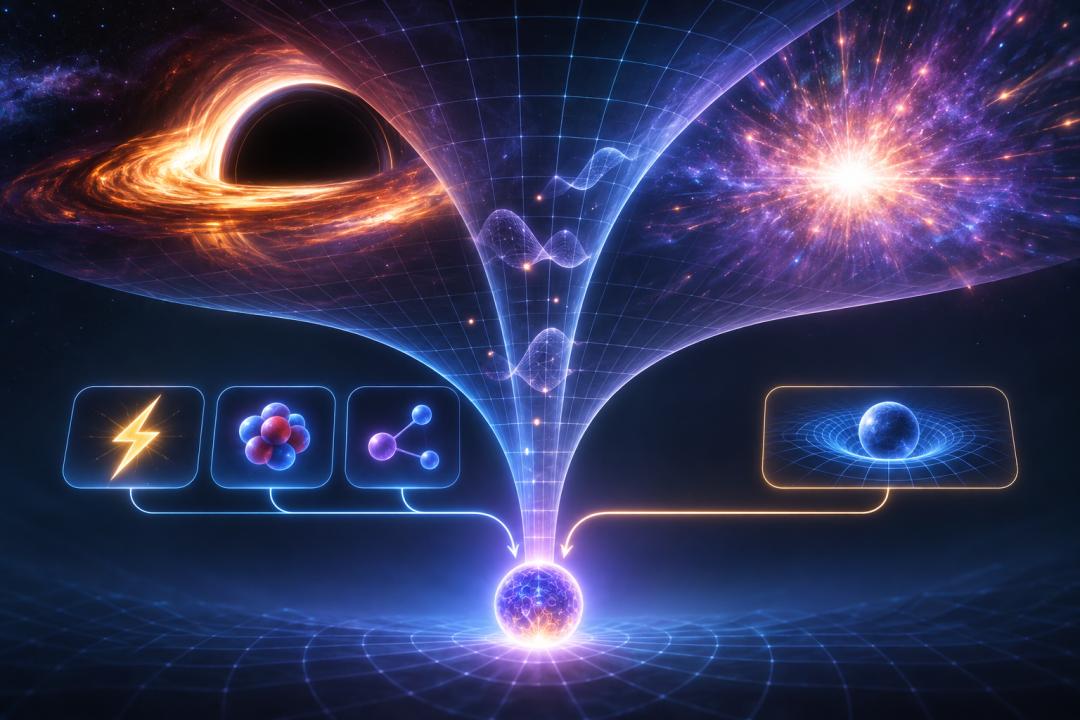
Generated by AI
Therefore, physicists have long been convinced through various clues that these two seemingly incompatible theories can actually be unified at the underlying level.
Of course, to get to the root of the matter, the most fundamental reason is "there is only one universe".
Microscopic particles and macroscopic spacetime cannot follow two sets of contradictory rules for a long time. The error in the equations only shows that the existing theory is not the final version.
A more direct clue comes from black hole research.
Black holes were originally purely gravitational celestial bodies predicted by general relativity. But after Bekenstein introduced quantum effects into the vicinity of the black hole horizon, he found that black holes actually radiate heat outward and have entropy proportional to their surface area.
Hawking later incorporated quantum field theory into curved spacetime, found that black holes radiate heat outward, and finally determined the exact coefficient of the entropy formula.
In the formula for calculating black hole entropy, Newton's constant representing gravity and Planck's constant representing quantum mechanics appear in the denominator at the same time, which indicates that gravity and quantum have real coupling on the black hole boundary, and there must be an underlying theory that can accommodate both.
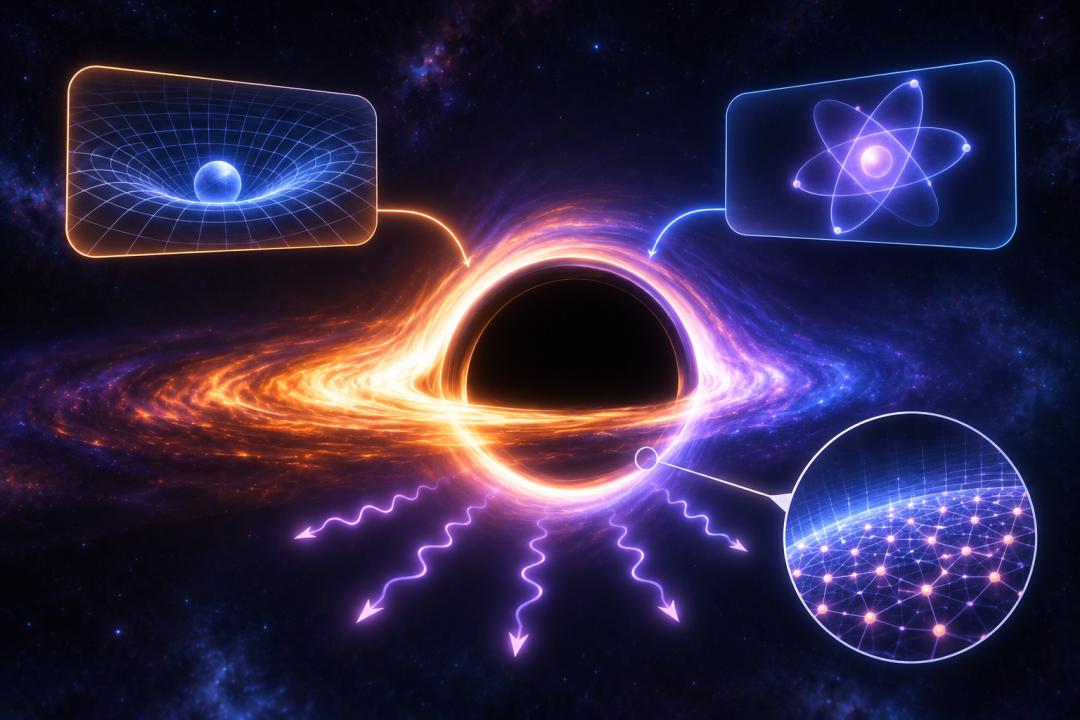
Generated by AI
Since unification is theoretically possible, why have physicists kept hitting the wall in the past hundred years?
There are two main obstacles.
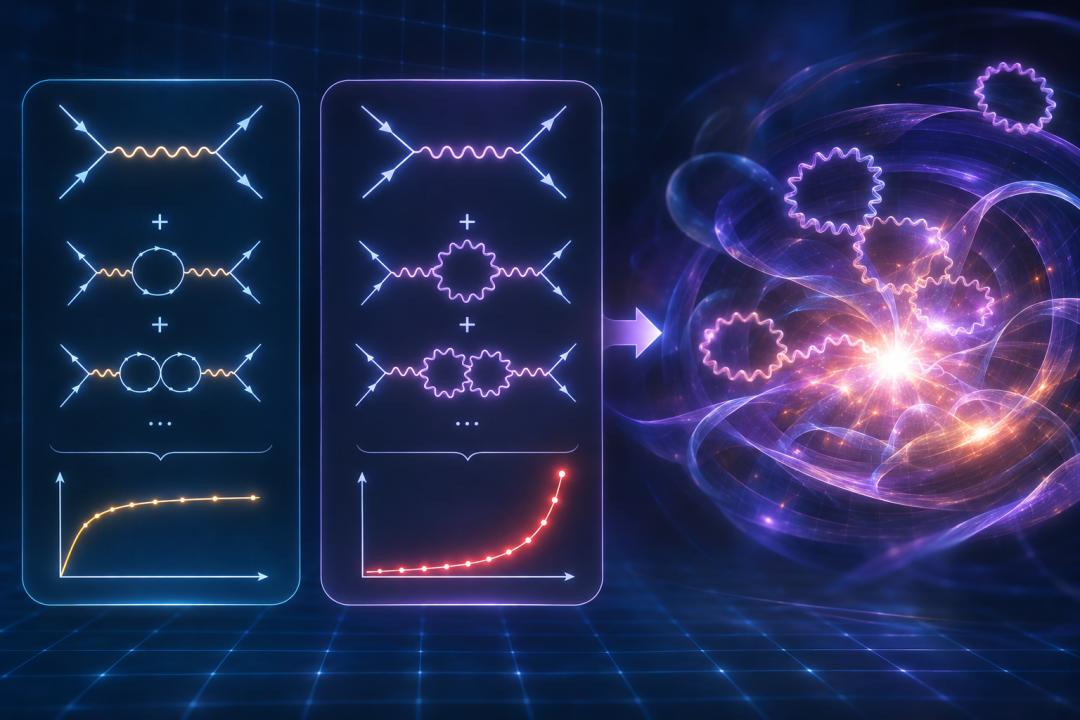
The first one in physics is called "perturbative non-renormalizability".
When physicists treat gravity as a perturbative quantum field (i.e. graviton) on a flat spacetime background and calculate the loop correction of high-energy scattering, the integral will produce ultraviolet divergences that cannot be eliminated by a finite number of counterterms.
In layman's terms, when calculating the electromagnetic force or nuclear force, you can suppress the error by adding a few more correction steps. But when calculating the violent collision between gravitons, the numbers in the formula will snowball into non-eliminable infinities, and the equation will report an error directly.
Generated by AI
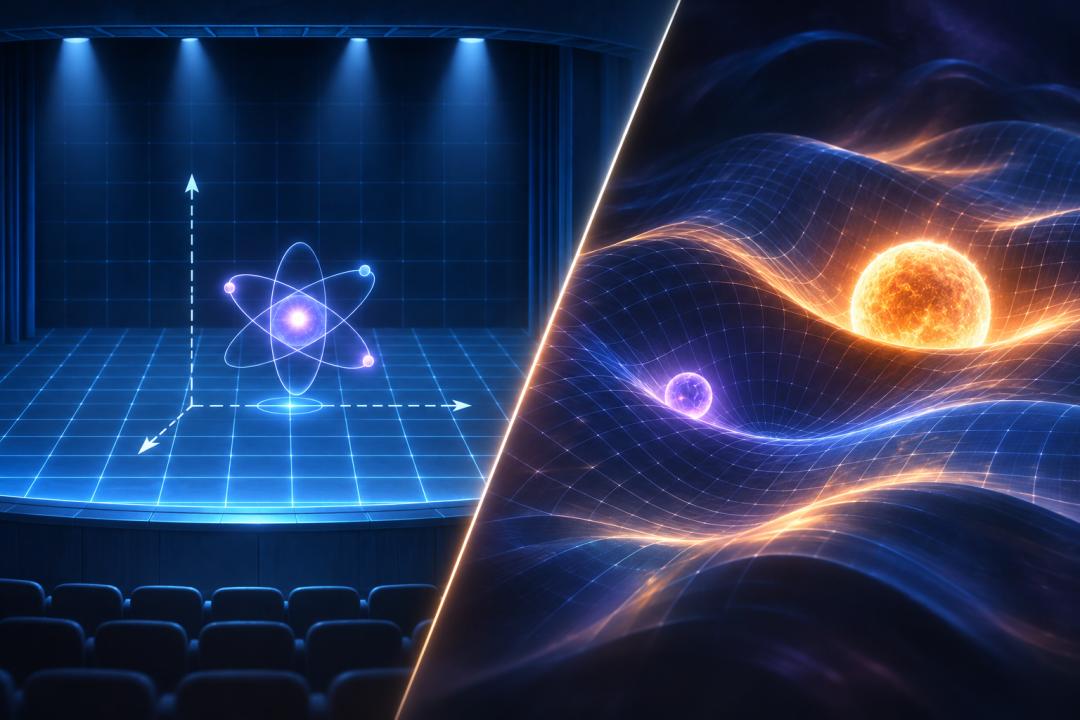
The second problem is about "background dependence".
The standard canonical quantization of quantum field theory requires a pre-set fixed spacetime metric as the background stage;
But general relativity shows that the metric itself is a dynamical variable, so a true quantum gravity theory must satisfy "background independence".
For example, quantum mechanics is used to building a solid fixed stage first, and then asking which coordinate on the stage the actor stands on;
But in general relativity, gravity is the bending and vibration of the stage itself. The stage itself is collapsing and deforming, and the original coordinate rulers and clocks no longer work.
Generated by AI
The physics community has tried several mainstream approaches before, each of which only solved half of the problem.
String theory replaces point particles with one-dimensional vibrating strings, eliminating short-distance ultraviolet divergences, but it has not yet completely got rid of perturbative expansion and given a complete and precise definition;
Loop quantum gravity achieves background independence through spin networks, but it is difficult to restore the smooth and continuous Einsteinian gravity in the low-energy macroscopic limit;
Holographic duality (AdS/CFT) is mathematically extremely accurate, but unfortunately it only applies to anti-de Sitter spacetime with a negative cosmological constant, which is equivalent to being calculated very accurately in a "can universe" with an inward-bending boundary, but cannot describe the universe we actually live in.
Starting from the light cone, compress spacetime onto the boundary
In this paper titled 《An algebraic quantization of gravity from the null cone》, Chandrasekaran finds a path that satisfies both sides.
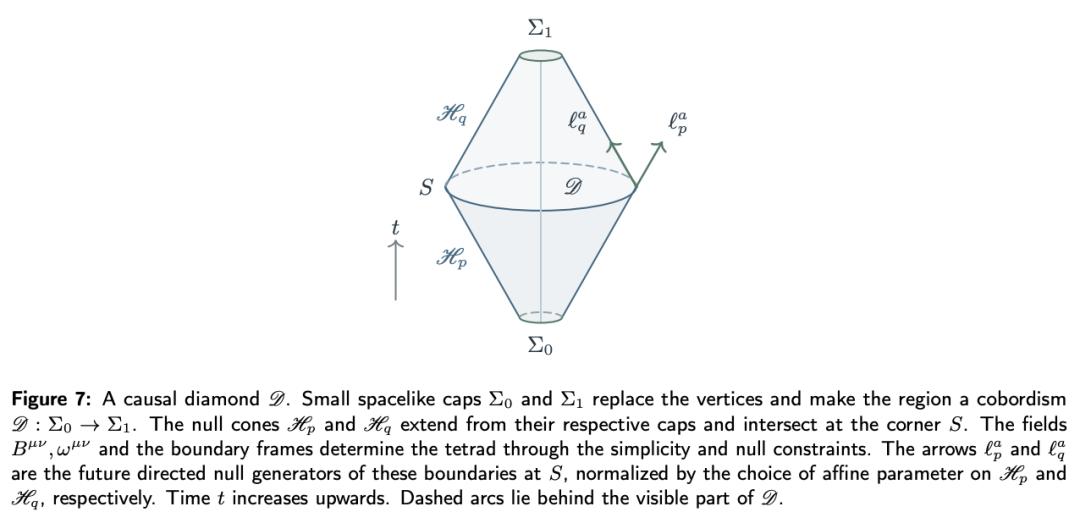
He chooses to directly start from the "first-order gravitational formalism" and "null cone" in four-dimensional Lorentz spacetime, and solve the gravitational constraints on the finite spacetime subregion "causal diamond" enclosed by the intersection of the past and future light cones.
If you find it abstract, you can imagine pressing a flashlight in the dark universe, the light sphere expands outward over time, drawing a future-pointing cone.
Take two events, one earlier and one later. The future light cone emitted by the earlier event and the past light cone that the later event can receive overlap in the air, and the area with sharp ends at both ends and bulging in the middle enclosed between them is a "causal diamond".
The advantage of choosing the null cone is that it takes both sides into account.
On the general relativity side, Einstein's constraint equations, which were originally tangled into a dead knot, will be greatly simplified once placed on the null cone surface traveled by light rays.
After retaining a small spacelike truncated cap at the intersection of the two light cones, the redundant metric components in the entire region can be directly reduced to two gravitational wave radiation degrees of freedom on the null cone boundary.
On the quantum mechanics side, this compression turns the infinitely complex internal spacetime into clean degrees of freedom on the boundary.
All gravitational changes in the entire causal diamond can be compressed onto the light cone boundary on its surface for recording and quantization, and the two sides finally find a common mathematical language.
To solve the problem of "how to measure without a fixed stage", the paper introduces gravitational "edge modes" at the two-dimensional corner where the front and back light cones intersect, and constructs relational observables that satisfy diffeomorphism invariance by "dressing" the bulk operators to the dynamic reference frame on the boundary.
In layman's terms, since the external absolute coordinate system is unreliable, he directly uses the boundary geometry of the gravitational field itself as a ruler at the waist corner where the two light cones meet, and establishes a set of internal reference frames that shake together with spacetime.
At the same time, using the affine parameter propagating along the null cone geodesic, he defines a "gravitational clock" operator that is intrinsic to the boundary geometry.
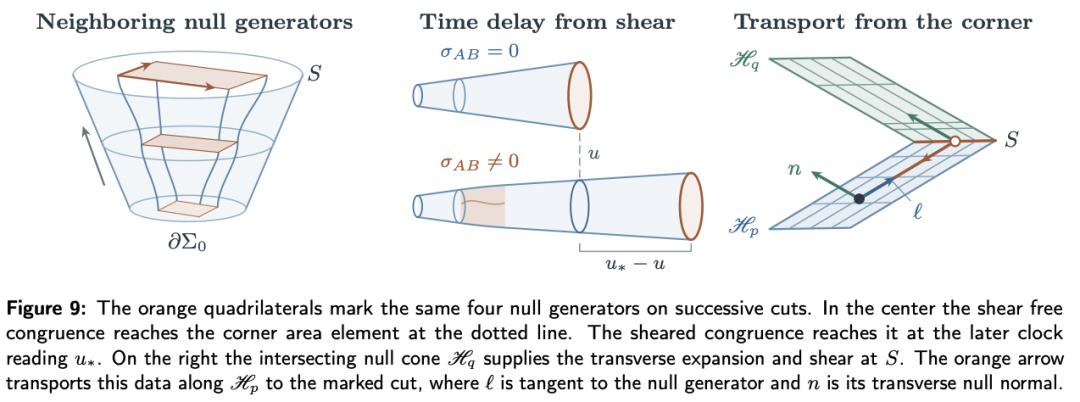
In four-dimensional spacetime, the shear caused by gravitational radiation will reduce the expansion rate of null geodesics, thus increasing the affine parameter required for light rays to reach the same area element at the corner. Therefore, as long as an upper limit is set for the reading of the gravitational clock, the gravitational radiation allowed inside the causal diamond can be constrained.
In the visualized scenario, when there is no gravitational wave interference, the light beam will expand uniformly and arrive at the boundary on time;
Once a gravitational wave pulls and distorts the light beam, the expansion speed of the light beam will slow down, and a larger reading will be needed to reach the same size of area.
By only limiting the maximum travel distance of this internal clock, physicists can constrain the intensity of gravitational waves allowed in spacetime.