Terence Tao personally stepped forward to verify the Riemann Hypothesis, commenting that "AI churning out proofs in batches is just like a power plant discharging nuclear waste."
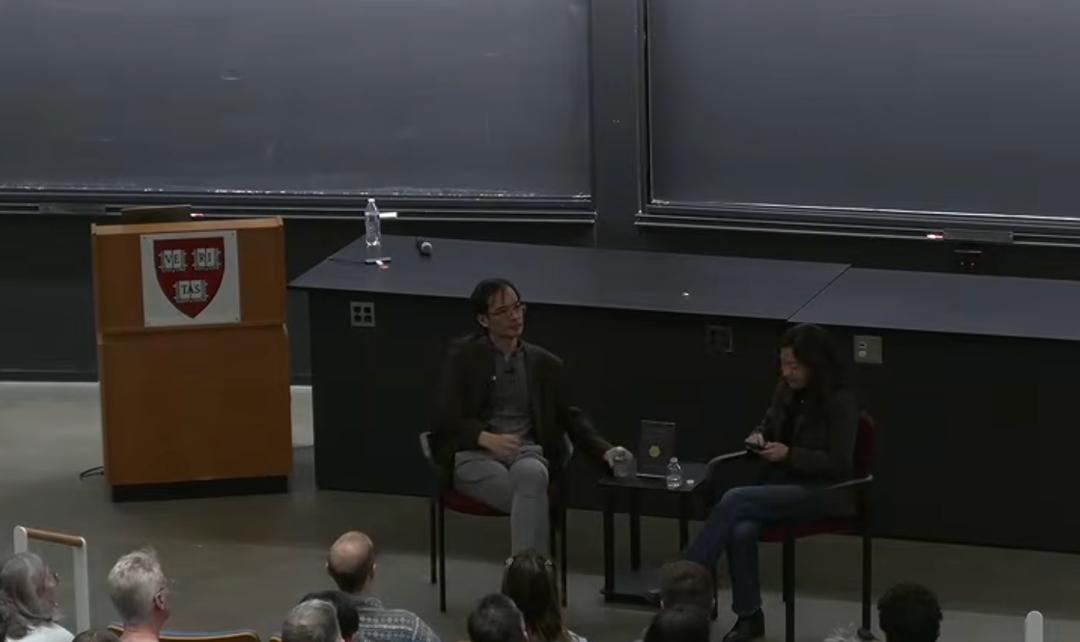
Just a few days before the announcement of the proof of the Riemann Hypothesis, Terrence Tao delivered his latest statement on AI mathematics at an event at Harvard University ——
To test their models, AI companies generate batches of indigestible mathematical proofs in bulk, just like power plants producing "nuclear waste"!
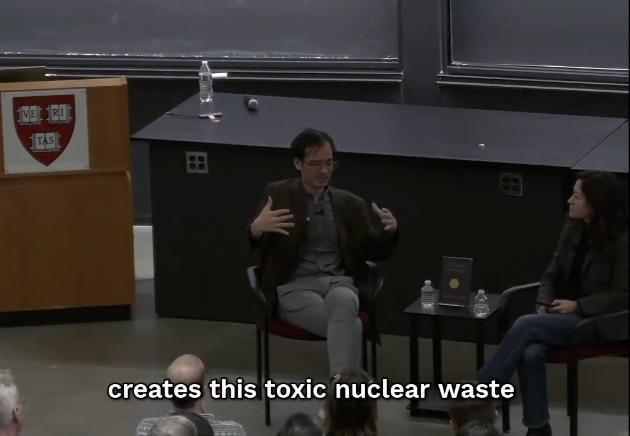
But don't get me wrong, he is not completely against the application of AI in mathematical research. He only believes that the collaboration between AI companies and human mathematicians can fully produce results that are easier to understand.
In fact, Terrence Tao himself is also following up and interpreting the AI-generated proof of the Riemann Hypothesis.
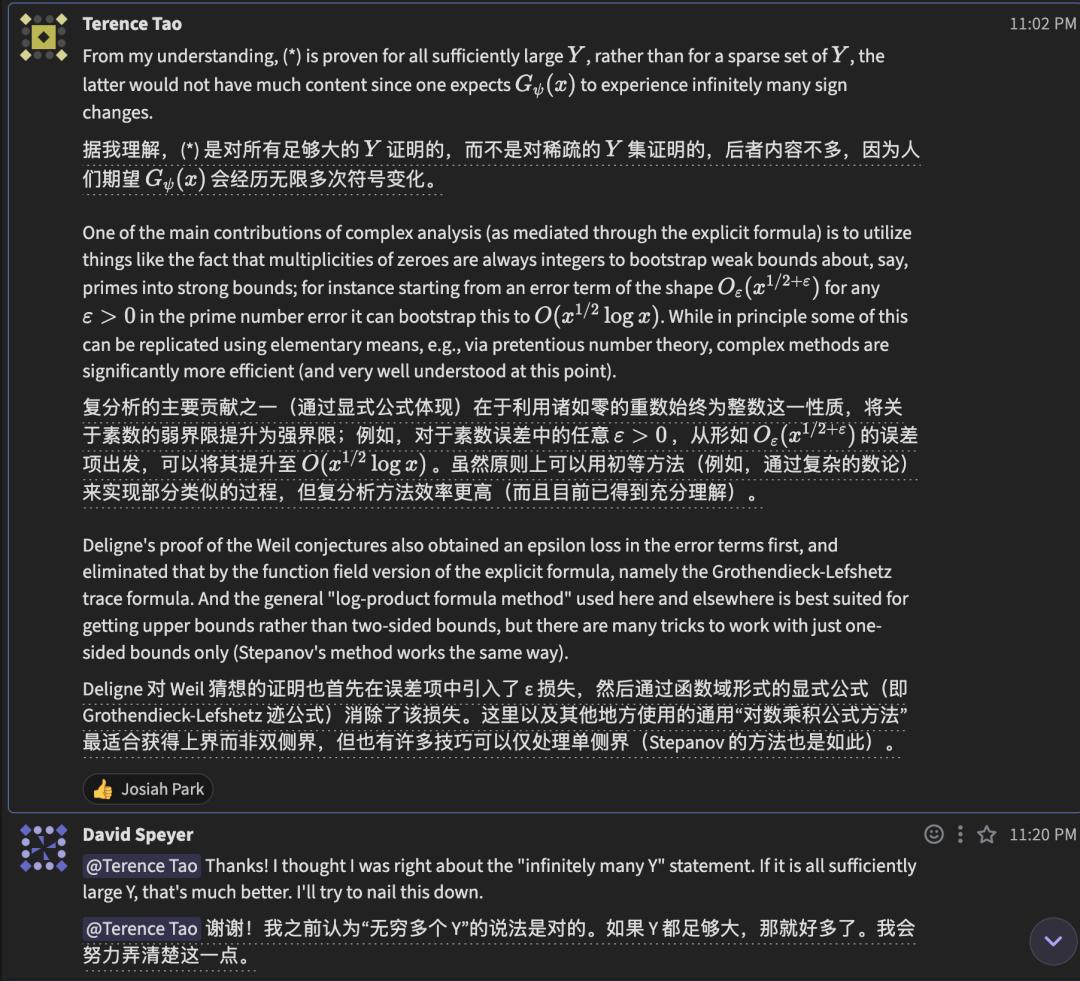
According to his preliminary judgment on his blog, this proof of the Riemann Hypothesis seems to use many modern tools from the Langlands Program and arithmetic geometry.
His blog has published a recruitment post for an open collaboration project, hoping that everyone can sort out the proof of the Riemann Hypothesis together.
So, who would pass up the opportunity to use the most cutting-edge AI to solve a once-in-a-millennium mathematical problem? No mathematician would do that.
Terrence Tao is no exception.
At the Harvard event, the host mentioned that some doctoral students are worried that the problems they are currently researching may have already been solved internally by AI companies, but not yet made public.
Terrence Tao said that after machines spit out a batch of indigestible proofs, companies have to choose from several troublesome options:
Keep storing them, make them public to the public, or pay someone to process them.
He hopes more that companies will consult with mathematicians before starting work, and jointly select mathematical problems worthy of being solved by AI.
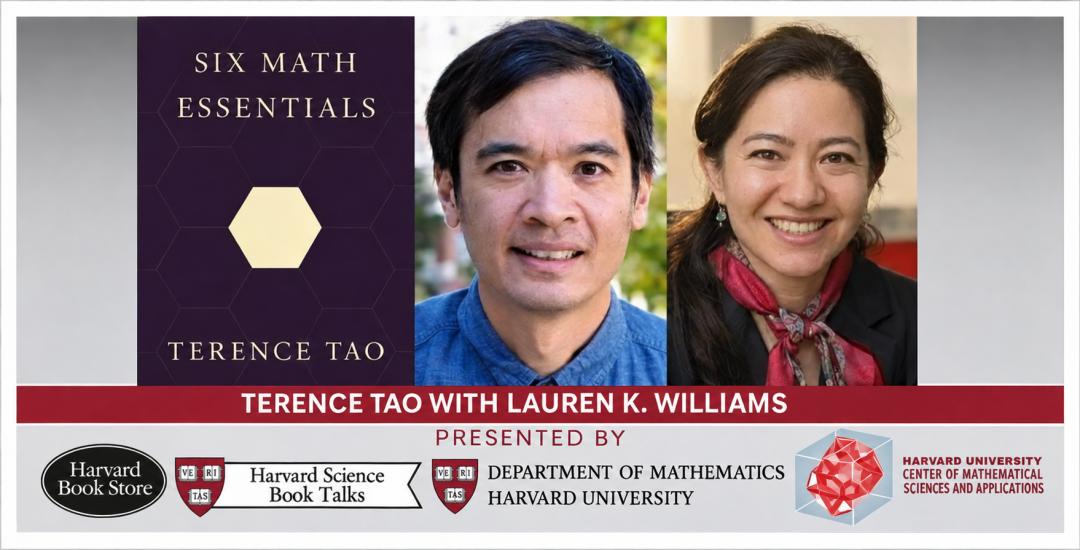
At this Harvard event, Terrence Tao also put forward the following views ——
1. What should students do if they worry that their research topics will be preempted by AI?
One of his students simply gathered his peers, listed thousands of related problems, and asked AI to help test how far the existing proofs can be generalized.
2. Now that papers can be written with AI, how can the mathematics department judge whether a candidate is qualified when recruiting teachers?
Terrence Tao proposed to let candidates give lectures on the blackboard, and peers can ask questions at any time.
3. What does Tao himself hand over to AI?
Writing Python, JavaScript and searching for literature, he has basically handed these tasks over to AI. He still wants to keep the ability to derive mathematics independently.
The following is an excerpt of the full transcript of Terrence Tao's Harvard speech and on-site Q&A, with partial abridgement and polishing.
Enjoy~
With more proofs being generated, is solving problems still the most important thing?
Terrence Tao: Solving problems is a bit like the score of a course, which is an indicator to judge whether you have learned something. In the past, this indicator worked quite well.
A person who is good at solving problems is usually also good at understanding and explaining mathematics, extracting insights from it, putting forward conjectures, writing textbooks and supervising students. In the past, these things were often closely linked to problem-solving ability.
So we adopted a convenient method: whoever solves a difficult problem will be awarded, and their papers can easily be published in good journals. When proofs were scarce, this set of indicators worked very well, because proof was indeed the bottleneck.
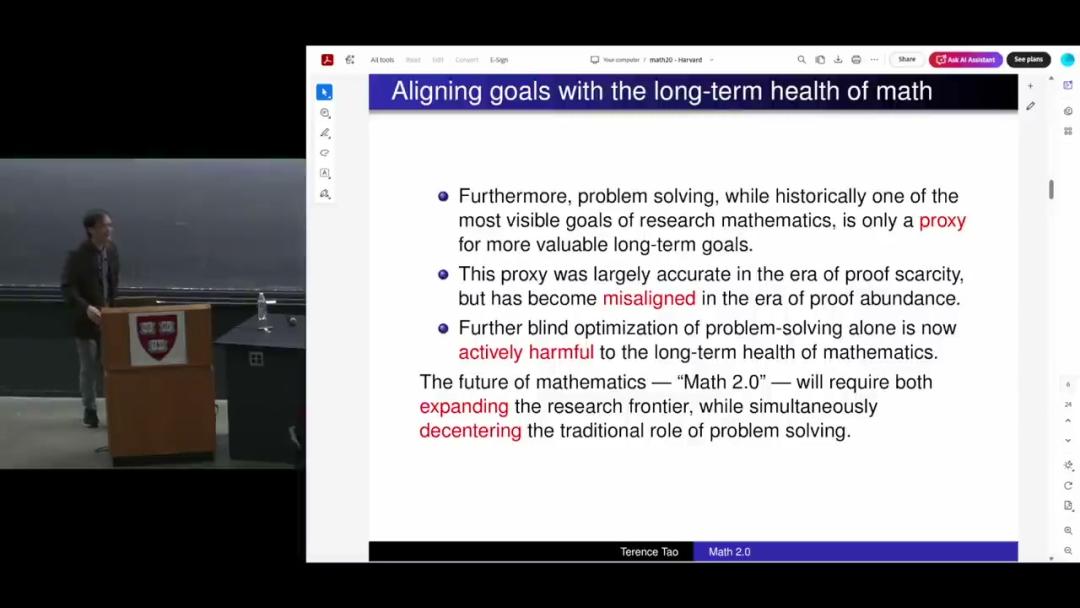
Nowadays, the cost of generating proofs is much lower. If we still take problem-solving as the main goal, it will gradually be disconnected from other things we expect mathematics to achieve.
Students at Caltech held a math hackathon on the weekend. The original plan was to compete to solve as many open problems as possible. Later, the competition system was changed: about 100 teams each picked a result that already has a proof, but the existing proof was not satisfactory in some aspects.
Everyone tried to give a simpler proof, write a clearer explanation, and also made animations or codes.
What if an AI company has already solved my doctoral research topic?
Lauren K. Williams: Scott Aaronson mentioned that some of his doctoral students are very anxious, worrying that OpenAI or Anthropic may have already worked out the problems they are working on internally without making them public. But once the results are announced, they are often questioned by the academic community due to quality issues. How should laboratories cooperate with the mathematics community?
Terrence Tao: Ideally, technology companies should cooperate with the mathematics community before letting machines automatically generate proofs. Once the machines spit out those proofs, there are basically no good options left.
It's just like power plants producing toxic nuclear waste. You can keep storing it, release it to the public, or pay someone to dispose of it. No choice is easy. The best way is not to produce this kind of waste in the first place.
But the current problem is that the fundamental incentives of technology companies and the mathematics community are completely different. Companies are solving mathematical problems, but their main goal is to train their own models. These proofs are by-products, almost waste-like by-products.
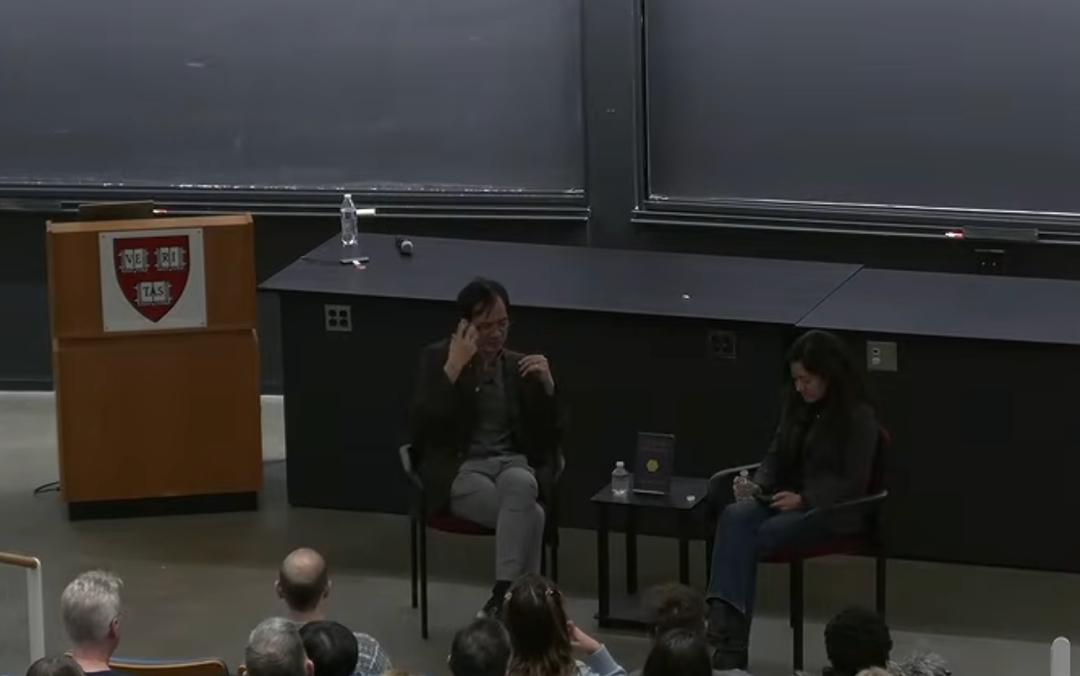
Lauren K. Williams: So if they want to use a certain conjecture to train their model, should they first cooperate with mathematicians in that field?
Terrence Tao: I can imagine another approach, where mathematicians and technology companies work together to design problem sets. The more than 20 million algebra problems in my project were not worked on by anyone before. The number of problems is so huge, but solving them is really interesting, and they can also be used as very good training materials.
Some problems we hope people solve in person, the purpose of which is to gain new insights and understanding. For other problems, we want to know the results, but the number is too large for people to handle, so we are very happy to hand them over to AI.
It's like a city such as Boston: some streets are for cars, and some streets are reserved for pedestrians. There is no need to turn every pedestrian path into a car lane.
What should students do if they worry that their research topics will be preempted by AI?
Lauren K. Williams: In the AI era, or in Mathematics 2.0, what are you most looking forward to for mathematics?
Terrence Tao: I want to see what creative methods everyone, especially young people, will come up with.
I have a student who was a little frustrated some time ago. A batch of AI achievements hit a large problem that is very close to his research topic and has attracted more attention. He was working on a variant of that large problem and had already made some progress, so he was a little worried.
After we talked, he is now working with several people in the same field. They plan to catalog thousands of variants of this type of problem, check what is currently known about each one, and then test them with AI. For each existing proof, see which variants it can be generalized to, and where it does not work.
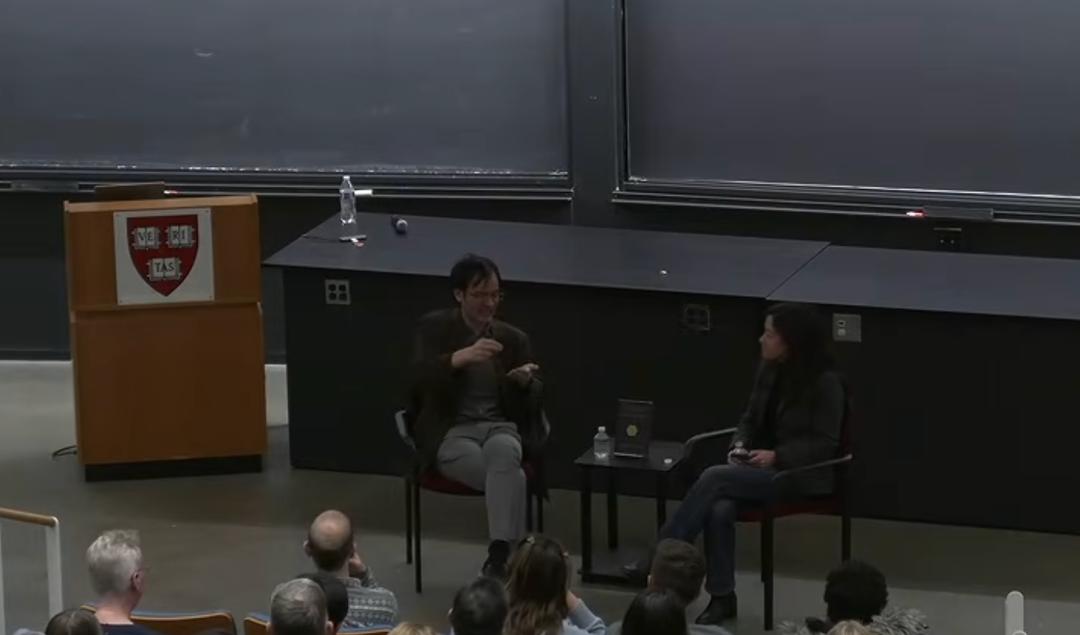
It used to be that a group of people competed to say "I solved this one", but now everyone is thinking about how to complete this data set together.
I have done this kind of thing before. Someone would say: "I found a new way to push the result from 86% to 87%. I still can't solve these few problems, here are the methods I tried, who can continue to work on it?"
Who can I ask if I can't understand an AI-generated proof?
Lauren K. Williams: What specific methods can make the academic community pay more attention to explaining results clearly, or reward less for being the first to get a proof?
Terrence Tao: I participated in editing a journal called "Mathematical Discourse". Submissions are a presentation, and peers will review this presentation.
There are also grants available to organize workshops, select a proof that no one can understand, often generated by AI, and invite 20 young researchers to figure it out together.
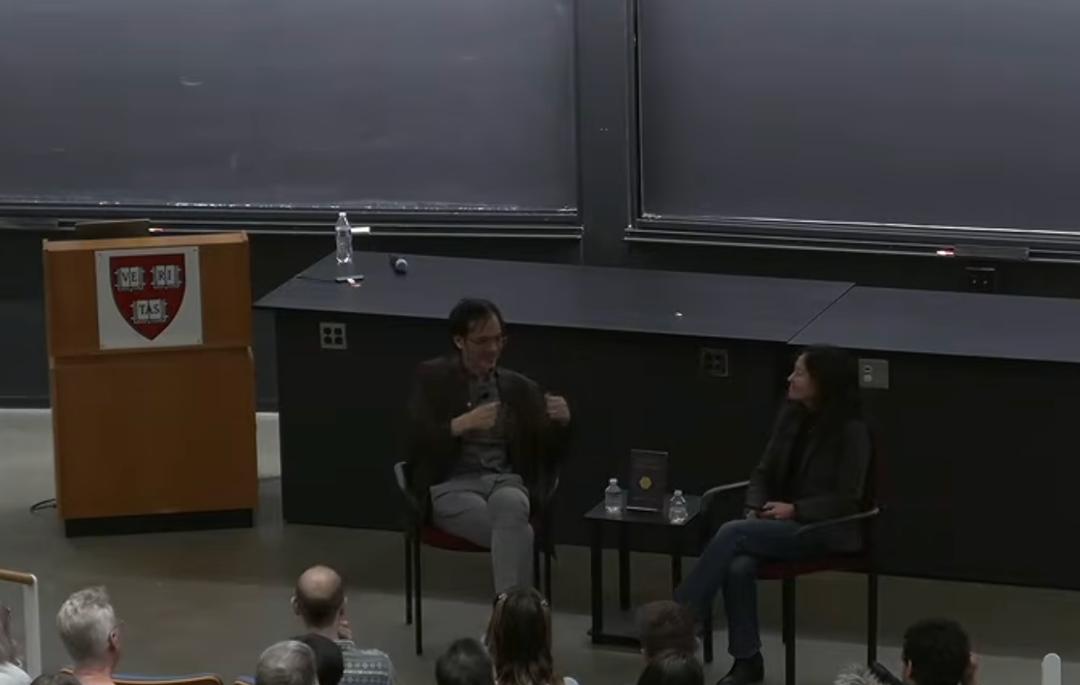
It's not fun at all to grind through a particularly hard-to-read AI proof alone. I've done that, and it's very tiring. When you read a paper written by a human, no matter how hard it is to read, you at least know there is someone you can ask. If you get stuck on a sentence, you can email the author and ask them to explain it. When you encounter an AI-generated proof, there is no such person to ask.
Recruitment, award evaluation, and promotion can no longer only look at how many papers a person has published in top journals. Now AI can write papers that look excellent, and the person who wrote the paper may not even understand the content inside at all.
In the future, when interviewing for academic positions, it is best to let candidates give lectures on the blackboard, and everyone can have back-and-forth questions and answers on the spot. Just showing a set of beautiful Beamer slides can only reveal limited information.
What does Terrence Tao himself hand over to AI?
Lauren K. Williams: What advice do you have for undergraduate and graduate students majoring in mathematics? When should they use AI, and when should they not use it for the time being?
Terrence Tao: Roughly speaking, you can divide the things you want to do into two categories. One category is the skills you want to retain, and you hope you can still do them. The other category is the skills you are willing to give up in order to get things done.
With AI, you can move a skill from the first category to the second. But once you get rusty, it's very difficult to pick it up again.
I don't think programming is a core skill I must retain. Now I only handwrite LaTeX, and I have handed over Python and JavaScript to AI. Literature search is also basically handed over to it.
But I still derive mathematical problems by myself. I rarely use these tools to do mathematical research directly. I want to keep this ability.
Reference Links:
[1]https://www.youtube.com/watch?v=pOQ7IO4_Vxg
This article is from the WeChat official account "QbitAI" (ID: QbitAI), author: Ting Yu, published with authorization from 36Kr.